
Cyber Security Presentation December 2017 Cybersecurity Presentation Opening

Cyber Security Presentation December 2017 Cybersecurity Presentation
Opening Thoughts… Today’s discussion is intended to build upon the general pre-reading material and develop a better understanding of cyber security risks, current cyber program structure and status, Board oversight role, and go-forward strategy. • Cyber threats have remained largely the same, but threat actors are becoming more sophisticated. • Two cyber attacks on an electric utility resulting in a blackout have now occurred. The Ukraine has had two power outages caused by cyber attacks (December, 2015 and December, 2016). • KCP&L cyber systems and assets directly supporting the bulk electric system are governed by NERC CIP (Critical Infrastructure Protection) and have been a major area of focus across the Company. • KCP&L has made significant investments in cyber-related processes and tools, many CIP-related, but must also focus on overarching cyber security. • Investments and refresh of cyber-related policies, processes, tools, staffing, training, and industry collaboration will be ongoing. Cybersecurity Presentation 2
Cyber Realities Cybersecurity Presentation
Global Cyber Trends The cyber security threat landscape has continued to evolve, mainly in the increasing sophistication of threat actors. Social engineering remains the most common point of vulnerability for organizations, with email phishing and malware remaining as the most prevalent type of attack. • The types of cyber threats and attacks have remained largely the same, but the threat actors are becoming more sophisticated and the volume of threats continues to increase. • The most common, and most successful points of entry into an organization for cyber attackers are socially engineered scenarios preying on human behavior. • Malware spread through social engineering attacks via email phishing and malicious links continues to be the most prevalent form of attack. • There continues to be a growing resource and talent shortage in cyber security on a global basis. There are between 1 -2 million open cybersecurity positions globally. Cybersecurity Presentation 4
Industry Cyber Trends Utilities continue to garner focus and attention as a target of cyber attacks considered a critical form of critical infrastructure and reinforced by the first successful blackouts enabled by a cyber attacks in Ukraine in 2015 and 2016. • The scope of cyber continues to expand proportionally to the ongoing convergence of information technology (IT) and operations technology (OT) • The underlying accelerator for the convergence is network connectivity via IP (internet protocol) which makes operations devices in the field “cyber aware” and thus fall into scope of cyber risk – this is consistent with the expansion of assets in scope for recent versions of Critical Infrastructure Protection (CIP) to include the assets of operations • The level and degree of sharing of cyber information across the industry continues to improve • A cyber mutual assistance group has been established by EEI, similar to the long-standing mutual assistance leveraged during storm restorations Cybersecurity Presentation 5
KCP&L Cyber Trends KCP&L has seen increased levels of cyber activity and has acquired a number of new tools and technologies to assist in the management of cyber assets, detection of threats, and begin performing correlation across high volumes of raw data. • KCP&L has a solid suite of security tools, several were recently acquired and still being fully configured and implemented to their full capabilities. • Like the industry, the scope of cyber continues to expand proportionally to the ongoing convergence of information technology (IT) and operations technology (OT) • Consistent with IT/OT convergence, KCP&L has a comprehensive cybersecurity strategy and operating model across corporate IT and operations (generation, transmission, distribution) with a focus on improving monitoring and incident response • Additional focus needs to be applied to data loss prevention strategy/tools along with data privacy • Cybersecurity programs are constantly evolving to keep pace with the constantly changing threat landscape Cybersecurity Presentation 6
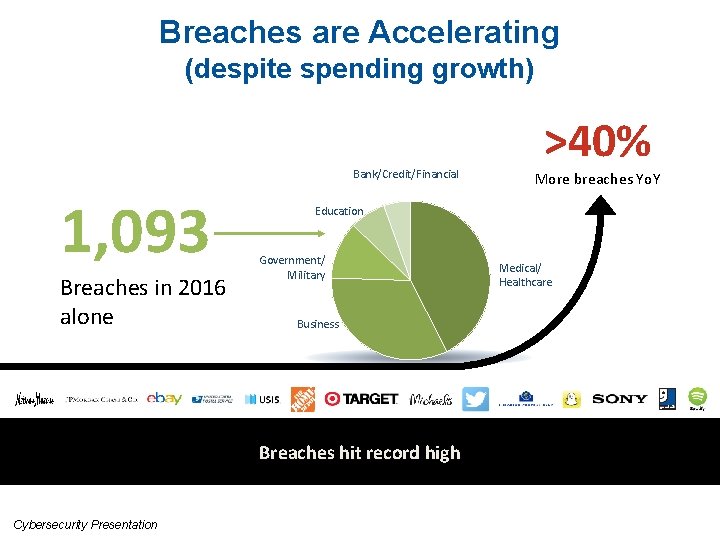
Breaches are Accelerating (despite spending growth) Bank/Credit/Financial 1, 093 Breaches in 2016 alone More breaches Yo. Y Education Government/ Military Business Breaches hit record high Cybersecurity Presentation >40% Medical/ Healthcare
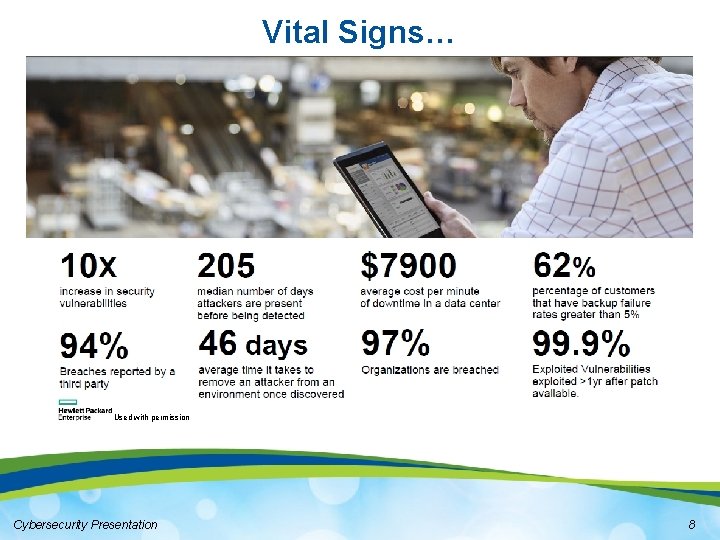
Vital Signs… Used with permission Cybersecurity Presentation 8
The People Problem • More open jobs than talent (demand exceeds supply) • Cisco Security report claims 1 M openings worldwide, 2 M predicted by 2020 • How do we stay competitive? • Targeted outsourcing • Creative security problems • Partner with universities – curriculum and interns • Challenging, changing environments • Pay market rates Cybersecurity Presentation
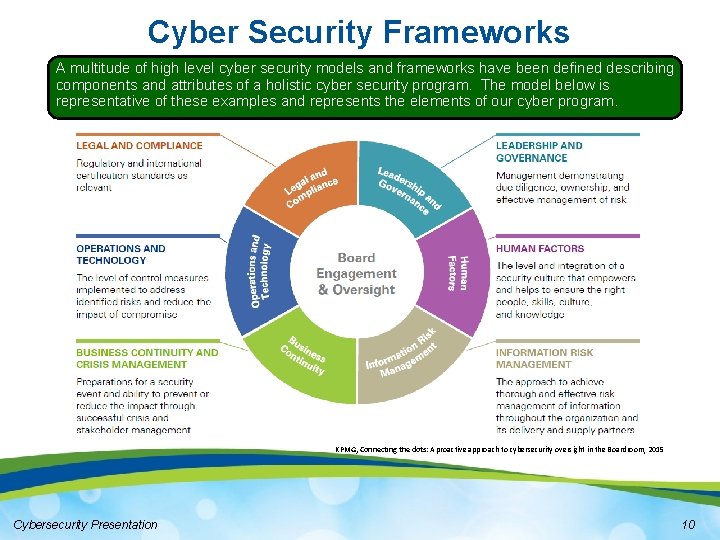
Cyber Security Frameworks A multitude of high level cyber security models and frameworks have been defined describing components and attributes of a holistic cyber security program. The model below is representative of these examples and represents the elements of our cyber program. KPMG, Connecting the dots: A proactive approach to cybersecurity oversight in the Boardroom, 2015 Cybersecurity Presentation 10
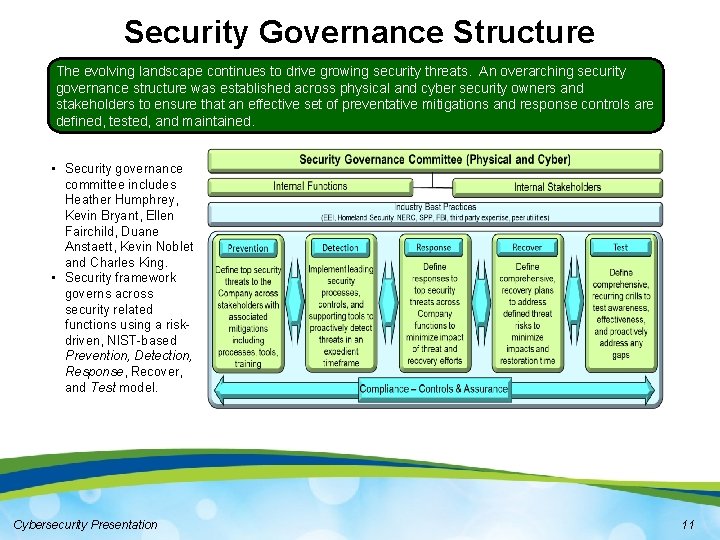
Security Governance Structure The evolving landscape continues to drive growing security threats. An overarching security governance structure was established across physical and cyber security owners and stakeholders to ensure that an effective set of preventative mitigations and response controls are defined, tested, and maintained. • Security governance committee includes Heather Humphrey, Kevin Bryant, Ellen Fairchild, Duane Anstaett, Kevin Noblet and Charles King. • Security framework governs across security related functions using a riskdriven, NIST-based Prevention, Detection, Response, Recover, and Test model. Cybersecurity Presentation 11
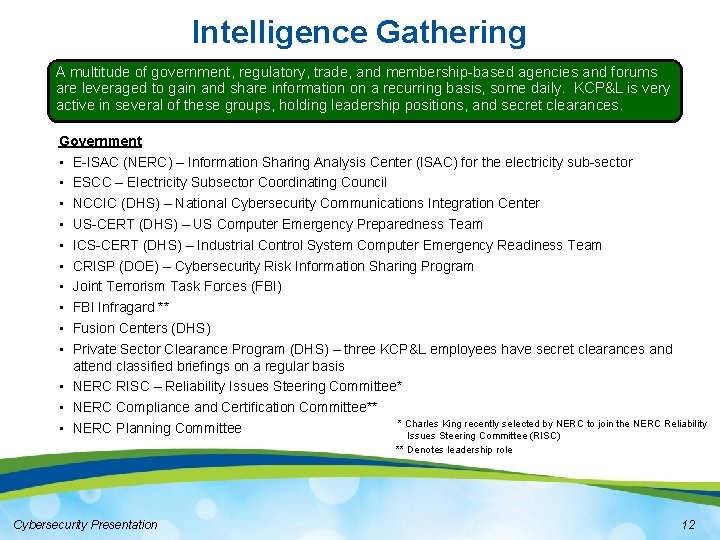
Intelligence Gathering A multitude of government, regulatory, trade, and membership-based agencies and forums are leveraged to gain and share information on a recurring basis, some daily. KCP&L is very active in several of these groups, holding leadership positions, and secret clearances. Government • E-ISAC (NERC) – Information Sharing Analysis Center (ISAC) for the electricity sub-sector • ESCC – Electricity Subsector Coordinating Council • NCCIC (DHS) – National Cybersecurity Communications Integration Center • US-CERT (DHS) – US Computer Emergency Preparedness Team • ICS-CERT (DHS) – Industrial Control System Computer Emergency Readiness Team • CRISP (DOE) – Cybersecurity Risk Information Sharing Program • Joint Terrorism Task Forces (FBI) • FBI Infragard ** • Fusion Centers (DHS) • Private Sector Clearance Program (DHS) – three KCP&L employees have secret clearances and attend classified briefings on a regular basis • NERC RISC – Reliability Issues Steering Committee* • NERC Compliance and Certification Committee** * Charles King recently selected by NERC to join the NERC Reliability • NERC Planning Committee Issues Steering Committee (RISC) ** Denotes leadership role Cybersecurity Presentation 12
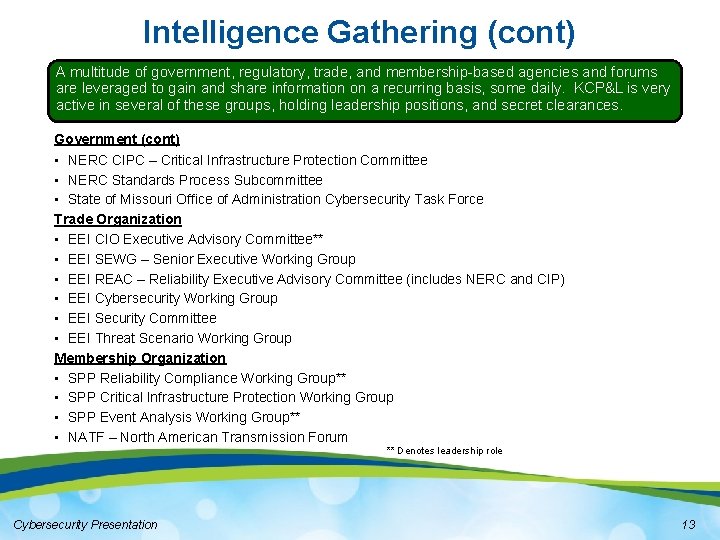
Intelligence Gathering (cont) A multitude of government, regulatory, trade, and membership-based agencies and forums are leveraged to gain and share information on a recurring basis, some daily. KCP&L is very active in several of these groups, holding leadership positions, and secret clearances. Government (cont) • NERC CIPC – Critical Infrastructure Protection Committee • NERC Standards Process Subcommittee • State of Missouri Office of Administration Cybersecurity Task Force Trade Organization • EEI CIO Executive Advisory Committee** • EEI SEWG – Senior Executive Working Group • EEI REAC – Reliability Executive Advisory Committee (includes NERC and CIP) • EEI Cybersecurity Working Group • EEI Security Committee • EEI Threat Scenario Working Group Membership Organization • SPP Reliability Compliance Working Group** • SPP Critical Infrastructure Protection Working Group • SPP Event Analysis Working Group** • NATF – North American Transmission Forum ** Denotes leadership role Cybersecurity Presentation 13
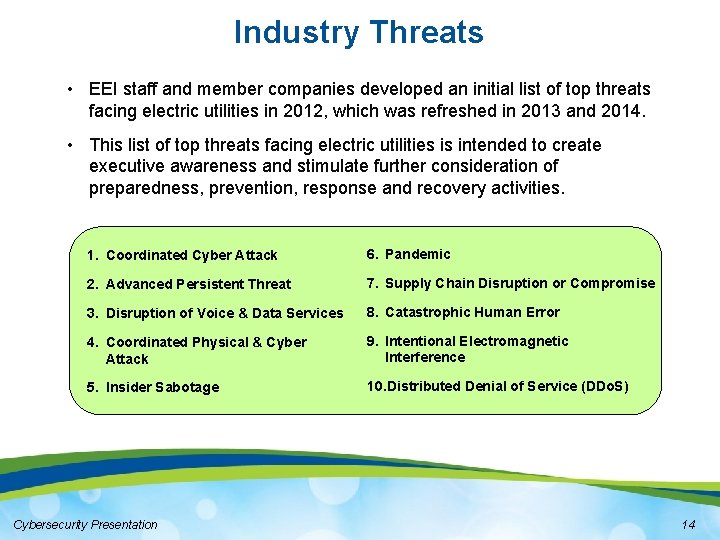
Industry Threats • EEI staff and member companies developed an initial list of top threats facing electric utilities in 2012, which was refreshed in 2013 and 2014. • This list of top threats facing electric utilities is intended to create executive awareness and stimulate further consideration of preparedness, prevention, response and recovery activities. 1. Coordinated Cyber Attack 6. Pandemic 2. Advanced Persistent Threat 7. Supply Chain Disruption or Compromise 3. Disruption of Voice & Data Services 8. Catastrophic Human Error 4. Coordinated Physical & Cyber Attack 9. Intentional Electromagnetic Interference 5. Insider Sabotage 10. Distributed Denial of Service (DDo. S) Cybersecurity Presentation 14
Cyber Security and CIP • Overlaps and inter-dependencies exist between cyber security and CIP regulations for utilities • Cyber security has a broader scope than CIP, but many actions taken to provide overall cyber security for the utility also provide protections for CIPrelated assets • The CIP standards and requirements are regulations focused on the correlation of security and reliability in protection of the bulk electric system • The CIP standards and requirements are largely a collection of best practices that apply to the cyber and physical security for the management of critical cyber systems and assets used in the operation of the bulk electric system • CIP standards do not directly address protection of customer data, website hacking, email phishing, or intellectual property, but these are addressed by the broader cyber security program Cybersecurity Presentation 15
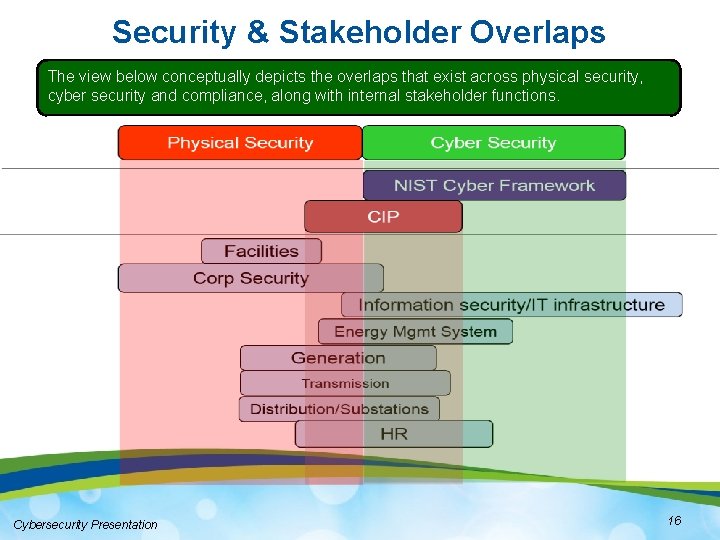
Security & Stakeholder Overlaps The view below conceptually depicts the overlaps that exist across physical security, cyber security and compliance, along with internal stakeholder functions. Cybersecurity Presentation 16
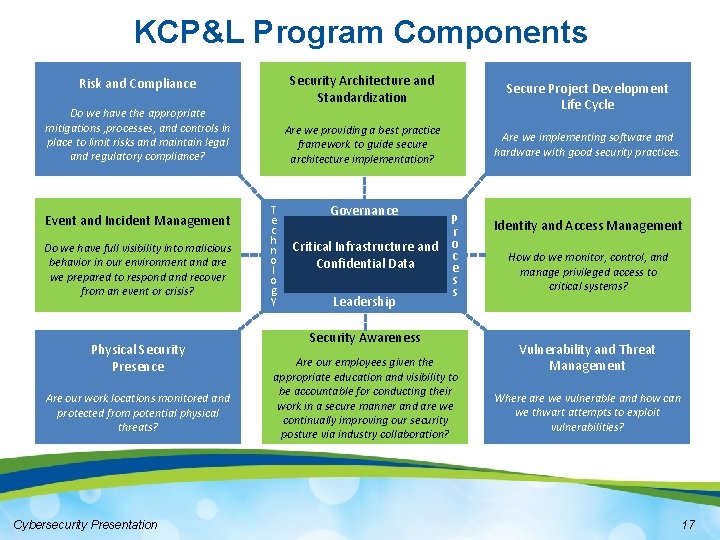
KCP&L Program Components Security Architecture and Standardization Risk and Compliance Do we have the appropriate mitigations , processes, and controls in place to limit risks and maintain legal and regulatory compliance? Event and Incident Management Do we have full visibility into malicious behavior in our environment and are we prepared to respond and recover from an event or crisis? Physical Security Presence Are our work locations monitored and protected from potential physical threats? Cybersecurity Presentation Are we providing a best practice framework to guide secure architecture implementation? T e c h n o l o g y Governance P r o Critical Infrastructure and c Confidential Data e s s Leadership Security Awareness Are our employees given the appropriate education and visibility to be accountable for conducting their work in a secure manner and are we continually improving our security posture via industry collaboration? Secure Project Development Life Cycle Are we implementing software and hardware with good security practices. Identity and Access Management How do we monitor, control, and manage privileged access to critical systems? Vulnerability and Threat Management Where are we vulnerable and how can we thwart attempts to exploit vulnerabilities? 17
Ukraine Cyber Attacks There have been two successful cyber attacks on the Ukraine. The first was in December of 2015 and cut power to over 200 K users. The second was in December of 2016 and impacted over 300 K users but was a much shorter event. • In December of 2015, a sophisticated team of hackers coordinated simultaneous attacks against the infrastructure of Ukraine, including four power providers. The attacks against power providers involved a series of different types of cyber attacks, working in coordination to achieve the blackouts. • Access to the Energy Management System (EMS) was obtained through the use of spear phishing emails and when malicious attachments were opened, malware was installed which mined user credentials • The captured credentials were then used to access the EMS remotely and operator commands were then issued to open breakers and produce blackouts • Destructive malware was used to erase system and communications data, delaying restoration of system, and forcing a manual restoration • Phones in the customer call center were also disabled through denial of service attacks Cybersecurity Presentation 18
Ukraine Cyber Attacks • A blackout occurred in December of 2016 in Ukraine which impacted approximately 300, 000 customers and had a duration of about 30 minutes (due to resorting to manual operation). It was not certain at the time if the cause was a cyberattack. • In June, it was revealed that the blackout was the result of a cyber attack using malware named Crash. Override, specifically developed for use against industrial control systems. • Malware was vendor specific and was designed as a “test” to run for one hour • Most evolved grid-sabotaging malware ever seen – can automate mass power outages with plug-in components that could be adapted for other utilities • Second known case of malicious code built purposely to disrupt physical systems, the first being Stuxnet, used to destroy centrifuges in Iran nuclear facility in 2009 • Attack is alarming since it requires very little human interaction and can send commands to industrial control systems in their unique languages and protocols • None of the indicators of compromise reported to accompany this malware have been detected in the KCP&L network Cybersecurity Presentation 19
Recent Focus Areas • Critical infrastructure protection (CIP) - version 5/6 compliance, audit completed with zero findings • Operational tools – acquisition and installation of several best in class tools to assist in the prevention, detection, and timely response to issues • Daily operations – patching, updating of firewall signatures and rules, vulnerability management, incident investigation and management, industry collaboration • Monitoring team – created the Cyber Threat Operations Center (CTOC) to handle tier 1 cyber incident response • Metrics definition – capture, reporting and trending of baseline security metrics • Staffing – steady stream of activity interviewing, hiring, and cross-training based upon turnover of resources Cybersecurity Presentation 20
What Keeps Us Up @ Night • The unknowns of cyber • “Not if but when” • Invest and implement robust defense mitigations, but also must define timely and effective detection and response in expectation of an occasional breach • Scarcity of resources • Acquisition and retention of talent/resources • • Partnering to develop increased supply of talent The weakest link…people • Social engineering • Email phishing/spear phishing Cybersecurity Presentation 21
The Future… • Cyber tools and process expansion – we will continue to invest in cyber tools to help defend the Company, the bulk electric system, and our customers. • • Products and defenses lag the threat actors in most cases Products continue to mature and may consolidate, resulting in a rationalization longer term • Company-wide Strategy – continue to refine cyber security strategy and scope of operating model across the Company • Monitoring and incident response - determine long term approach to potential 7 x 24 operations center model • Additional cloud preparation – cloud maturity and security have improved, cost models shifting, and need to prepare for migrating more capabilities to cloud • Cyber education - continue to educate, train, and create a cyber health culture • Cyber reporting – expand mature data capture, correlation, and trending • Staffing – continue the focus on recruiting and staffing Cybersecurity Presentation 22
- Slides: 22