
Cyber Security for Smart Grids Seemita Pal Department
Cyber Security for Smart Grids Seemita Pal Department of Electrical, Computer and Systems Engineering Rensselaer Polytechnic Institute, Troy, NY 28 th October, 2015
Outline § Motivation § Impacts and Challenges § Computer networks § Network security § § § Cryptography Hash function Intrusion Detection § Cyber security threats for smart grids § Defense strategies 1 -2
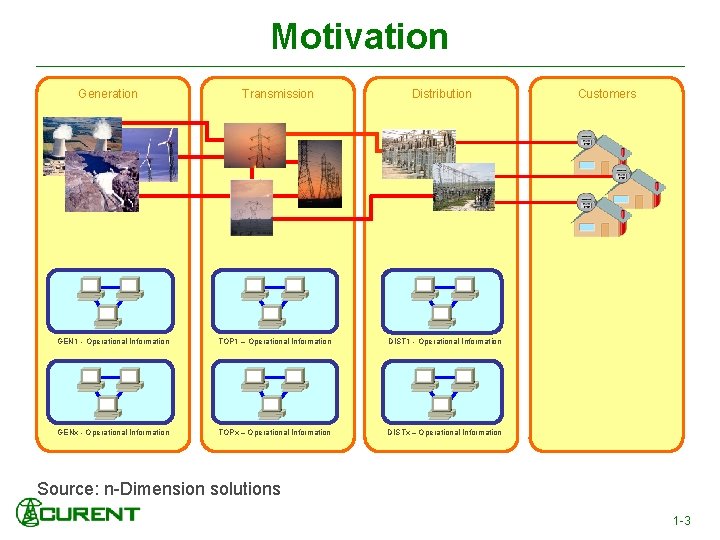
Motivation Generation Transmission Distribution GEN 1 - Operational Information TOP 1 – Operational Information DIST 1 - Operational Information GENx - Operational Information TOPx – Operational Information DISTx – Operational Information Customers Source: n-Dimension solutions 1 -3
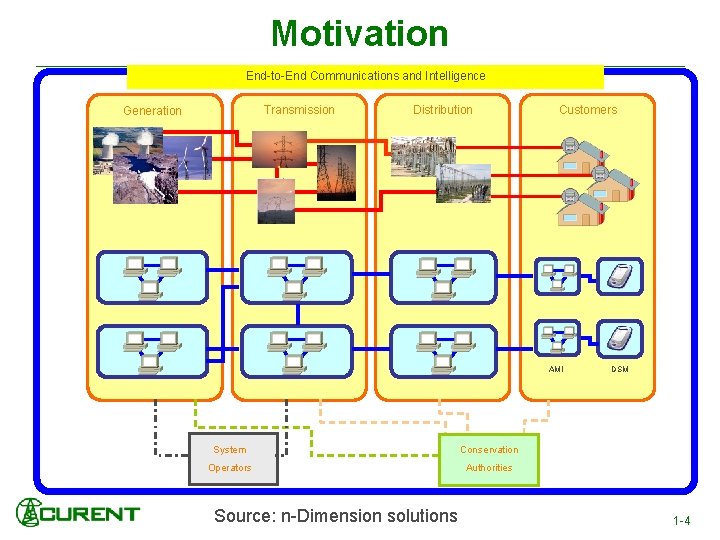
Motivation End-to-End Communications and Intelligence Transmission Generation Distribution Customers AMI System Conservation Operators Authorities Source: n-Dimension solutions DSM 1 -4
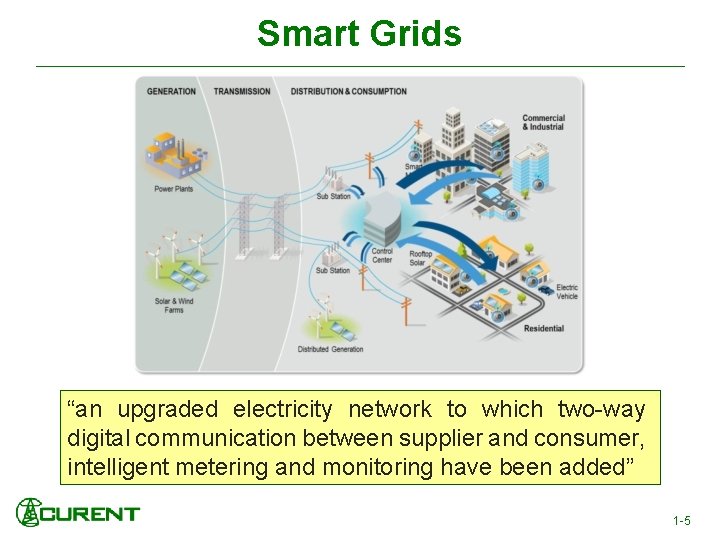
Smart Grids “an upgraded electricity network to which two-way digital communication between supplier and consumer, intelligent metering and monitoring have been added” 1 -5
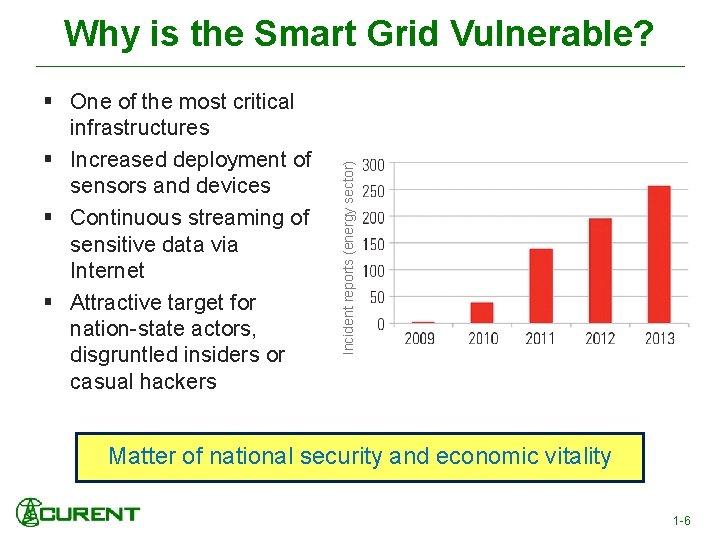
§ One of the most critical infrastructures § Increased deployment of sensors and devices § Continuous streaming of sensitive data via Internet § Attractive target for nation-state actors, disgruntled insiders or casual hackers Incident reports (energy sector) Why is the Smart Grid Vulnerable? Matter of national security and economic vitality 1 -6
Possible Impacts and Challenges § Impacts § Loss of system observability § Uneconomic dispatch choices § Equipment damage § Monetary loss § BLACKOUT!!! § Challenges § Legacy systems § Limited processing capabilities § Low bandwidth connections § Minimum network feedback § Elimination of false alarms § Low detection delay 1 -7
Today’s Computer Networks § § § Packet: Data chopped up into small blocks (e. g. , ~ 500 bytes) Header: Each packet carries extra information to allow it to reach its destination Route: Each intermediate node processes the packet and forward it to the next node Packet-Switched Networks 1 -8
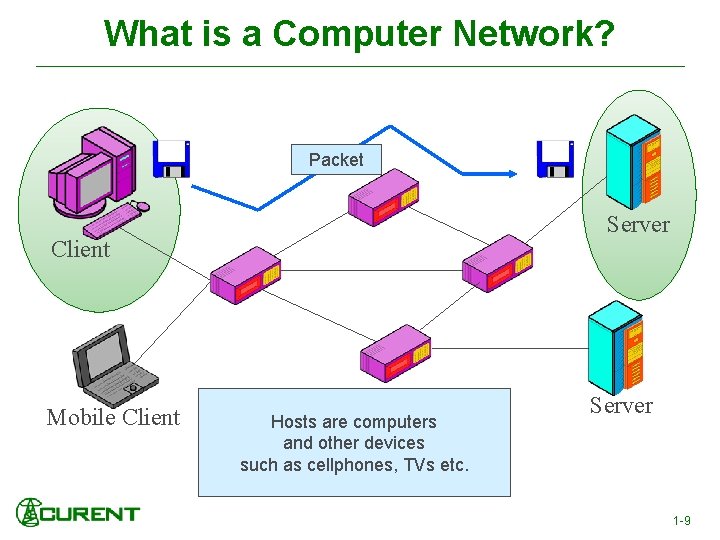
What is a Computer Network? Packet Server Client Mobile Client Hosts are computers and other devices such as cellphones, TVs etc. Server 1 -9
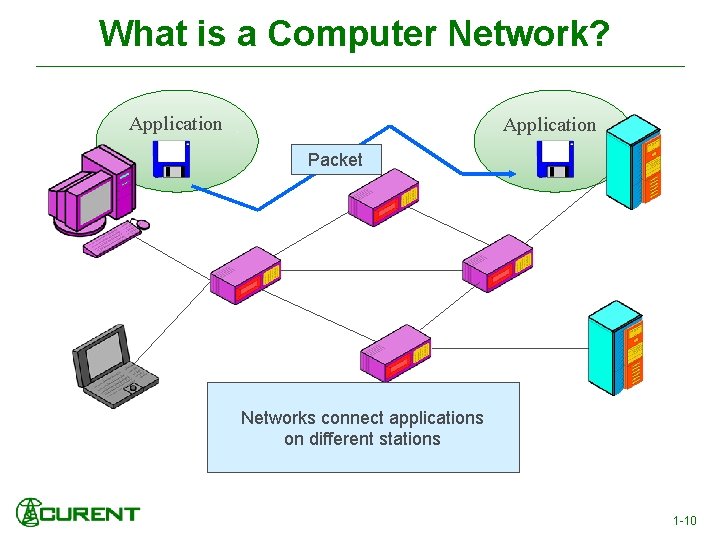
What is a Computer Network? Application Packet Networks connect applications on different stations 1 -10
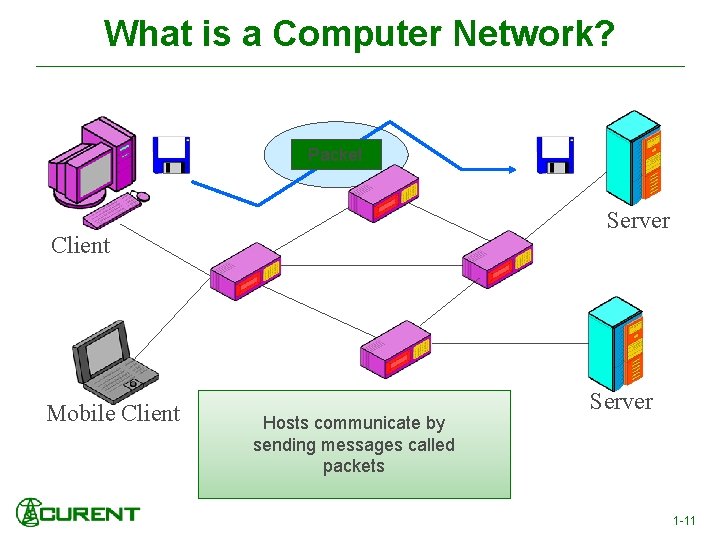
What is a Computer Network? Packet Server Client Mobile Client Hosts communicate by sending messages called packets Server 1 -11

What is a Computer Network? Packet Router Packets may pass through multiple routers; Each switch reads the packet header and passes it on 1 -12
What is a Computer Network? § A collection of computers (PCs, workstations) and other devices (e. g. printers, smart meters) that are all interconnected § Goal: provide connectivity and ubiquitous access to resources (e. g. , database servers, Web), allow remote users to communicate (e. g. , email) § Components: § Hosts (computers) § Links (coaxial cable, twisted pair, optical fiber, radio, satellite) § Switches/routers (intermediate systems) 1 -13
Networking Issues § Resource sharing: accommodate many users over the same link or through the same router § Addressing and routing: how does an email message find its way to the receiver § Reliability and recovery: guarantee end-to-end delivery § Traffic management: monitoring and regulating the traffic in the network 1 -14
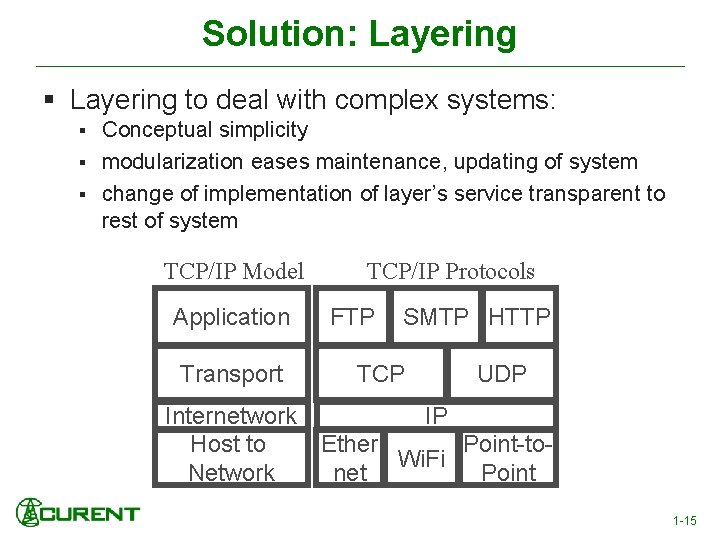
Solution: Layering § Layering to deal with complex systems: § § § Conceptual simplicity modularization eases maintenance, updating of system change of implementation of layer’s service transparent to rest of system TCP/IP Model Application Transport TCP/IP Protocols FTP SMTP HTTP TCP UDP Internetwork IP Host to Ether Point-to. Wi. Fi Network net Point 1 -15
Network Performance § There a number of measures that characterize and capture the performance of a network § It is not enough that networks work § They must work well § Quality of service (Qo. S) defines quantitative measures of service quality § § § Data rate or throughput Delay (Latency) Reliability § Security (not a Qo. S measure but crucial) 1 -16
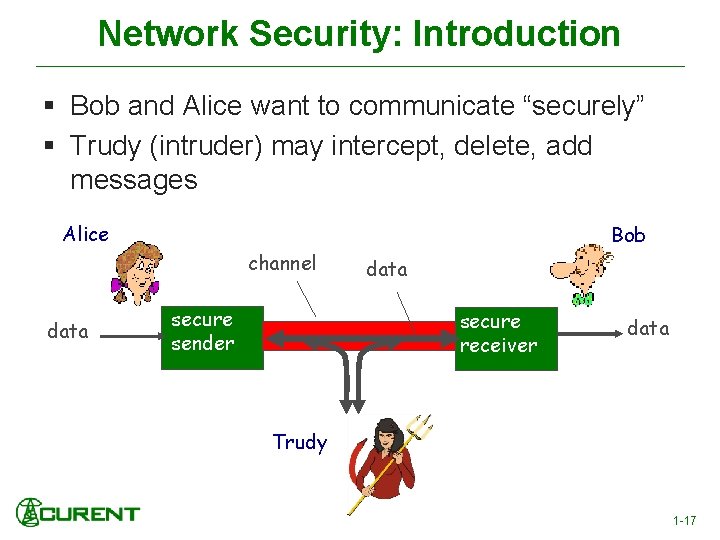
Network Security: Introduction § Bob and Alice want to communicate “securely” § Trudy (intruder) may intercept, delete, add messages Alice Bob channel data secure sender data secure receiver data Trudy 1 -17
Who might Bob, Alice be? § well, real-life Bobs and Alices! § Phasor measurement units sending synchrophasor data § Web browser/server for electronic transactions (e. g. , on-line purchases) § Information exchange between power distribution networks and power generators § on-line banking client/server § routers exchanging routing table updates 1 -18
Who might Trudy be? § Disgruntled insider § Nation-state actor § Contracted employee § Professional hacker § Casual hacker 1 -19
Types of Security Breaches Q: What can a “bad guy” do? A: A lot § § § eavesdrop: intercept messages actively insert messages into connection impersonation: can fake (spoof) source address in packet (or any field in packet) hijacking: “take over” ongoing connection by removing sender or receiver, inserting himself in place denial of service: prevent service from being used by others (e. g. , by overloading resources) 1 -20
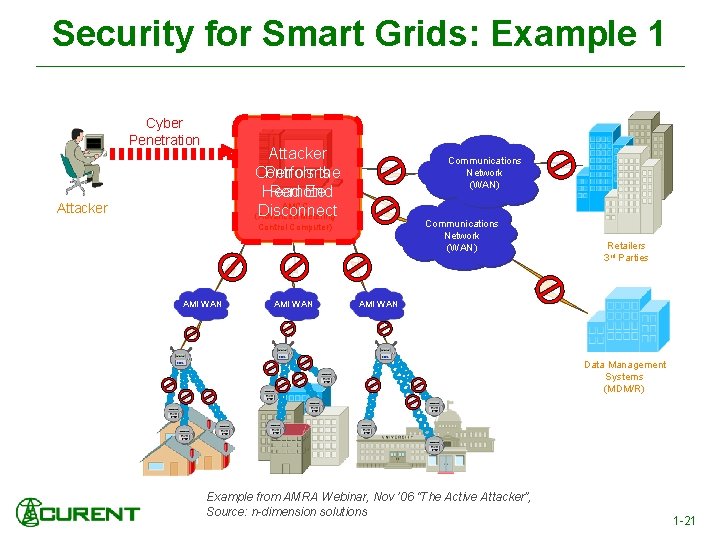
Security for Smart Grids: Example 1 Cyber Penetration Attacker Performs Controls the Remote Head End AMCC Disconnect (Advanced Metering Attacker Communications Network (WAN) Control Computer) AMI WAN Retailers 3 rd Parties AMI WAN Data Management Systems (MDM/R) Example from AMRA Webinar, Nov ’ 06 “The Active Attacker”, Source: n-dimension solutions 1 -21
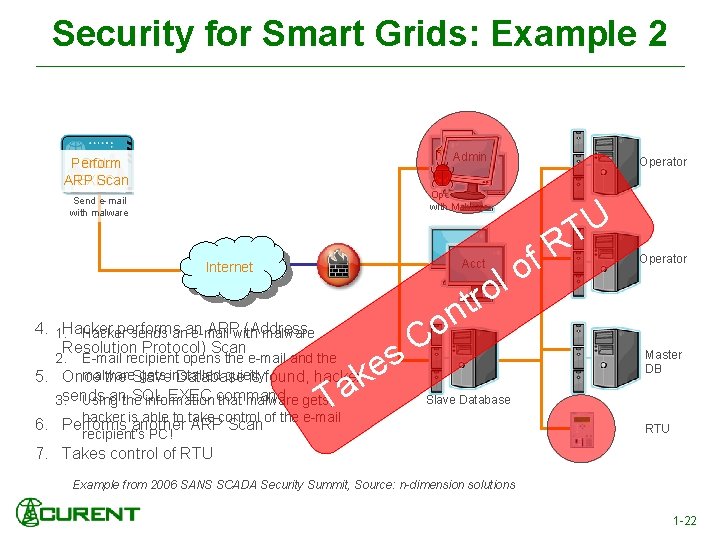
Security for Smart Grids: Example 2 Admin Perform SQL ARP EXEC Scan Operator Opens Email with Malware Send e-mail with malware Acct l o tr Internet 4. 1. Hacker performs ARPwith (Address Hacker sends anan e-mail malware Resolution Protocol) Scan 2. E-mail recipient opens the e-mail and the malware gets installed quietly 5. Once the Slave Database is found, hacker k a T es anthe SQL EXEC command 3. sends Using information that malware gets, n o C of U T R Operator Master DB Slave Database hacker is able to take control of the e-mail 6. Performs another ARP Scan recipient’s PC! RTU 7. Takes control of RTU Example from 2006 SANS SCADA Security Summit, Source: n-dimension solutions 1 -22
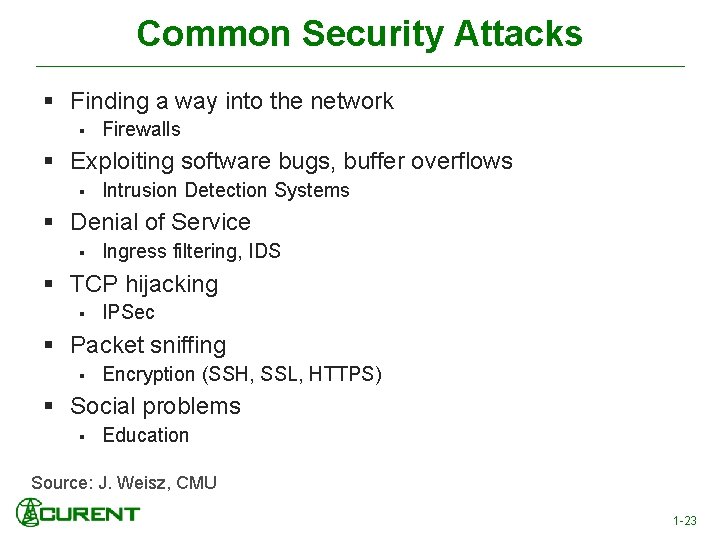
Common Security Attacks § Finding a way into the network § Firewalls § Exploiting software bugs, buffer overflows § Intrusion Detection Systems § Denial of Service § Ingress filtering, IDS § TCP hijacking § IPSec § Packet sniffing § Encryption (SSH, SSL, HTTPS) § Social problems § Education Source: J. Weisz, CMU 1 -23
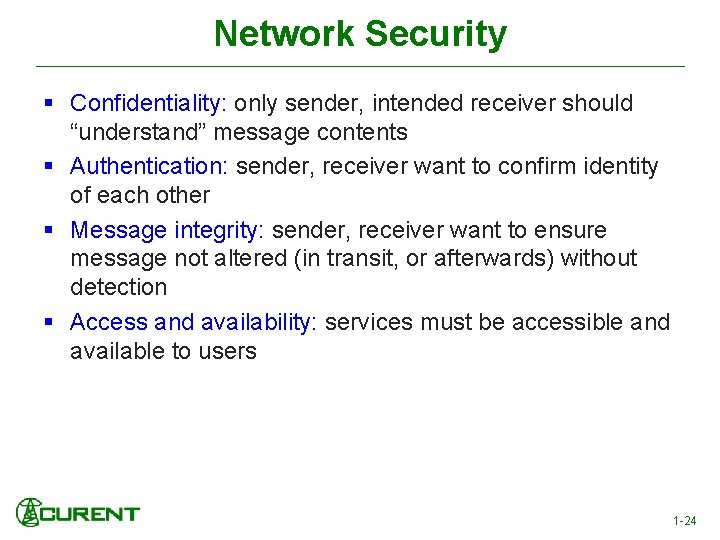
Network Security § Confidentiality: only sender, intended receiver should “understand” message contents § Authentication: sender, receiver want to confirm identity of each other § Message integrity: sender, receiver want to ensure message not altered (in transit, or afterwards) without detection § Access and availability: services must be accessible and available to users 1 -24
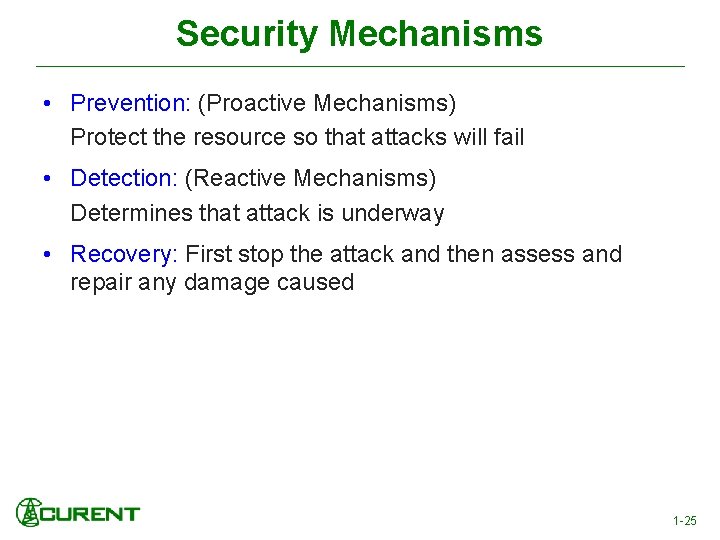
Security Mechanisms • Prevention: (Proactive Mechanisms) Protect the resource so that attacks will fail • Detection: (Reactive Mechanisms) Determines that attack is underway • Recovery: First stop the attack and then assess and repair any damage caused 1 -25
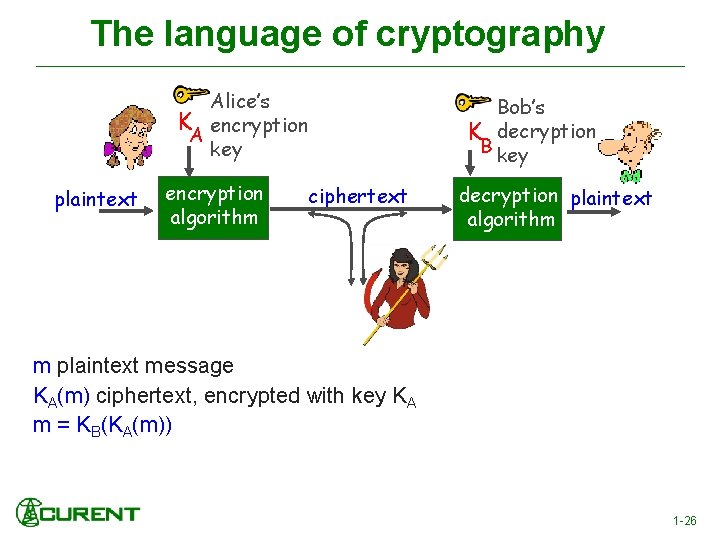
The language of cryptography Alice’s K encryption A key plaintext encryption algorithm Bob’s K decryption B key ciphertext decryption plaintext algorithm m plaintext message KA(m) ciphertext, encrypted with key KA m = KB(KA(m)) 1 -26
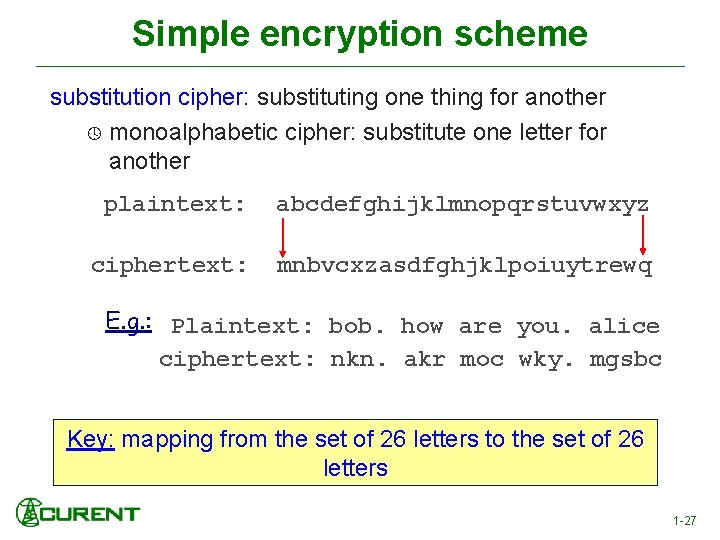
Simple encryption scheme substitution cipher: substituting one thing for another monoalphabetic cipher: substitute one letter for another plaintext: abcdefghijklmnopqrstuvwxyz ciphertext: mnbvcxzasdfghjklpoiuytrewq E. g. : Plaintext: bob. how are you. alice ciphertext: nkn. akr moc wky. mgsbc Key: mapping from the set of 26 letters to the set of 26 letters 1 -27
Message Integrity § allows communicating parties to verify that received messages are authentic. § § § Content of message has not been altered Source of message is who/what you think it is Sequence of messages is maintained § let’s first talk about message digests 1 -28
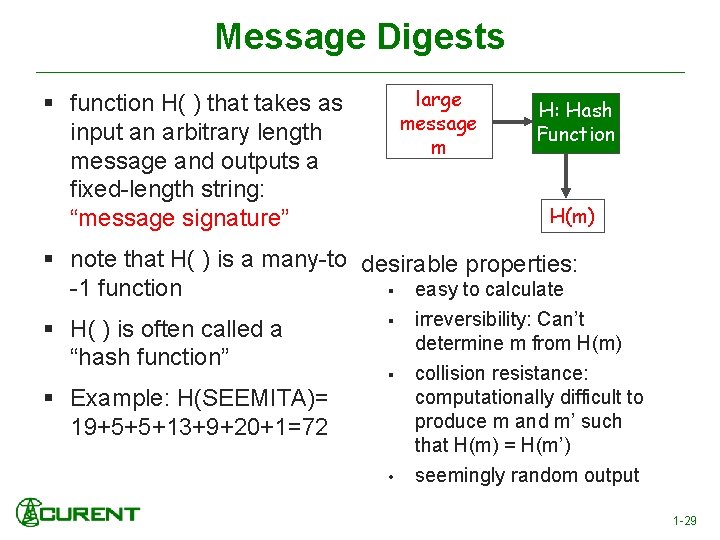
Message Digests large message m § function H( ) that takes as input an arbitrary length message and outputs a fixed-length string: “message signature” H: Hash Function H(m) § note that H( ) is a many-to desirable properties: -1 function § easy to calculate § H( ) is often called a “hash function” § § § Example: H(SEEMITA)= 19+5+5+13+9+20+1=72 • irreversibility: Can’t determine m from H(m) collision resistance: computationally difficult to produce m and m’ such that H(m) = H(m’) seemingly random output 1 -29
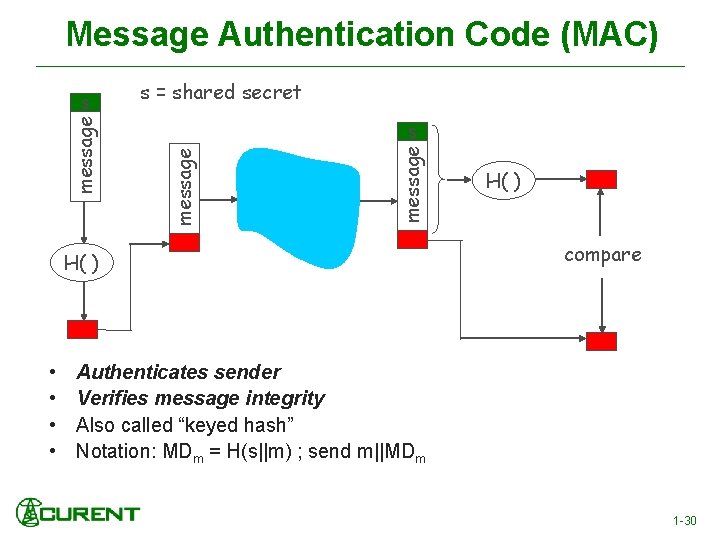
Message Authentication Code (MAC) s = shared secret message s H( ) • • H( ) compare Authenticates sender Verifies message integrity Also called “keyed hash” Notation: MDm = H(s||m) ; send m||MDm 1 -30
Hash Function Algorithms § MD 5 hash function widely used (RFC 1321) § computes 128 -bit message digest in 4 -step process. § SHA-1 is also used § US standard [NIST, FIPS PUB 180 -1] § 160 -bit message digest 1 -31
Firewalls § Many network applications and protocols have security problems, fixed over time § § Difficult for users to keep up with changes and keep host secure Solution § Administrators limit access to end hosts by using a firewall § Firewall is kept up-to-date by administrators § Can be hardware or software § § Ex. Some routers come with firewall functionality ipfw, ipchains, pf on Unix systems, Windows XP and Mac OS X have built in firewalls Source: J. Weisz, CMU 1 -32
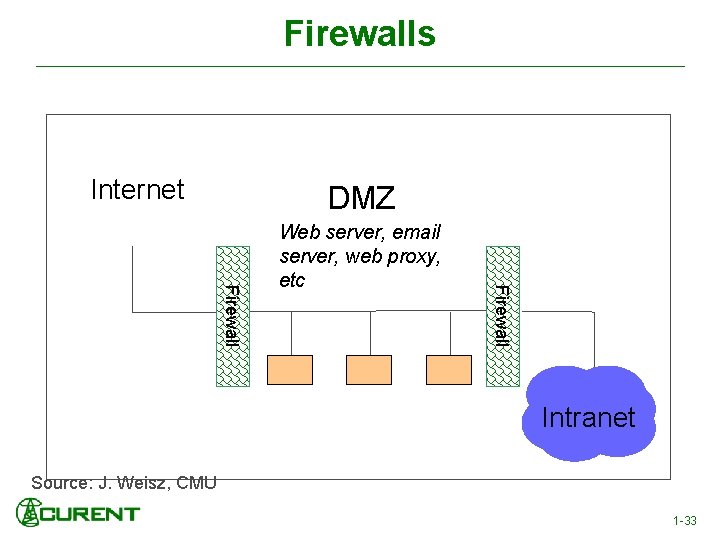
Firewalls Internet DMZ Firewall Web server, email server, web proxy, etc Intranet Source: J. Weisz, CMU 1 -33
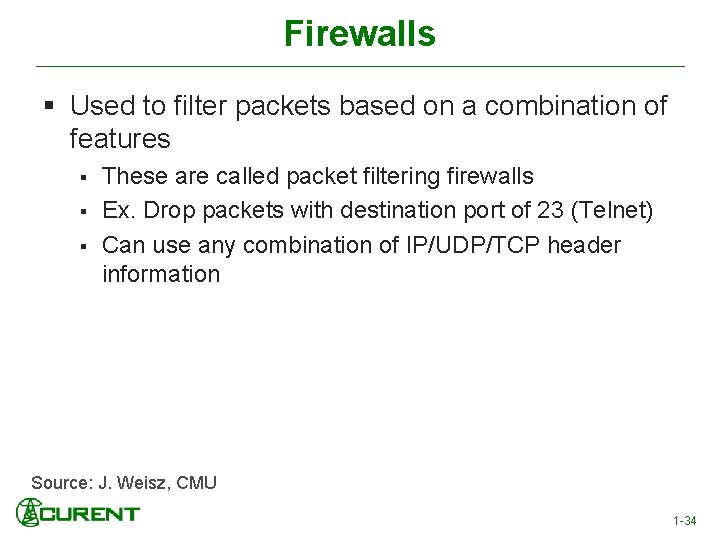
Firewalls § Used to filter packets based on a combination of features § § § These are called packet filtering firewalls Ex. Drop packets with destination port of 23 (Telnet) Can use any combination of IP/UDP/TCP header information Source: J. Weisz, CMU 1 -34
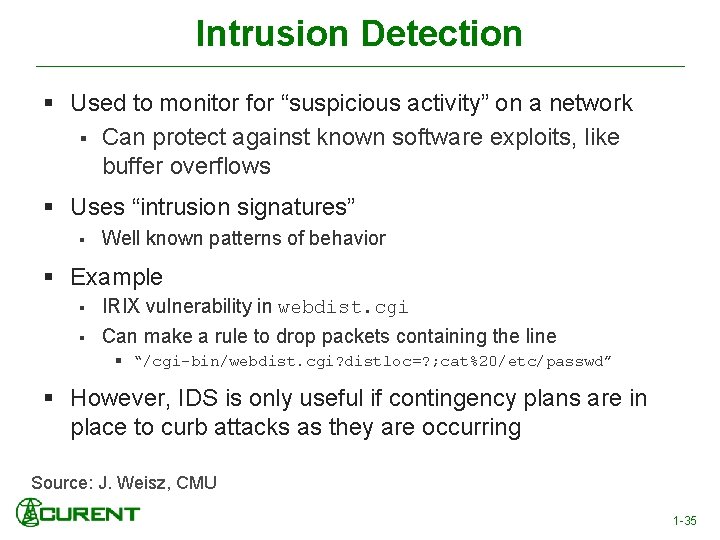
Intrusion Detection § Used to monitor for “suspicious activity” on a network § Can protect against known software exploits, like buffer overflows § Uses “intrusion signatures” § Well known patterns of behavior § Example § IRIX vulnerability in webdist. cgi § Can make a rule to drop packets containing the line § “/cgi-bin/webdist. cgi? distloc=? ; cat%20/etc/passwd” § However, IDS is only useful if contingency plans are in place to curb attacks as they are occurring Source: J. Weisz, CMU 1 -35
Network Security (Recap) • Confidentiality: only sender, intended receiver should “understand” message contents • Authentication: sender, receiver want to confirm identity of each other • Message integrity: sender, receiver want to ensure message not altered (in transit, or afterwards) without detection • Access and availability: services must be accessible and available to users 1 -36
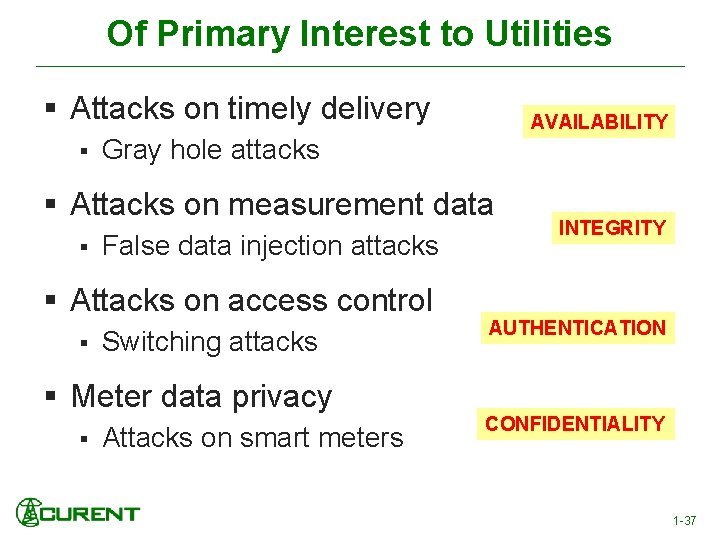
Of Primary Interest to Utilities § Attacks on timely delivery § AVAILABILITY Gray hole attacks § Attacks on measurement data § False data injection attacks § Attacks on access control § Switching attacks § Meter data privacy § Attacks on smart meters INTEGRITY AUTHENTICATION CONFIDENTIALITY 1 -37
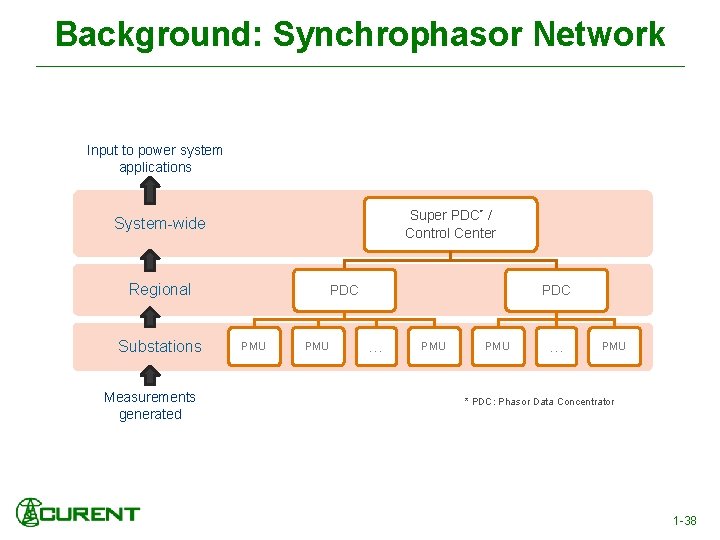
Background: Synchrophasor Network Input to power system applications Super PDC* / Control Center System-wide Regional Substations Measurements generated PDC PMU PDC … PMU * PDC: Phasor Data Concentrator 1 -38
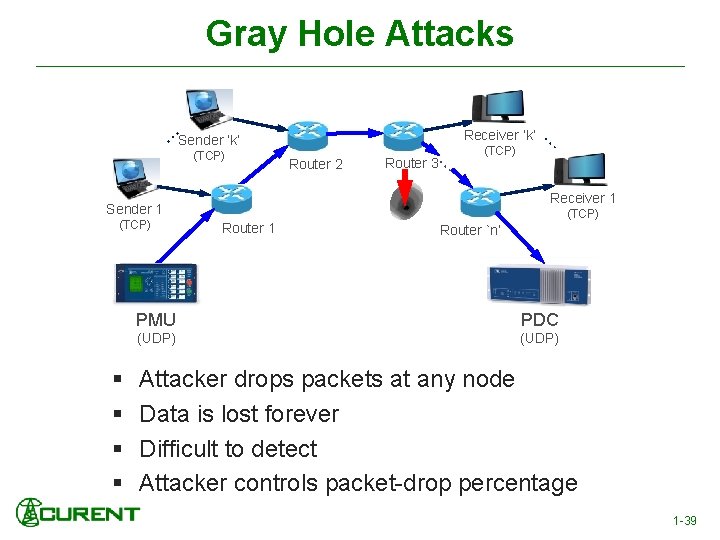
Cyber Solutions - Defense Gray Hole Attackssin Depth Receiver ‘k’ …Sender ‘k’ (TCP) Router 2 … Router 3 (TCP) Receiver 1 Sender 1 (TCP) § § … Router 1 (TCP) Router `n’ PMU PDC (UDP) Attacker drops packets at any node Data is lost forever Difficult to detect Attacker controls packet-drop percentage 1 -39
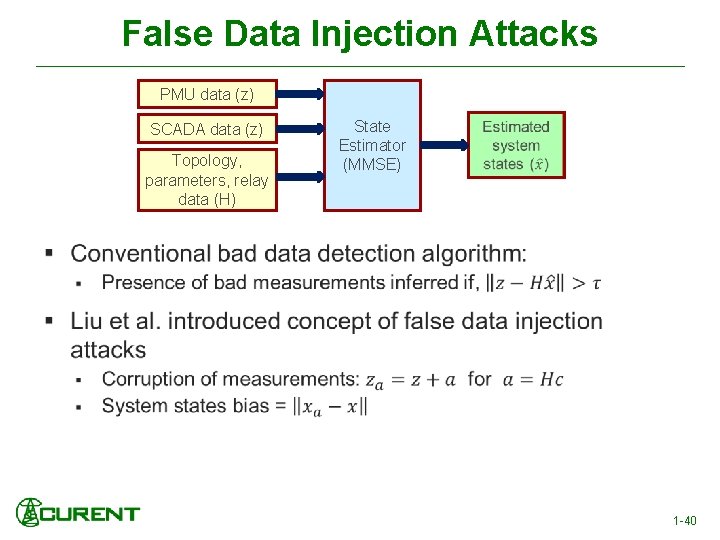
False Data Injection Attacks PMU data (z) SCADA data (z) Topology, parameters, relay data (H) State Estimator (MMSE) • 1 -40
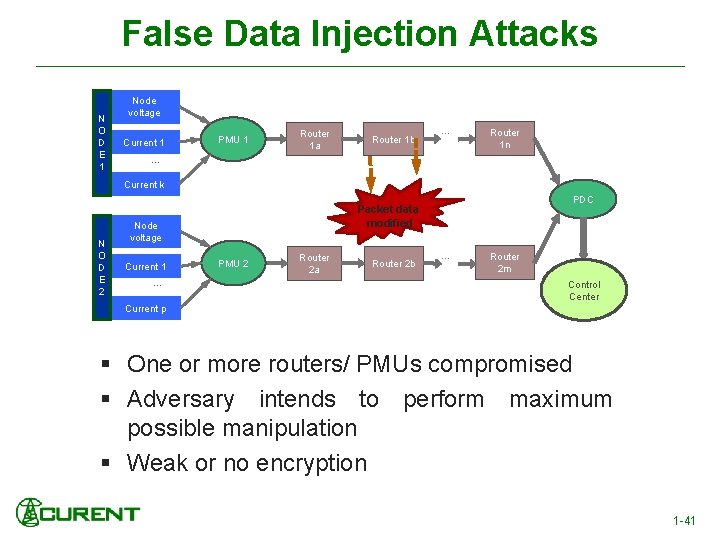
Cyber. False Solutions Defense in. Attacks Depth Data- Injection N O D E 1 Node voltage Current 1 PMU 1 Router 1 a Router 1 b … Router 1 n … Current k N O D E 2 Node voltage Current 1 … PDC Packet data modified PMU 2 Router 2 a Router 2 b … Router 2 m Control Center Current p § One or more routers/ PMUs compromised § Adversary intends to perform maximum possible manipulation § Weak or no encryption 1 -41
Cyber Solutions - Defense in Depth Switching Attacks § Smart grid envisions remote access of circuit breakers and switches § Breaker control signals corrupted or a particular switching sequence applied § Destabilization of system occurs 1 -42
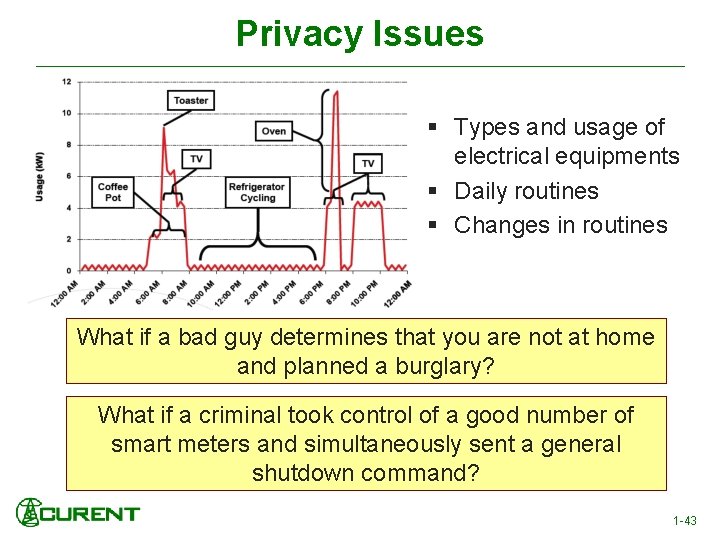
Cyber Solutions - Defense in Depth Privacy Issues § Types and usage of electrical equipments § Daily routines § Changes in routines What if a bad guy determines that you are not at home and planned a burglary? What if a criminal took control of a good number of smart meters and simultaneously sent a general shutdown command? 1 -43
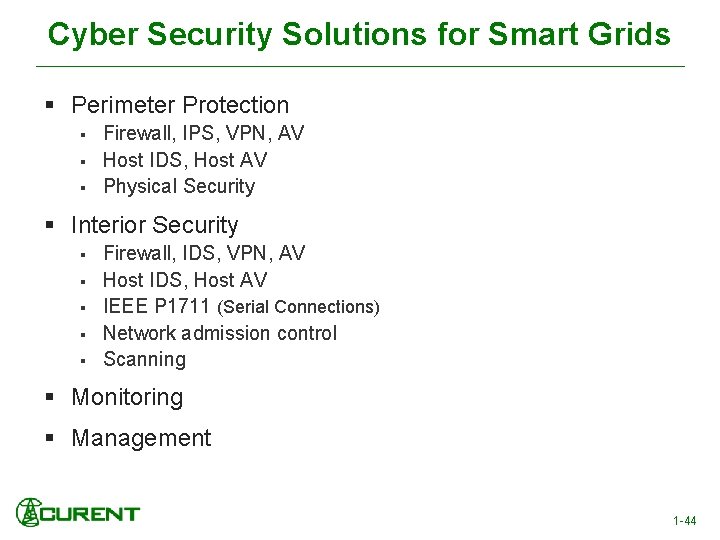
Cyber Solutions Security Solutions Smart Grids Cyber - Defensefor in Depth § Perimeter Protection § § § Firewall, IPS, VPN, AV Host IDS, Host AV Physical Security § Interior Security § § § Firewall, IDS, VPN, AV Host IDS, Host AV IEEE P 1711 (Serial Connections) Network admission control Scanning § Monitoring § Management 1 -44
Questions? 1 -45
- Slides: 45