
CYBER KIDS CYBER BULLYING AND CYBER BALANCE BY
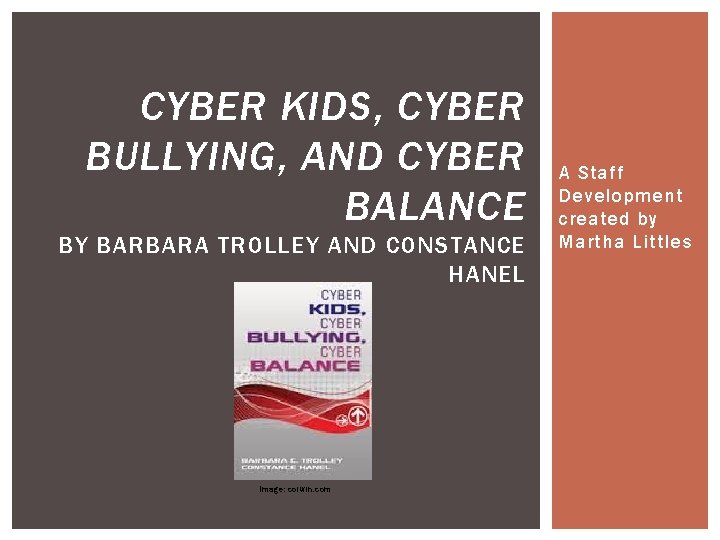
CYBER KIDS, CYBER BULLYING, AND CYBER BALANCE BY BARBARA TROLLEY AND CONSTANCE HANEL Image: corwin. com A Staff Development created by Martha Littles
WELCOME TO THEIR WORLD Our students live in the digital world. 87% of US teens (21 million) use the Internet. This is a 73% increase since 2000. It is our responsibility to enable them to move safely and with respect for others in this world. This is called “digital citizenship. ”
POSITIVE USES FOR TECHNOLOGY Instantaneous communication Search for information quickly and easily Everyone has a voice Socialization – especially for those who find face-to-face communication difficult Children can stay in touch with parents Fosters connections between people
CHALLENGES PERMANENCE § Words and images cannot be retrieved or taken back § Information becomes a permanent record to be shared, repeated, manipulated, and possibly used against you § Others can record, distribute, and even alter what you’ve said or written § Teach students - If you wouldn’t say it to their face, don’t say it online. Chances are, they will see it eventually!
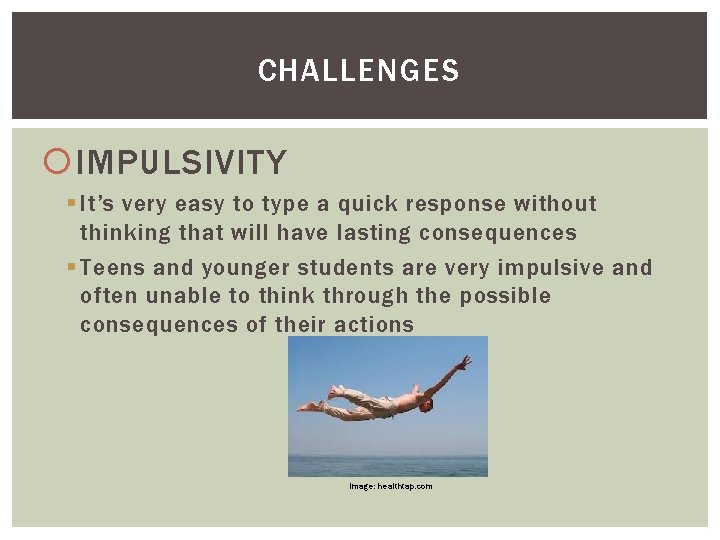
CHALLENGES IMPULSIVITY § It’s very easy to type a quick response without thinking that will have lasting consequences § Teens and younger students are very impulsive and often unable to think through the possible consequences of their actions Image: healthtap. com
CHALLENGES Anonymity/Emotionally Removed from Others § Empathy is removed when you can’t see the person’s reaction to your hurtful words. § “A sense of invisibility, coupled with inexperience, sets the stage for tragedy. ” Image: sobernation. com
CHALLENGES Lack of affordability/access Learning curve – leaving older generations behind Loss of productivity/focus at work and school Long term effects of texting and tech lingo on writing skills So much information is available – do young people actually know how to access it and are they motivated to do so? Do they access quality, reliable sources? Misinterpretation of communication without facial and nonverbal cues Breaches of confidentiality Exposure to pornography Parents are not as tech savvy as their children – lack of supervision
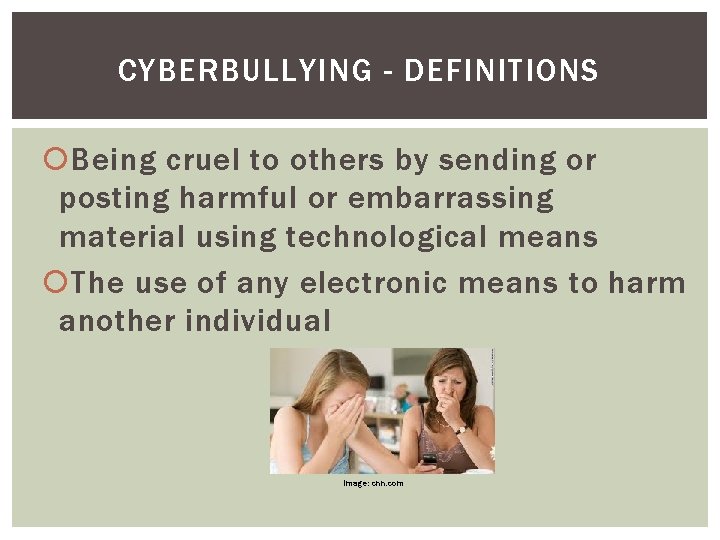
CYBERBULLYING - DEFINITIONS Being cruel to others by sending or posting harmful or embarrassing material using technological means The use of any electronic means to harm another individual Image: cnn. com
HOW DOES IT DIFFER FROM “TRADITIONAL” BULLYING Technology allows cruelty to be exponentially more far reaching and cruel Empathy is removed when you are shielded from seeing the face of the person whom you’ve harmed Often occurs off school property – more difficult to monitor Cyberbullies often have good relationships with adults and teachers Illusion of anonymity and the ease of responding without the physical presence of the other person allows children the “freedom” to do things they might not otherwise do.
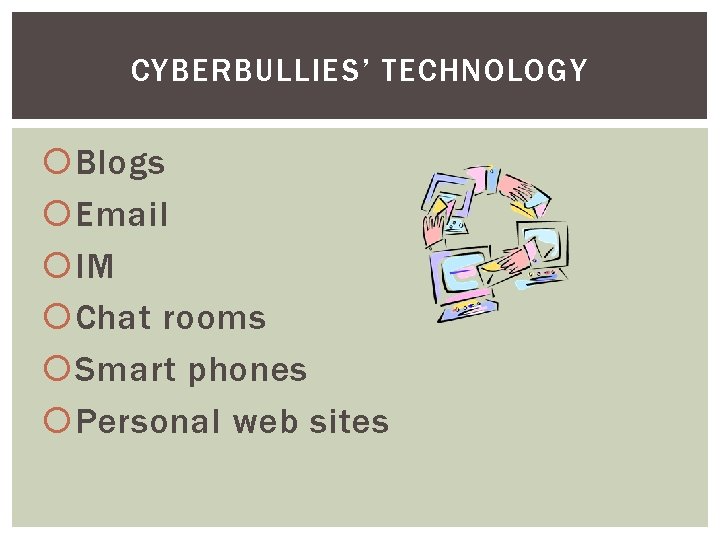
CYBERBULLIES’ TECHNOLOGY Blogs Email IM Chat rooms Smart phones Personal web sites
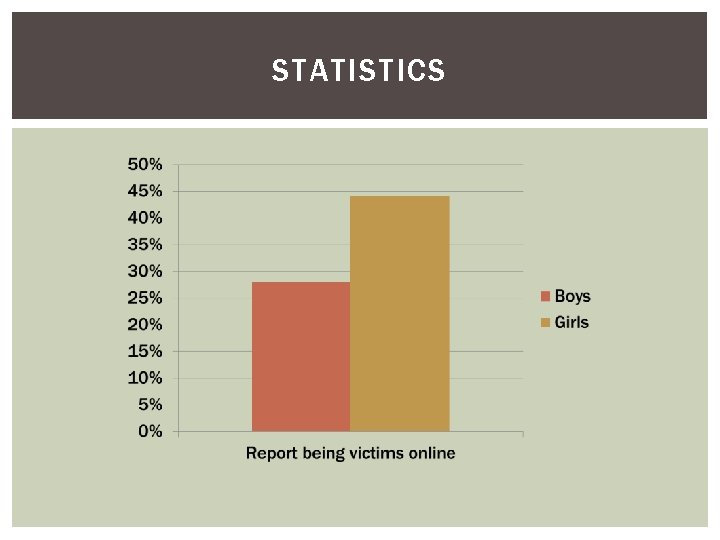
STATISTICS
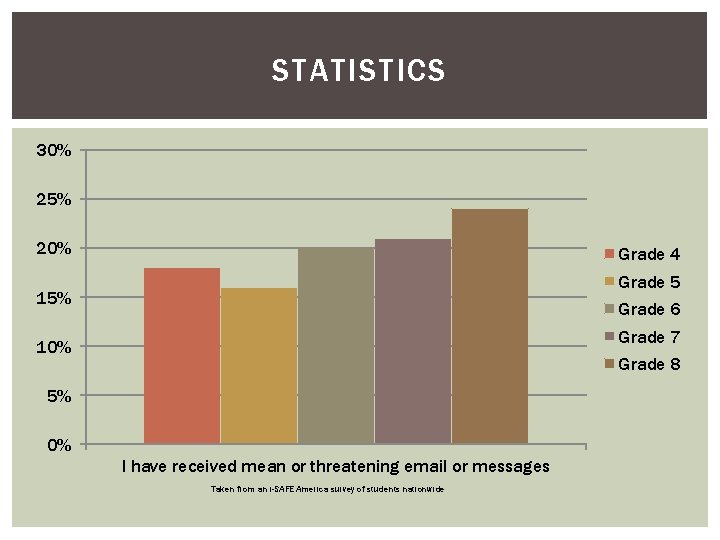
STATISTICS 30% 25% 20% Grade 4 Grade 5 15% Grade 6 Grade 7 10% Grade 8 5% 0% I have received mean or threatening email or messages Taken from an i-SAFE America survey of students nationwide
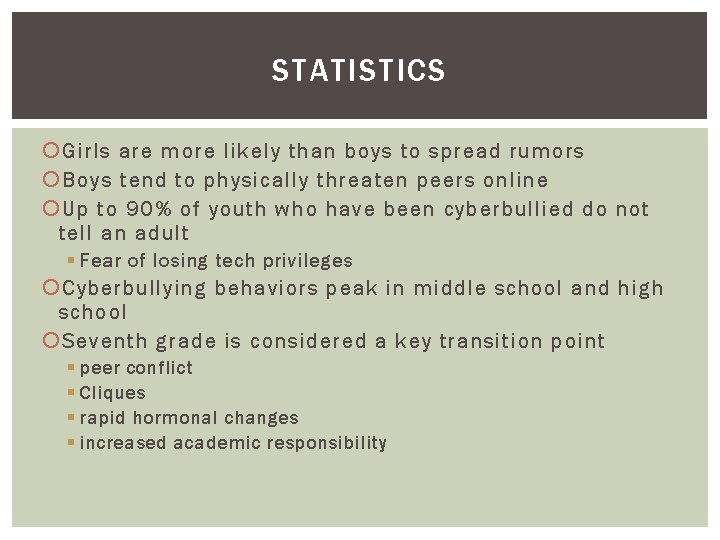
STATISTICS Girls are more likely than boys to spread rumors Boys tend to physically threaten peers online Up to 90% of youth who have been cyberbullied do not tell an adult § Fear of losing tech privileges Cyberbullying behaviors peak in middle school and high school Seventh grade is considered a key transition point § peer conflict § Cliques § rapid hormonal changes § increased academic responsibility
IT’S A GRAY AREA Cyberbullying is not black and white. § Friendly one-upmanship banter turns ugly? § A negative email is sent to a peer who has physically bullied another student? § Negative song lyrics are typed and sent to a peer? Many incidents can often be perceived by one party but not the other as cyberbullying. Often cyclical – only partial documentation is presented to make one child seems like a victim and one the instigator when it is often a cyclical process.
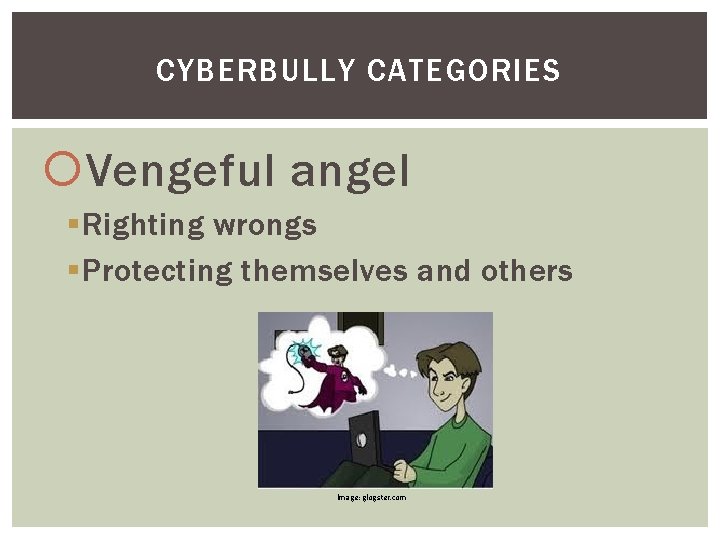
CYBERBULLY CATEGORIES Vengeful angel § Righting wrongs § Protecting themselves and others Image: glogster. com
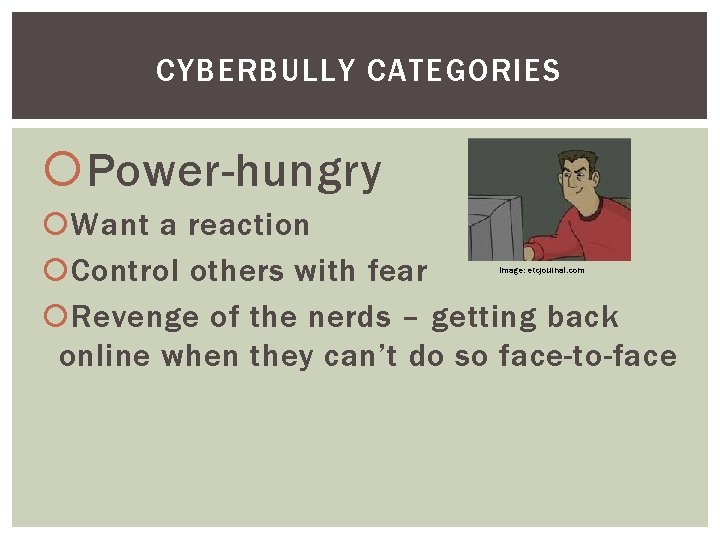
CYBERBULLY CATEGORIES Power-hungry Want a reaction Control others with fear Revenge of the nerds – getting back online when they can’t do so face-to-face Image: etcjournal. com
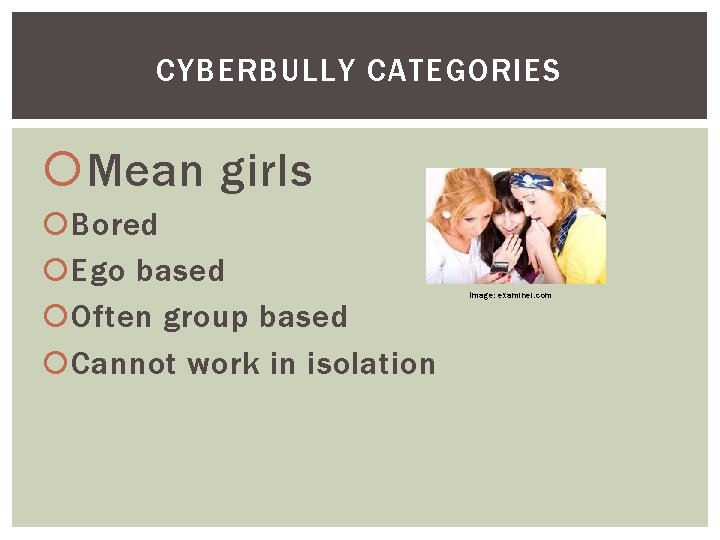
CYBERBULLY CATEGORIES Mean girls Bored Ego based Often group based Cannot work in isolation Image: examiner. com
CYBERBULLY CATEGORIES Entitled § Put down those to whom they feel superior § Feel they have the right to harass and demean others who they deem different or inferior Image: babble. com
CYBERBULLY CATEGORIES Inadvertent Bully Does not realize it’s wrong or harmful Role-playing
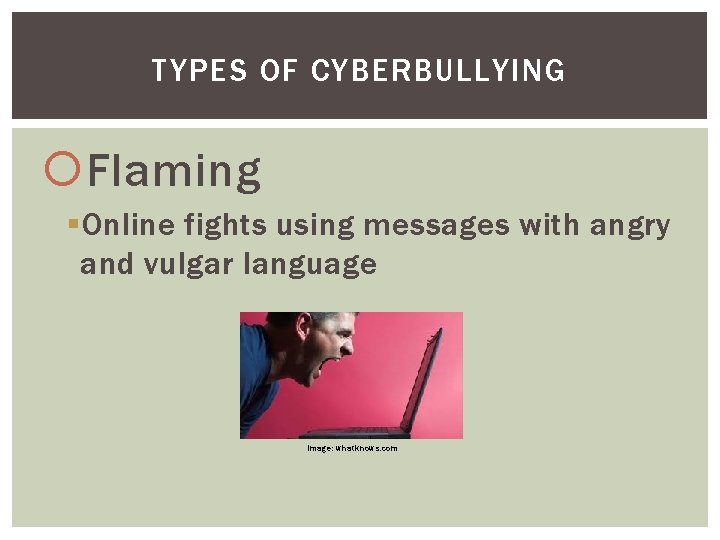
TYPES OF CYBERBULLYING Flaming § Online fights using messages with angry and vulgar language Image: whatknows. com
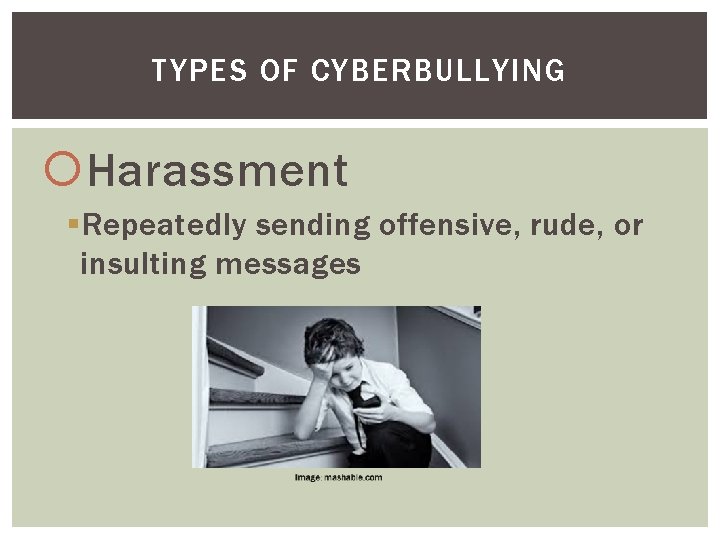
TYPES OF CYBERBULLYING Harassment § Repeatedly sending offensive, rude, or insulting messages
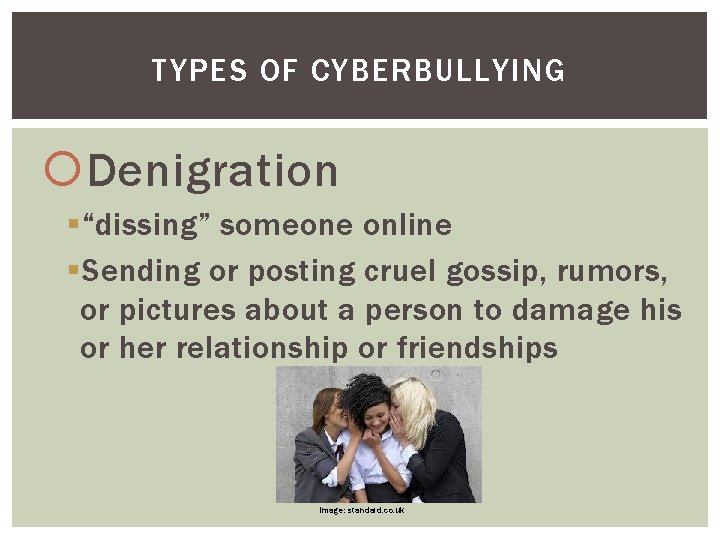
TYPES OF CYBERBULLYING Denigration § “dissing” someone online § Sending or posting cruel gossip, rumors, or pictures about a person to damage his or her relationship or friendships Image: standard. co. uk
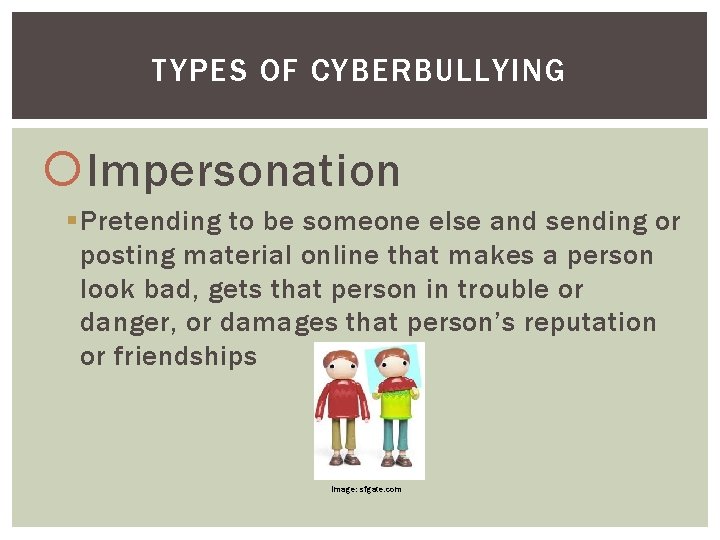
TYPES OF CYBERBULLYING Impersonation § Pretending to be someone else and sending or posting material online that makes a person look bad, gets that person in trouble or danger, or damages that person’s reputation or friendships Image: sfgate. com
TYPES OF CYBERBULLYING Outing and Trickery § Sharing someone’s secrets or embarrassing information online § Tricking them into doing the same
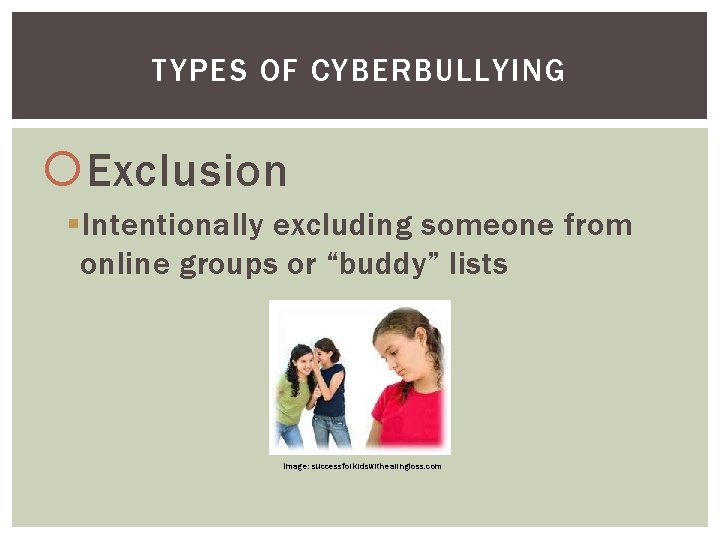
TYPES OF CYBERBULLYING Exclusion § Intentionally excluding someone from online groups or “buddy” lists Image: successforkidswithearingloss. com
BYSTANDERS Teach students to become more involved and stand up for what is right Often, it is the bystander who reports cyberbullying Problem Bystanders § encourage or support the bullying or do nothing to help Solution Bystanders § speak up against bullying, provide support to victims, tell adults
SIGNS OF CYBERBULLYING Victims – § § § Displays frustration or anger after computer use Avoids discussions about computer use Displays anxiety over instant messages or emails Change in mood or disposition Stops using computer Avoidance of friends, school, or other activities Instigators – § § § Avoids discussions about computer use Unusual agitation when unable to use computer Excessive computer use Use of multiple accounts that may not be their own Closes programs or does not allow you to view the computer screen
LEGAL ISSUES Fine line between “freedom of speech” and balancing school safety. States are in the process of defining new laws to handle online crimes Morse decision – schools can reach out into situations outside of school for student safety School officials can be held liable for being deliberately indifferent to harassment of which they have actual knowledge that is so severe that it deprives the victims of access to an education Parents are financially liable for the actions of/harm caused by their minor children
HOW TO RESPOND DO NOT turn incidents back to the families DO NOT react with zero-tolerance policies Each situation must be examined individually and assessed carefully § Is the “victim” really the instigator or vice versa? § Was it cyclical?
HOW TO RESPOND Situations must be therapeutically addressed The one “caught” is frequently disciplined severely while the others remain untouched The behavior is deemed wrong, but the needs behind the behavior are not addressed – dooming them to repeat Cyberbullies were frequently once victims of bullying, and that must be worked through to stop the cycle CYBER BULLIES NEED HELP, NOT BANISHMENT
TEAM APPROACH Families and schools must work together to identify, resolve, and prevent cyberbullying. This requires acknowledgment of responsibility from all parties and a cooperative approach. The key is education for all.
SCHOOLS’ RESPONSIBILITIES Involve an attorney attuned to cyberbullying for creation of policy Add cyberbullying to current bullying policy Add cyberbullying to the Acceptable Use Policy regarding the proper use of school computers Remember that if it appears to have been initiated off school property, the roots could be school based Educate parents React individually to each incident and look to support all parties concerned Measure the level of cyberbullying in school, when it is occurring, and through what means Educate staff on cyberbullying
PARENTS’ RESPONSIBILITIES Introduce children to internet safety at home Educate themselves on changes in technology Foster communication and trust with children Communicate the responsibilities and dangers that go along with the privilege of using the computer, as well as consequences for misuse Monitor children’s use of the computer, smart phones, and devices Keep the computer in an open family area Limit computer, phone, and other device time Work with the school as a partner to solve problems Mediate between children and the school when necessary
YOUTH RESPONSIBILITY Understand that the use of technology is a privilege that comes with associated responsibility Be cautious about sharing personal information or visiting questionable websites Understand that words do hurt, even if you cannot see the recipient's response Develop empathy for peers
ASSESSING AN ALLEGATION Fill out an incident report and a cyberbullying student assessment form Do not rush to judgment - often the party reporting the incident or saving documentation is deemed the victim when it is often a circular event Collect as much data as possible Determine any potential threat or harm § Suicide § Homicide Impersonation must be considered, but not accepted at face value
WHAT’S NOT EFFECTIVE Zero tolerance Three strikes and you’re out Anger management in isolation Skill building in isolation Self esteem building Why? § Unwillingness to report § Self esteem is often not the problem § Acquisition of more negative behaviors and feelings
HOLISTIC APPROACH Address the school and the community Interventions must occur at the parent/community, school, classroom, and individual levels It takes a village Character education – creating a caring school environment Move beyond isolated disciplinary responses which are often determined beforehand with no thought to the individual situation with no comprehensive assessment
PEAS PROGRAM Psychological, Educational, and Social Response § Directed to meet the needs of all the parties affected by cyberbullying Two main components § Assessment § Therapeutic response Proactive rather than reactive
“P” - PSYCHOLOGICAL RESPONSE The school counselor is needed to: Follow up on the assessment of the cyberbully Provide therapeutic intervention to help address the issues of the cyberbully § address the need that the bullying satisfied § work through emotional conflicts § development positive thought and behavioral patterns Offer a forum of mediation between the bully and victim Prevent future events through development of healthy, adaptive skills in a multitude of areas
“E” - EDUCATIONAL RESPONSE Media Specialist/Teachers/Administration are needed to: Educate all members of the community to the specific nature of cyberbullying in order to effectively detect and address the situations that occur § § Parents Teachers Staff Community members Use classroom settings, assemblies, and continuing education programs for education
AND “S” - SOCIAL RESPONSE School Counselor/Teachers are needed to: Teach youth to relate to their peers in positive ways through friendships and conflict resolution Teach social competence and social skills Parents/The Community are needed to: Provide access to moral and supportive role models Provide constructive outlets for free time
AN OUNCE OF PREVENTION… Model correct behavior Keep lines of communication open Teach youth to respect technology Cyber kids need to have clear, definable boundaries and an action plan at home and school to navigate cyberspace safely Working on impulse and thinking later is not an option when every action is documented.
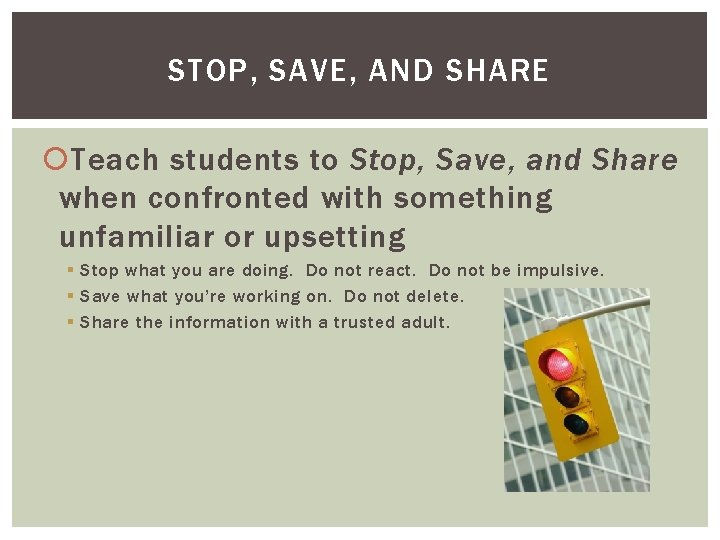
STOP, SAVE, AND SHARE Teach students to Stop, Save, and Share when confronted with something unfamiliar or upsetting § Stop what you are doing. Do not react. Do not be impulsive. § Save what you’re working on. Do not delete. § Share the information with a trusted adult.
BIBLIOGRAPHY Trolley, B. C. , & Hanel, C. (2010). Cyber Kids, Cyber Bullying, Cyber Balance. Thousand Oaks: Corwin.
- Slides: 44