
Cyber God Emerging Trends of the Virtual Church
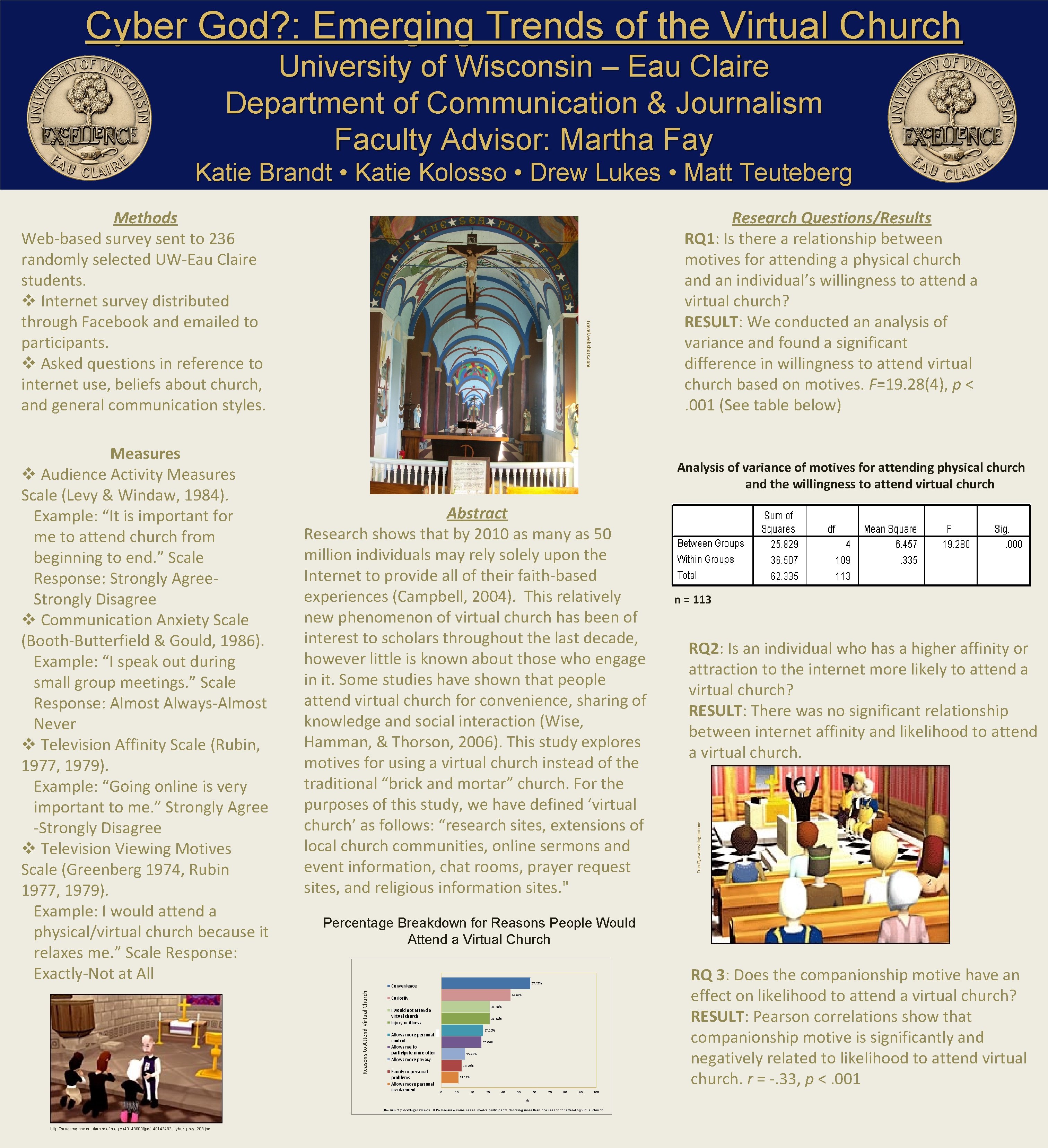
Cyber God? : Emerging Trends of the Virtual Church University of Wisconsin – Eau Claire Department of Communication & Journalism Faculty Advisor: Martha Fay Katie Brandt • Katie Kolosso • Drew Lukes • Matt Teuteberg Analysis of variance of motives for attending physical church and the willingness to attend virtual church RQ 2: Is an individual who has a higher affinity or attraction to the internet more likely to attend a virtual church? RESULT: There was no significant relationship between internet affinity and likelihood to attend a virtual church. Percentage Breakdown for Reasons People Would Attend a Virtual Church Convenience 44. 68% Curiosity 31. 38% I would not attend a virtual church Injury or illness Allows more personal control Allows me to participate more often Allows more privacy RQ 3: Does the companionship motive have an effect on likelihood to attend a virtual church? RESULT: Pearson correlations show that companionship motive is significantly and negatively related to likelihood to attend virtual church. r = -. 33, p <. 001 57. 45% 31. 38% 1 27. 12% 26. 06% 15. 42% 13. 29% Family or personal problems Allows more personal involvement 11. 17% 0 10 20 30 40 50 60 70 80 90 100 % The sum of percentages exceeds 100% because some cases involve participants choosing more than one reason for attending virtual church. http: //newsimg. bbc. co. uk/media/images/40143000/jpg/_40143483_cyber_pray_203. jpg n = 113 Transfigurations. blogspot. com Abstract Research shows that by 2010 as many as 50 million individuals may rely solely upon the Internet to provide all of their faith-based experiences (Campbell, 2004). This relatively new phenomenon of virtual church has been of interest to scholars throughout the last decade, however little is known about those who engage in it. Some studies have shown that people attend virtual church for convenience, sharing of knowledge and social interaction (Wise, Hamman, & Thorson, 2006). This study explores motives for using a virtual church instead of the traditional “brick and mortar” church. For the purposes of this study, we have defined ‘virtual church’ as follows: “research sites, extensions of local church communities, online sermons and event information, chat rooms, prayer request sites, and religious information sites. " Reasons to Attend Virtual Church Measures v Audience Activity Measures Scale (Levy & Windaw, 1984). Example: “It is important for me to attend church from beginning to end. ” Scale Response: Strongly Agree. Strongly Disagree v Communication Anxiety Scale (Booth-Butterfield & Gould, 1986). Example: “I speak out during small group meetings. ” Scale Response: Almost Always-Almost Never v Television Affinity Scale (Rubin, 1977, 1979). Example: “Going online is very important to me. ” Strongly Agree -Strongly Disagree v Television Viewing Motives Scale (Greenberg 1974, Rubin 1977, 1979). Example: I would attend a physical/virtual church because it relaxes me. ” Scale Response: Exactly-Not at All Research Questions/Results RQ 1: Is there a relationship between motives for attending a physical church and an individual’s willingness to attend a virtual church? RESULT: We conducted an analysis of variance and found a significant difference in willingness to attend virtual church based on motives. F=19. 28(4), p <. 001 (See table below) travel. webshots. com Methods Web-based survey sent to 236 randomly selected UW-Eau Claire students. v Internet survey distributed through Facebook and emailed to participants. v Asked questions in reference to internet use, beliefs about church, and general communication styles.
- Slides: 1