
Cyanobacteria and Drinking Water Supplies Cyanobacteria An Emerging
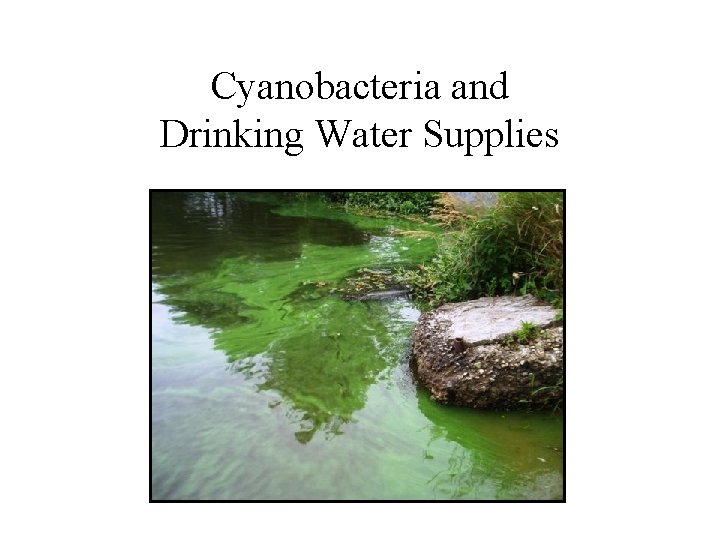
Cyanobacteria and Drinking Water Supplies
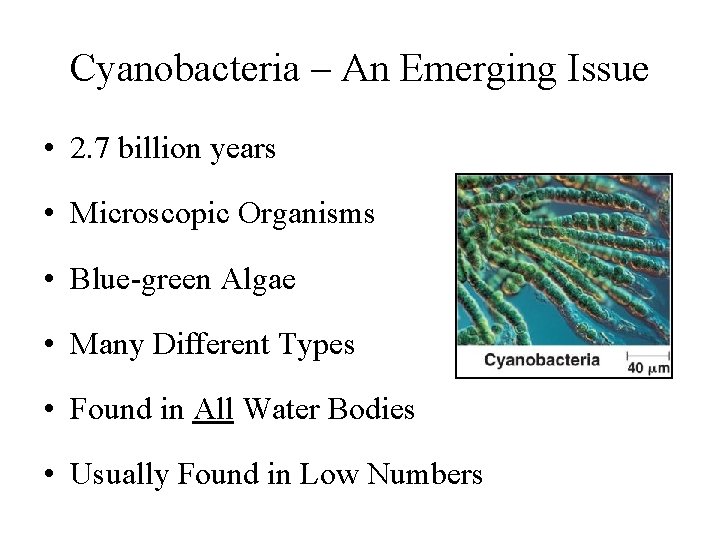
Cyanobacteria – An Emerging Issue • 2. 7 billion years • Microscopic Organisms • Blue-green Algae • Many Different Types • Found in All Water Bodies • Usually Found in Low Numbers
Increased Concentrations May Create Problem Blooms • • Low Water Flow Warm Summer & Early Fall Water Temperatures Nitrogen & Phosphorus Enter the Water • Taste and Odor Problems for PWS • Public Health Concerns for Humans & Pets • Cells May Contain Toxin
Health Concerns Depend Upon: • Type of Exposure • Concentrations of Cyanobacteria Species & Toxins Present
Routes of Exposure in DW • Skin Contact • Toxins are released when the cells are ingested and they break down in the stomach. • After an algae bloom ends and the organisms die, the toxins are released into the water where they can be directly ingested.
Symptoms From Exposure • • Skin Rash Numb lips Tingling fingers & toes Dizziness Abdominal pain Diarrhea Vomiting
Symptoms from Exposure • Elevated Levels of Toxin: Can cause serious damage to liver, kidneys, nervous system • Deaths in Animals (dogs) Have Occurred in Massachusetts At Recreational Waters
Cyanobacteria Blooms Are Tricky • Can occur at different depths • Location varies based on wind direction, depth of water body, etc. • Confirmation of cyanobacteria can only be made by observing cells under a microscope. • Cyanobacteria can develop toxins at any time. • Confirmation of toxins in cyanobacteria cells can only be made using analytical laboratory tests.
• There are no uniform procedures for sampling, performing cell counts, or treating cyanobacteria impacted waters. • Some DW Treatment Plant Processes Are Effective In Removing Some Cells and/or Some Toxins
• Cyanobacteria are not regulated by EPA or by Massachusetts. • U. S. EPA - UCMR 4
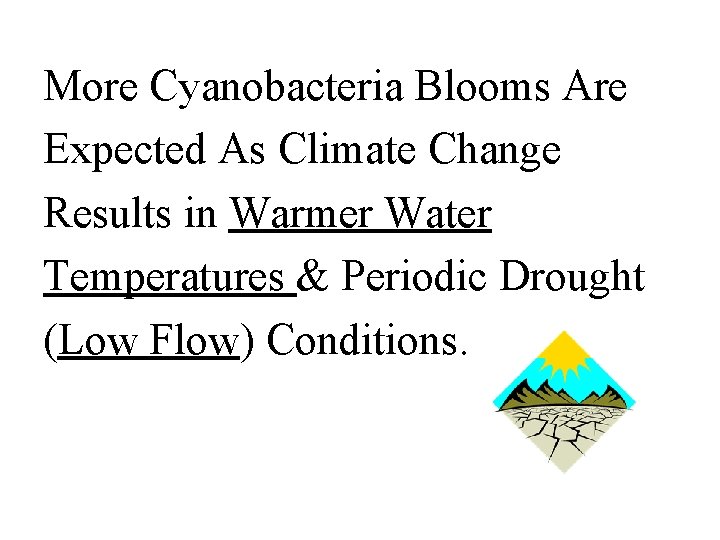
More Cyanobacteria Blooms Are Expected As Climate Change Results in Warmer Water Temperatures & Periodic Drought (Low Flow) Conditions.
National Oceanic and Atmospheric Administration (NOAA): Blooms appear to be increasing along the coasts and in freshwaters.
Cyanobacteria Strategies 1. Be Aware of Issue 2. Implement Source Water Protection for Prevention 3. Plan Ahead for Cyanobacteria Blooms in Your ER Plan
1. Strategy: Awareness of Issue • PWS Experience • Mass. DEP Fact sheet • Mass. DEP Guidance • Discuss with Public
2. Strategy: Source Water Protection Reduce nitrogen and phosphorus flowing through the watershed to the reservoir from land uses such as: • Septic Systems • Lawn/Gardens • Dog Waste • Agriculture • Golf Courses • Other
Source Water Protection • Fact sheets that address these topics and many others are located on Mass. DEP’s web site at www. mass. gov/eea/agencies/massdep/water/drinking/so urce-water-protection-for-drinking-watersupplies. html.
3. Strategy: Plan for Blooms in ER Plan • Mass. DEP survey • Vulnerability of surface water to blooms • Include information in ER Plan
Groups Working on Cyanobacteria • • Mass. DEP Drinking Water Program Other Mass. DEP Programs Mass. Department of Public Health Other NE States & NY U. S. EPA American Water Works Association Boards of Health Universities
Worcester Polytechnic Institute Project • Public ground water wells under the influence of surface waters. • Are there impacts to the well when the surface water has a cyanobacteria bloom? • Identify owners of surface waters. • Write new fact sheet to raise awareness of issue. • Encourage communication between PWS with well & owner of the surface water.
Mass. DEP Contacts • • • WERO CERO NERO SERO Boston Kim Longridge (or Deirdre Doherty) Bob Bostwick Nick Zessoules (or Tom Mahin) Rick Rondeau Kathy Romero
- Slides: 20