
CY 2550 Foundations of Cybersecurity Cryptography The Science
CY 2550 Foundations of Cybersecurity Cryptography
The Science of Secrets • Cryptography: the study of mathematical techniques to providing aspects of information security services • Creating secrets • Cryptanalysis: the study of mathematical techniques for attempting to defeat information security services • Breaking secrets • Cryptology: the study of cryptography and cryptanalysis
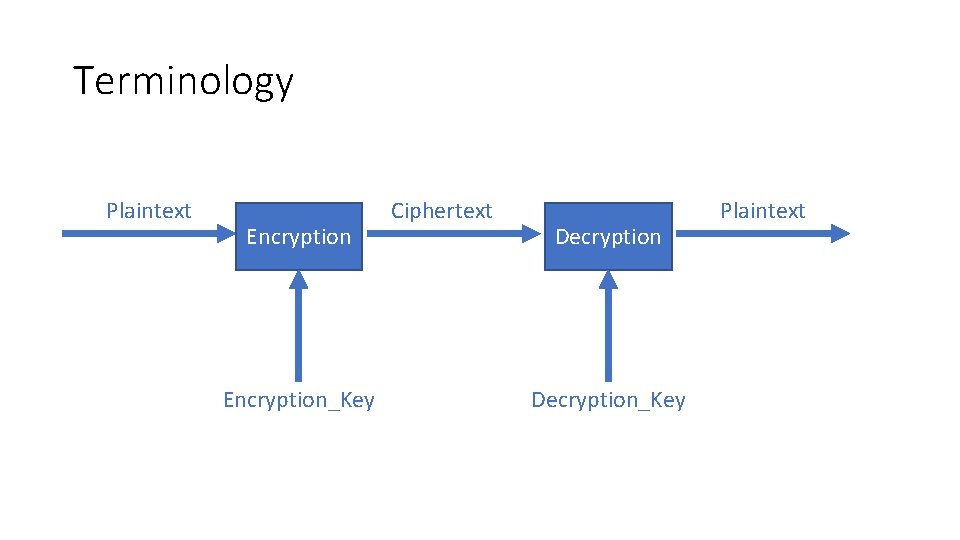
Terminology Plaintext Encryption_Key Ciphertext Decryption_Key Plaintext
Fundamental Goals • Confidentiality – no eavesdropping • Integrity – no unauthorized modifications • Authenticity – no spoofing or faking • Non-repudiation – no disclaiming of authorship
Additional Goals of Modern Crypto • Pseudo-random number generation • Anonymity • E-voting • Secret sharing • Zero-knowledge proof • Secure multi-party computation • Computation over encrypted data (homomorphic encryption)
Cryptographic Protocols • Protocols that • Enable parties to… • Achieve goals to… • Overcome adversaries • Need to understand • Who are the parties and the context in which they act? • What are the security goals of the protocols? • What are the capabilities of the adversaries?
Attacker Threat Model 1. Interaction with messages and the protocol • Passive: only observes and attempts to decrypt messages • Only threatens confidentiality • Active: observes, modifies, or deletes messages • Threatens confidentiality, integrity, and authenticity 2. Full knowledge of the chosen cryptographic algorithm • Kerchhoff’s Principle • A cryptosystem should be secure even if everything about the system, except the key, is public knowledge • Shannon’s Maxim • The enemy knows the system • No security through obscurity
Attacker Threat Model 3. Interaction with cipher algorithm • Chosen-plaintext attack • Attacker may choose a number of messages and obtain the ciphertexts for them • Chosen-ciphertext attack • Attacker may choose a number of ciphertexts and obtain the plaintexts • Both attacks may be adaptive • Choices may change based on results of previous requests 4. Computationally bounded • Finite resources to calculate and store things • No quantum computers
Cryptography and Cryptanalysis through history
Approaches to Secure Communication Steganography • “covered writing” • hides the existence of a message • depends on secrecy of method Cryptography • “hidden writing” • hide the meaning of a message • depends on secrecy of a short key, not method
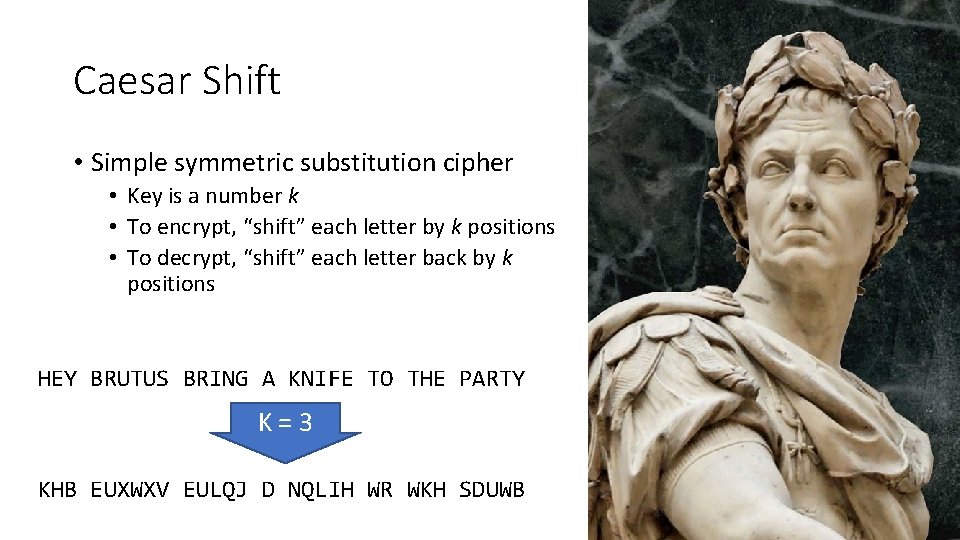
Caesar Shift • Simple symmetric substitution cipher • Key is a number k • To encrypt, “shift” each letter by k positions • To decrypt, “shift” each letter back by k positions HEY BRUTUS BRING A KNIFE TO THE PARTY K=3 KHB EUXWXV EULQJ D NQLIH WR WKH SDUWB

Cryptanalysis of Shift Cipher • Brute force: try all 25 possible keys (assuming English text) • K = 0 and K = 26 don’t make sense • Lessons? • Simple, exhaustive key search can be effective • Key space needs to be large enough to prevent attack
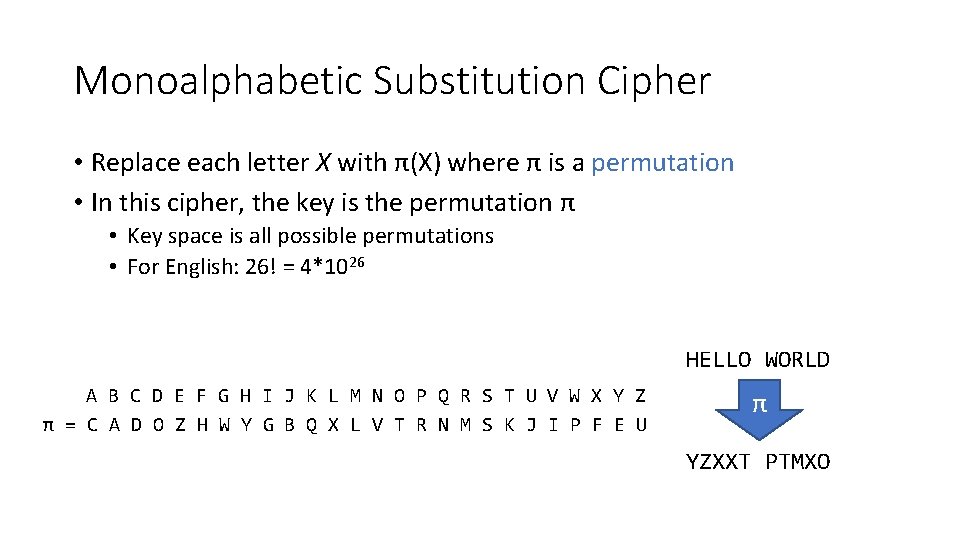
Monoalphabetic Substitution Cipher • Replace each letter X with π(X) where π is a permutation • In this cipher, the key is the permutation π • Key space is all possible permutations • For English: 26! = 4*1026 HELLO WORLD A B C D E F G H I J K L M N O P Q R S T U V W X Y Z π = C A D O Z H W Y G B Q X L V T R N M S K J I P F E U π YZXXT PTMXO
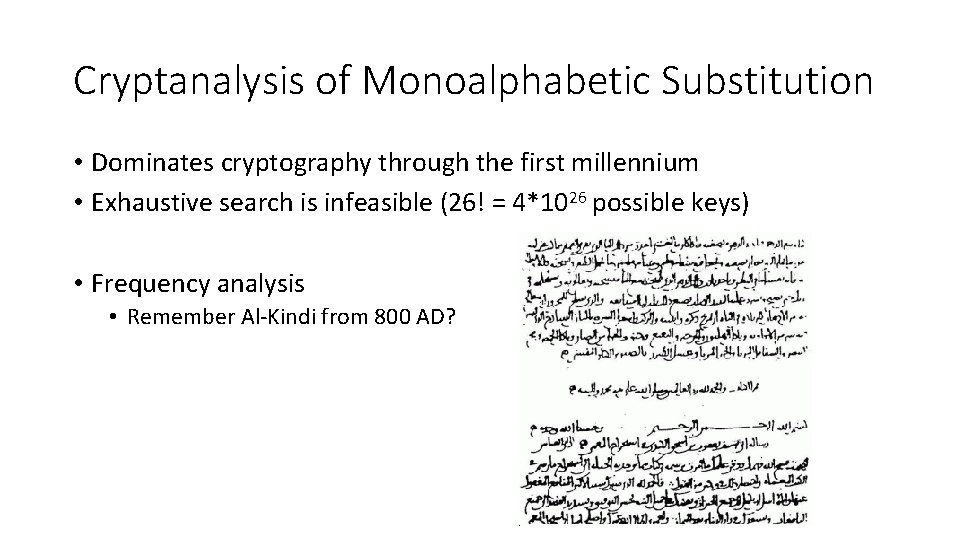
Cryptanalysis of Monoalphabetic Substitution • Dominates cryptography through the first millennium • Exhaustive search is infeasible (26! = 4*1026 possible keys) • Frequency analysis • Remember Al-Kindi from 800 AD?
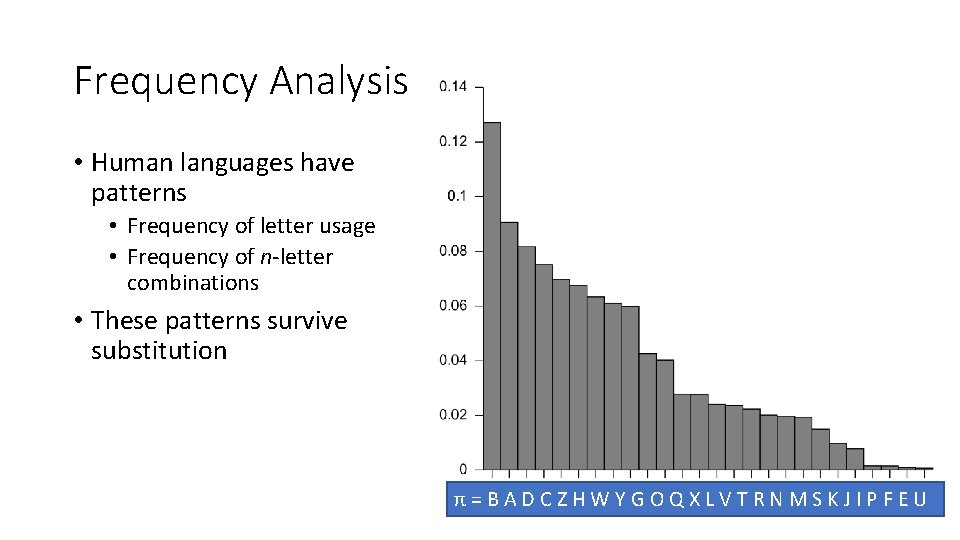
Frequency Analysis • Human languages have patterns • Frequency of letter usage • Frequency of n-letter combinations • These patterns survive substitution π=BADCZHWYGOQXLVTRNMSKJIPFEU
Cryptanalysis of Monoalphabetic Substitution • Dominates cryptography through the first millennium • Exhaustive search is infeasible (26! = 4*1026 possible keys) • Frequency analysis • Remember Al-Kindi from 800 AD? • Lessons? • Use large blocks: instead of replacing ~6 bits at a time, replace 64 or 128 bits • Leads to block ciphers like DES and AES • Use different substitutions to prevent frequency analysis • Leads to polyalphabetic substitution ciphers and stream ciphers
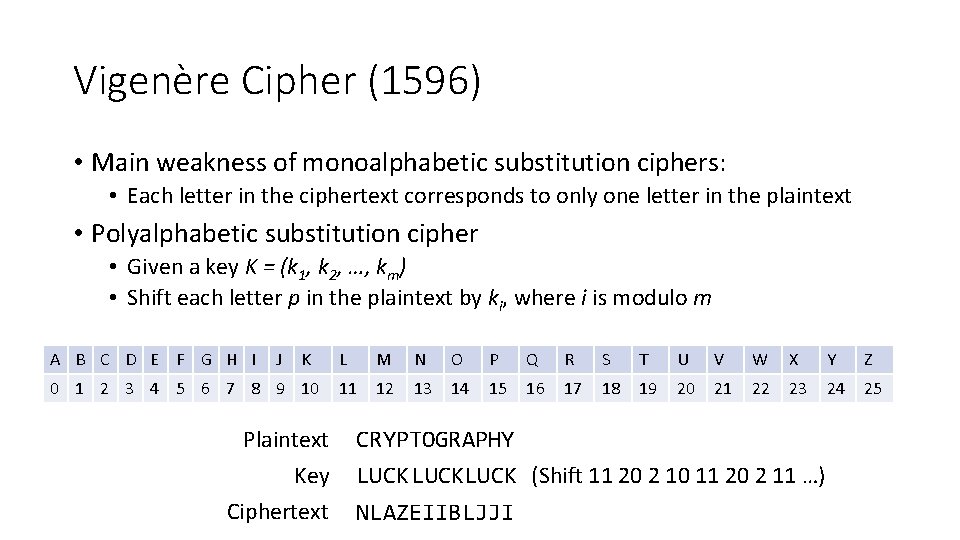
Vigenère Cipher (1596) • Main weakness of monoalphabetic substitution ciphers: • Each letter in the ciphertext corresponds to only one letter in the plaintext • Polyalphabetic substitution cipher • Given a key K = (k 1, k 2, …, km) • Shift each letter p in the plaintext by ki, where i is modulo m A B C D E F G H I J K 0 1 2 3 4 5 6 7 8 9 10 Plaintext Key Ciphertext L M N O P Q R S T U V W X Y Z 11 12 13 14 15 16 17 18 19 20 21 22 23 24 25 CRYPTOGRAPHY LUCKLUCK (Shift 11 20 2 10 11 20 2 11 …) NLAZEIIBLJJI
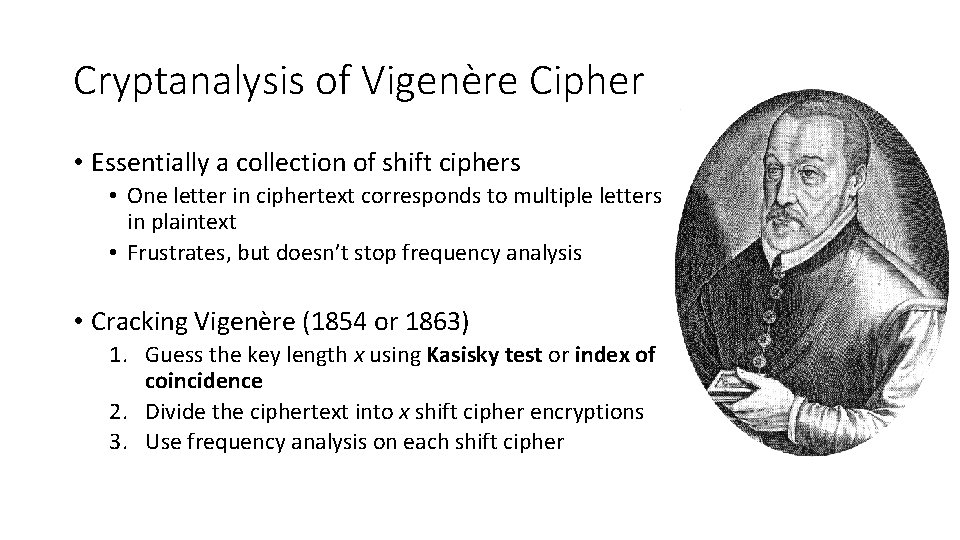
Cryptanalysis of Vigenère Cipher • Essentially a collection of shift ciphers • One letter in ciphertext corresponds to multiple letters in plaintext • Frustrates, but doesn’t stop frequency analysis • Cracking Vigenère (1854 or 1863) 1. Guess the key length x using Kasisky test or index of coincidence 2. Divide the ciphertext into x shift cipher encryptions 3. Use frequency analysis on each shift cipher
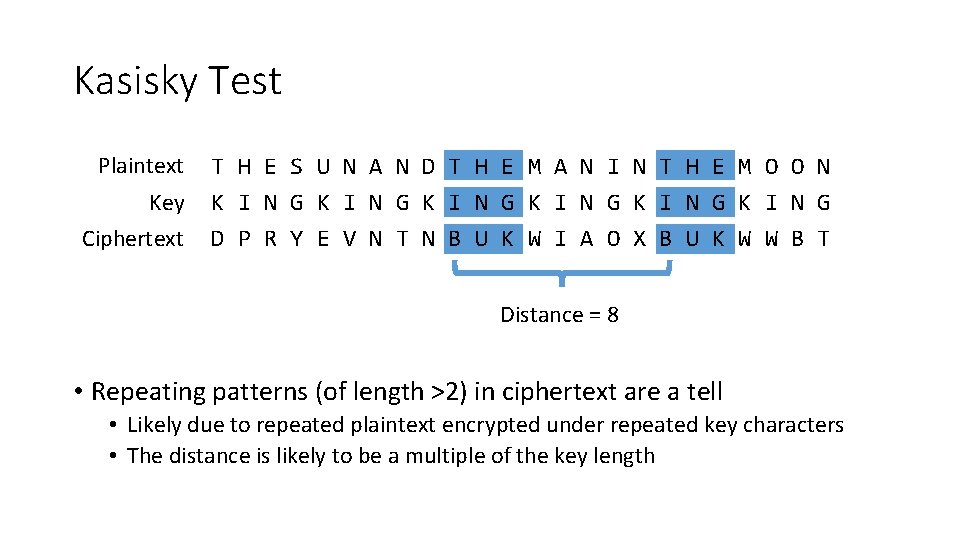
Kasisky Test Plaintext T H E S U N A N D T H E M A N I N T H E M O O N Key K I N G K I N G Ciphertext D P R Y E V N T N B U K W I A O X B U K W W B T Distance = 8 • Repeating patterns (of length >2) in ciphertext are a tell • Likely due to repeated plaintext encrypted under repeated key characters • The distance is likely to be a multiple of the key length
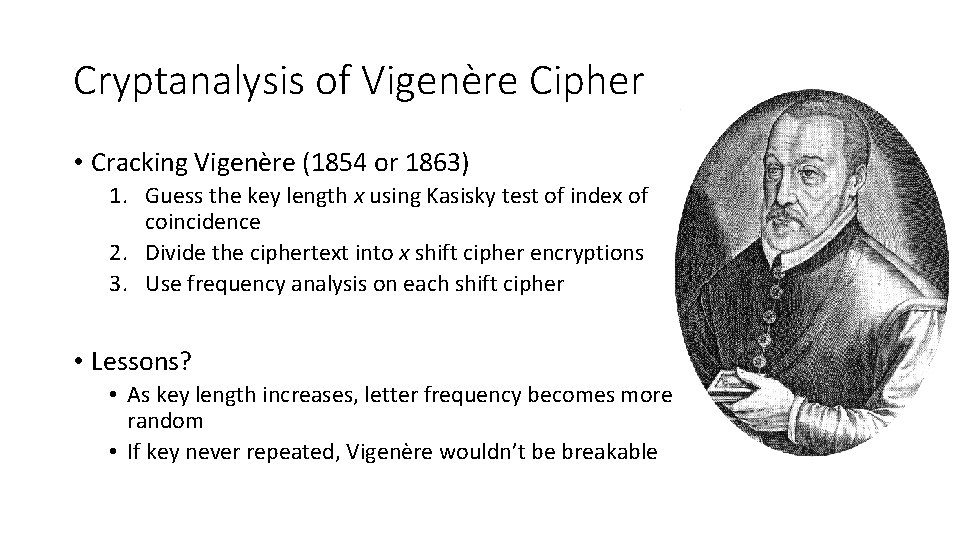
Cryptanalysis of Vigenère Cipher • Cracking Vigenère (1854 or 1863) 1. Guess the key length x using Kasisky test of index of coincidence 2. Divide the ciphertext into x shift cipher encryptions 3. Use frequency analysis on each shift cipher • Lessons? • As key length increases, letter frequency becomes more random • If key never repeated, Vigenère wouldn’t be breakable
One Time Pads and Perfect Secrecy
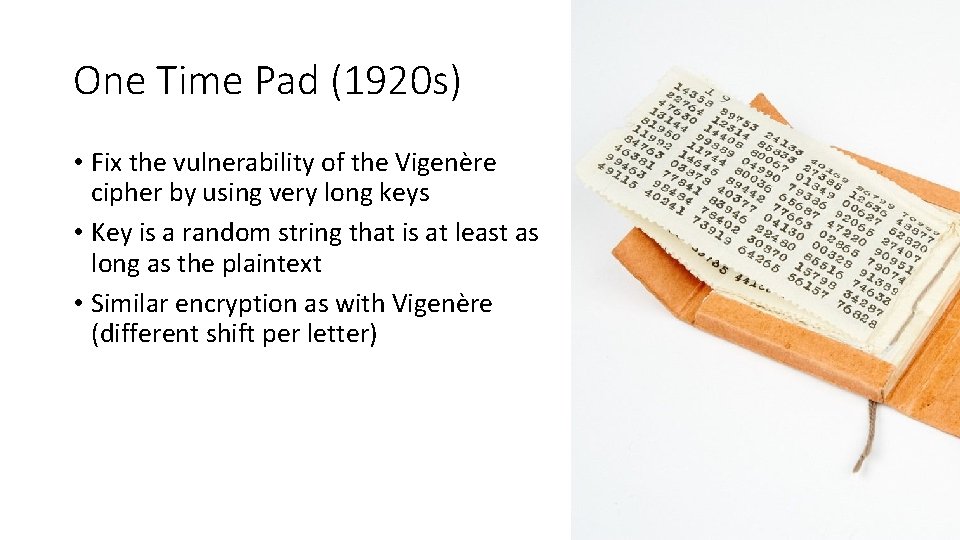
One Time Pad (1920 s) • Fix the vulnerability of the Vigenère cipher by using very long keys • Key is a random string that is at least as long as the plaintext • Similar encryption as with Vigenère (different shift per letter)
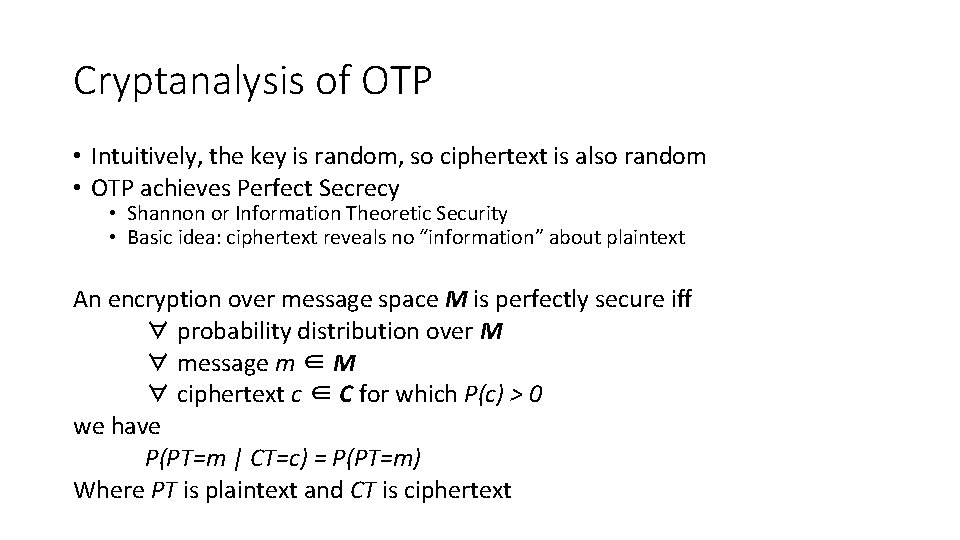
Cryptanalysis of OTP • Intuitively, the key is random, so ciphertext is also random • OTP achieves Perfect Secrecy • Shannon or Information Theoretic Security • Basic idea: ciphertext reveals no “information” about plaintext An encryption over message space M is perfectly secure iff ∀ probability distribution over M ∀ message m ∈ M ∀ ciphertext c ∈ C for which P(c) > 0 we have P(PT=m | CT=c) = P(PT=m) Where PT is plaintext and CT is ciphertext
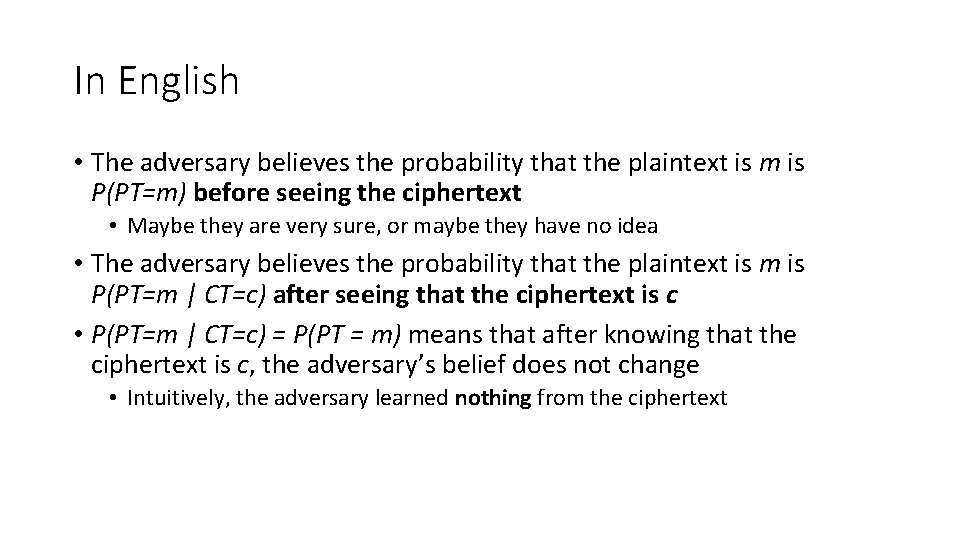
In English • The adversary believes the probability that the plaintext is m is P(PT=m) before seeing the ciphertext • Maybe they are very sure, or maybe they have no idea • The adversary believes the probability that the plaintext is m is P(PT=m | CT=c) after seeing that the ciphertext is c • P(PT=m | CT=c) = P(PT = m) means that after knowing that the ciphertext is c, the adversary’s belief does not change • Intuitively, the adversary learned nothing from the ciphertext
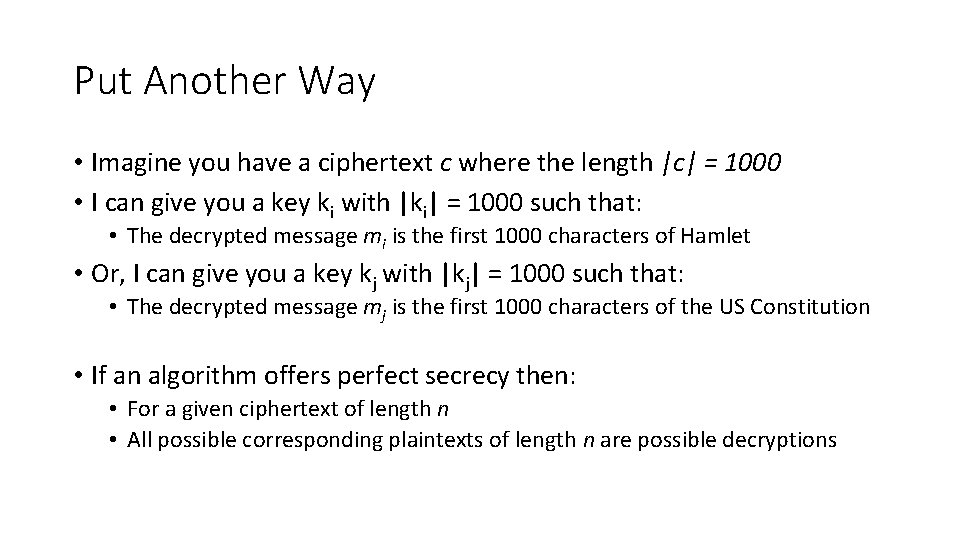
Put Another Way • Imagine you have a ciphertext c where the length |c| = 1000 • I can give you a key ki with |ki| = 1000 such that: • The decrypted message mi is the first 1000 characters of Hamlet • Or, I can give you a key kj with |kj| = 1000 such that: • The decrypted message mj is the first 1000 characters of the US Constitution • If an algorithm offers perfect secrecy then: • For a given ciphertext of length n • All possible corresponding plaintexts of length n are possible decryptions
Cryptanalysis of OTP • Intuitively, the key is random, so ciphertext is also random • OTP achieves Perfect Secrecy • Shannon or Information Theoretic Security • Basic idea: ciphertext reveals no “information” about plaintext • Caveats • If the length of the OTP key is less than the length of the message… • It’s not a OTP anymore, not perfectly secret! • If you reuse the OTP key… • It’s not a OTP anymore, not perfectly secret! • Major issue with OTP in practice? • How to securely distribute the key books to both parties
Modern Symmetric Block Cyphers
Symmetric Key Cryptography • Algorithms that use a single key for encryption and decryption • i. e. the algorithm is reversible • ∀ k ∀ m Dk(Ek(m)) = m where m is a message, k is a key, and Dk and Ek are decryption and encryption using k • Historic examples: • Caeser shift, mono and polyalphabetic substitution, OTP • Modern examples: • DES, 3 DES, RC 4, Blowfish, Twofish, AES • Warning: many of these methods are known to be vulnerable
Why Block Ciphers? • One way to defeat frequency analysis • Use different keys in different locations • Examples: OTP, stream ciphers • Another way • Make the unit of transformation larger • Instead of encrypting letter by letter (~6 bits), encrypt block by block (n bits)
Data Encryption Standard (DES) • Designed by IBM, with modifications proposed by the NSA • US national standard from 1977 to 2001 • Block size is 64 bits • Key size is 56 bits • Has 16 rounds • Designed mostly for fast implementation in hardware • Software implementation is somewhat slow • Considered insecure now • Vulnerable to brute-force attacks, key too short
Advanced Encryption Standard (AES) • In 1997, NIST made a formal call for algorithms stipulating that the AES would specify an unclassified, publicly disclosed encryption algorithm, available royalty-free, worldwide • Goal: replace DES for both government and private-sector encryption. • The algorithm must implement symmetric key cryptography as a block cipher and (at a minimum) support block sizes of 128 -bits and key sizes of 128 -, 192 -, and 256 -bits. • In 1998, NIST selected 15 AES candidate algorithms. • In 2000, NIST selected Rijndael (invented by Joan Daemen and Vincent Rijmen) as the AES
AES Features • Designed to be efficient in both hardware and software • Block size: 128 bits • Variable key size: 128, 192, or 256 bits • No known weaknesses
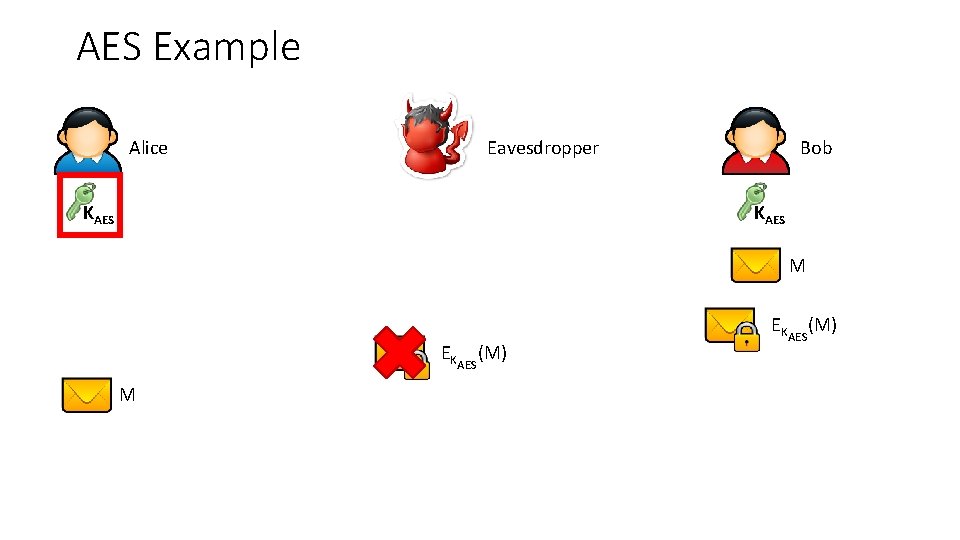
AES Example Alice Eavesdropper KAES Bob KAES M EKAES(M)
Block Cypher Modes
Need for Encryption Modes • A block cipher encrypts only one block • But a message may be longer than one block • Need a way to extend the algorithm to encrypt arbitrarily long messages • Need to ensure that if block cipher is secure, then whole encryption is secure • Unit test vs. integration test • Whole operation should be IND-CPA secure if block cipher is IND-CPA secure
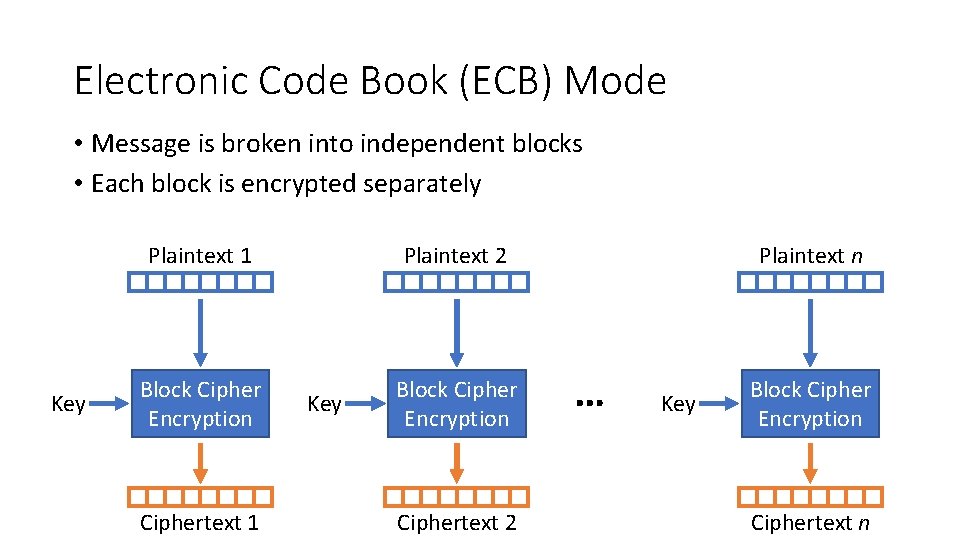
Electronic Code Book (ECB) Mode • Message is broken into independent blocks • Each block is encrypted separately Plaintext 1 Key Block Cipher Encryption Ciphertext 1 Plaintext 2 Key Block Cipher Encryption Ciphertext 2 Plaintext n … Key Block Cipher Encryption Ciphertext n
Cryptanalysis of ECB Mode • Deterministic • The same data block always gets encrypted the same way • Reveals patterns when data repeats! • m encrypted with k always produces the same c • This is the same problem we had with the Vigenère cipher • Do not use ECB mode in practice
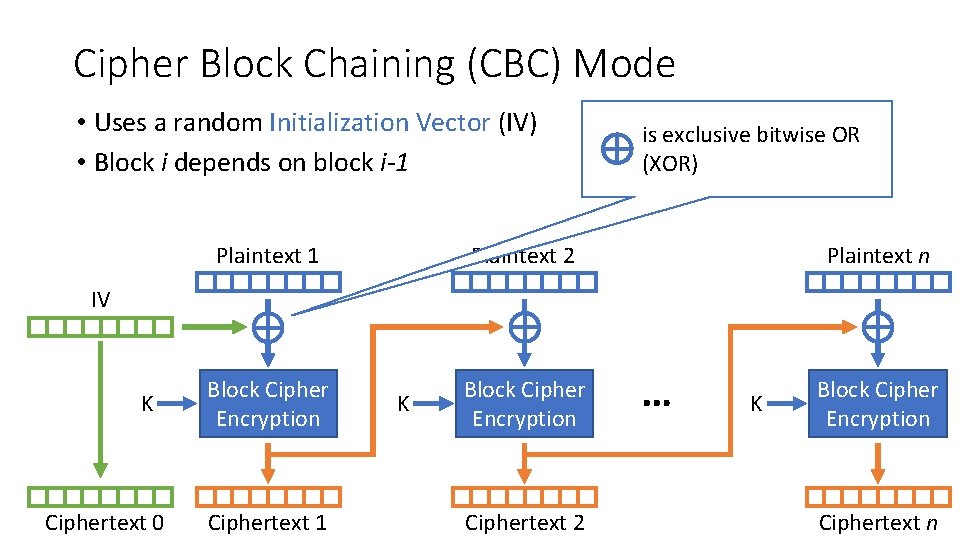
Cipher Block Chaining (CBC) Mode • Uses a random Initialization Vector (IV) • Block i depends on block i-1 Plaintext 1 is exclusive bitwise OR (XOR) Plaintext 2 Plaintext n IV K Ciphertext 0 Block Cipher Encryption Ciphertext 1 K Block Cipher Encryption Ciphertext 2 … K Block Cipher Encryption Ciphertext n
Cryptanalysis of CBC Mode • CBC randomizes the encryption • IV ensures initial block is randomized • Dependency between blocks propagates randomness • Usage in practice: choose random IV and protect its integrity • The IV is not secret (it becomes part of the ciphertext) • Do not let the adversary control the IV • CBC is IND-CPA assuming • Block cipher itself is secure • IV is truly random • IV is sufficiently large
Review of Computational Complexity
Towards Computational Security • Perfect secrecy is too difficult to achieve in practice • Imagine trying to do OTP encryption with every website that uses HTTPS • Computational security uses two relaxations: 1. Security is preserved only against computationally bounded adversaries • Limits on computational power and storage • No quantum computers 2. Adversaries may successfully crack encryption with a very small probability • So small that (we hope) it becomes negligible
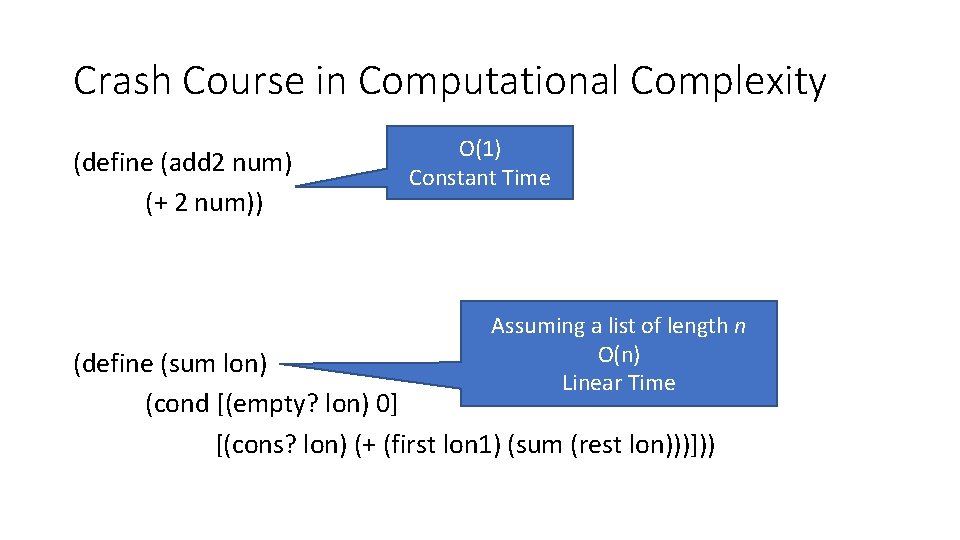
Crash Course in Computational Complexity (define (add 2 num) (+ 2 num)) O(1) Constant Time Assuming a list of length n O(n) Linear Time (define (sum lon) (cond [(empty? lon) 0] [(cons? lon) (+ (first lon 1) (sum (rest lon)))]))
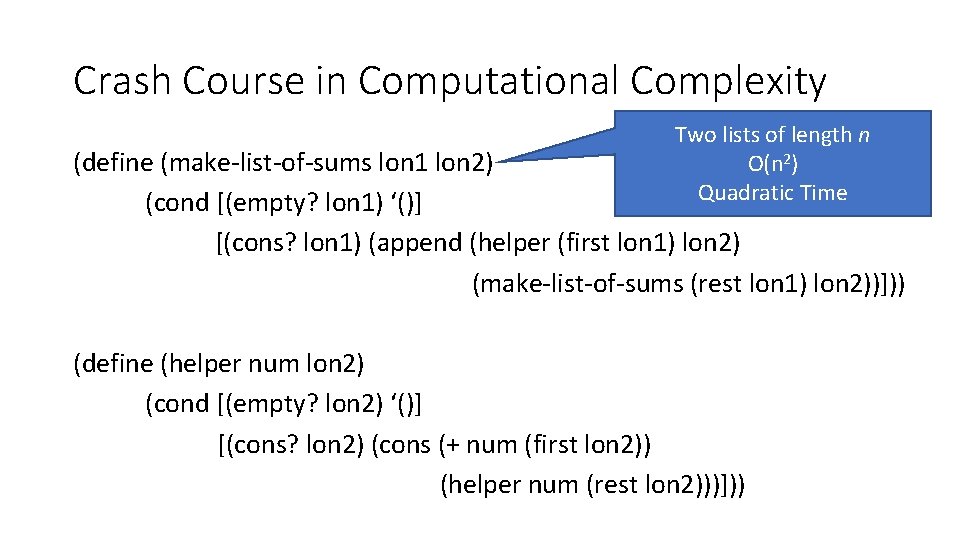
Crash Course in Computational Complexity Two lists of length n O(n 2) Quadratic Time (define (make-list-of-sums lon 1 lon 2) (cond [(empty? lon 1) ‘()] [(cons? lon 1) (append (helper (first lon 1) lon 2) (make-list-of-sums (rest lon 1) lon 2))])) (define (helper num lon 2) (cond [(empty? lon 2) ‘()] [(cons? lon 2) (cons (+ num (first lon 2)) (helper num (rest lon 2)))]))
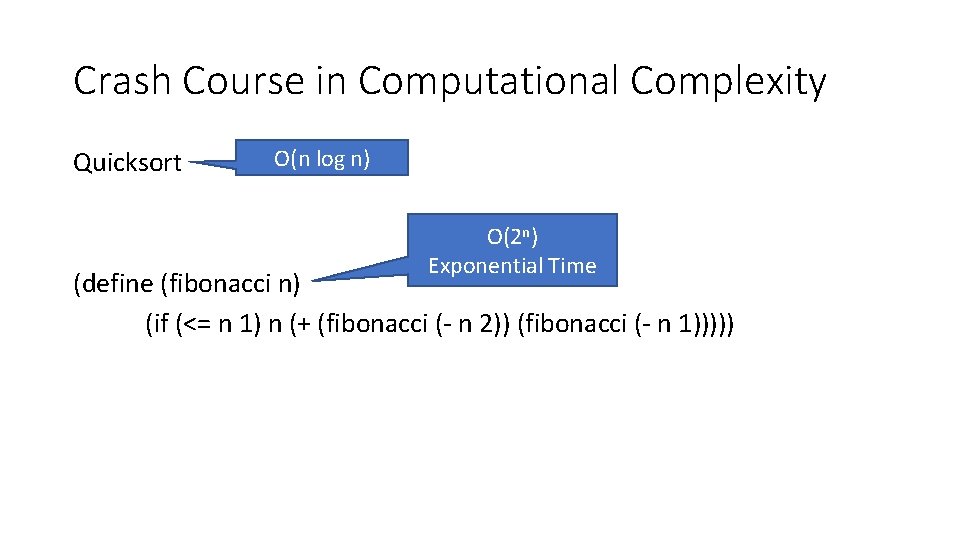
Crash Course in Computational Complexity Quicksort O(n log n) O(2 n) Exponential Time (define (fibonacci n) (if (<= n 1) n (+ (fibonacci (- n 2)) (fibonacci (- n 1)))))
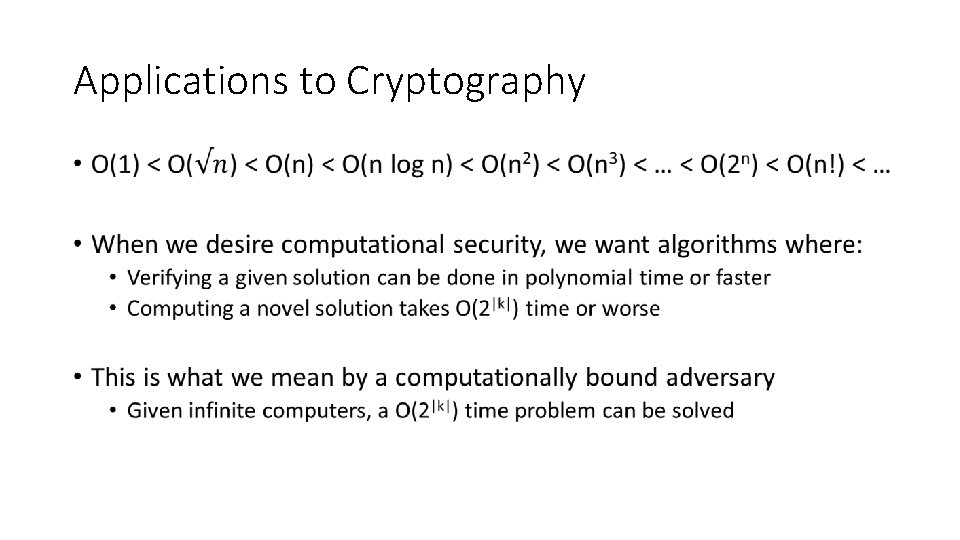
Applications to Cryptography •
The IND-CPA Game
Towards Computational Security • Perfect secrecy is too difficult to achieve in practice • Imagine trying to do OTP encryption with every website that uses HTTPS • Computational security uses two relaxations: 1. Security is preserved only against computationally bounded adversaries • Limits on computational power and storage • No quantum computers 2. Adversaries may successfully crack encryption with a very small probability • So small that (we hope) it becomes negligible
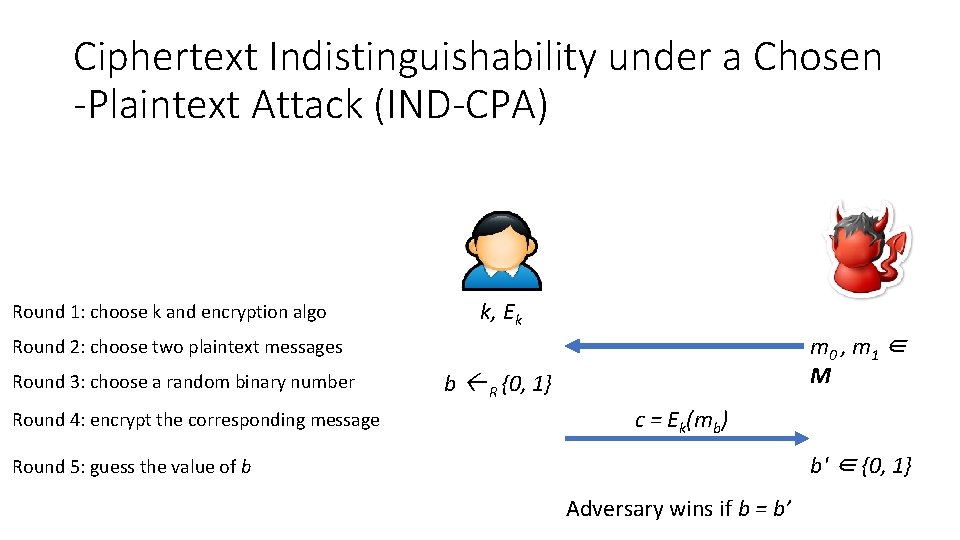
Ciphertext Indistinguishability under a Chosen -Plaintext Attack (IND-CPA) Round 1: choose k and encryption algo k, Ek m 0 , m 1 ∈ M Round 2: choose two plaintext messages Round 3: choose a random binary number Round 4: encrypt the corresponding message b R {0, 1} c = Ek(mb) b' ∈ {0, 1} Round 5: guess the value of b Adversary wins if b = b’
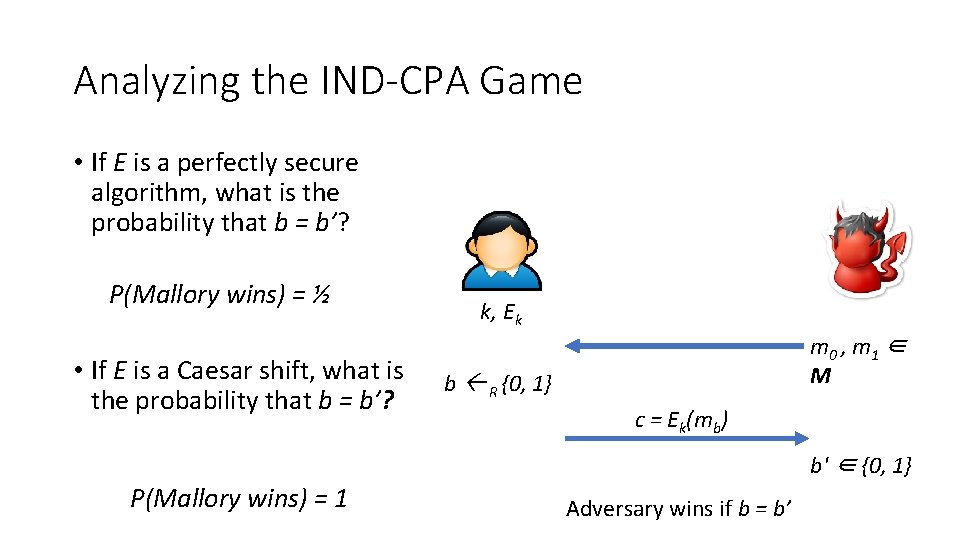
Analyzing the IND-CPA Game • If E is a perfectly secure algorithm, what is the probability that b = b’? P(Mallory wins) = ½ • If E is a Caesar shift, what is the probability that b = b’? k, Ek m 0 , m 1 ∈ M b R {0, 1} c = Ek(mb) b' ∈ {0, 1} P(Mallory wins) = 1 Adversary wins if b = b’
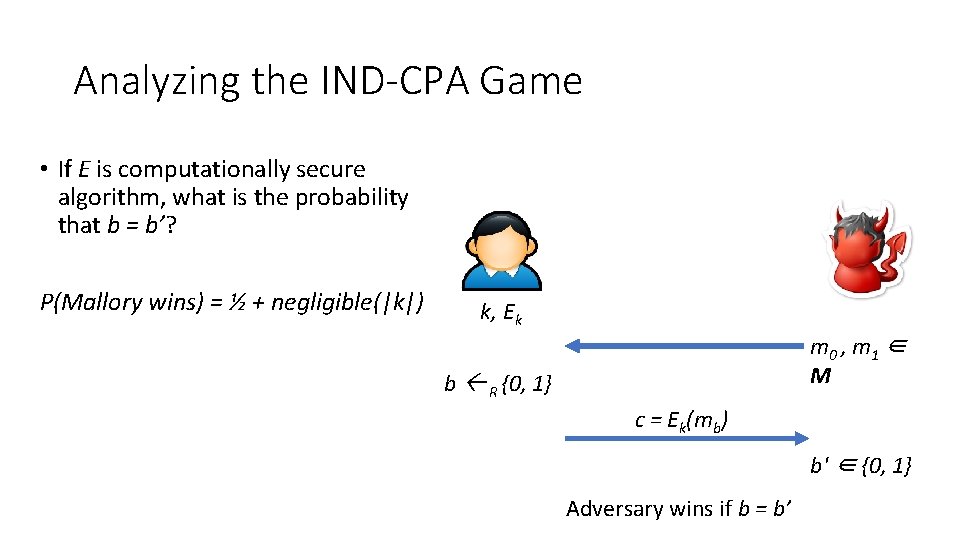
Analyzing the IND-CPA Game • If E is computationally secure algorithm, what is the probability that b = b’? P(Mallory wins) = ½ + negligible(|k|) k, Ek m 0 , m 1 ∈ M b R {0, 1} c = Ek(mb) b' ∈ {0, 1} Adversary wins if b = b’
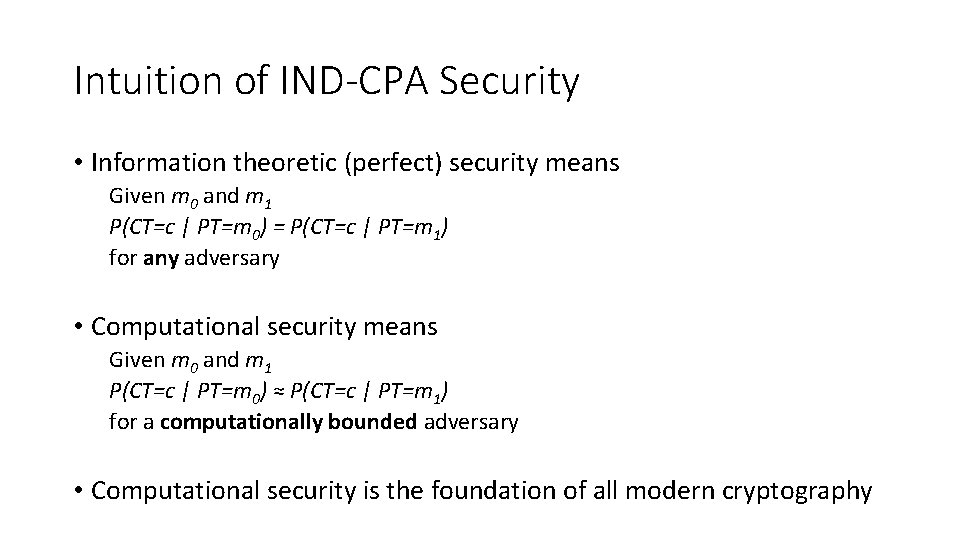
Intuition of IND-CPA Security • Information theoretic (perfect) security means Given m 0 and m 1 P(CT=c | PT=m 0) = P(CT=c | PT=m 1) for any adversary • Computational security means Given m 0 and m 1 P(CT=c | PT=m 0) ≈ P(CT=c | PT=m 1) for a computationally bounded adversary • Computational security is the foundation of all modern cryptography
Public Key Cryptography
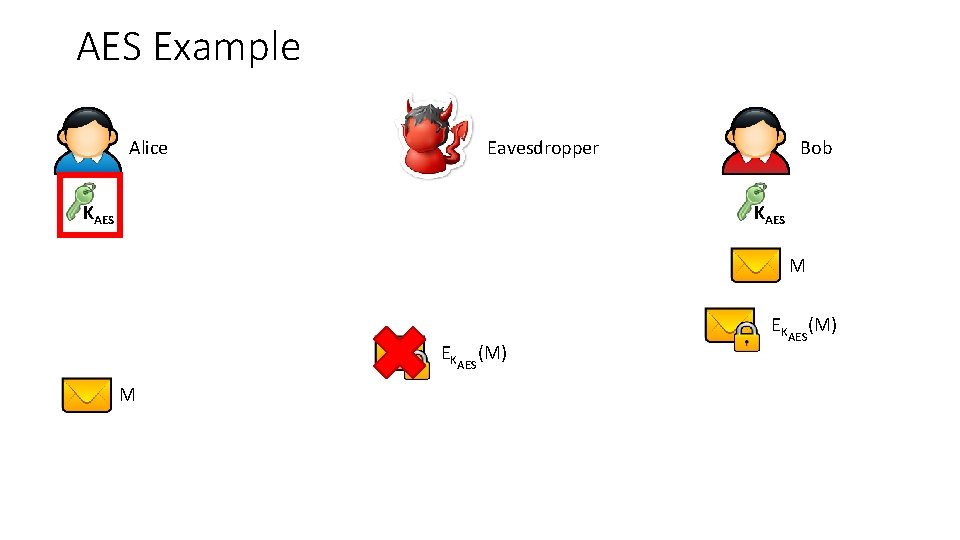
AES Example Alice Eavesdropper KAES Bob KAES M EKAES(M)
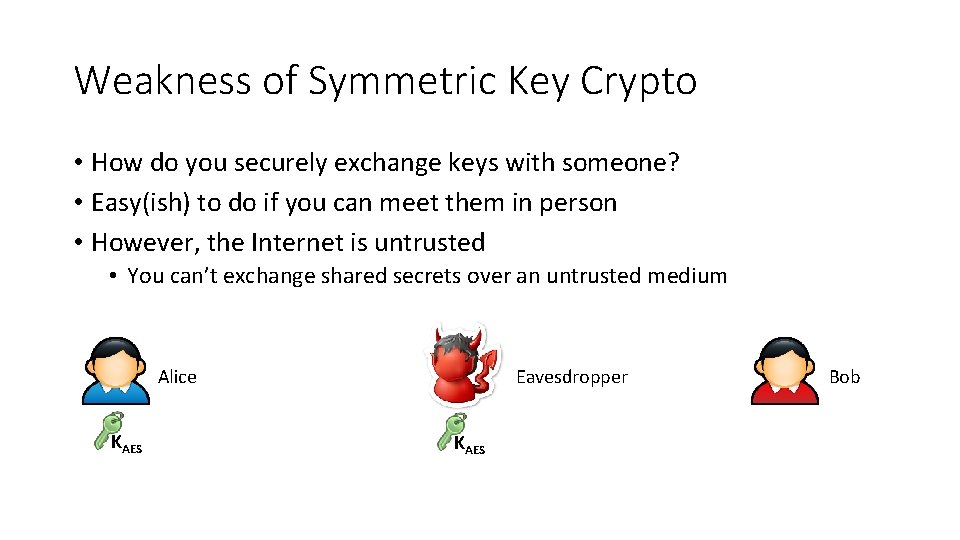
Weakness of Symmetric Key Crypto • How do you securely exchange keys with someone? • Easy(ish) to do if you can meet them in person • However, the Internet is untrusted • You can’t exchange shared secrets over an untrusted medium Eavesdropper Alice KAES Bob
Public Key Cryptography • Public key cryptography, a. k. a. asymmetric cryptography • Each principal has two keys: private (secret) and public • A message encrypted with one key must be decrypted by the other • Thus, the public key can be sent in-the-clear over the Internet • Security is based on Very Hard Math Problems • O(1) time to verify a given solution for a given instance • Exponential time to check all possible solutions for a given instance • Many different algorithms that offer different security properties • Diffie-Hellman, RSA, Goldwasser-Micali, El. Gamal • Forms the basis for most modern secure protocols • IPsec, SSL, TLS, S/MIME, PGP/GPG, etc.

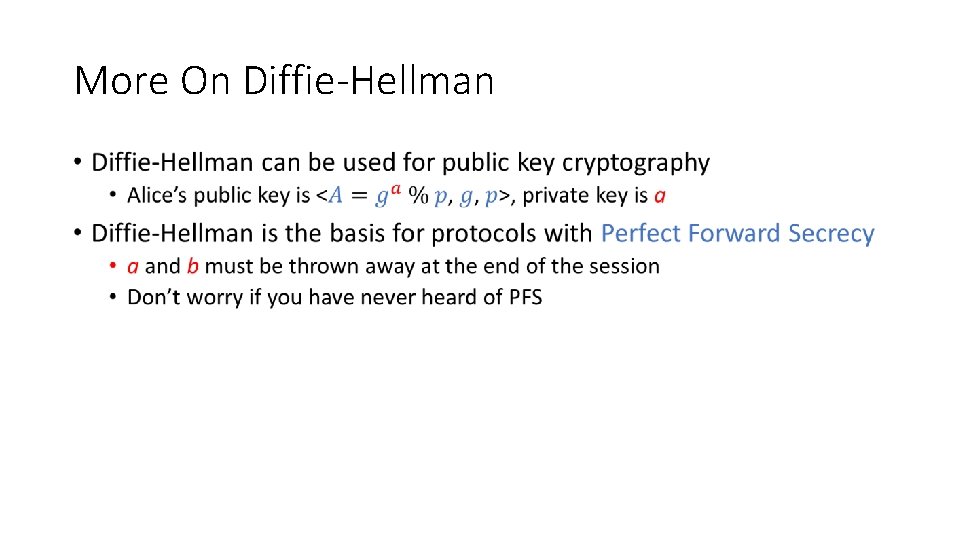
Diffie-Hellman •
Diffie-Hellman Protocol •
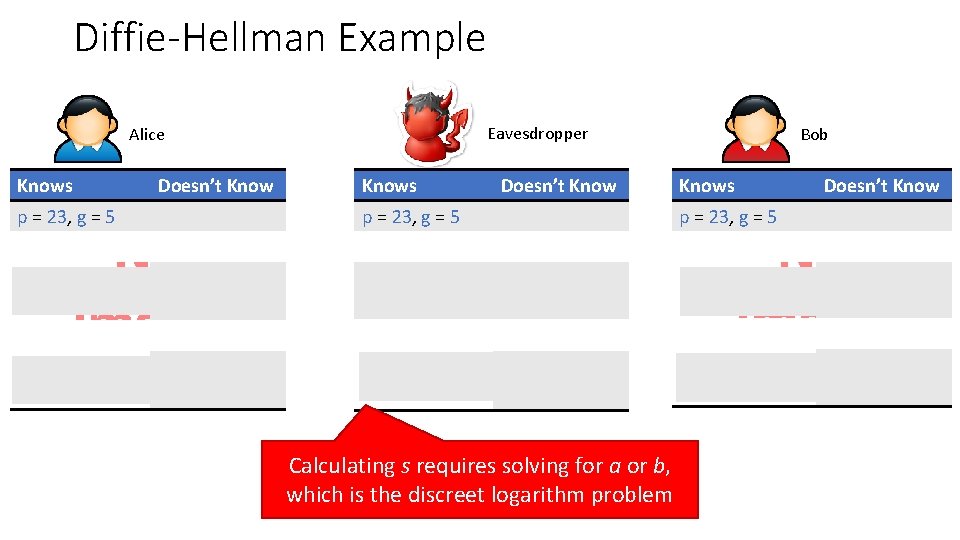
Diffie-Hellman Example Eavesdropper Alice Knows Doesn’t Know p = 23, g = 5 a=6 B = 19 Knows Doesn’t Know p = 23, g = 5 b=? Bob Knows Doesn’t Know p = 23, g = 5 a = ? , b = ? A = 8, B = 19 Calculating s requires solving for a or b, which is the discreet logarithm problem b = 15 A=8 a=?
More On Diffie-Hellman •
RSA • Invented by Rivest, Shamir, and Adleman in 1978 • Equivalent system invented by Clifford Cox in 1973, but GCHQ classified it • RSA is the dominant public key cryptosystem today for historical reasons • Algorithm was commercialized by RSA Security • RSA Security created a certificate authority that eventually became Verisign
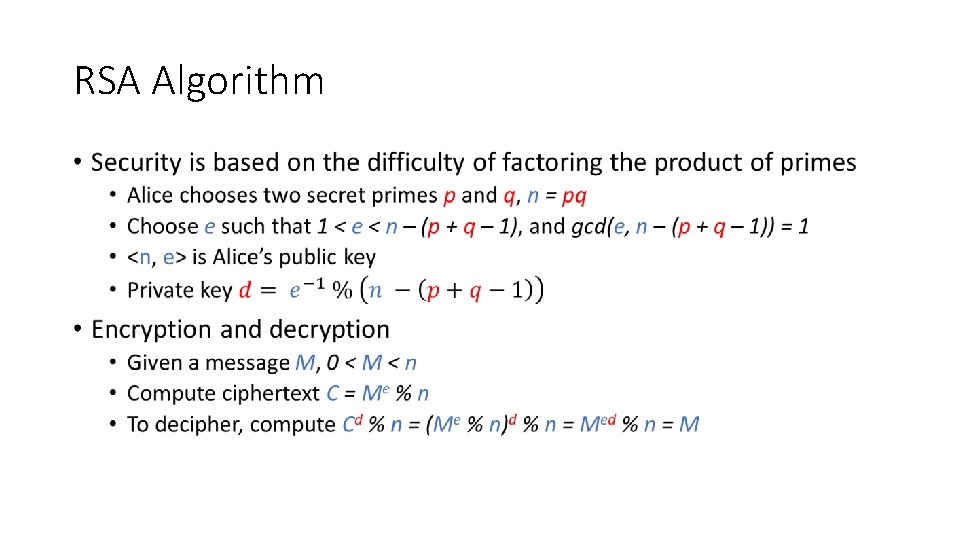
RSA Algorithm •
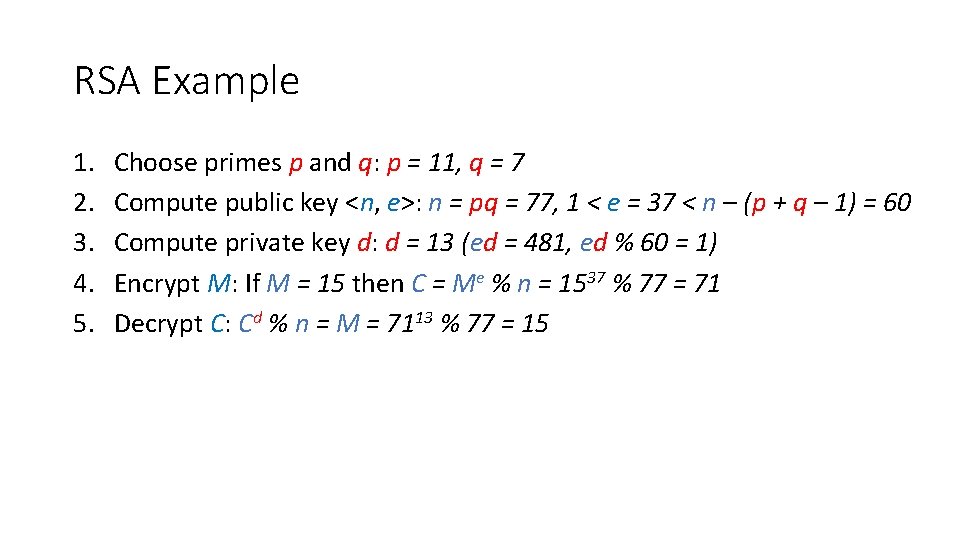
RSA Example 1. 2. 3. 4. 5. Choose primes p and q: p = 11, q = 7 Compute public key <n, e>: n = pq = 77, 1 < e = 37 < n – (p + q – 1) = 60 Compute private key d: d = 13 (ed = 481, ed % 60 = 1) Encrypt M: If M = 15 then C = Me % n = 1537 % 77 = 71 Decrypt C: Cd % n = M = 7113 % 77 = 15
Attacks Against RSA • The length of n = pq reflects the strength • 700 -bit n factored in 2007 • 768 bit factored in 2009 • 1024 bit for minimal level of security today • Likely to be breakable in near future • 2048 bits recommended for current usage • RSA encryption/decryption speed is quadratic in key length • Factoring is easy with a quantum computer
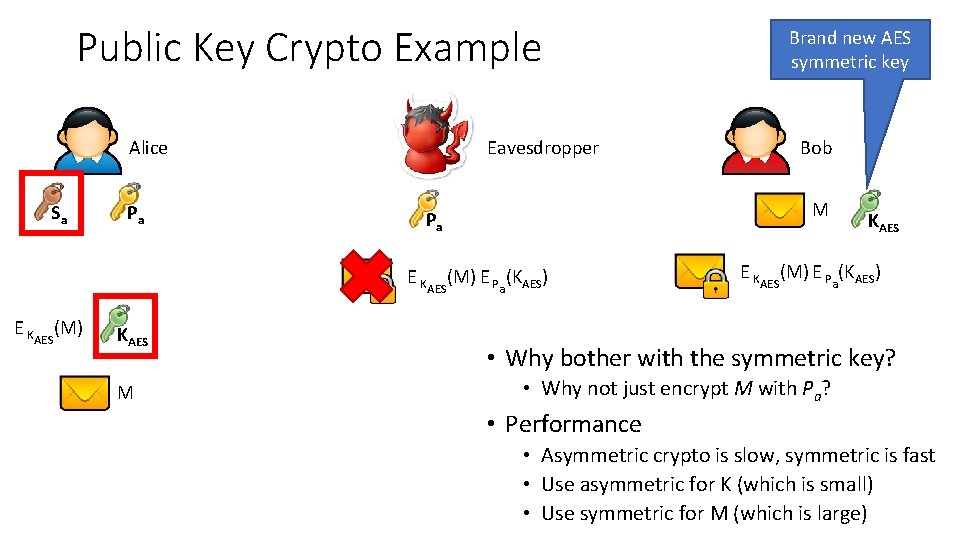
Public Key Crypto Example Eavesdropper Alice Sa Pa KAES M Bob M Pa E KAES(M) E Pa(KAES) E KAES(M) Brand new AES symmetric key KAES E KAES(M) E Pa(KAES) • Why bother with the symmetric key? • Why not just encrypt M with Pa? • Performance • Asymmetric crypto is slow, symmetric is fast • Use asymmetric for K (which is small) • Use symmetric for M (which is large)
Chosen Plaintext Attacks •
Digital Signatures and Authentication
Cryptographic Hash Functions • Cryptographic hash function transform input data into scrambled output data • Arbitrary length input fixed length output • Deterministic: hash(A) = hash(A) • High entropy: • md 5(‘security’) = e 91 e 6348157868 de 9 dd 8 b 25 c 81 aebfb 9 • md 5(‘security 1’) = 8632 c 375 e 9 eba 096 df 51844 a 5 a 43 ae 93 • md 5(‘Security’) = 2 fae 32629 d 4 ef 4 fc 6341 f 1751 b 405 e 45 • Collision resistant • Locating A’ such that hash(A) = hash(A’) takes a long time • Example: 221 tries for md 5
Well Known Hash Functions • MD 5 • Outputs 128 bits • Collision resistance totally broken in 2004 • SHA 1 • Outputs 160 bits • Partially broken: method exists to find collisions in 280 tries • Deprecated • SHA 2 (SHA-224, SHA-256, SHA-384, SHA-512) • SHA-224 matches the 112 bit key length of 3 DES • SHA-256, SHA-384, SHA-512 match the key lengths of AES (128, 192, 256 bits) • Considered safe
The Future: SHA 3 • 2007: NIST opens competition for new hash functions • 2008: Submission deadline, 64 entries, 51 make the cut • 2009: 14 candidates move to round 2 • 2010: 5 candidates move to round 3 • 2011: final round of public comments • 2012: NIST selects keccak (pronounced “catch-ack”) as SHA 3 • Created by Guido Bertoni, Joan Daemen, Gilles Van Assche, Michaël Peeters
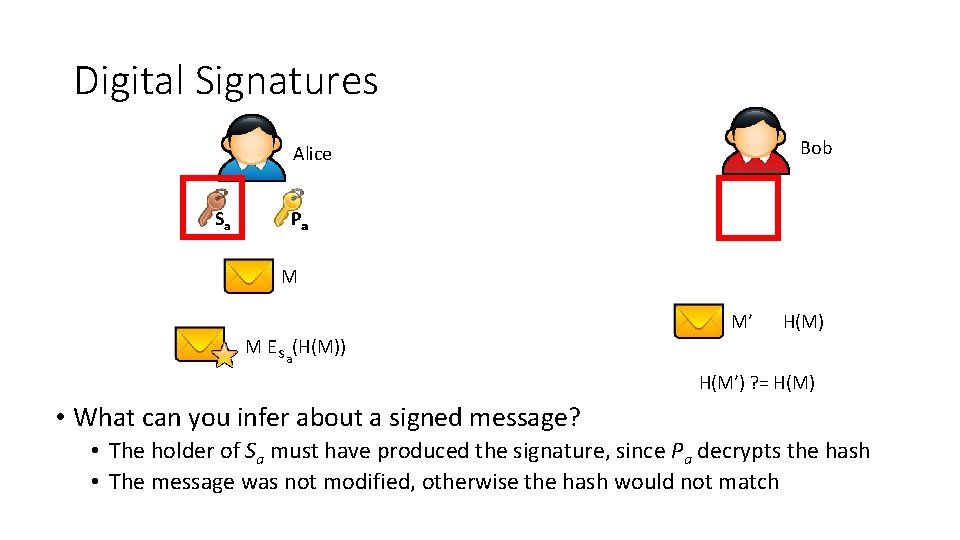
Digital Signatures Bob Alice Sa Pa M M’ H(M) M E Sa(H(M)) H(M’) ? = H(M) • What can you infer about a signed message? • The holder of Sa must have produced the signature, since Pa decrypts the hash • The message was not modified, otherwise the hash would not match
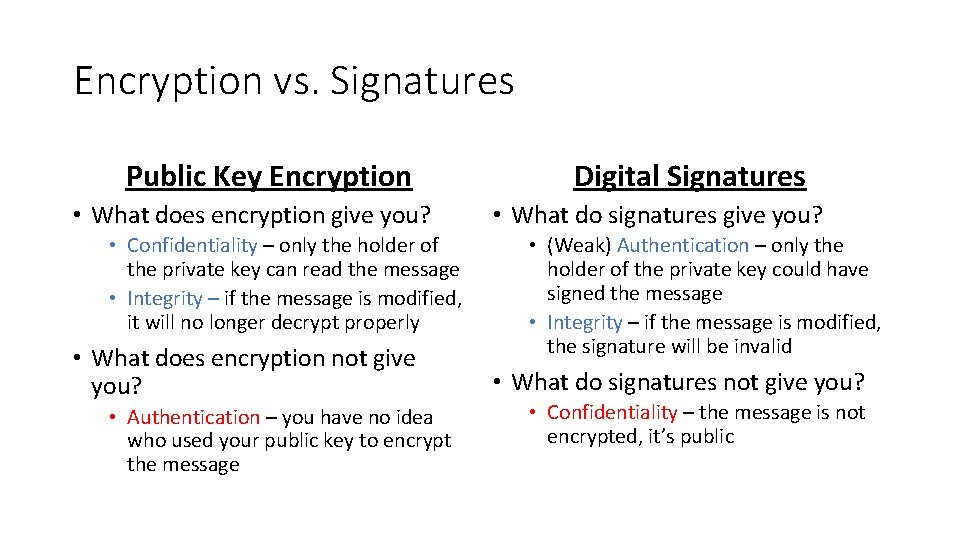
Encryption vs. Signatures Public Key Encryption • What does encryption give you? • Confidentiality – only the holder of the private key can read the message • Integrity – if the message is modified, it will no longer decrypt properly • What does encryption not give you? • Authentication – you have no idea who used your public key to encrypt the message Digital Signatures • What do signatures give you? • (Weak) Authentication – only the holder of the private key could have signed the message • Integrity – if the message is modified, the signature will be invalid • What do signatures not give you? • Confidentiality – the message is not encrypted, it’s public
Authenticating Public Keys
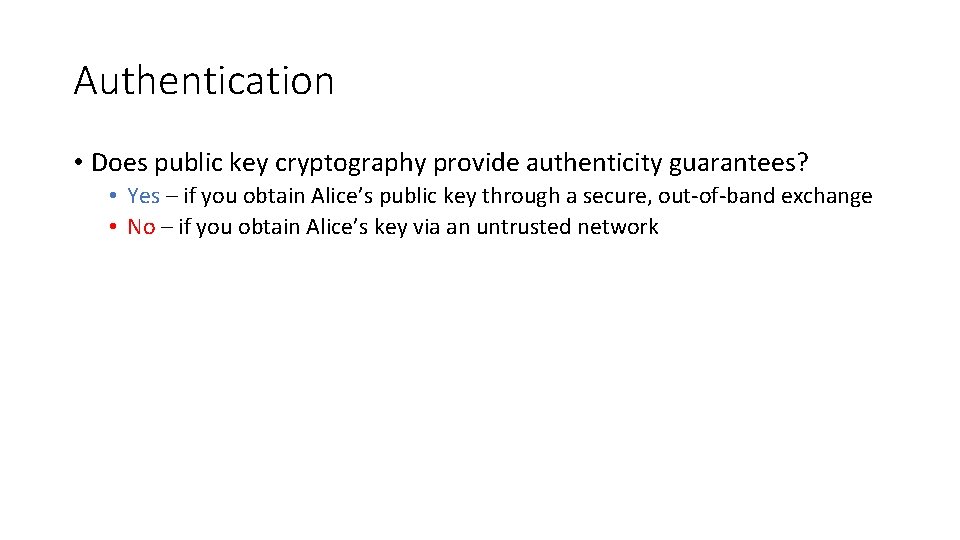
Authentication • Does public key cryptography provide authenticity guarantees? • Yes – if you obtain Alice’s public key through a secure, out-of-band exchange • No – if you obtain Alice’s key via an untrusted network
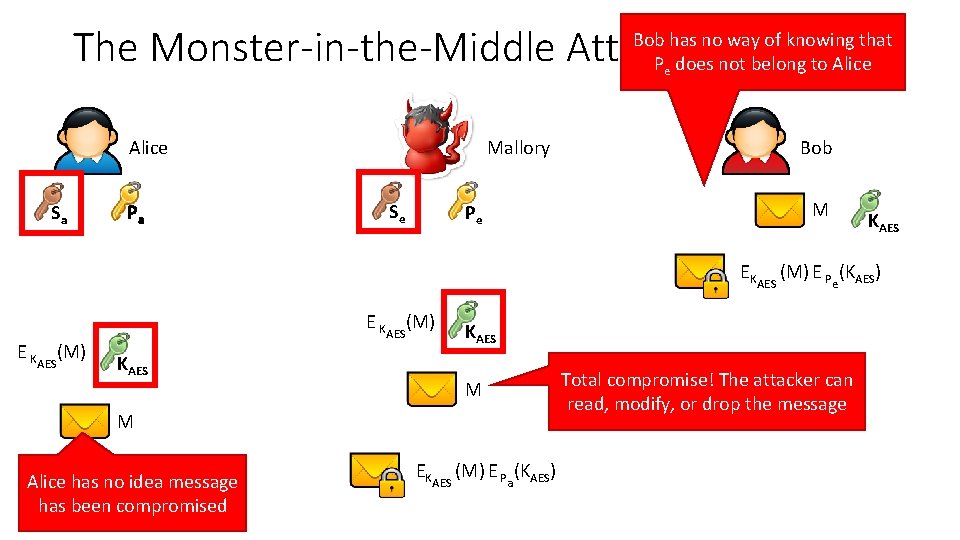
The Monster-in-the-Middle Attack Bob has no way of knowing that Pe does not belong to Alice Mallory Alice Sa Pa Se Pe Bob M KAES EKAES (M) E Pe(KAES) E KAES(M) KAES M M Alice has no idea message has been compromised EKAES (M) E Pa(KAES) Total compromise! The attacker can read, modify, or drop the message
Signing Public Keys • The only way to authenticate a public key is to rely on trust • One or more third-party, trusted principals vouch for Alice’s key by signing it • Bob can verify the signatures using the public keys of the trusted third-parties • If Alice’s key is not signed, maybe Bob should not trust it • Question: who do you trust? 1. Web of trust: a social network of private individuals who sign each others keys • Open. PGP keys 2. Certificate authorities: companies that verify individuals and sign public keys for a fee • X. 509 certificates (more on these later)
PGP and GPG • Pretty Good Privacy (PGP) – Phil Zimmermann, 1991 • Widely used open source encryption software • Helped originate the Open. PGP standards for key exchange and digital signatures • Supports RSA keypairs as well as many symmetric cypher suites • Gnu Privacy Guard (GPG) – 1999 • Open source implementation of the Open. PGP standards • Installed by default on most Linux/Unix/BSD systems
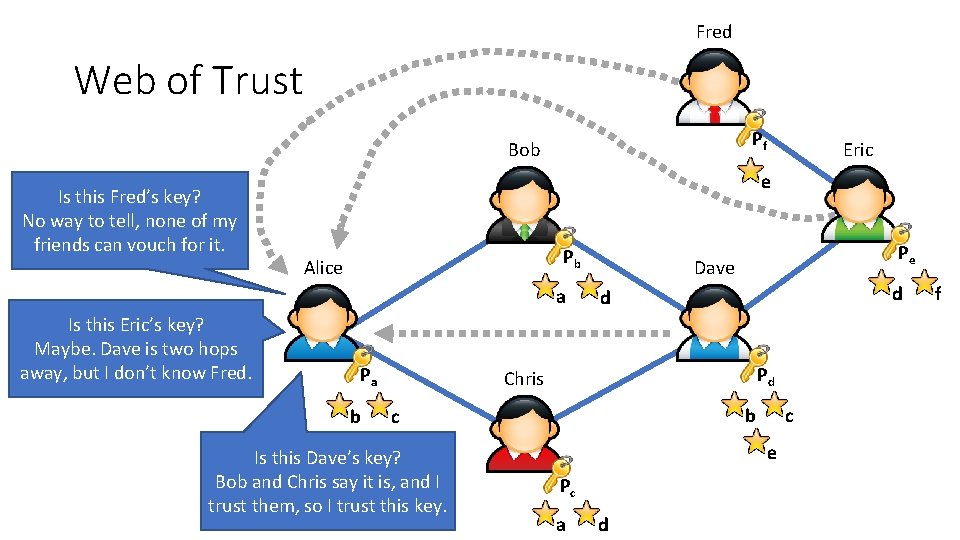
Fred Web of Trust Pf Bob Is this Fred’s key? No way to tell, none of my friends can vouch for it. e Pb Alice a Is this Eric’s key? Maybe. Dave is two hops away, but I don’t know Fred. Eric Pa b Pe Dave d d Pd Chris b c Is this Dave’s key? Bob and Chris say it is, and I trust them, so I trust this key. c e Pc a d f
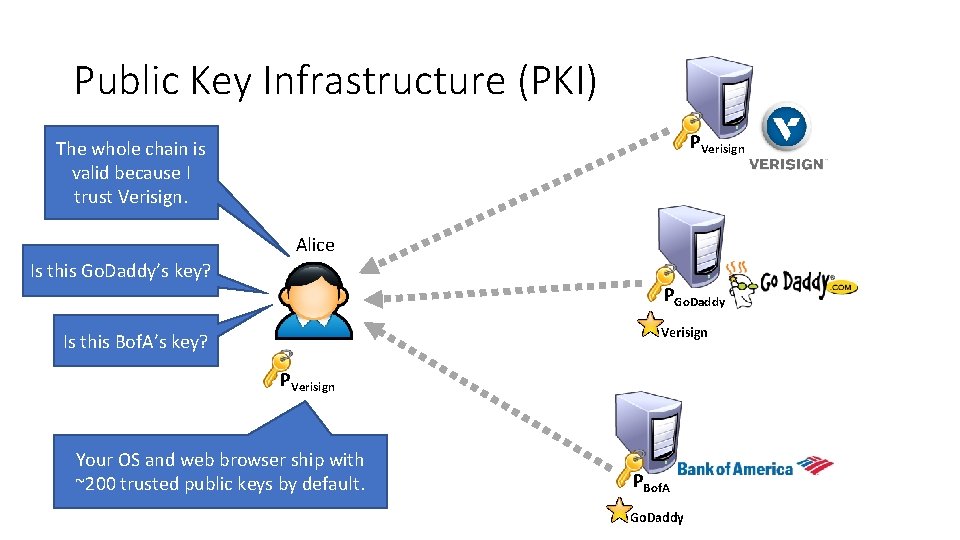
Public Key Infrastructure (PKI) PVerisign The whole chain is valid because I trust Verisign. Alice Is this Go. Daddy’s key? PGo. Daddy Verisign Is this Bof. A’s key? PVerisign Your OS and web browser ship with ~200 trusted public keys by default. PBof. A Go. Daddy
Transport Layer Security (TLS)
SSL/TLS • Application-layer protocol for confidentiality, integrity, and authentication between clients and servers • Introduced by Netscape in 1995 as the Secure Sockets Layer (SSL) • Designed to encapsulate HTTP, hence HTTPS • Transport Layer Security (TLS) is the upgraded standard • Defined in an RFC in 1999 • Supersedes SSL: SSL is known to be insecure and should not be used • Sits between transport and application layers • Thus, applications must be TLS-aware • Server must have an asymmetric keypair • X. 509 certificates contain signed public keys • PKI rooted in trusted (? ) Certificate Authorities (CAs)
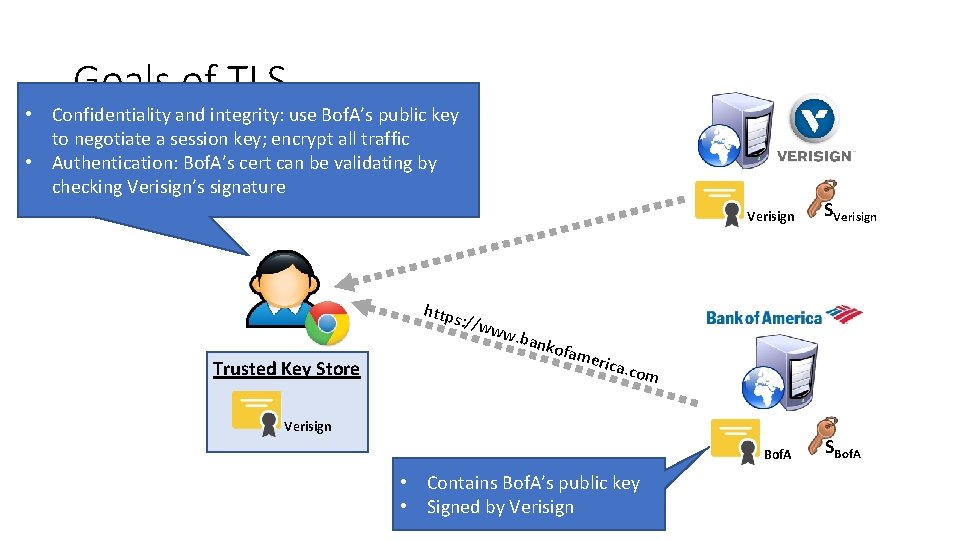
Goals of TLS • Confidentiality and integrity: use Bof. A’s public key to negotiate a session key; encrypt all traffic • Authentication: Bof. A’s cert can be validating by checking Verisign’s signature Verisign SVerisign https : //ww Trusted Key Store w. ba nkof ame rica. c om Verisign Bof. A • Contains Bof. A’s public key • Signed by Verisign SBof. A
Let’s Talk about Certificates • Suppose you start a new website and you want TLS encryption • You need a certificate. How do you get one? • Option 1: generate a certificate yourself • Use openssl to generate a new asymmetric keypair • Use openssl to generate a certificate that includes your new public key • Problem? • Your new cert is self-signed, i. e. not signed by a trusted CA • Browsers cannot validate that the cert is trustworthy • Users will be shown a scary security warning when they visit your site • Option 2: • Get a well-known CA to sign your certificate • Any browser that trusts the CA will also trust your new cert
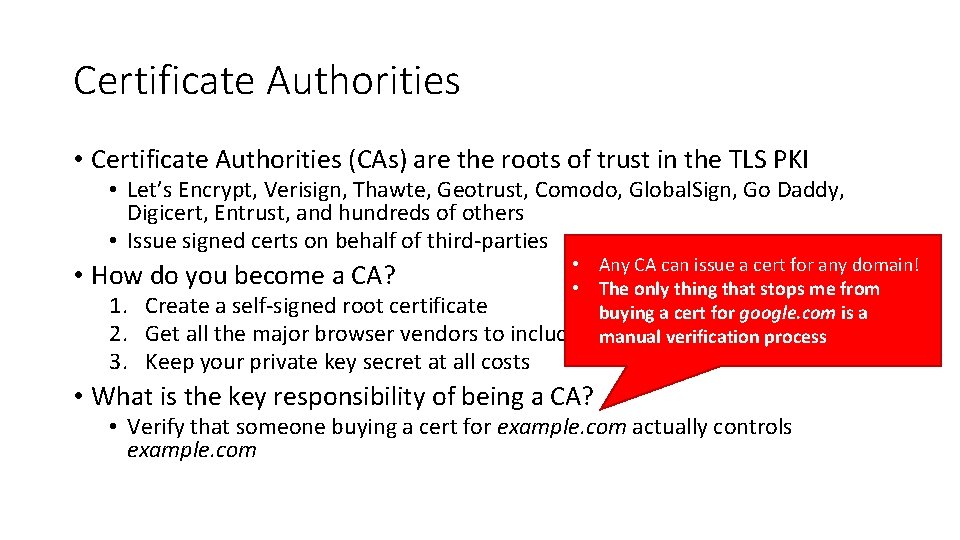
Certificate Authorities • Certificate Authorities (CAs) are the roots of trust in the TLS PKI • Let’s Encrypt, Verisign, Thawte, Geotrust, Comodo, Global. Sign, Go Daddy, Digicert, Entrust, and hundreds of others • Issue signed certs on behalf of third-parties • • Any CA can issue a cert for any domain! How do you become a CA? • The only thing that stops me from 1. Create a self-signed root certificate buying a cert for google. com is a 2. Get all the major browser vendors to include your certverification with theirprocess software manual 3. Keep your private key secret at all costs • What is the key responsibility of being a CA? • Verify that someone buying a cert for example. com actually controls example. com
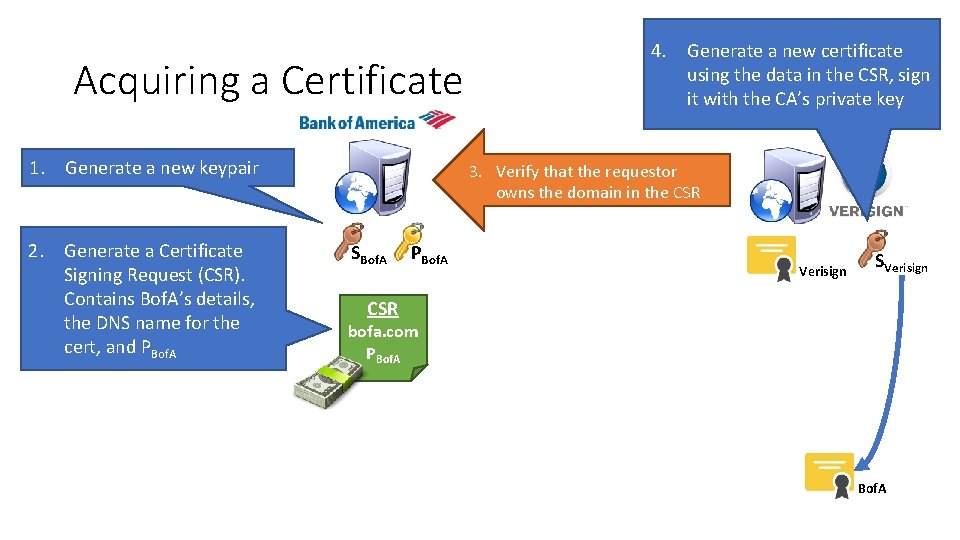
Acquiring a Certificate 1. Generate a new keypair 2. Generate a Certificate Signing Request (CSR). Contains Bof. A’s details, the DNS name for the cert, and PBof. A 4. Generate a new certificate using the data in the CSR, sign it with the CA’s private key 3. Verify that the requestor owns the domain in the CSR SBof. A PBof. A Verisign SVerisign CSR bofa. com PBof. A
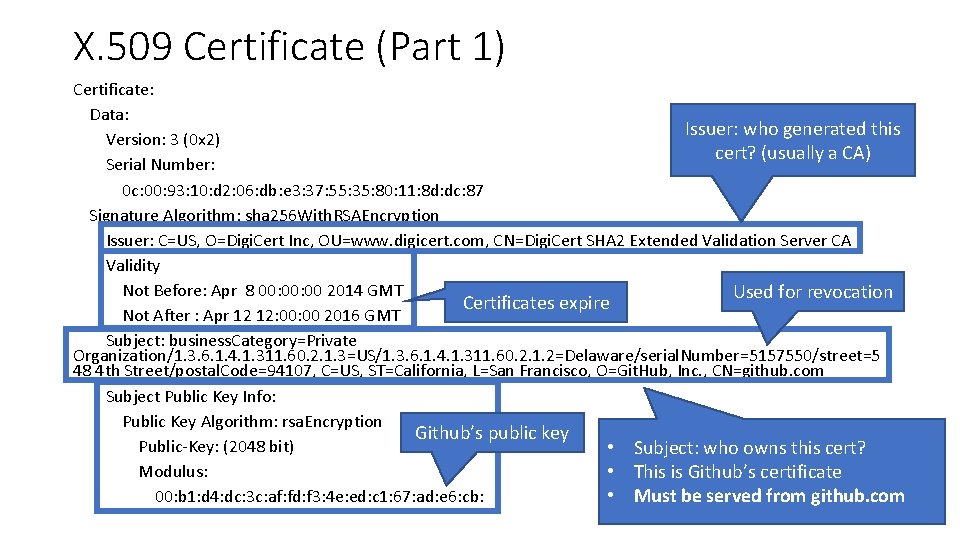
X. 509 Certificate (Part 1) Certificate: Data: Issuer: who generated this Version: 3 (0 x 2) cert? (usually a CA) Serial Number: 0 c: 00: 93: 10: d 2: 06: db: e 3: 37: 55: 35: 80: 11: 8 d: dc: 87 Signature Algorithm: sha 256 With. RSAEncryption Issuer: C=US, O=Digi. Cert Inc, OU=www. digicert. com, CN=Digi. Cert SHA 2 Extended Validation Server CA Validity Not Before: Apr 8 00: 00 2014 GMT Used for revocation Certificates expire Not After : Apr 12 12: 00 2016 GMT Subject: business. Category=Private Organization/1. 3. 6. 1. 4. 1. 311. 60. 2. 1. 3=US/1. 3. 6. 1. 4. 1. 311. 60. 2. 1. 2=Delaware/serial. Number=5157550/street=5 48 4 th Street/postal. Code=94107, C=US, ST=California, L=San Francisco, O=Git. Hub, Inc. , CN=github. com Subject Public Key Info: Public Key Algorithm: rsa. Encryption Github’s public key Public-Key: (2048 bit) • Subject: who owns this cert? Modulus: • This is Github’s certificate • Must be served from github. com 00: b 1: d 4: dc: 3 c: af: fd: f 3: 4 e: ed: c 1: 67: ad: e 6: cb:
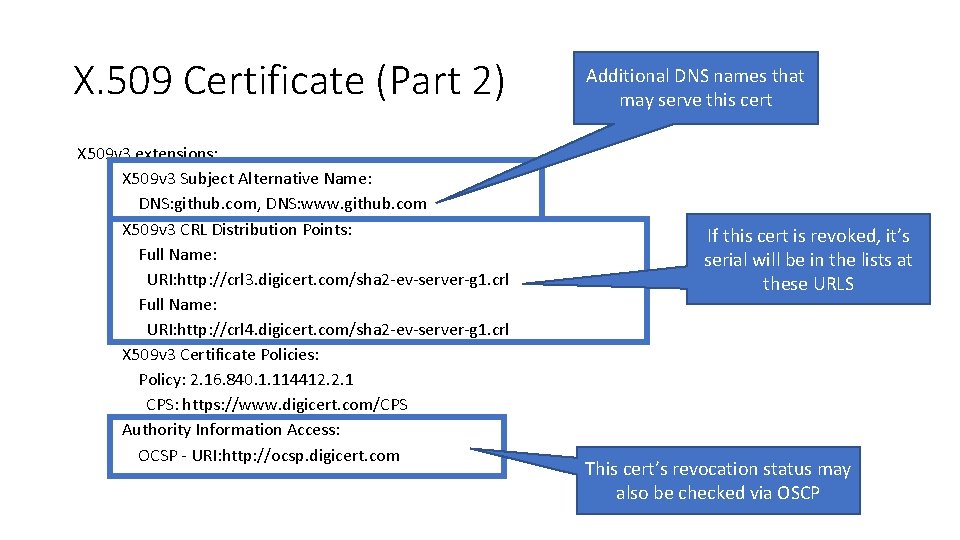
X. 509 Certificate (Part 2) X 509 v 3 extensions: X 509 v 3 Subject Alternative Name: DNS: github. com, DNS: www. github. com X 509 v 3 CRL Distribution Points: Full Name: URI: http: //crl 3. digicert. com/sha 2 -ev-server-g 1. crl Full Name: URI: http: //crl 4. digicert. com/sha 2 -ev-server-g 1. crl X 509 v 3 Certificate Policies: Policy: 2. 16. 840. 1. 114412. 2. 1 CPS: https: //www. digicert. com/CPS Authority Information Access: OCSP - URI: http: //ocsp. digicert. com Additional DNS names that may serve this cert If this cert is revoked, it’s serial will be in the lists at these URLS This cert’s revocation status may also be checked via OSCP
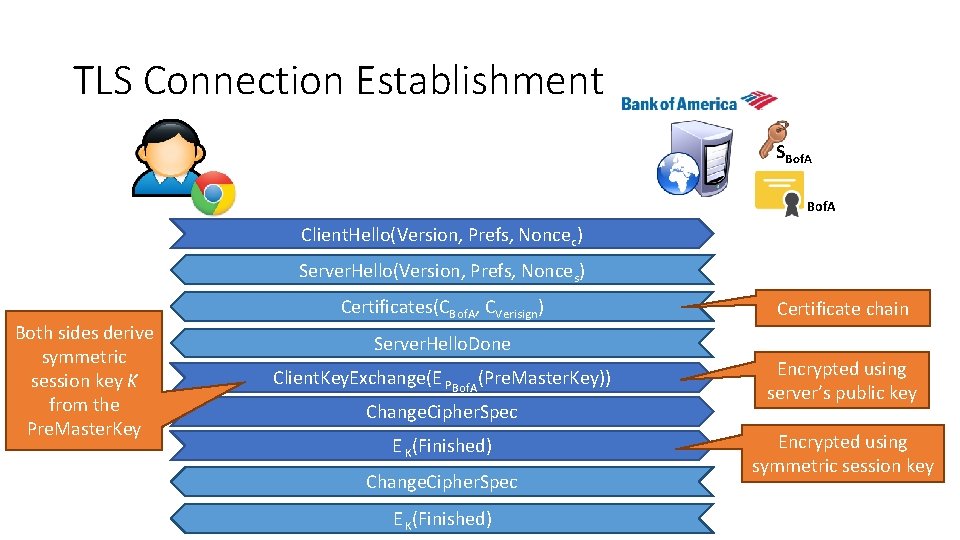
TLS Connection Establishment SBof. A Client. Hello(Version, Prefs, Noncec) Server. Hello(Version, Prefs, Nonces) Both sides derive symmetric session key K from the Pre. Master. Key Certificates(CBof. A, CVerisign) Certificate chain Server. Hello. Done Client. Key. Exchange(E PBof. A(Pre. Master. Key)) Change. Cipher. Spec E K(Finished) Encrypted using server’s public key Encrypted using symmetric session key
TLS Authentication • During the TLS handshake, the client receives a certificate chain • Chain contains the server’s cert, as well as the certs of the signing CA(s) • The client must validate the certificate chain to establish trust • i. e. is this chain authentic, correct, cryptographically sound, etc. • Client-side validation checks • Does the server’s DNS name match the common name in the cert? • • • E. g. example. com cannot serve a cert with common name google. com Are any certs in the chain expired? Is the CA’s signature cryptographically valid? Is the cert of the root CA in the chain present in the client’s trusted key store? Is any cert in the chain revoked? (more on this later)
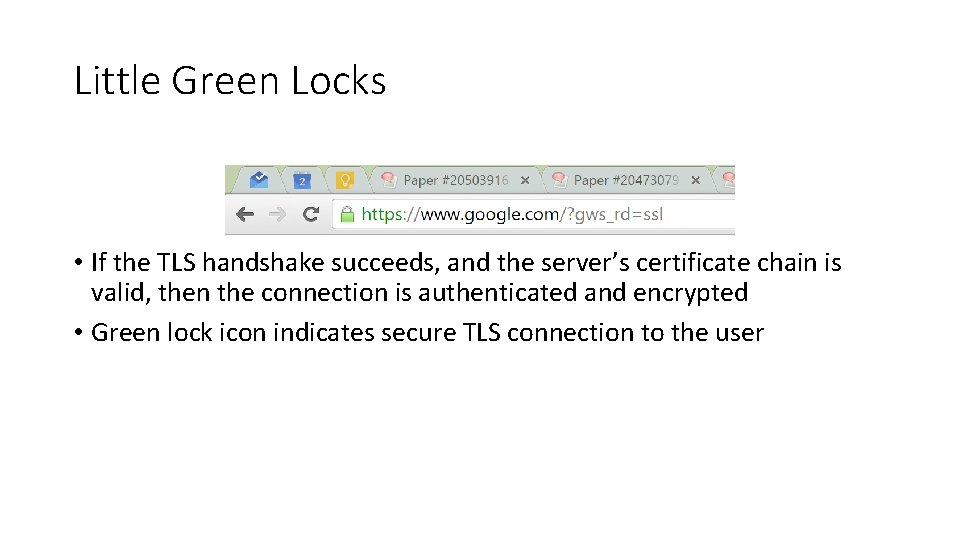
Little Green Locks • If the TLS handshake succeeds, and the server’s certificate chain is valid, then the connection is authenticated and encrypted • Green lock icon indicates secure TLS connection to the user
Key Compromise and Revocation
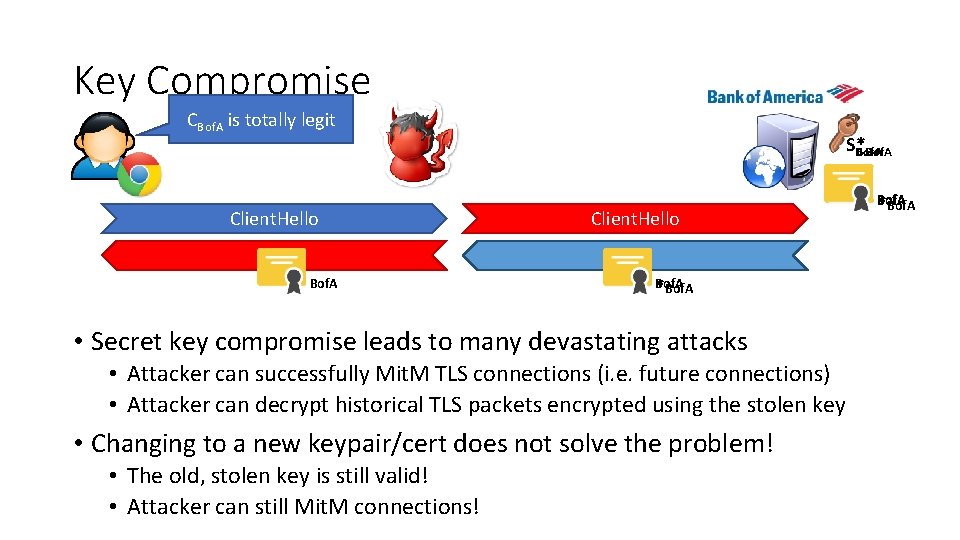
Key Compromise CBof. A is totally legit Client. Hello Bof. A SS*Bof. A Client. Hello *Bof. A • Secret key compromise leads to many devastating attacks • Attacker can successfully Mit. M TLS connections (i. e. future connections) • Attacker can decrypt historical TLS packets encrypted using the stolen key • Changing to a new keypair/cert does not solve the problem! • The old, stolen key is still valid! • Attacker can still Mit. M connections! Bof. A *Bof. A
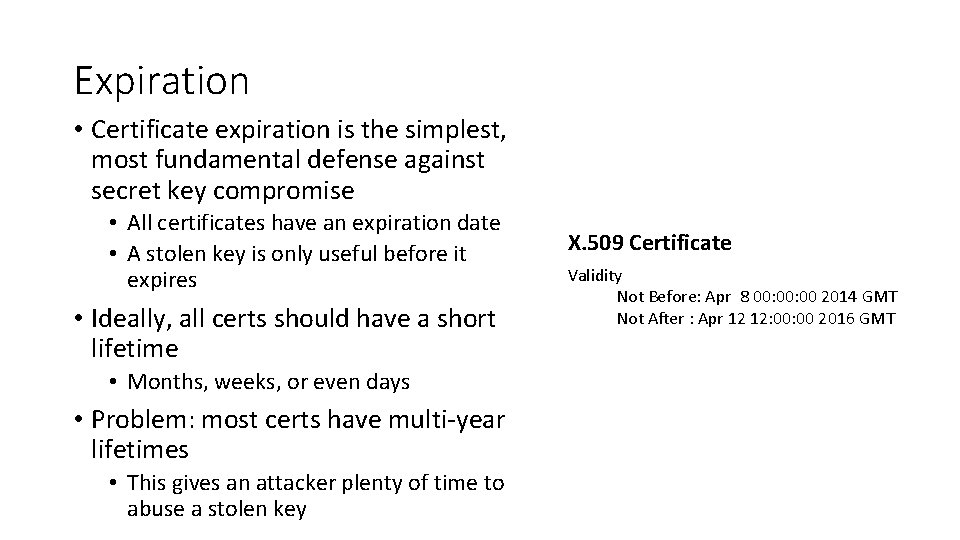
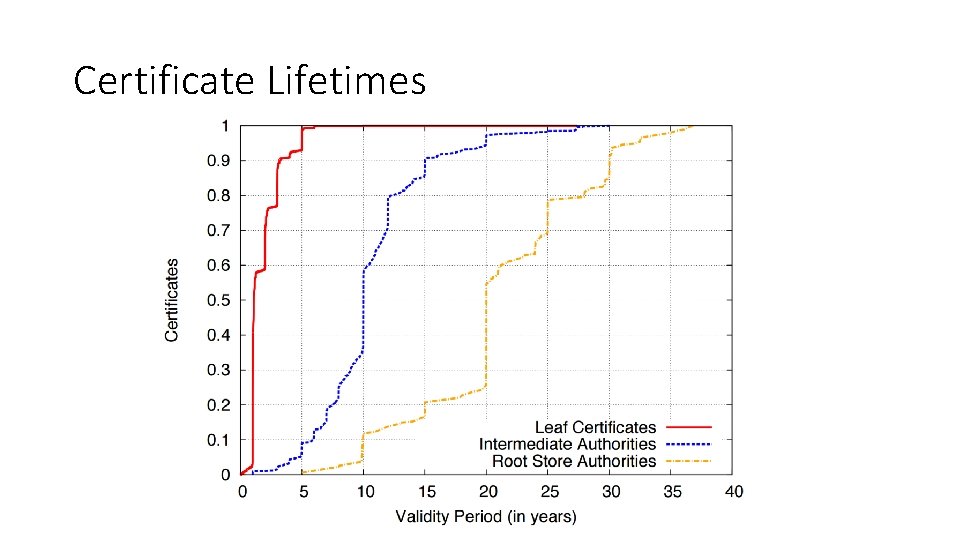
Expiration • Certificate expiration is the simplest, most fundamental defense against secret key compromise • All certificates have an expiration date • A stolen key is only useful before it expires • Ideally, all certs should have a short lifetime • Months, weeks, or even days • Problem: most certs have multi-year lifetimes • This gives an attacker plenty of time to abuse a stolen key X. 509 Certificate Validity Not Before: Apr 8 00: 00 2014 GMT Not After : Apr 12 12: 00 2016 GMT
Certificate Lifetimes
Revocation • Certificate revocations are another fundamental mechanism for mitigating secret key compromises • After a secret key has been compromised, the owner is supposed to revoke the certificate • CA’s are responsible for hosting databases of revoked certificates that they issued • Clients are supposed to query the revocation status of all certificates they encounter during validation • If a certificate is revoked, the client should never accept it • Two revocation protocols for TLS certificates 1. Certificate Revocation Lists (CRLs) 2. Online Certificate Status Protocol (OCSP)
Certificate Revocation Lists • CRLs are the original mechanism for announcing and querying the revocation status of certificates • CAs compile lists of serial numbers of revoked certificates • URL for the list is included in each cert issued by the CA • CRL is signed by the CA to protect integrity
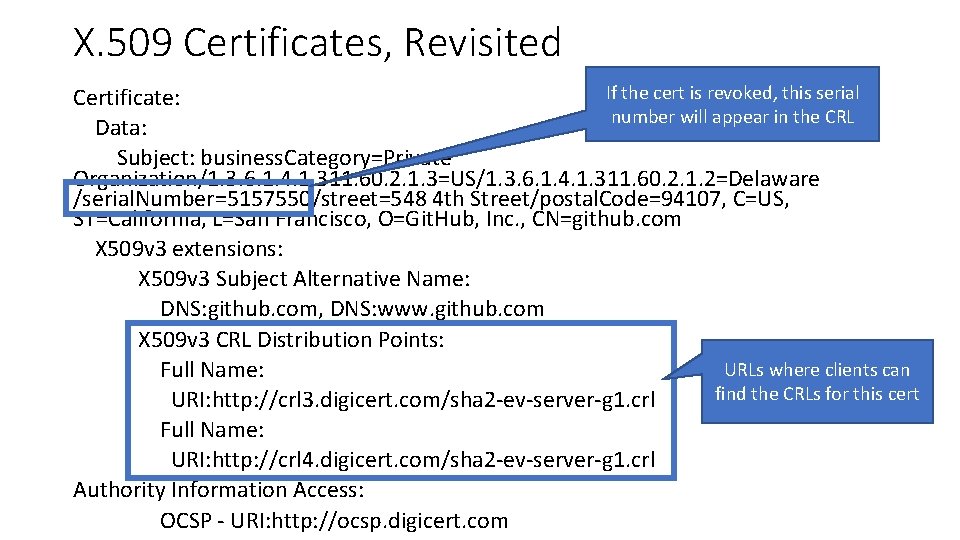
X. 509 Certificates, Revisited If the cert is revoked, this serial Certificate: number will appear in the CRL Data: Subject: business. Category=Private Organization/1. 3. 6. 1. 4. 1. 311. 60. 2. 1. 3=US/1. 3. 6. 1. 4. 1. 311. 60. 2. 1. 2=Delaware /serial. Number=5157550/street=548 4 th Street/postal. Code=94107, C=US, ST=California, L=San Francisco, O=Git. Hub, Inc. , CN=github. com X 509 v 3 extensions: X 509 v 3 Subject Alternative Name: DNS: github. com, DNS: www. github. com X 509 v 3 CRL Distribution Points: URLs where clients can Full Name: find the CRLs for this cert URI: http: //crl 3. digicert. com/sha 2 -ev-server-g 1. crl Full Name: URI: http: //crl 4. digicert. com/sha 2 -ev-server-g 1. crl Authority Information Access: OCSP - URI: http: //ocsp. digicert. com
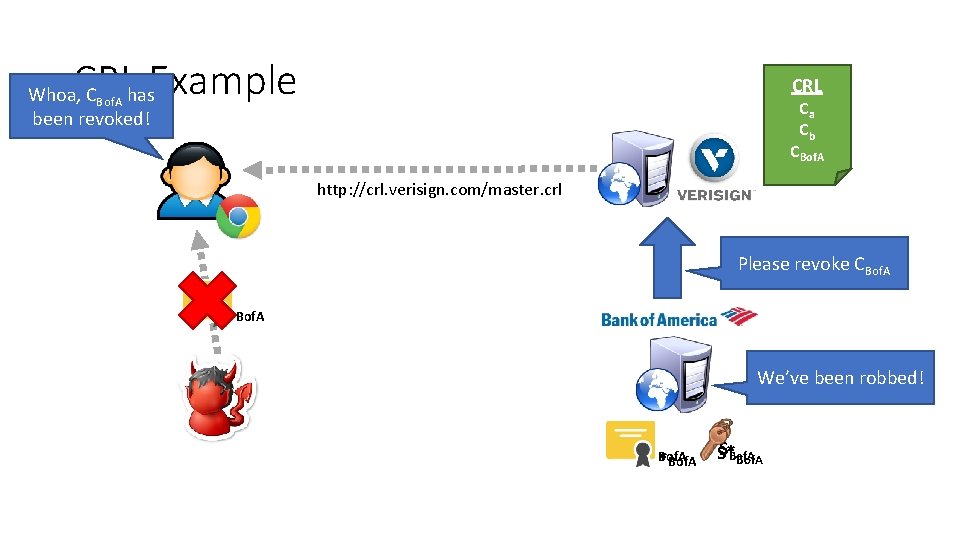
CRL Example CRL Whoa, CBof. A has been revoked! Ca Cb CBof. A http: //crl. verisign. com/master. crl Please revoke CBof. A We’ve been robbed! Bof. A *Bof. A S* Bof. A
Problems with CRLs • Clients should check the revocation status of every cert they encounter • Leaf, intermediate, and root certs • Problems • Latency – additional RTTs of latency are needed to download CRLs before a page will load • Size – CRLs can grow to be quite large (~MBs), downloads may be slow • Mit. M attackers can block access to the CRL/OCSP URLs • Browsers default-accept certificates if the revocation status cannot be checked • Known as soft-fail or fail-open security posture • Does caching CRLs mitigate these performance problems? • Yes, somewhat • But caching CRLs for long periods is dangerous: they may be out of date
Online Certificate Status Protocol • OCSP is the modern replacement for CRLs • API-style protocol that allows clients to query the revocation status of one or more certs • No longer necessary to download the entire CRL • CA’s host an OCSP server that clients may query • OCSP URL included in OCSP-compliant certs • Responses are signed by the CA to maintain integrity • Responses also include an expiration date to prevent replay attacks
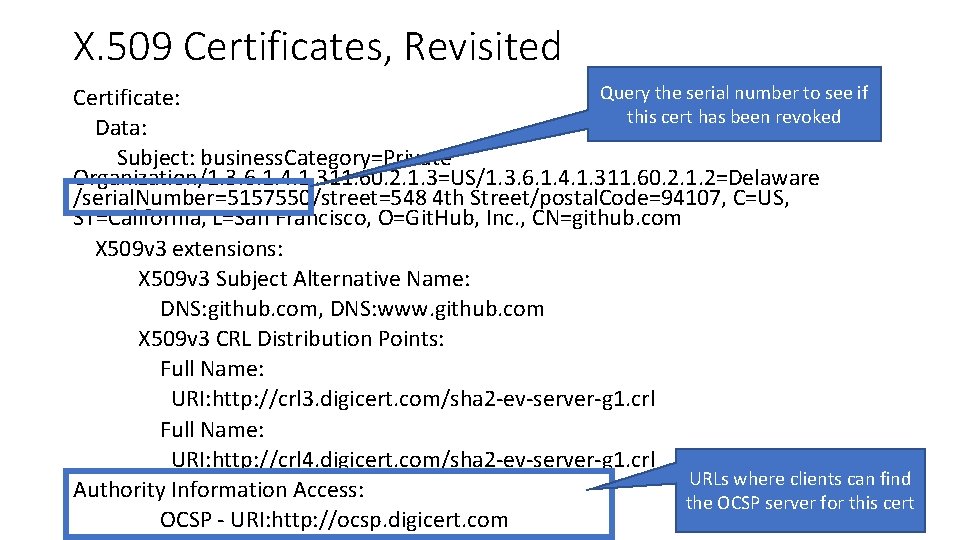
X. 509 Certificates, Revisited Query the serial number to see if Certificate: this cert has been revoked Data: Subject: business. Category=Private Organization/1. 3. 6. 1. 4. 1. 311. 60. 2. 1. 3=US/1. 3. 6. 1. 4. 1. 311. 60. 2. 1. 2=Delaware /serial. Number=5157550/street=548 4 th Street/postal. Code=94107, C=US, ST=California, L=San Francisco, O=Git. Hub, Inc. , CN=github. com X 509 v 3 extensions: X 509 v 3 Subject Alternative Name: DNS: github. com, DNS: www. github. com X 509 v 3 CRL Distribution Points: Full Name: URI: http: //crl 3. digicert. com/sha 2 -ev-server-g 1. crl Full Name: URI: http: //crl 4. digicert. com/sha 2 -ev-server-g 1. crl URLs where clients can find Authority Information Access: the OCSP server for this cert OCSP - URI: http: //ocsp. digicert. com
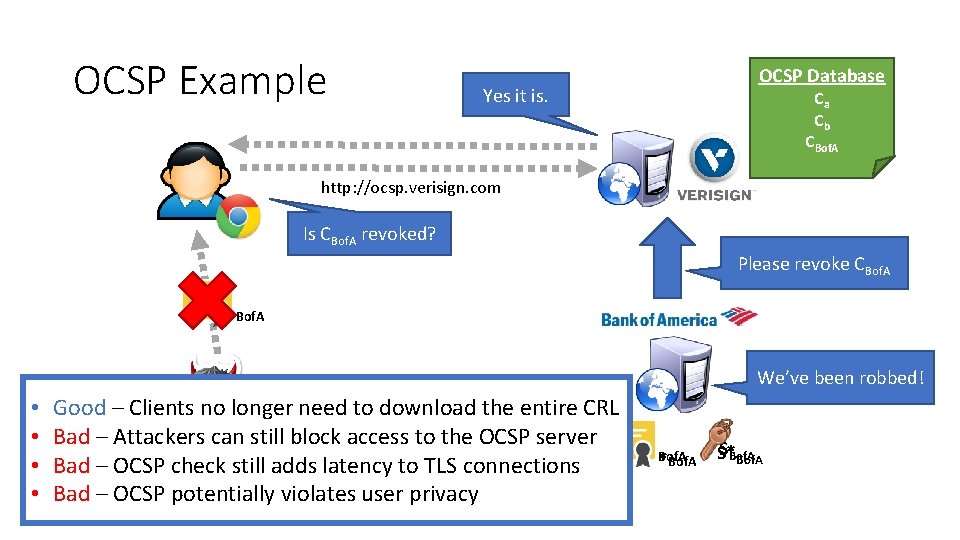
OCSP Example OCSP Database Yes it is. Ca Cb CBof. A http: //ocsp. verisign. com Is CBof. A revoked? Please revoke CBof. A We’ve been robbed! • • Good – Clients no longer need to download the entire CRL Bad – Attackers can still block access to the OCSP server Bad – OCSP check still adds latency to TLS connections Bad – OCSP potentially violates user privacy Bof. A *Bof. A S* Bof. A
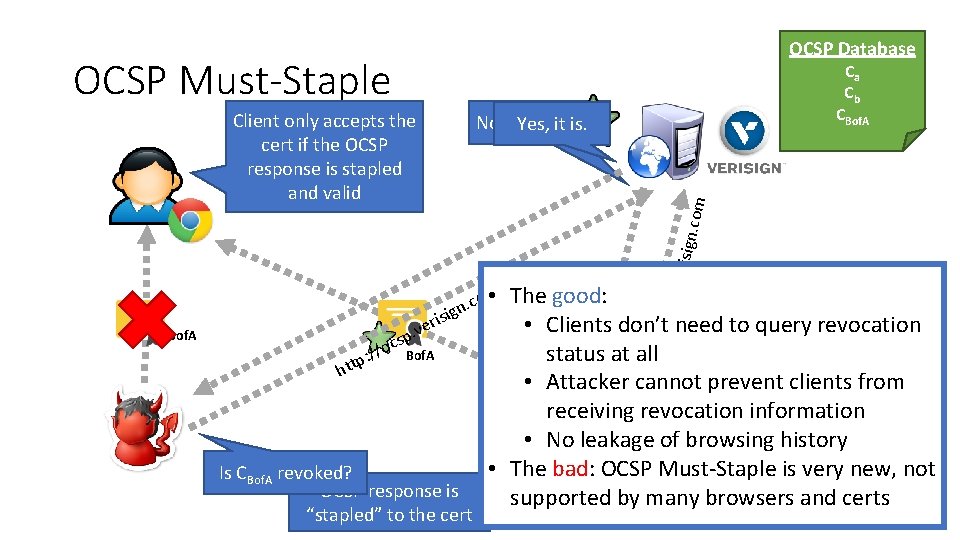
OCSP Database OCSP Must-Staple Client only accepts the cert if the OCSP response is stapled and valid Ca Cb CBof. A : / p. s c /o p htt The good: • Clients don’t need to query revocation status at all Is CBof. A revoked? • Attacker cannot prevent clients from receiving revocation information • No leakage of browsing history • The bad: Bof. A OCSP Must-Staple is very new, not SBof. A supported by many browsers and certs • om c. n ig s i r ve Bof. A Is CBof. A revoked? OCSP response is “stapled” to the cert ocsp. ve risign . com No, its not. Yes, it is.
Revocation in Practice • Revocation is one of the most broken parts of the TLS ecosystem • Mit. M attackers can block access to the CRL/OCSP URLs • Browsers default-accept certificates if the revocation status cannot be checked • Solved by OCSP Must-Staple, but this extension is not well deployed • Many browsers no longer perform proper revocation checks • Firefox only supports OCSP • Chrome only does OCSP checks on EV certs, and only on some platforms • Windows – Yes, Linux and Android – No • Chrome uses an alternative implementation called CRLset which is busted • Mobile browsers never check for revocations • Adds additional latency to HTTPS connections onto already slow mobile networks • Many administrators fail to revoke compromised certificates
- Slides: 103