
CWSUWHO A LOOK INSIDE THE NATIONAL WEATHER SERVICE
- Slides: 14
CWSU…WHO? A LOOK INSIDE THE NATIONAL WEATHER SERVICE “CENTER WEATHER SERVICE UNITS” Rick Winther National Weather Service CWSU ZDC
NWS HISTORY HIGHLIGHTS • 1849 - Smithsonian Institution supplies weather instruments to telegraph companies and establishes extensive observation network. • 1870 - President Ulysses S. Grant signed into law a new weather “Signal Service” within the U. S. Army Signal Service’s Division of Telegrams and Reports. • 1890 - The Signal Service was transferred to the Agriculture Department as the National Weather Bureau. • 1904 - The government begins using airplanes to conduct upper air atmospheric research. • 1909 - The Weather Bureau begins its program of free-rising balloon observations. • 1918 - The Weather Bureau begins issuing bulletins and forecasts for domestic military flights and for new air mail routes.
A FEW NWS HISTORY HIGHLIGHTS • 1940 – National Weather Bureau transferred to the Department of Commerce. • 1948 - USAF Air Weather Service meteorologists issue first tornado warnings from Tinker Air Force Base. • 1960 - The world's first weather satellite, the polar-orbiting TIROS I, successfully launches. • 1970 – National Weather Bureau renamed the National Weather Service. • 1978 - FAA contracted NWS to set up 3 person weather units in 13 Air Route Traffic Control Centers. • 1982 - MIC (4 person unit) position created for 20 ARTCC. • 1980 s through the 1990 s - Modernization and associated restructuring (MAR). The MAR fundamentally changed the NWS field office structure to ensure that rapid detection and timely forecasts and warnings are delivered to the public. • 1997 - Nationwide WSR-88 D radar network is fully deployed.
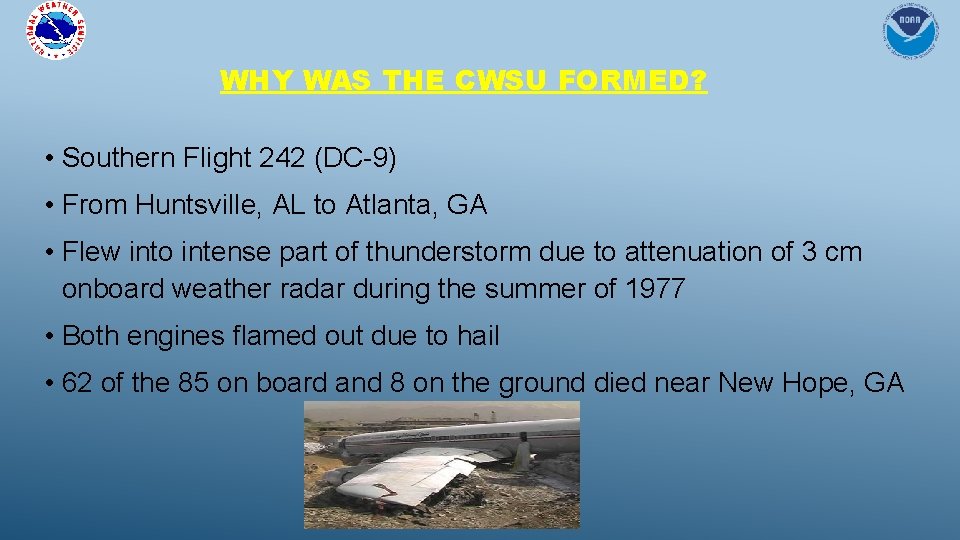
WHY WAS THE CWSU FORMED? • Southern Flight 242 (DC-9) • From Huntsville, AL to Atlanta, GA • Flew into intense part of thunderstorm due to attenuation of 3 cm onboard weather radar during the summer of 1977 • Both engines flamed out due to hail • 62 of the 85 on board and 8 on the ground died near New Hope, GA
NTSB RECOMMENDATION A-77 -68 • Formulate rules and procedures for timely dissemination by AT controllers of all available severe weather information to INBOUND and OUTBOUND flight crews in the TERMINAL AREA
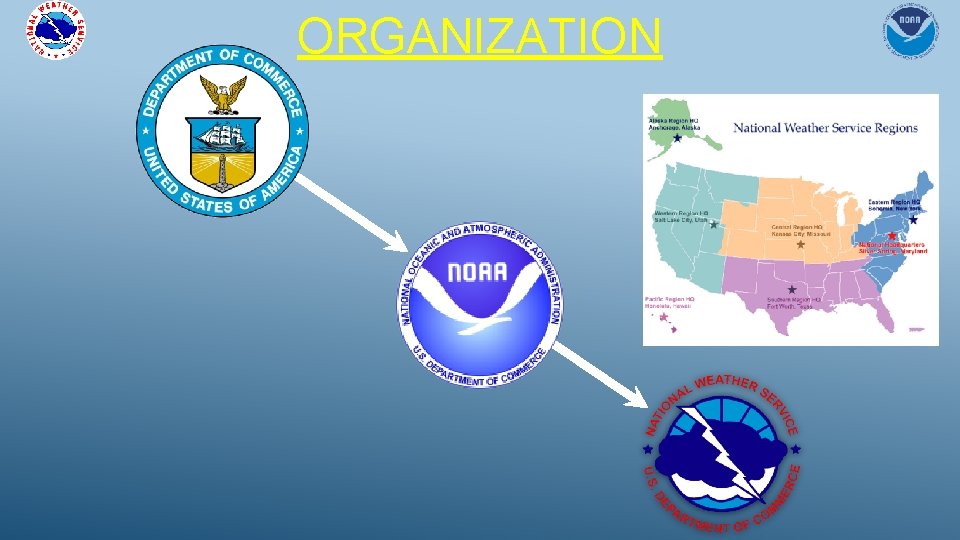
ORGANIZATION
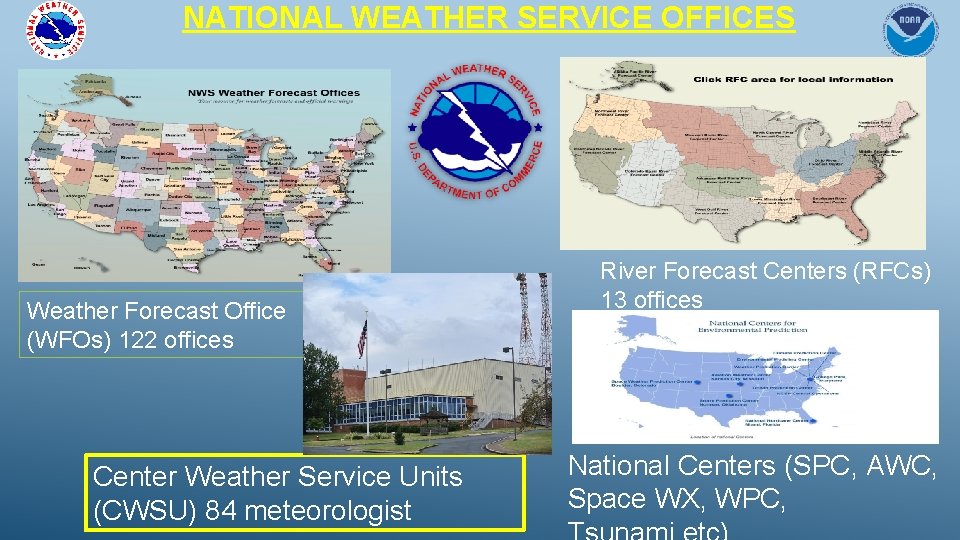
NATIONAL WEATHER SERVICE OFFICES Weather Forecast Office (WFOs) 122 offices Center Weather Service Units (CWSU) 84 meteorologist River Forecast Centers (RFCs) 13 offices National Centers (SPC, AWC, Space WX, WPC,
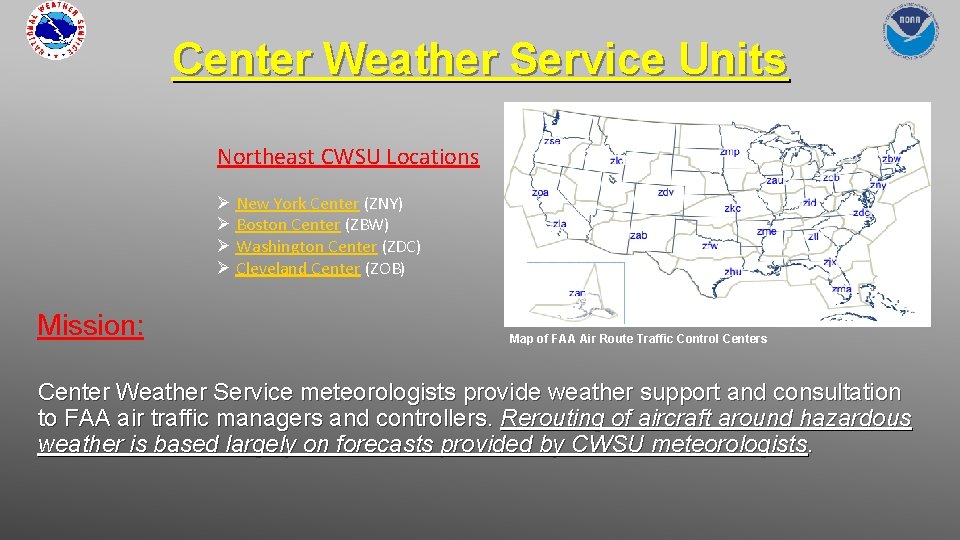
Center Weather Service Units Northeast CWSU Locations Ø New York Center (ZNY) Ø Boston Center (ZBW) Ø Washington Center (ZDC) Ø Cleveland Center (ZOB) Mission: Map of FAA Air Route Traffic Control Centers Center Weather Service meteorologists provide weather support and consultation to FAA air traffic managers and controllers. Rerouting of aircraft around hazardous weather is based largely on forecasts provided by CWSU meteorologists.
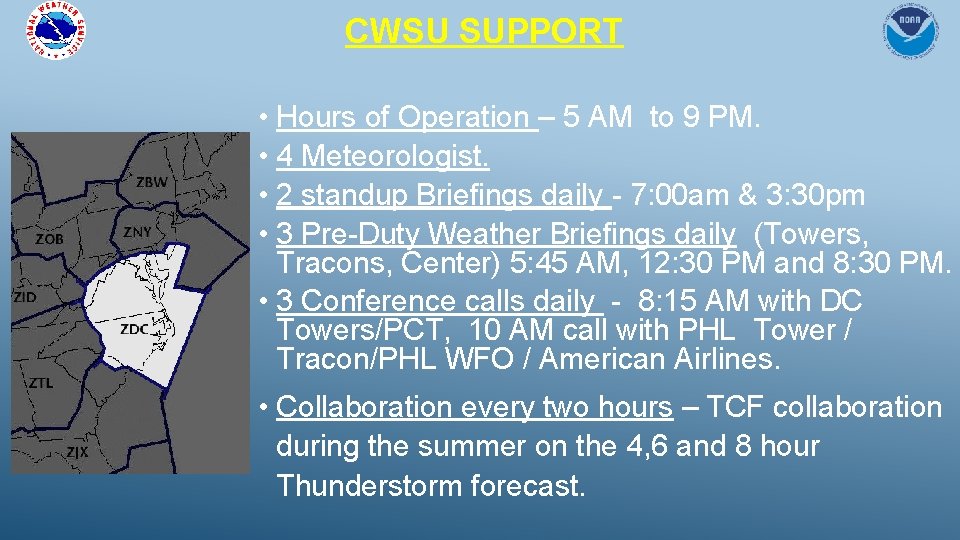
CWSU SUPPORT • Hours of Operation – 5 AM to 9 PM. • 4 Meteorologist. • 2 standup Briefings daily - 7: 00 am & 3: 30 pm • 3 Pre-Duty Weather Briefings daily (Towers, Tracons, Center) 5: 45 AM, 12: 30 PM and 8: 30 PM. • 3 Conference calls daily - 8: 15 AM with DC Towers/PCT, 10 AM call with PHL Tower / Tracon/PHL WFO / American Airlines. • Collaboration every two hours – TCF collaboration during the summer on the 4, 6 and 8 hour Thunderstorm forecast.
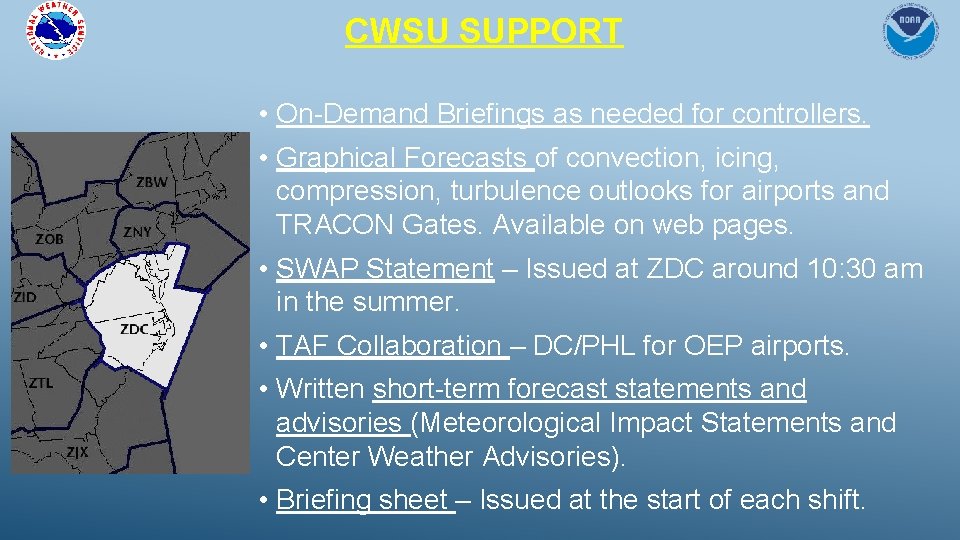
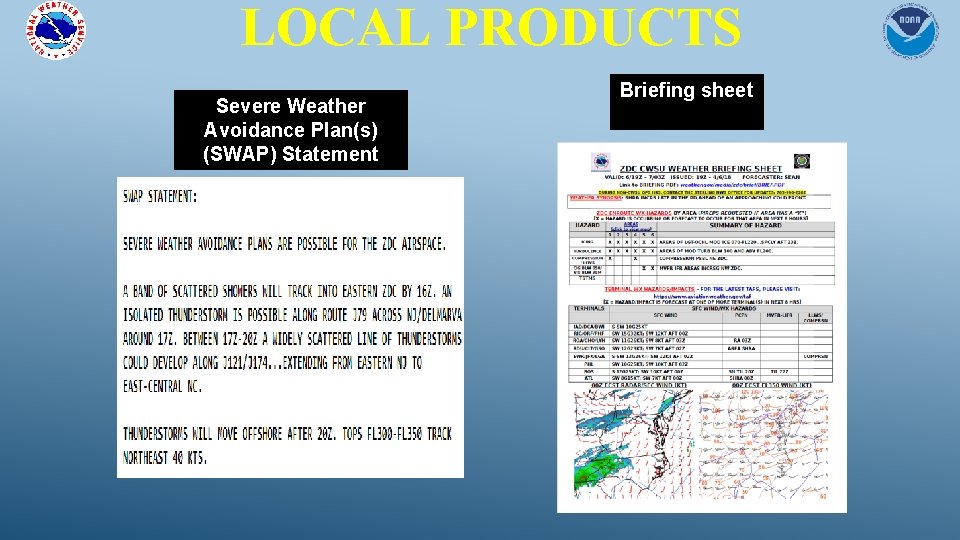
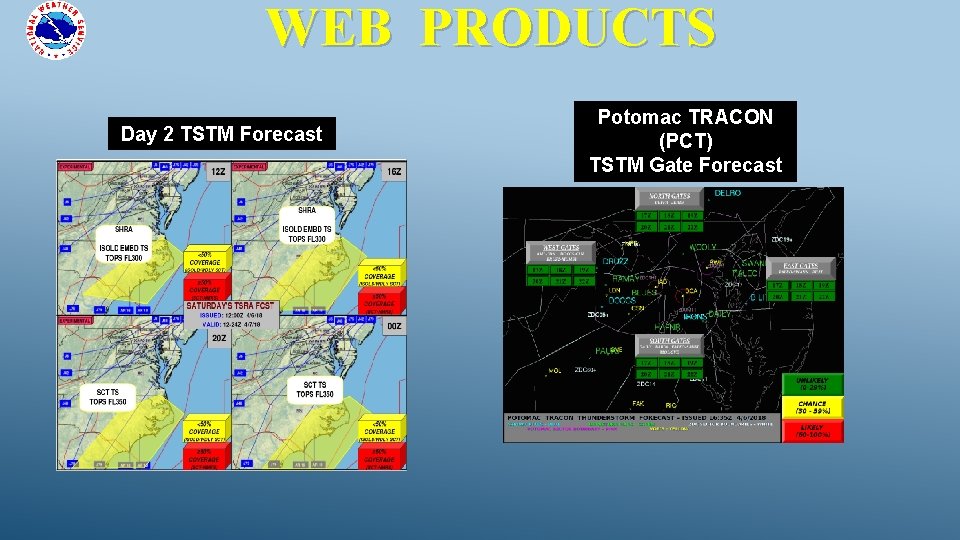
CWSU SUPPORT • On-Demand Briefings as needed for controllers. • Graphical Forecasts of convection, icing, compression, turbulence outlooks for airports and TRACON Gates. Available on web pages. • SWAP Statement – Issued at ZDC around 10: 30 am in the summer. • TAF Collaboration – DC/PHL for OEP airports. • Written short-term forecast statements and advisories (Meteorological Impact Statements and Center Weather Advisories). • Briefing sheet – Issued at the start of each shift.
LOCAL PRODUCTS Severe Weather Avoidance Plan(s) (SWAP) Statement Briefing sheet
WEB PRODUCTS Day 2 TSTM Forecast Potomac TRACON (PCT) TSTM Gate Forecast
IT IS ALL ABOUT COLLABORATION & COMMUNICATION • We no longer live in a world where products exist and are developed in isolation. 13
QUESTIONS