
CW 01 January 2022 Acceleration required Practical Do


- Slides: 13
CW 01 January 2022 Acceleration required Practical Do Now Activity What is the unit for acceleration?
Self Assess • m/s 2
Progress Indicators Good Progress • State independent, dependent and control variables • Describe the relationship between force and acceleration • Describe the relationship between mass and acceleration Outstanding Progress • Describe a method to investigate how force affects acceleration. Last Lesson: Chemistry Topic This Lesson: Acceleration Next Lesson: Terminal Velocity
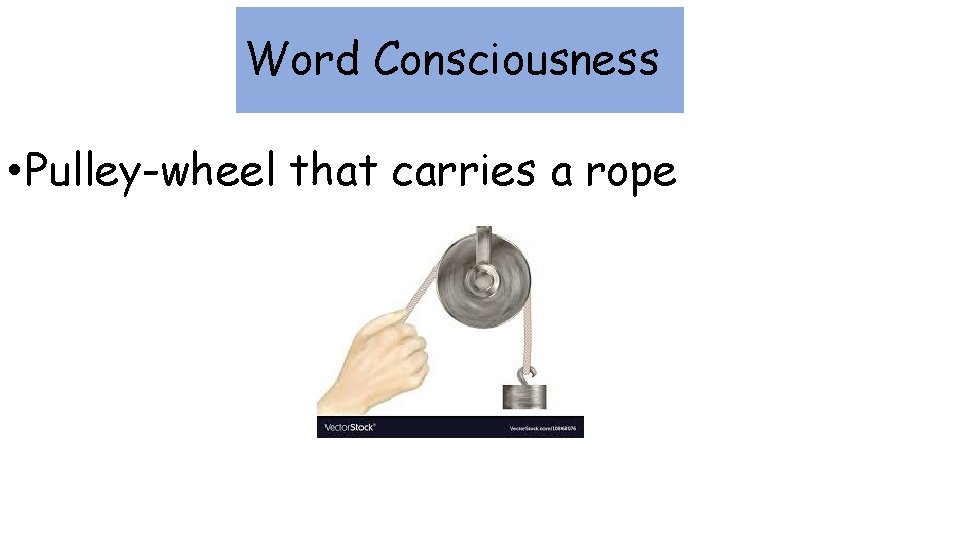
Word Consciousness • Pulley-wheel that carries a rope
Man vs Plane-who will win and why? • https: //www. youtube. com/watch? v=P 66 ISni. QCq. Y
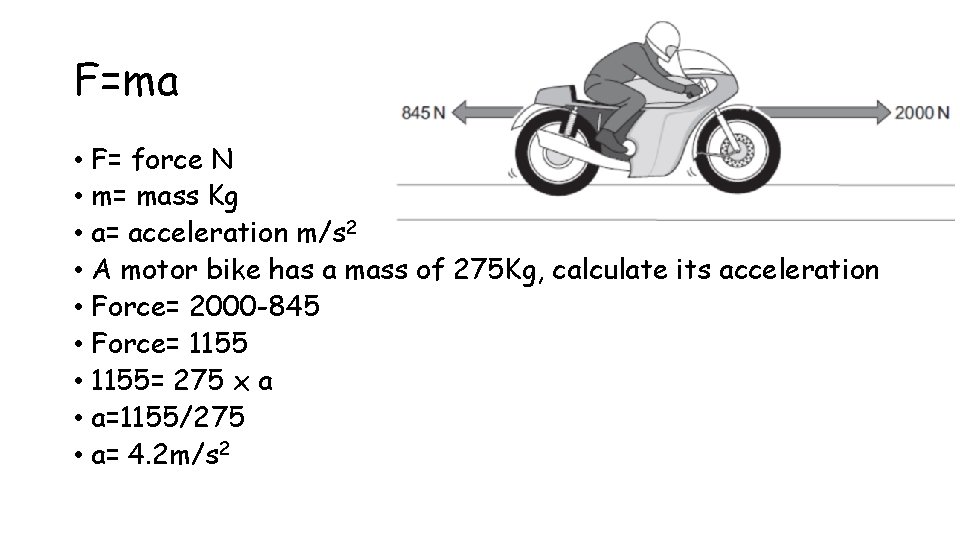
F=ma • F= force N • m= mass Kg • a= acceleration m/s 2 • A motor bike has a mass of 275 Kg, calculate its acceleration • Force= 2000 -845 • Force= 1155 • 1155= 275 x a • a=1155/275 • a= 4. 2 m/s 2
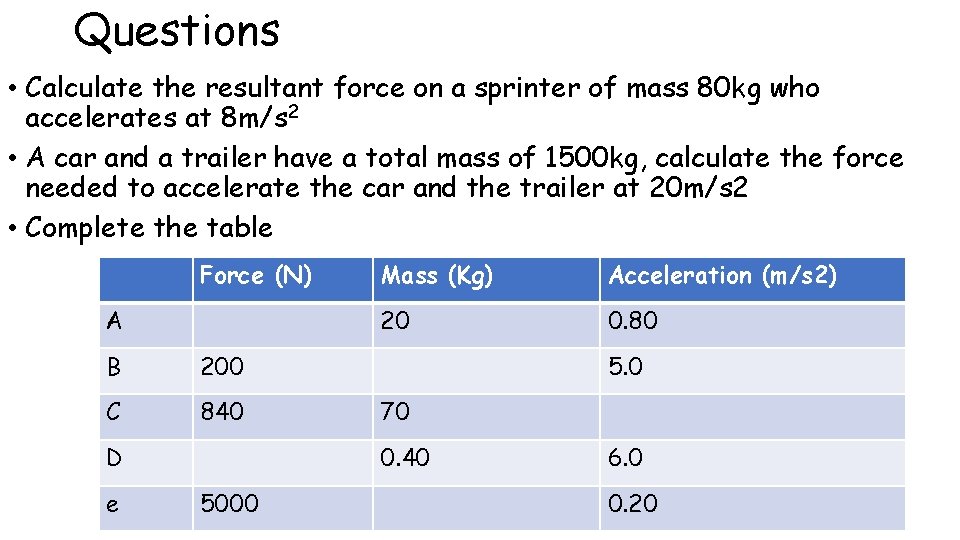
Questions • Calculate the resultant force on a sprinter of mass 80 kg who accelerates at 8 m/s 2 • A car and a trailer have a total mass of 1500 kg, calculate the force needed to accelerate the car and the trailer at 20 m/s 2 • Complete the table Force (N) A B 200 C 840 D e Mass (Kg) Acceleration (m/s 2) 20 0. 80 5. 0 70 0. 40 5000 6. 0 0. 20
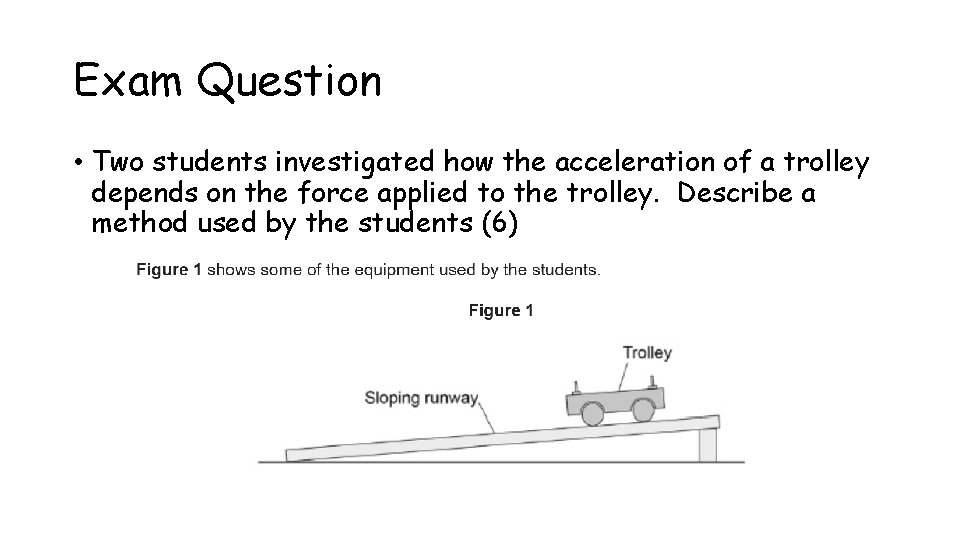
Exam Question • Two students investigated how the acceleration of a trolley depends on the force applied to the trolley. Describe a method used by the students (6)
https: //www. youtube. com/watch? v=ugzjeggjznw&list=PLM 7 l. G Cvspo. Ey. If 73 YJHl 5 zz. FTo 0 x. Ous 6 U&index=14 From the video you need to note down, equipment, basic method and variables (independent, dependent and control), range of force and what equation you need.
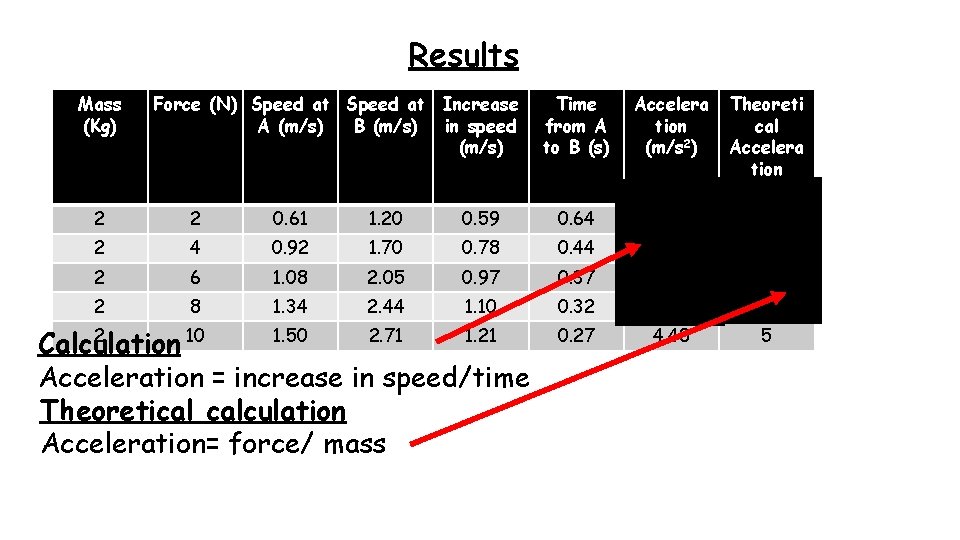
Results Mass (Kg) Force (N) Speed at Increase A (m/s) B (m/s) in speed (m/s) Time from A to B (s) Accelera tion (m/s 2) Theoreti cal Accelera tion (m/s 2) 2 2 0. 61 1. 20 0. 59 0. 64 0. 92 1 2 4 0. 92 1. 70 0. 78 0. 44 1. 77 2 2 6 1. 08 2. 05 0. 97 0. 37 2. 62 3 2 8 1. 34 2. 44 1. 10 0. 32 3. 44 4 0. 27 4. 48 5 2 10 1. 50 2. 71 1. 21 Calculation Acceleration = increase in speed/time Theoretical calculation Acceleration= force/ mass
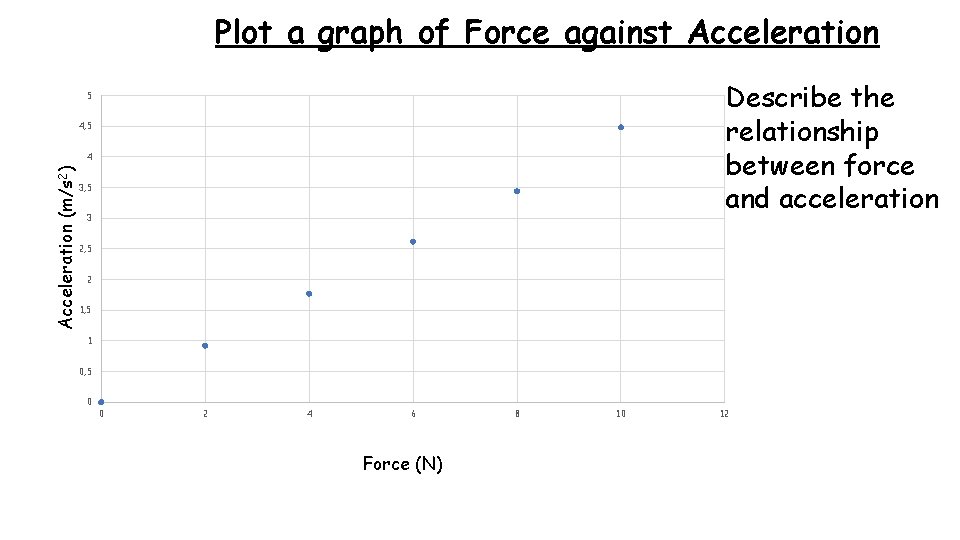
Plot a graph of Force against Acceleration Describe the relationship between force and acceleration 5 4, 5 Acceleration (m/s 2) 4 3, 5 3 2, 5 2 1, 5 1 0, 5 0 0 2 4 6 Force (N) 8 10 12
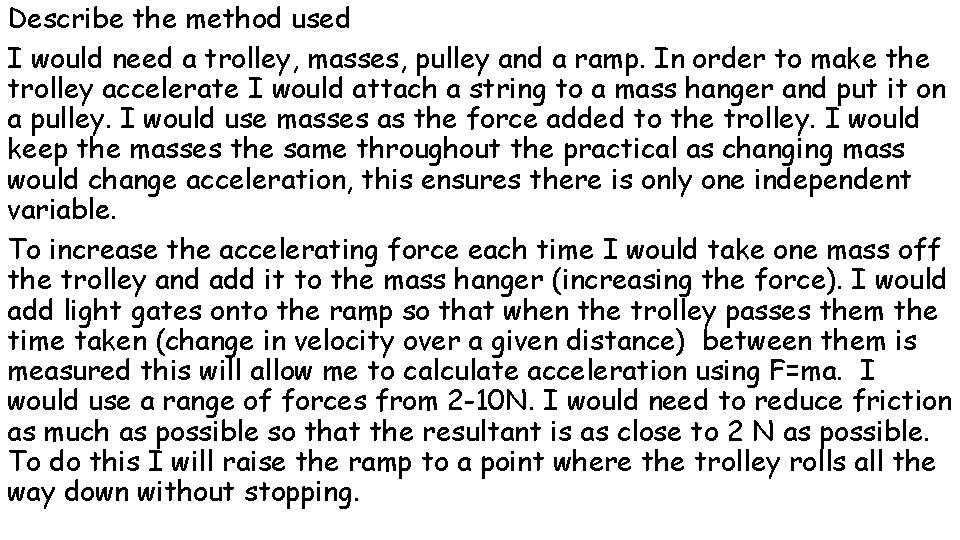
Describe the method used I would need a trolley, masses, pulley and a ramp. In order to make the trolley accelerate I would attach a string to a mass hanger and put it on a pulley. I would use masses as the force added to the trolley. I would keep the masses the same throughout the practical as changing mass would change acceleration, this ensures there is only one independent variable. To increase the accelerating force each time I would take one mass off the trolley and add it to the mass hanger (increasing the force). I would add light gates onto the ramp so that when the trolley passes them the time taken (change in velocity over a given distance) between them is measured this will allow me to calculate acceleration using F=ma. I would use a range of forces from 2 -10 N. I would need to reduce friction as much as possible so that the resultant is as close to 2 N as possible. To do this I will raise the ramp to a point where the trolley rolls all the way down without stopping.
Plenary