
Customized Fortification of Human Milk for the VLBW
Customized Fortification of Human Milk for the VLBW Infant HOT TOPICS in NEONATOLOGY Washington, D. C. Dec 2014 David H Adamkin Professor of Pediatrics, Director of Division of Neonatology, University of Louisville
Disclosures • Consultant and Investor in Medolac Laboratories • I will not discuss any off-label use and/or investigational use in my presentation
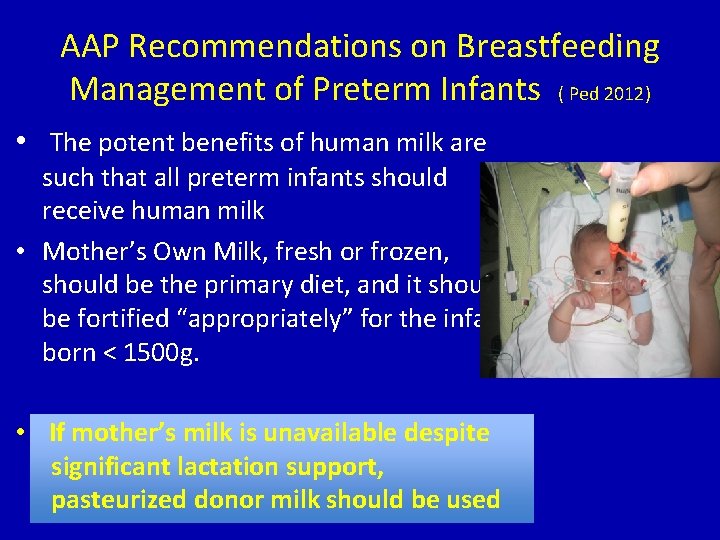
AAP Recommendations on Breastfeeding Management of Preterm Infants ( Ped 2012) • The potent benefits of human milk are such that all preterm infants should receive human milk • Mother’s Own Milk, fresh or frozen, should be the primary diet, and it should be fortified “appropriately” for the infant born < 1500 g. • If mother’s milk is unavailable despite significant lactation support, pasteurized donor milk should be used
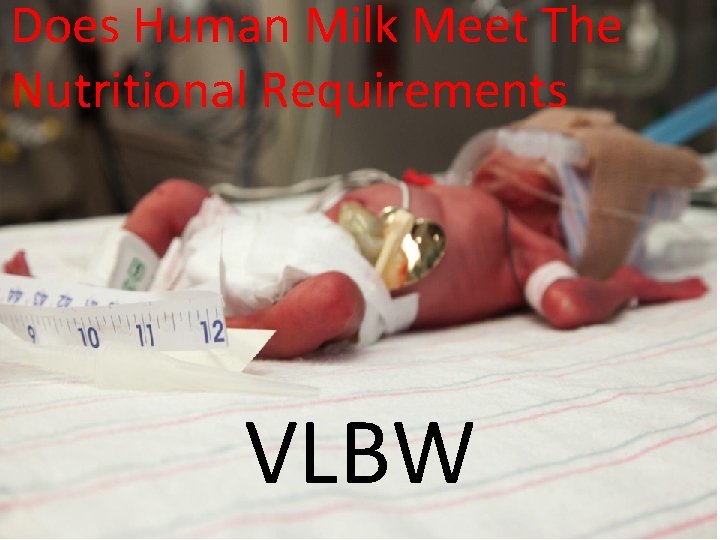
Does Human Milk Meet The Nutritional Requirements VLBW
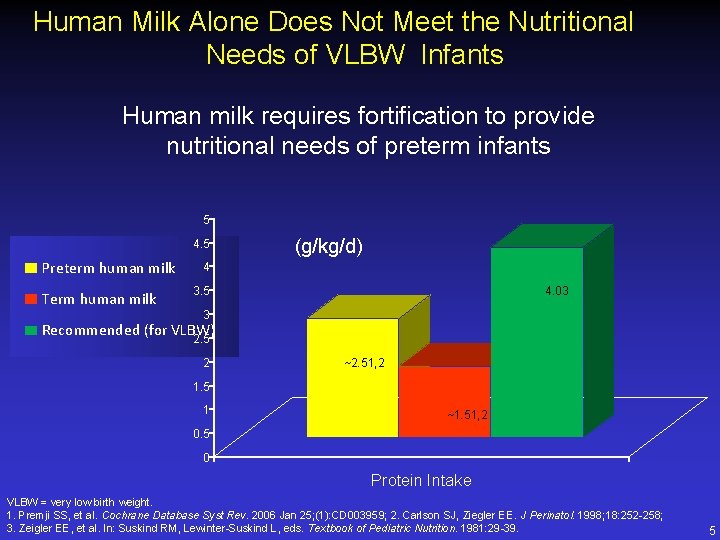
Human Milk Alone Does Not Meet the Nutritional Needs of VLBW Infants Human milk requires fortification to provide nutritional needs of preterm infants 5 4. 5 Preterm human milk Term human milk (g/kg/d) 4 3. 5 4. 03 3 Recommended (for VLBW) 2. 5 2 ~2. 51, 2 1. 5 1 ~1. 51, 2 0. 5 0 Protein Intake VLBW = very low birth weight. 1. Premji SS, et al. Cochrane Database Syst Rev. 2006 Jan 25; (1): CD 003959; 2. Carlson SJ, Ziegler EE. J Perinatol. 1998; 18: 252 -258; 3. Zeigler EE, et al. In: Suskind RM, Lewinter-Suskind L, eds. Textbook of Pediatric Nutrition. 1981: 29 -39. 5
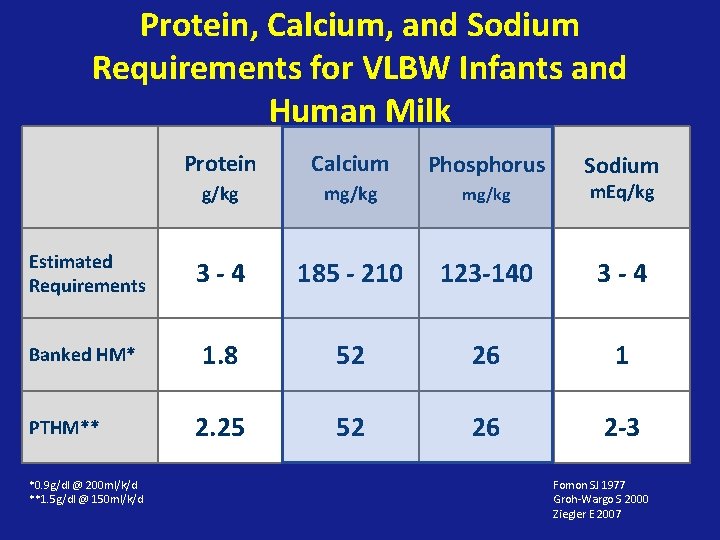
Protein, Calcium, and Sodium Requirements for VLBW Infants and Human Milk Protein Calcium Phosphorus g/kg mg/kg m. Eq/kg Estimated Requirements 3 - 4 185 - 210 123 -140 3 - 4 Banked HM* 1. 8 52 26 1 2. 25 52 26 2 -3 PTHM** *0. 9 g/dl @ 200 ml/k/d **1. 5 g/dl @ 150 ml/k/d Sodium Fomon SJ 1977 Groh-Wargo S 2000 Ziegler E 2007
Human Milk Nutrients • The high variability in nutrient content in human milk makes meeting nutrient recommendations inherently inaccurate. • Milk composition varies with volume of milk expressed, the type of milk obtained (foremilk or hindmilk), and the stage of lactation. • For example, two to three fold differences in protein, fat and hence energy have been demonstrated regardless of stage of lactation. • The creamatocrit accuracy has been challenged and the creamatocrit does not measure carbohydrate or protein.
Fortification Strategies • Standard, Fixed Dosage Enhancement • Adjustable Fortification Based on BUN • Targeted Customized, Individualized – Daily or triggered by defined need
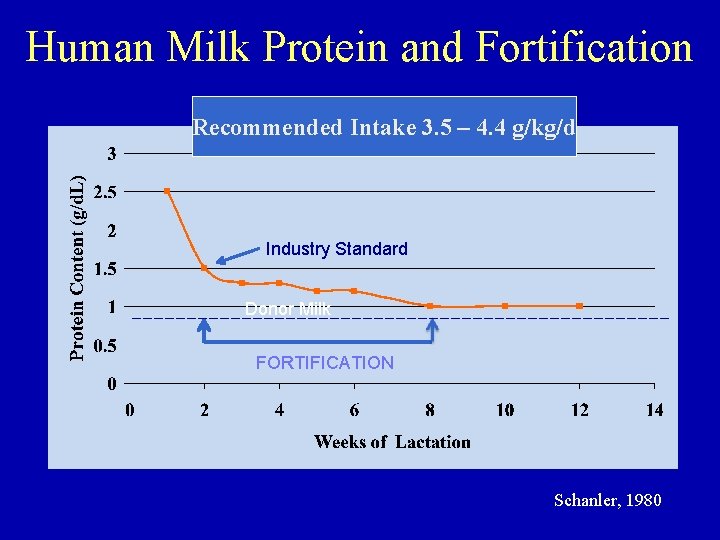
Human Milk Protein and Fortification Recommended Intake 3. 5 – 4. 4 g/kg/d Industry Standard Donor Milk FORTIFICATION Schanler, 1980
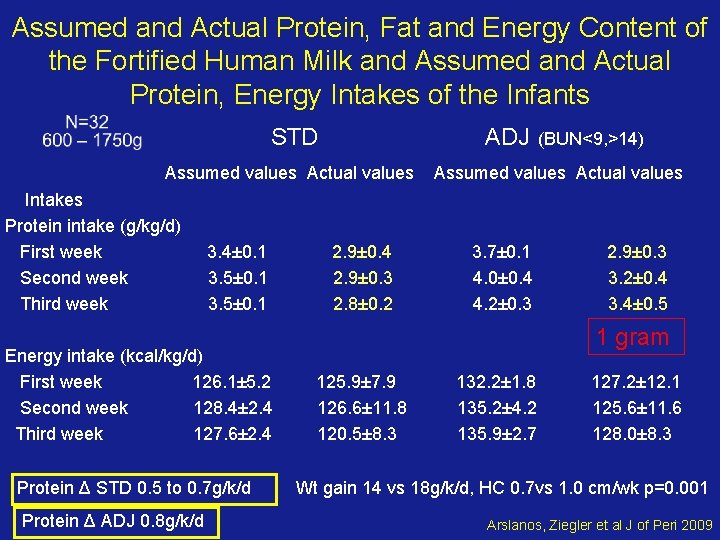
Assumed and Actual Protein, Fat and Energy Content of the Fortified Human Milk and Assumed and Actual Protein, Energy Intakes of the Infants STD ADJ (BUN<9, >14) Assumed values Actual values Intakes Protein intake (g/kg/d) First week 3. 4± 0. 1 2. 9± 0. 4 3. 7± 0. 1 2. 9± 0. 3 Second week 3. 5± 0. 1 2. 9± 0. 3 4. 0± 0. 4 3. 2± 0. 4 Third week 3. 5± 0. 1 2. 8± 0. 2 4. 2± 0. 3 3. 4± 0. 5 1 gram Energy intake (kcal/kg/d) First week 126. 1± 5. 2 125. 9± 7. 9 132. 2± 1. 8 127. 2± 12. 1 Second week 128. 4± 2. 4 126. 6± 11. 8 135. 2± 4. 2 125. 6± 11. 6 Third week 127. 6± 2. 4 120. 5± 8. 3 135. 9± 2. 7 128. 0± 8. 3 Protein Δ STD 0. 5 to 0. 7 g/k/d Wt gain 14 vs 18 g/k/d, HC 0. 7 vs 1. 0 cm/wk p=0. 001 Protein Δ ADJ 0. 8 g/k/d Arslanos, Ziegler et al J of Peri 2009
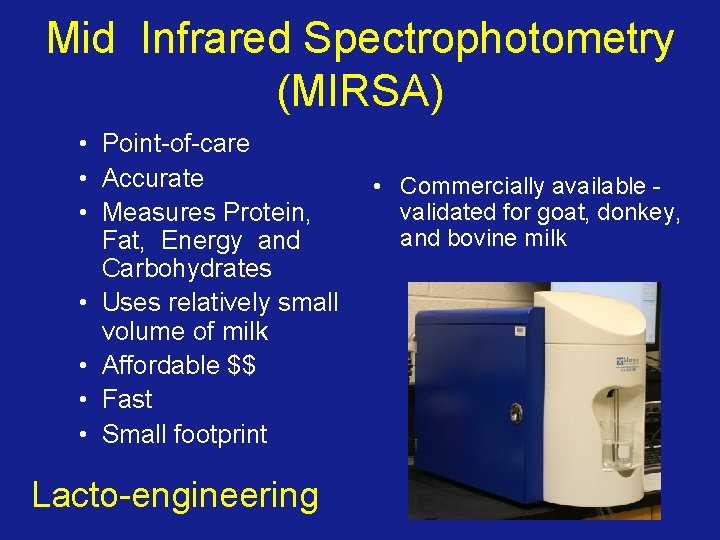
Mid Infrared Spectrophotometry (MIRSA) • Point-of-care • Accurate • Measures Protein, Fat, Energy and Carbohydrates • Uses relatively small volume of milk • Affordable $$ • Fast • Small footprint Lacto-engineering • Commercially available - validated for goat, donkey, and bovine milk
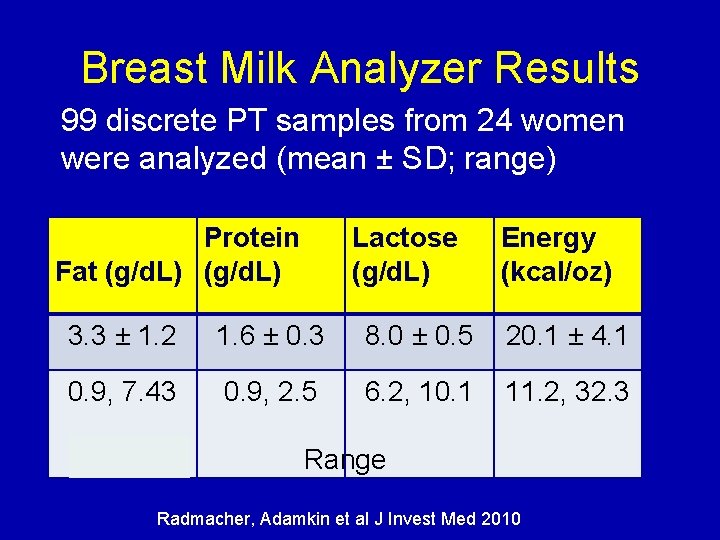
Breast Milk Analyzer Results 99 discrete PT samples from 24 women were analyzed (mean ± SD; range) Protein Fat (g/d. L) 3. 3 ± 1. 2 1. 6 ± 0. 3 Lactose (g/d. L) Energy (kcal/oz) 8. 0 ± 0. 5 20. 1 ± 4. 1 0. 9, 7. 43 0. 9, 2. 5 6. 2, 10. 1 Range 11. 2, 32. 3 Radmacher, Adamkin et al J Invest Med 2010
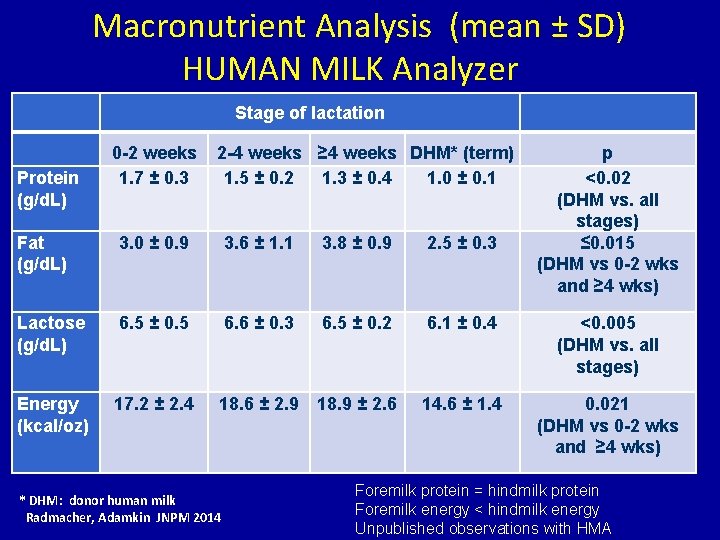
Macronutrient Analysis (mean ± SD) HUMAN MILK Analyzer Protein (g/d. L) Stage of lactation 0 -2 weeks 1. 7 ± 0. 3 2 -4 weeks ≥ 4 weeks DHM* (term) 1. 5 ± 0. 2 1. 3 ± 0. 4 1. 0 ± 0. 1 p <0. 02 (DHM vs. all stages) ≤ 0. 015 (DHM vs 0 -2 wks and ≥ 4 wks) Fat (g/d. L) 3. 0 ± 0. 9 3. 6 ± 1. 1 3. 8 ± 0. 9 2. 5 ± 0. 3 Lactose (g/d. L) 6. 5 ± 0. 5 6. 6 ± 0. 3 6. 5 ± 0. 2 6. 1 ± 0. 4 <0. 005 (DHM vs. all stages) Energy (kcal/oz) 17. 2 ± 2. 4 18. 6 ± 2. 9 18. 9 ± 2. 6 14. 6 ± 1. 4 0. 021 (DHM vs 0 -2 wks and ≥ 4 wks) * DHM: donor human milk Radmacher, Adamkin JNPM 2014 Foremilk protein = hindmilk protein Foremilk energy < hindmilk energy Unpublished observations with HMA
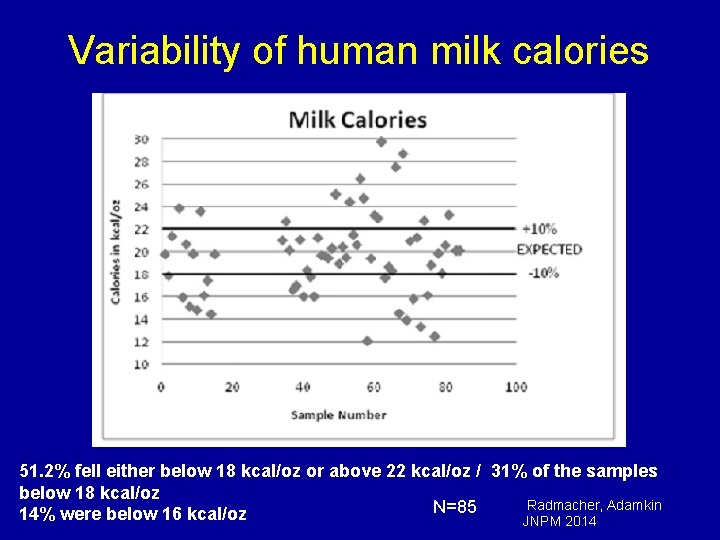
Variability of human milk calories 51. 2% fell either below 18 kcal/oz or above 22 kcal/oz / 31% of the samples below 18 kcal/oz Radmacher, Adamkin N=85 14% were below 16 kcal/oz JNPM 2014
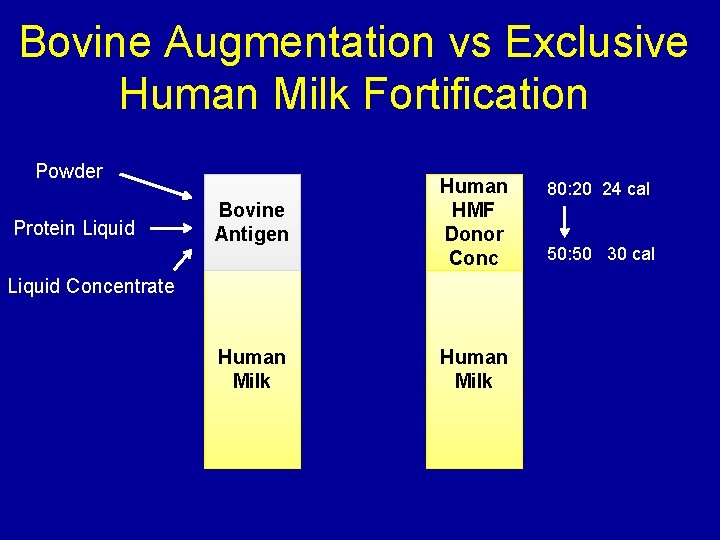
Bovine Augmentation vs Exclusive Human Milk Fortification Powder Protein Liquid Bovine Antigen Human HMF Donor Conc Human Milk Liquid Concentrate 80: 20 24 cal 50: 50 30 cal
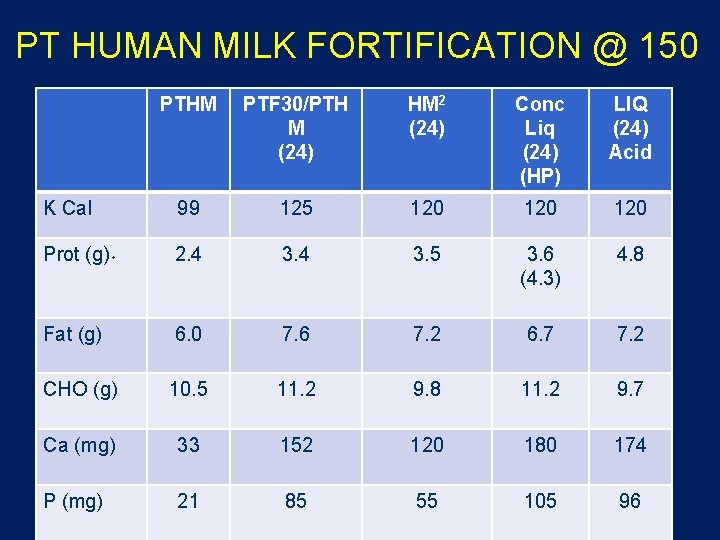
PT HUMAN MILK FORTIFICATION @ 150 PTHM PTF 30/PTH M (24) HM 2 (24) Conc Liq (24) (HP) LIQ (24) Acid K Cal 99 125 120 120 Prot (g)˖ 2. 4 3. 5 3. 6 (4. 3) 4. 8 Fat (g) 6. 0 7. 6 7. 2 6. 7 7. 2 CHO (g) 10. 5 11. 2 9. 8 11. 2 9. 7 Ca (mg) 33 152 120 180 174 55 105 96 P (mg) ( ) Cal 21 85 + assumes PTHM @ 1. 6 g/100 m. L
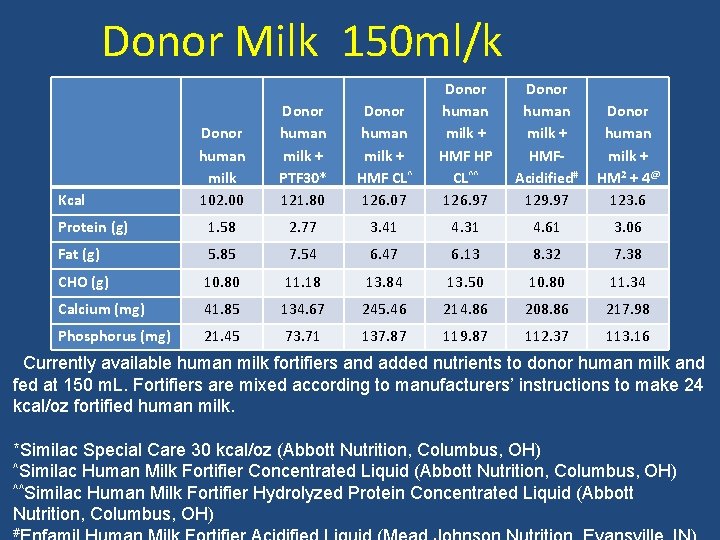
Donor Milk 150 ml/k Donor human milk 102. 00 Donor human milk + PTF 30* 121. 80 Donor human milk + HMF CL^ 126. 07 Donor human milk + HMF HP CL^^ 126. 97 Donor human milk + HMFAcidified# 129. 97 Donor human milk + HM 2 + 4@ 123. 6 Protein (g) 1. 58 2. 77 3. 41 4. 31 4. 61 3. 06 Fat (g) 5. 85 7. 54 6. 47 6. 13 8. 32 7. 38 CHO (g) 10. 80 11. 18 13. 84 13. 50 10. 80 11. 34 Calcium (mg) 41. 85 134. 67 245. 46 214. 86 208. 86 217. 98 Phosphorus (mg) 21. 45 73. 71 137. 87 119. 87 112. 37 113. 16 Kcal Currently available human milk fortifiers and added nutrients to donor human milk and fed at 150 m. L. Fortifiers are mixed according to manufacturers’ instructions to make 24 kcal/oz fortified human milk. *Similac Special Care 30 kcal/oz (Abbott Nutrition, Columbus, OH) ^Similac Human Milk Fortifier Concentrated Liquid (Abbott Nutrition, Columbus, OH) ^^Similac Human Milk Fortifier Hydrolyzed Protein Concentrated Liquid (Abbott Nutrition, Columbus, OH) #
LACTOENGINEERING
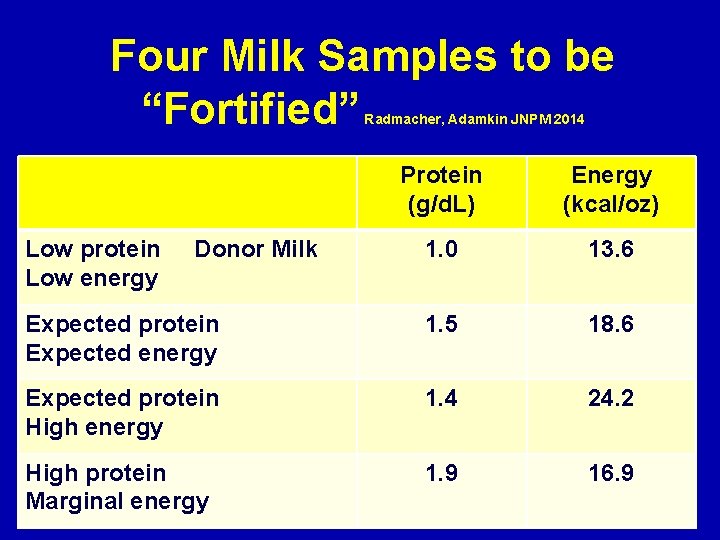
Four Milk Samples to be “Fortified” Radmacher, Adamkin JNPM 2014 Protein (g/d. L) Energy (kcal/oz) Low protein Donor Milk Low energy 1. 0 13. 6 Expected protein Expected energy 1. 5 18. 6 Expected protein High energy 1. 4 24. 2 High protein Marginal energy 1. 9 16. 9
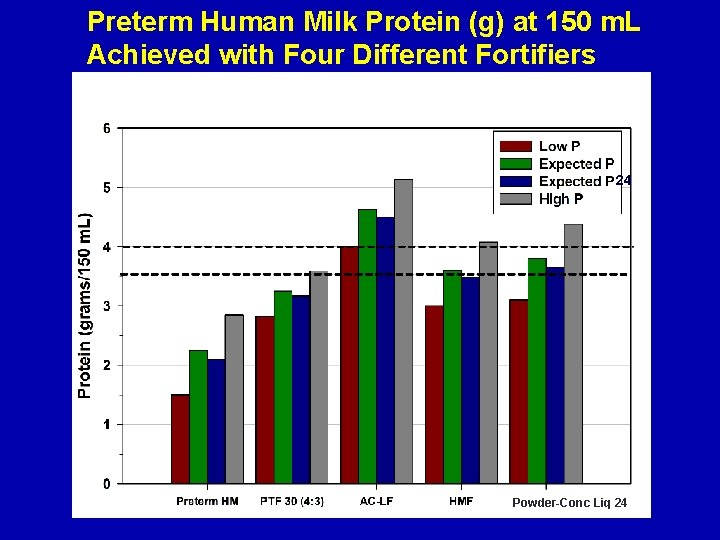
Preterm Human Milk Protein (g) at 150 m. L Achieved with Four Different Fortifiers 24 Powder-Conc Liq 24
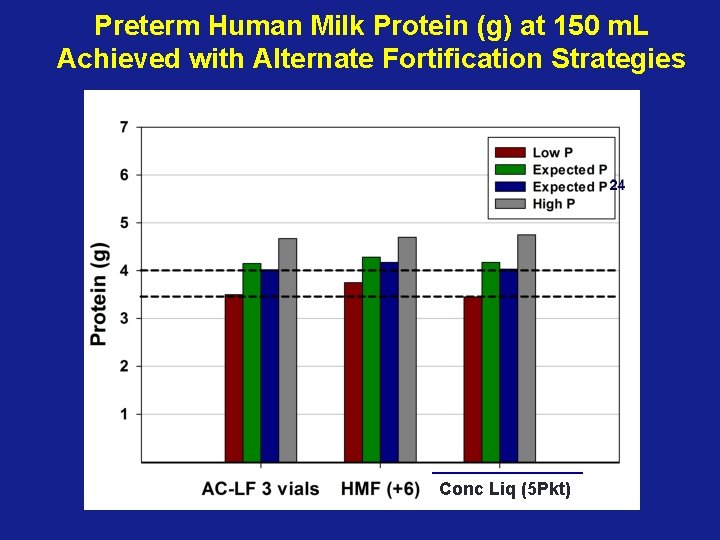
Preterm Human Milk Protein (g) at 150 m. L Achieved with Alternate Fortification Strategies Conc Liq (5 Pkt)
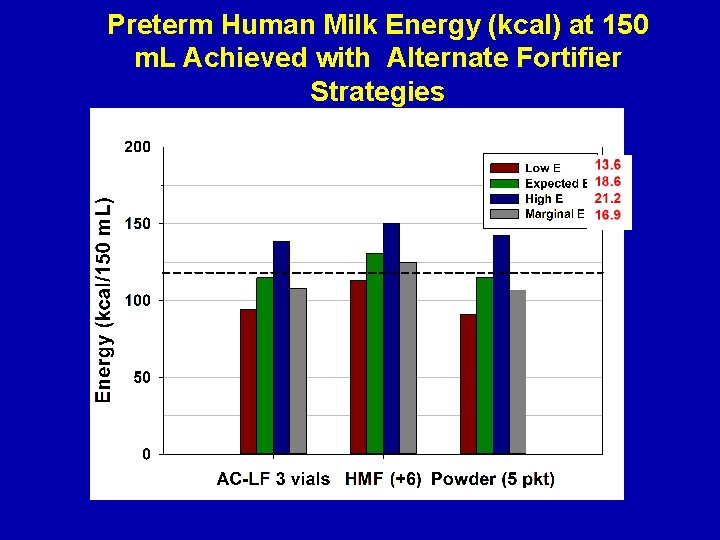
Preterm Human Milk Energy (kcal) at 150 m. L Achieved with Alternate Fortifier Strategies
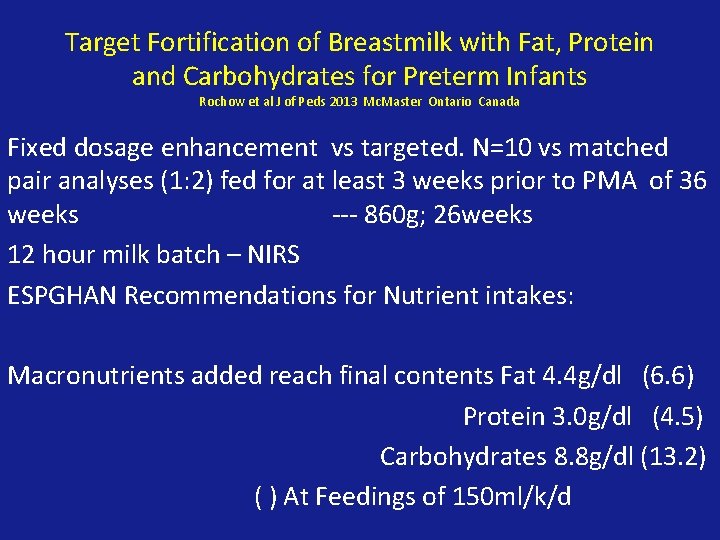
Target Fortification of Breastmilk with Fat, Protein and Carbohydrates for Preterm Infants Rochow et al J of Peds 2013 Mc. Master Ontario Canada Fixed dosage enhancement vs targeted. N=10 vs matched pair analyses (1: 2) fed for at least 3 weeks prior to PMA of 36 weeks --- 860 g; 26 weeks 12 hour milk batch – NIRS ESPGHAN Recommendations for Nutrient intakes: Macronutrients added reach final contents Fat 4. 4 g/dl (6. 6) Protein 3. 0 g/dl (4. 5) Carbohydrates 8. 8 g/dl (13. 2) ( ) At Feedings of 150 ml/k/d
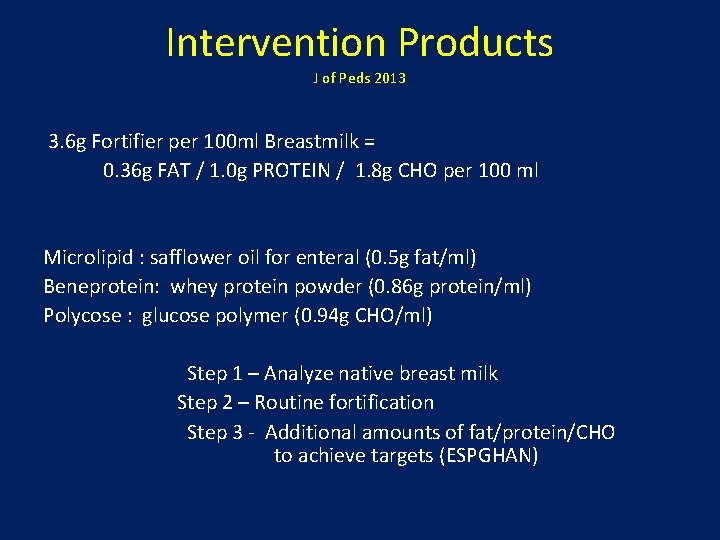
Intervention Products J of Peds 2013 3. 6 g Fortifier per 100 ml Breastmilk = 0. 36 g FAT / 1. 0 g PROTEIN / 1. 8 g CHO per 100 ml Microlipid : safflower oil for enteral (0. 5 g fat/ml) Beneprotein: whey protein powder (0. 86 g protein/ml) Polycose : glucose polymer (0. 94 g CHO/ml) Step 1 – Analyze native breast milk Step 2 – Routine fortification Step 3 - Additional amounts of fat/protein/CHO to achieve targets (ESPGHAN)
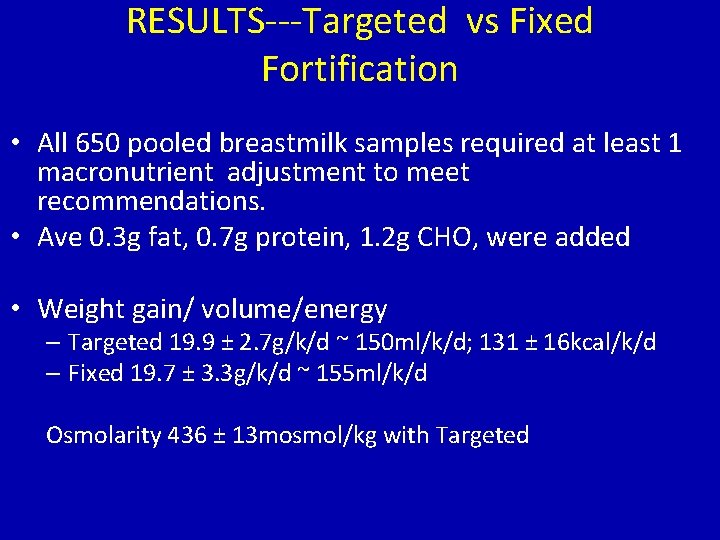
RESULTS---Targeted vs Fixed Fortification • All 650 pooled breastmilk samples required at least 1 macronutrient adjustment to meet recommendations. • Ave 0. 3 g fat, 0. 7 g protein, 1. 2 g CHO, were added • Weight gain/ volume/energy – Targeted 19. 9 ± 2. 7 g/k/d ~ 150 ml/k/d; 131 ± 16 kcal/k/d – Fixed 19. 7 ± 3. 3 g/k/d ~ 155 ml/k/d Osmolarity 436 ± 13 mosmol/kg with Targeted
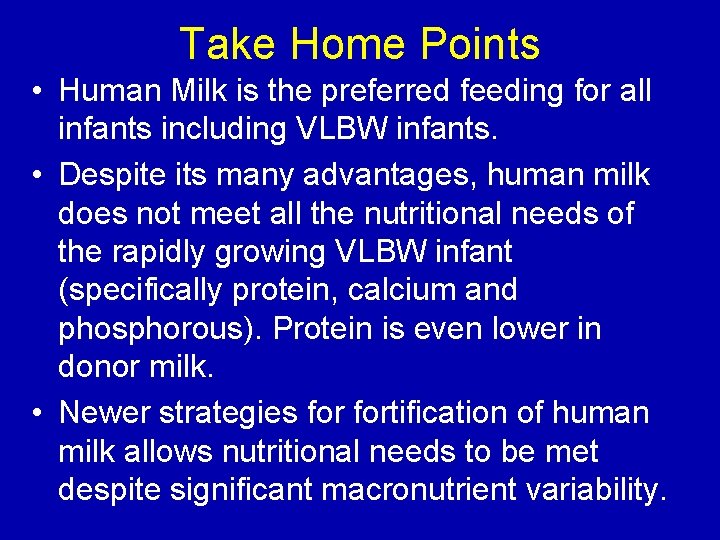
Take Home Points • Human Milk is the preferred feeding for all infants including VLBW infants. • Despite its many advantages, human milk does not meet all the nutritional needs of the rapidly growing VLBW infant (specifically protein, calcium and phosphorous). Protein is even lower in donor milk. • Newer strategies fortification of human milk allows nutritional needs to be met despite significant macronutrient variability.
- Slides: 26