
CUSTOMER RELATIONSHIP MANAGEMENT CONCEPTS AND TECHNOLOGIES Chapter 4
- Slides: 26
CUSTOMER RELATIONSHIP MANAGEMENT CONCEPTS AND TECHNOLOGIES Chapter 4 Developing, Managing and Using Customer-related Databases
Why customer-related data are important v All forms of CRM – strategic, operational, analytical and collaborative – rely on customer-related data v Customer-related databases are the foundation for the execution of CRM strategy. v Proficiency at acquiring, enhancing, storing, distributing and using customer-related data is critical to CRM performance
What are customer-related data? v Customer-related data is anything pertinent to the development and maintenance of customer relationships. v Customer-related data can have a current, past or future perspective ● focussing upon current opportunities, historic sales, or potential opportunities. v Customer-related data might be about individual customers, customer cohorts, customer segments, market segments or entire markets. v Customer-related data might also contain product information, competitor information, regulatory data
Where can you find customer–related data? v In functional areas ● sales, marketing, service, logistics and accounts ● each serving different operational purposes. ● each recording different customer-related data – opportunities, campaigns, enquiries, deliveries, and billing. v In channel silos ● company-owned retail stores, third-party retail outlets and online retail, for example. v In product silos ● different product managers might maintain their own customer-related data.
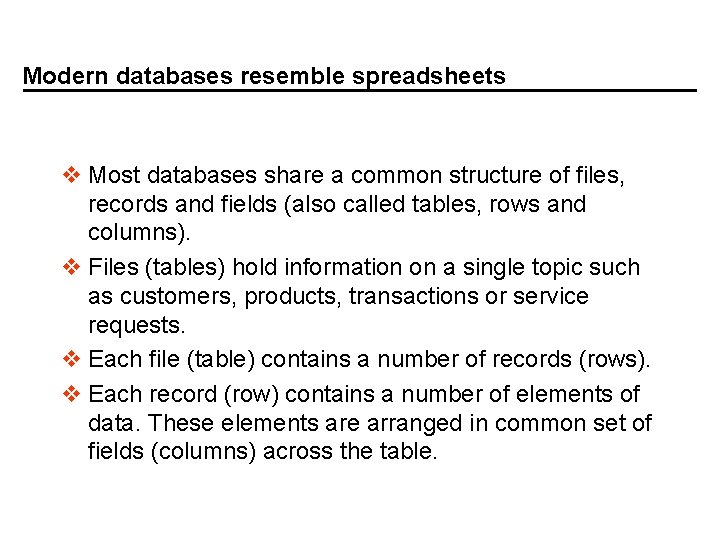
Modern databases resemble spreadsheets v Most databases share a common structure of files, records and fields (also called tables, rows and columns). v Files (tables) hold information on a single topic such as customers, products, transactions or service requests. v Each file (table) contains a number of records (rows). v Each record (row) contains a number of elements of data. These elements are arranged in common set of fields (columns) across the table.
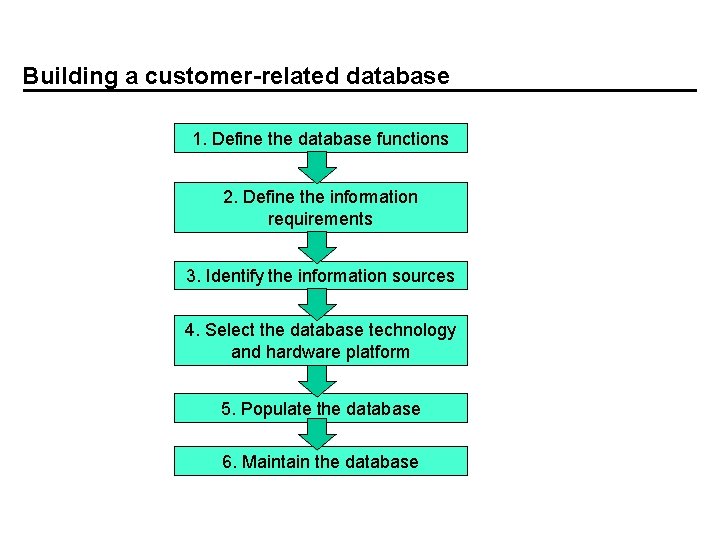
Building a customer-related database 1. Define the database functions 2. Define the information requirements 3. Identify the information sources 4. Select the database technology and hardware platform 5. Populate the database 6. Maintain the database
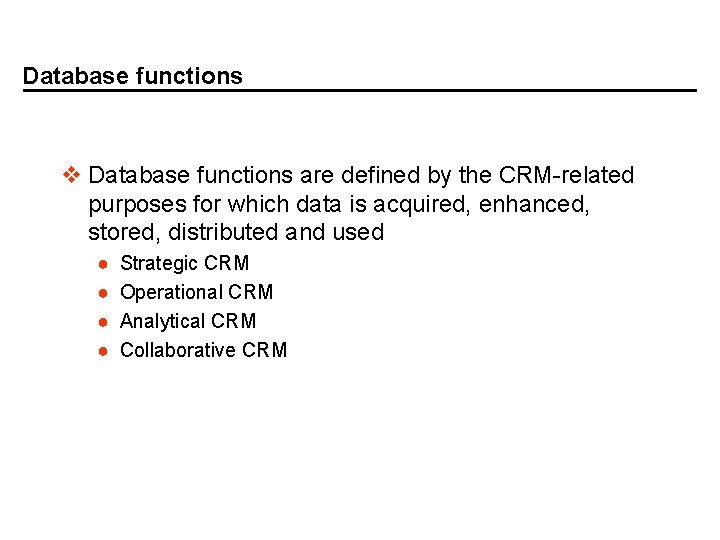
Database functions v Database functions are defined by the CRM-related purposes for which data is acquired, enhanced, stored, distributed and used ● ● Strategic CRM Operational CRM Analytical CRM Collaborative CRM
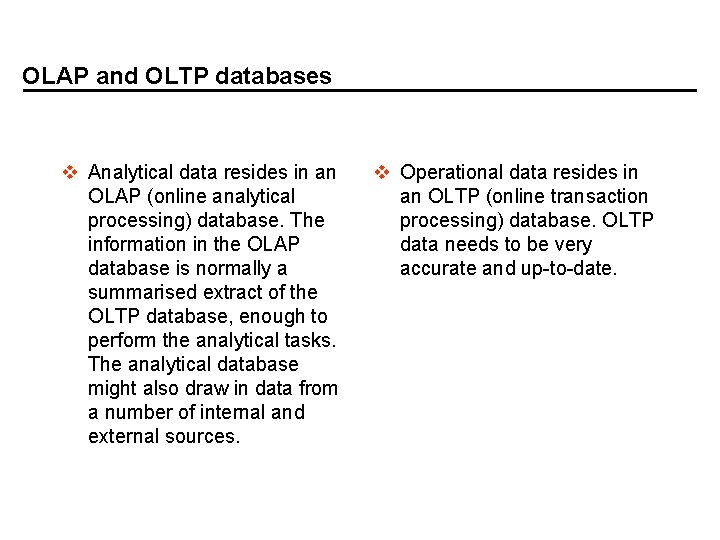
OLAP and OLTP databases v Analytical data resides in an OLAP (online analytical processing) database. The information in the OLAP database is normally a summarised extract of the OLTP database, enough to perform the analytical tasks. The analytical database might also draw in data from a number of internal and external sources. v Operational data resides in an OLTP (online transaction processing) database. OLTP data needs to be very accurate and up-to-date.
Define the information requirements v The people best placed to answer the question ‘what information is needed? ’ are those who interact with, or communicate with, customers for sales, marketing and service purposes, and those who have to make strategic CRM decisions. v Many packaged CRM software applications come with industry-specific data models.
Identify the information sources v Internal and external sources v Internal: marketing, sales, service, finance v Data audit before data acquisition v Internal data are the foundation of most CRM programs. v The amount of information available about customers depends upon the degree of customer contact
Common customer information fields v contact data v contact history v transactional history v current pipeline v future opportunities v communication preferences v service history
Enhancing the data v External data can be used to enhance the internal data v External data can be imported from a number of sources including market research companies and marketing database companies. v 3 main classes of external data ● compiled list data ● census data ● modelled data
Secondary and primary data v Secondary data are data that have already been collected, perhaps for a purpose that is very different from your CRM requirement. v Primary data are data that are collected for the first time, either for CRM or other purposes.
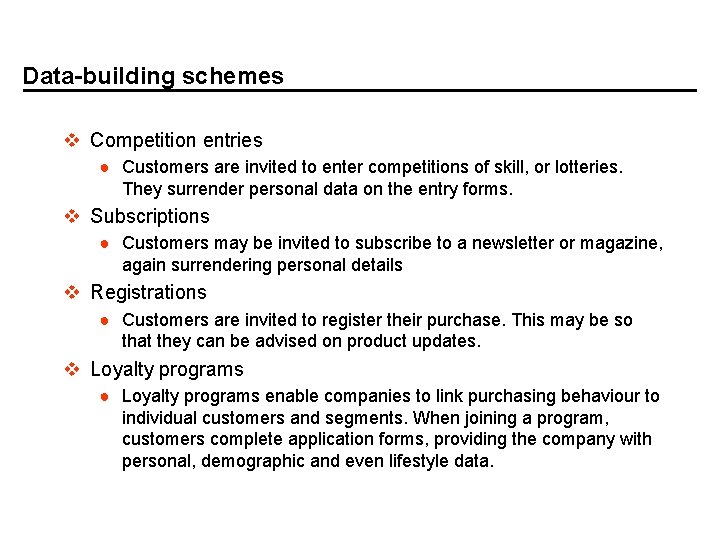
Data-building schemes v Competition entries ● Customers are invited to enter competitions of skill, or lotteries. They surrender personal data on the entry forms. v Subscriptions ● Customers may be invited to subscribe to a newsletter or magazine, again surrendering personal details v Registrations ● Customers are invited to register their purchase. This may be so that they can be advised on product updates. v Loyalty programs ● Loyalty programs enable companies to link purchasing behaviour to individual customers and segments. When joining a program, customers complete application forms, providing the company with personal, demographic and even lifestyle data.
Types of database v hierarchical v network v relational
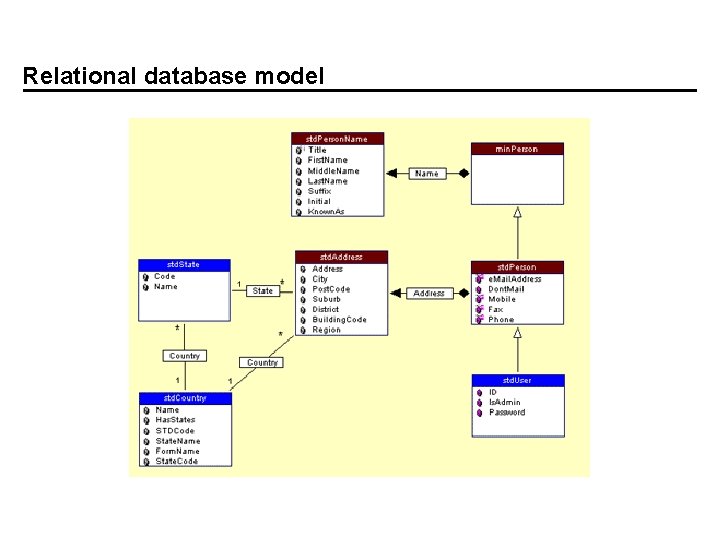
Relational database model
Considerations in the choice of hardware platform v The size of the databases ● Even standard desktop PCs are capable of storing huge amounts of customer-related data. v Existing technology ● Most companies will already have technology that lends itself to database applications. v The number and location of users ● Many CRM applications are quite simple, but in an increasingly global market place the hardware may need very careful specification and periodic review.
Relational database management system (RDBMS) v An RDBMS is a software program that allows users to create, update and administer a relational database. v Leading RDBMS products are Oracle, DB 2 from IBM, and Microsoft’s SQL server. v Most RDBMS products use SQL to access, update and query the database. v Modern database applications come together with their own database schema, which predetermines the tables and columns in the database structure. v Each CRM vendor supports a specified list of database technologies
Processes in populating the database 1. 2. 3. 4. verify the data validate the data de-duplicate the data merge and purge data from 2 or more sources
Database degradation v 19% of managing directors change jobs in any year v 8% of businesses relocate in any year v In the UK, 5% of post-codes change in an average year v In western economies about 1. 2% of the population dies each year v In the USA, over 40 million people change addresses each year
Desirable data attributes: STARTS v Sharable v Transportable v Accurate v Relevant v Timely v Secure
Data warehouse attributes v Subject-oriented ● the warehouse organises data around the essential subjects of the business – customers and products - rather than around applications v Integrated ● It is consistent in the way that data from several sources is extracted and transformed v Time-variant ● Data are organised by various time-periods (e. g. months) v Non-volatile ● The warehouse’s database is not updated in real time. There is periodic bulk uploading of transactional and other data.
Data access v standard reports v database queries v data mining
Data mining definition v Data mining is the application of descriptive and predictive analytics to support the marketing, sales and service functions
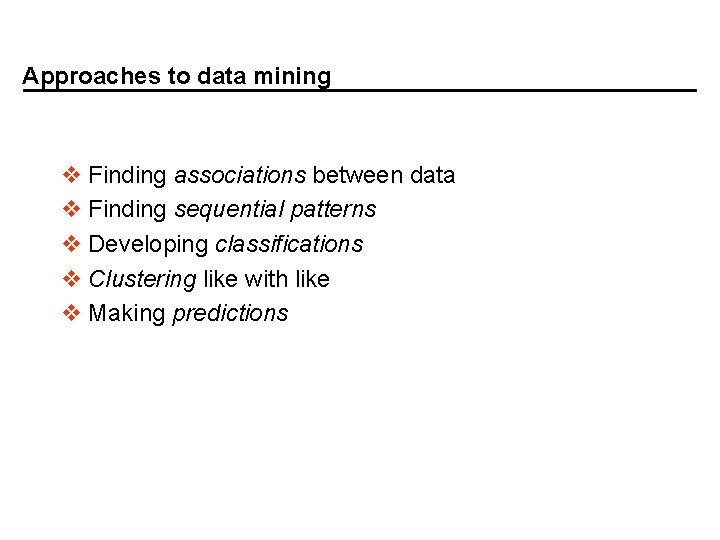
Approaches to data mining v Finding associations between data v Finding sequential patterns v Developing classifications v Clustering like with like v Making predictions
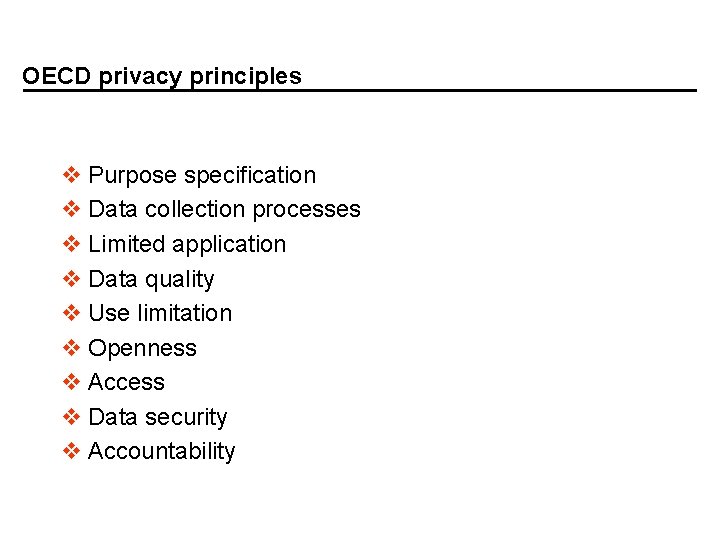
OECD privacy principles v Purpose specification v Data collection processes v Limited application v Data quality v Use limitation v Openness v Access v Data security v Accountability