
Customer Relationship Management and Customer Loyalty in the
- Slides: 13
Customer Relationship Management and Customer Loyalty in the Casino Industry: A Quantitative Correlational Study Sharon K Stroburg, DBA Chris Roberts, Ph. D
Problem Statement • The general problem is the casino reinvestment rate to maintain customer loyalty increased from 18 -28% in 2005 to 25 -43% by 2009, and it remains unknown if CRM programs, which comprise a significant portion of the casino reinvestment rate, have a positive correlation with customer loyalty (Klebanow, 2009). • The specific problem is that the increasing reinvestment rates to maintain customers may cause profit margins to decline, and the correlation of direct mail CRM with customer loyalty in the local or regional casino market, where loyalty refers to frequency of visits and customer value, remains unknown. • A gap exists in the literature regarding a general understanding of the relationship among CRM programs, loyalty, and profitability in an experience-based industry where reward for spending has become an expectation. 2
Purpose Statement • To determine if relationships existed among direct mail CRM programs and casino loyalty and in a selected local or regional casino within the commercial U. S. casino industry. 3
Research Questions • RQ 1: How does the mailing of a direct mail piece within a CRM program (DMM) correlate with casino customer loyalty as determined by casino customer frequency of visitation (CV)? • RQ 2: How does redemption of a direct mail piece within a direct mail CRM program (DMR) correlate with casino customer loyalty as determined by casino customer frequency of visitation (CV)? • RQ 3: How does mailing a direct mail piece within a CRM program (DMM) correlate with casino customer loyalty as determined by casino customer average amount spent per visit (ADT)? • RQ 4: How does redemption of a direct mail piece within a CRM program (DMR) correlate with casino customer loyalty as determined by casino customer average amount spent per visit (ADT)? 4
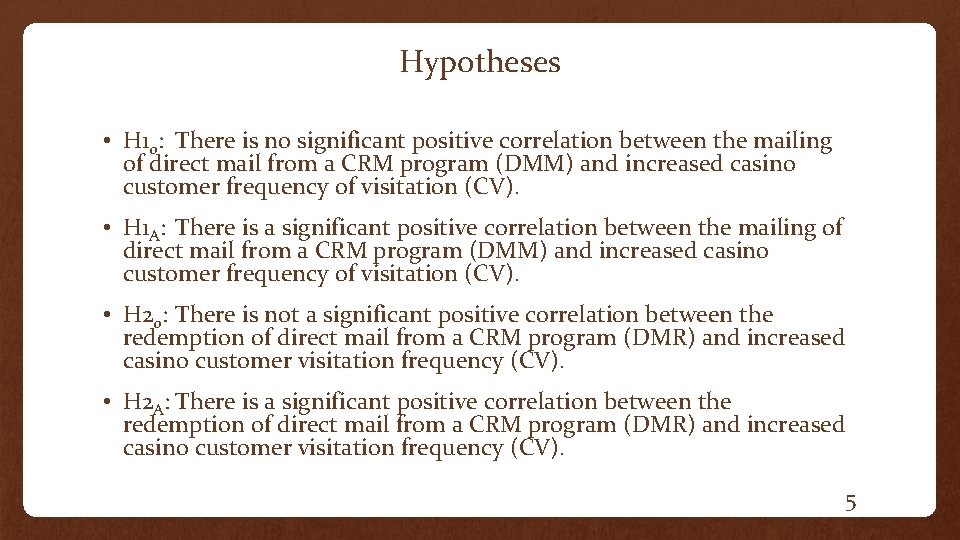
Hypotheses • H 10: There is no significant positive correlation between the mailing of direct mail from a CRM program (DMM) and increased casino customer frequency of visitation (CV). • H 1 A: There is a significant positive correlation between the mailing of direct mail from a CRM program (DMM) and increased casino customer frequency of visitation (CV). • H 20: There is not a significant positive correlation between the redemption of direct mail from a CRM program (DMR) and increased casino customer visitation frequency (CV). • H 2 A: There is a significant positive correlation between the redemption of direct mail from a CRM program (DMR) and increased casino customer visitation frequency (CV). 5
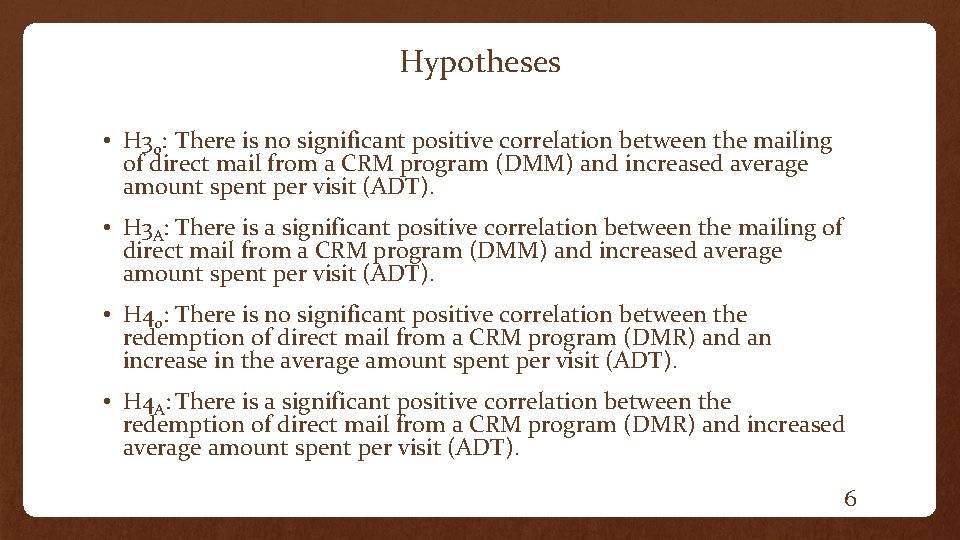
Hypotheses • H 30: There is no significant positive correlation between the mailing of direct mail from a CRM program (DMM) and increased average amount spent per visit (ADT). • H 3 A: There is a significant positive correlation between the mailing of direct mail from a CRM program (DMM) and increased average amount spent per visit (ADT). • H 40: There is no significant positive correlation between the redemption of direct mail from a CRM program (DMR) and an increase in the average amount spent per visit (ADT). • H 4 A: There is a significant positive correlation between the redemption of direct mail from a CRM program (DMR) and increased average amount spent per visit (ADT). 6
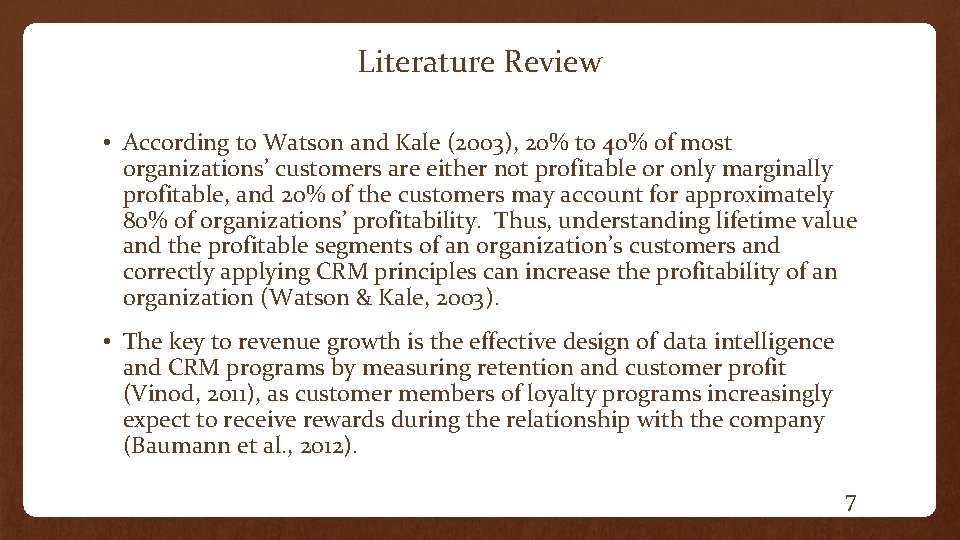
Literature Review • According to Watson and Kale (2003), 20% to 40% of most organizations’ customers are either not profitable or only marginally profitable, and 20% of the customers may account for approximately 80% of organizations’ profitability. Thus, understanding lifetime value and the profitable segments of an organization’s customers and correctly applying CRM principles can increase the profitability of an organization (Watson & Kale, 2003). • The key to revenue growth is the effective design of data intelligence and CRM programs by measuring retention and customer profit (Vinod, 2011), as customer members of loyalty programs increasingly expect to receive rewards during the relationship with the company (Baumann et al. , 2012). 7
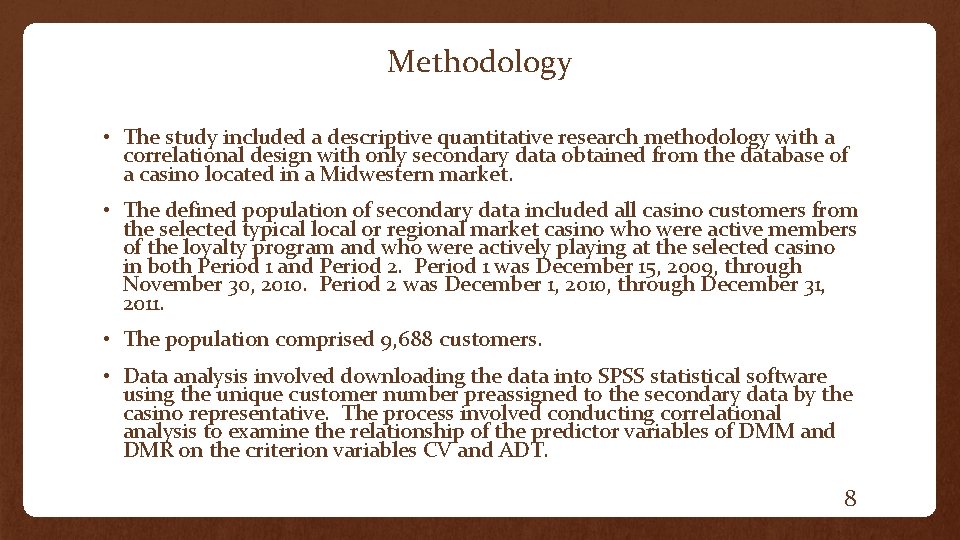
Methodology • The study included a descriptive quantitative research methodology with a correlational design with only secondary data obtained from the database of a casino located in a Midwestern market. • The defined population of secondary data included all casino customers from the selected typical local or regional market casino who were active members of the loyalty program and who were actively playing at the selected casino in both Period 1 and Period 2. Period 1 was December 15, 2009, through November 30, 2010. Period 2 was December 1, 2010, through December 31, 2011. • The population comprised 9, 688 customers. • Data analysis involved downloading the data into SPSS statistical software using the unique customer number preassigned to the secondary data by the casino representative. The process involved conducting correlational analysis to examine the relationship of the predictor variables of DMM and DMR on the criterion variables CV and ADT. 8
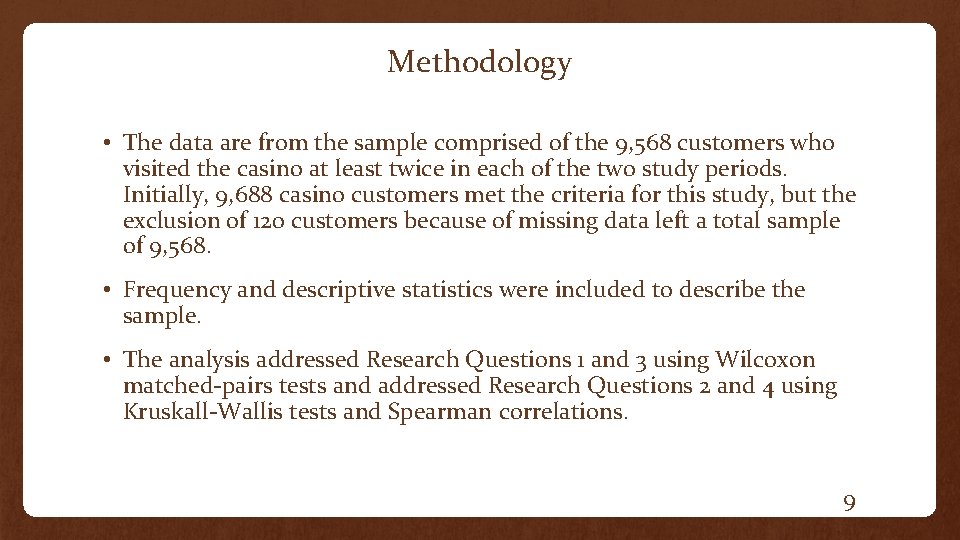
Methodology • The data are from the sample comprised of the 9, 568 customers who visited the casino at least twice in each of the two study periods. Initially, 9, 688 casino customers met the criteria for this study, but the exclusion of 120 customers because of missing data left a total sample of 9, 568. • Frequency and descriptive statistics were included to describe the sample. • The analysis addressed Research Questions 1 and 3 using Wilcoxon matched-pairs tests and addressed Research Questions 2 and 4 using Kruskall-Wallis tests and Spearman correlations. 9
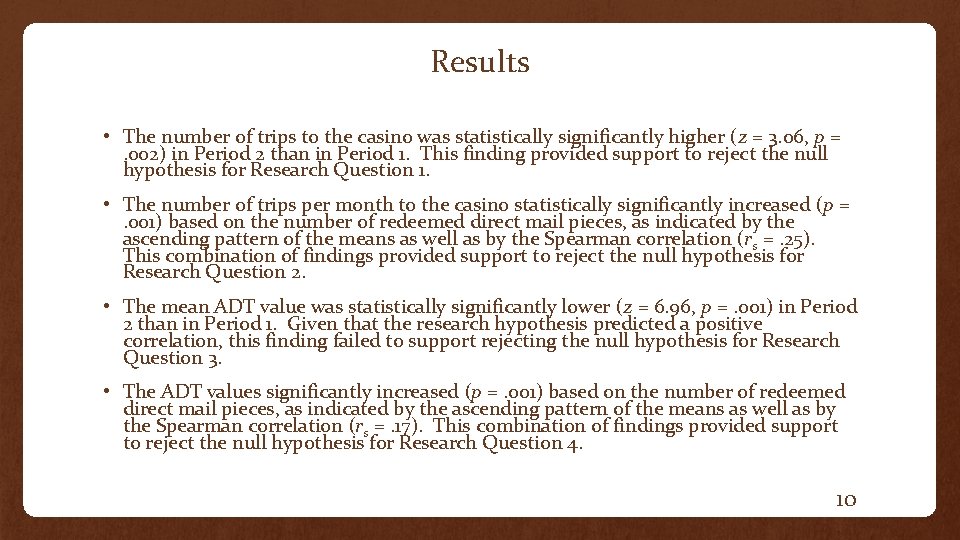
Results • The number of trips to the casino was statistically significantly higher (z = 3. 06, p =. 002) in Period 2 than in Period 1. This finding provided support to reject the null hypothesis for Research Question 1. • The number of trips per month to the casino statistically significantly increased (p =. 001) based on the number of redeemed direct mail pieces, as indicated by the ascending pattern of the means as well as by the Spearman correlation (rs =. 25). This combination of findings provided support to reject the null hypothesis for Research Question 2. • The mean ADT value was statistically significantly lower (z = 6. 96, p =. 001) in Period 2 than in Period 1. Given that the research hypothesis predicted a positive correlation, this finding failed to support rejecting the null hypothesis for Research Question 3. • The ADT values significantly increased (p =. 001) based on the number of redeemed direct mail pieces, as indicated by the ascending pattern of the means as well as by the Spearman correlation (rs =. 17). This combination of findings provided support to reject the null hypothesis for Research Question 4. 10
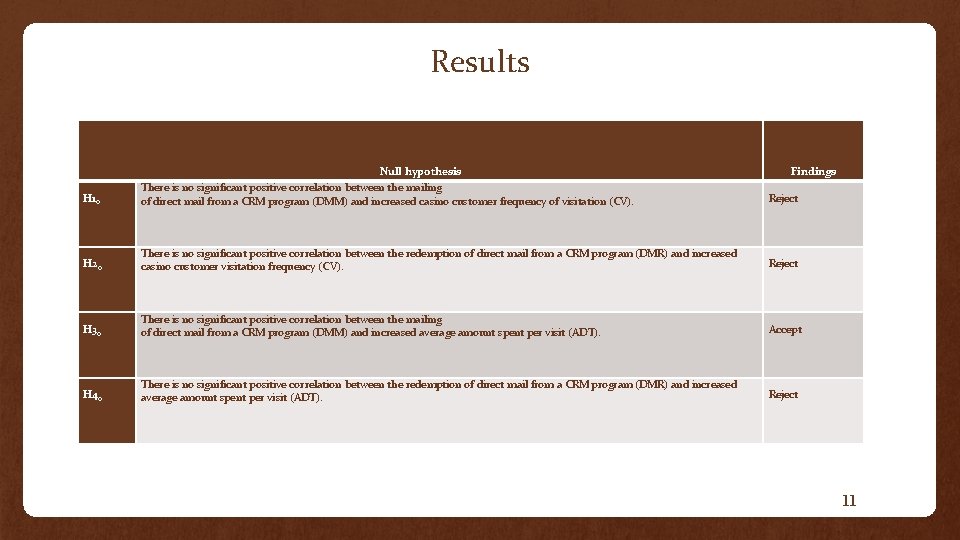
Results H 10 Null hypothesis There is no significant positive correlation between the mailing of direct mail from a CRM program (DMM) and increased casino customer frequency of visitation (CV). Findings Reject H 20 There is no significant positive correlation between the redemption of direct mail from a CRM program (DMR) and increased casino customer visitation frequency (CV). Reject H 30 There is no significant positive correlation between the mailing of direct mail from a CRM program (DMM) and increased average amount spent per visit (ADT). Accept H 40 There is no significant positive correlation between the redemption of direct mail from a CRM program (DMR) and increased average amount spent per visit (ADT). Reject 11
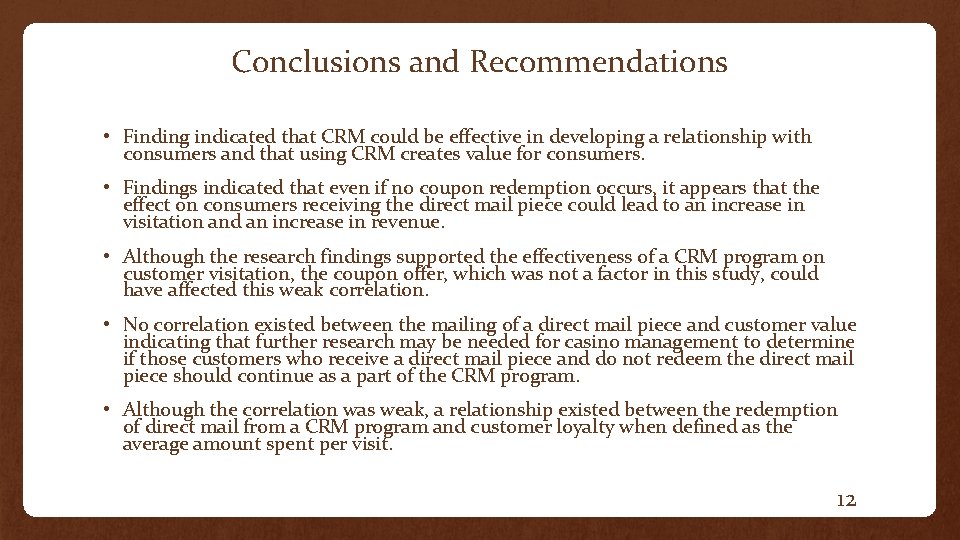
Conclusions and Recommendations • Finding indicated that CRM could be effective in developing a relationship with consumers and that using CRM creates value for consumers. • Findings indicated that even if no coupon redemption occurs, it appears that the effect on consumers receiving the direct mail piece could lead to an increase in visitation and an increase in revenue. • Although the research findings supported the effectiveness of a CRM program on customer visitation, the coupon offer, which was not a factor in this study, could have affected this weak correlation. • No correlation existed between the mailing of a direct mail piece and customer value indicating that further research may be needed for casino management to determine if those customers who receive a direct mail piece and do not redeem the direct mail piece should continue as a part of the CRM program. • Although the correlation was weak, a relationship existed between the redemption of direct mail from a CRM program and customer loyalty when defined as the average amount spent per visit. 12
Key References Baumann, C. , Elliott, G. , & Burton, S. (2012). Modeling customer satisfaction and loyalty: Survey data versus data mining. Journal of Services Marketing, 26(3), 148 -157. doi: 10. 1108/08876041211223951 Klebanow, A. (2009). Customer reinvestment analysis in the gaming industry. Worldwide Hospitality and Tourism Themes, 1, 386 -391. doi: 10. 1108/17554210911002228 Vinod, B. (2011). Unleashing the power of loyalty programs: The next 30 years. Journal of Revenue and Pricing Management, 10, 471 -476. doi: 10. 1057/rpm. 2011. 11 Watson, L. , & Kale, S. H. (2003). Know when to hold them: Applying the customer lifetime value concept to casino table gaming. International Gambling Studies, 3, 89 -101. doi: 10. 1080/14459790304587 13