
Custom Animations A few examples Animation with Crisscross

- Slides: 31
Custom Animations A few examples
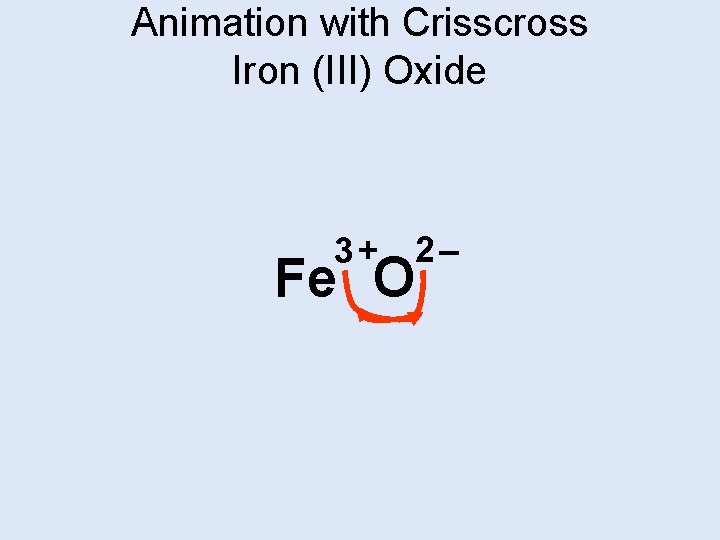
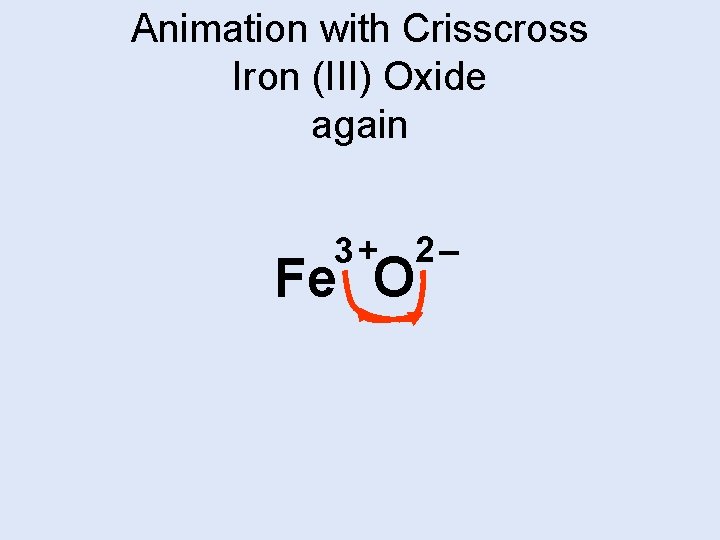
Animation with Crisscross Iron (III) Oxide 3+ Fe O 2–
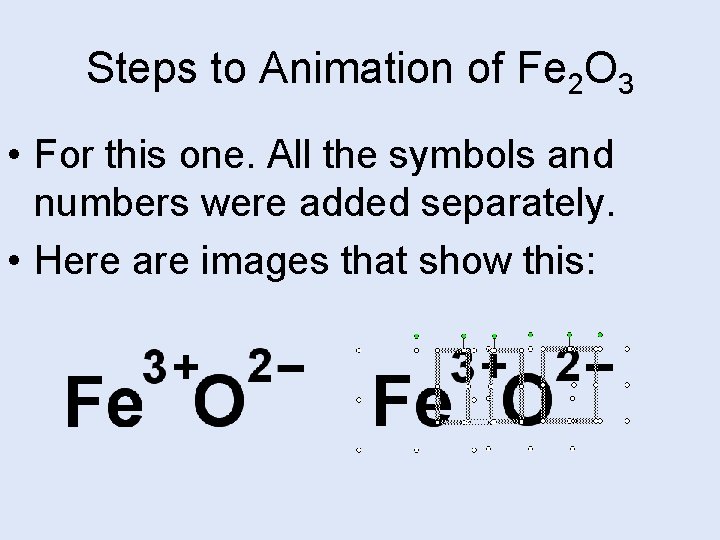
Steps to Animation of Fe 2 O 3 • For this one. All the symbols and numbers were added separately. • Here are images that show this:
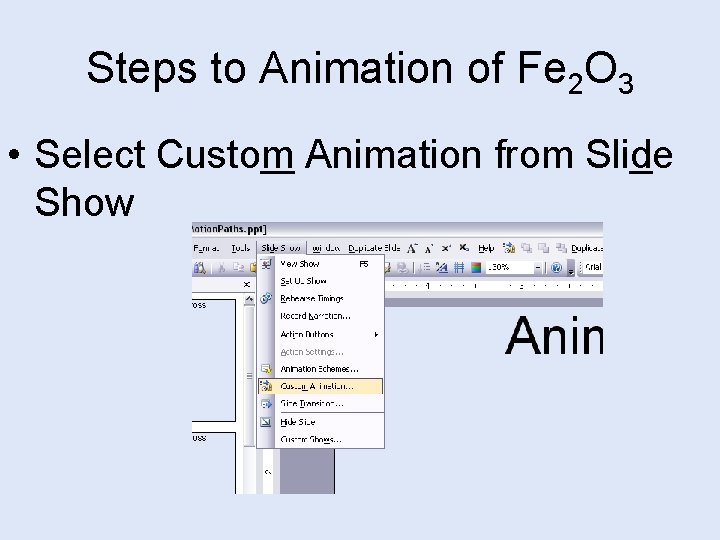
Steps to Animation of Fe 2 O 3 • Select Custom Animation from Slide Show
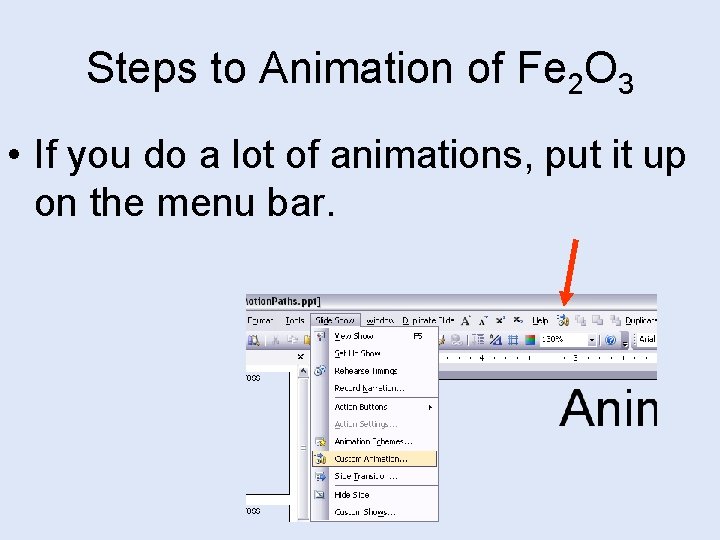
Steps to Animation of Fe 2 O 3 • If you do a lot of animations, put it up on the menu bar.
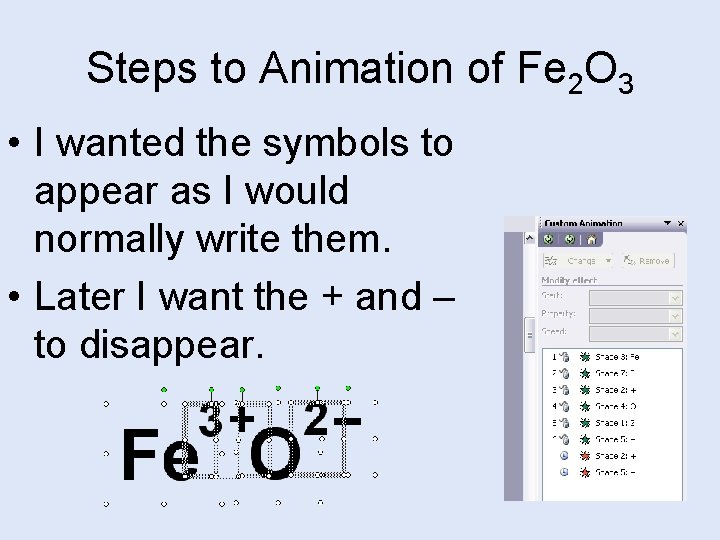
Steps to Animation of Fe 2 O 3 • I wanted the symbols to appear as I would normally write them. • Later I want the + and – to disappear.
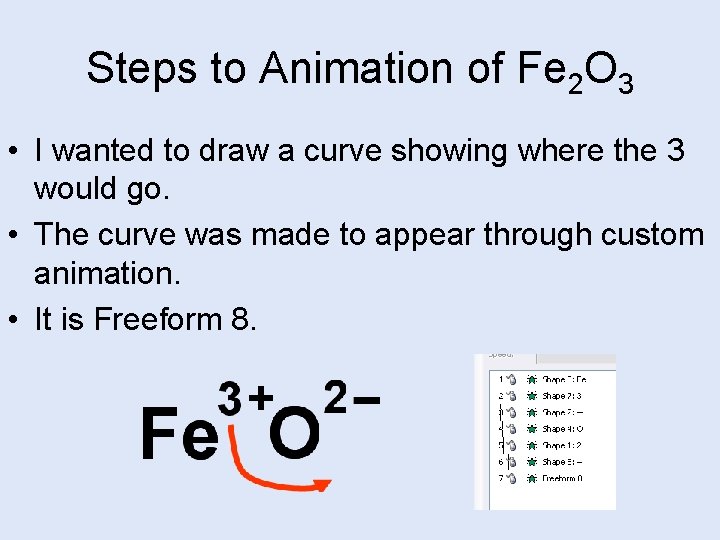
Steps to Animation of Fe 2 O 3 • I wanted to draw a curve showing where the 3 would go. • The curve was made to appear through custom animation. • It is Freeform 8.
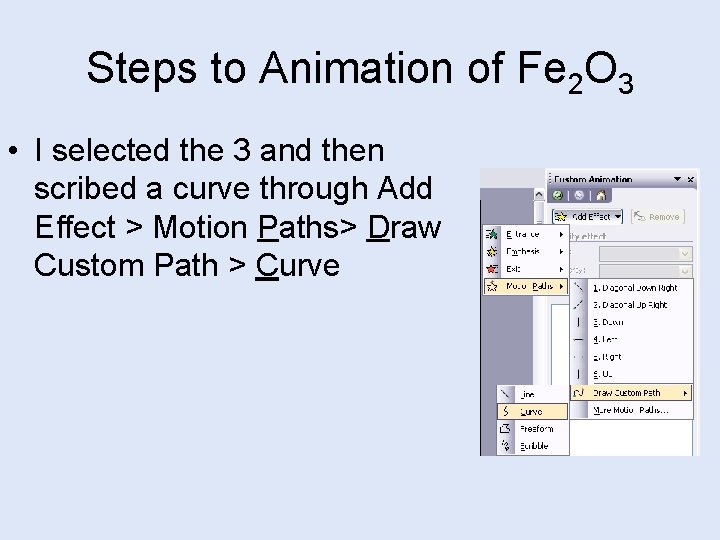
Steps to Animation of Fe 2 O 3 • I selected the 3 and then scribed a curve through Add Effect > Motion Paths> Draw Custom Path > Curve
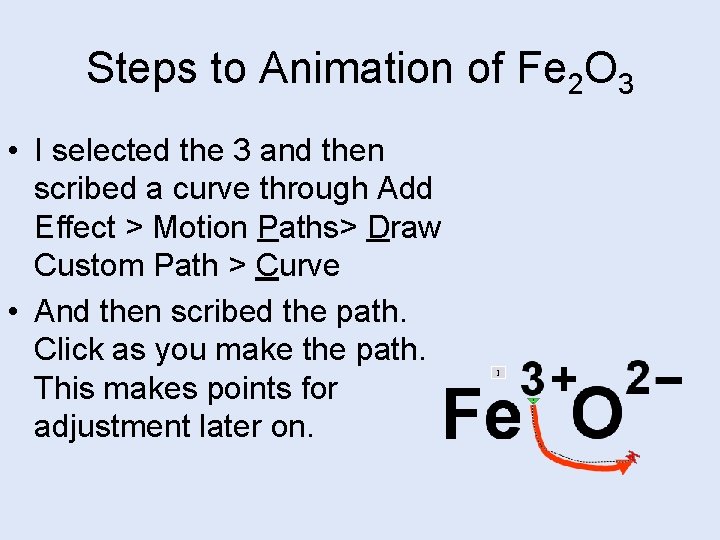
Steps to Animation of Fe 2 O 3 • I selected the 3 and then scribed a curve through Add Effect > Motion Paths> Draw Custom Path > Curve • And then scribed the path. Click as you make the path. This makes points for adjustment later on.
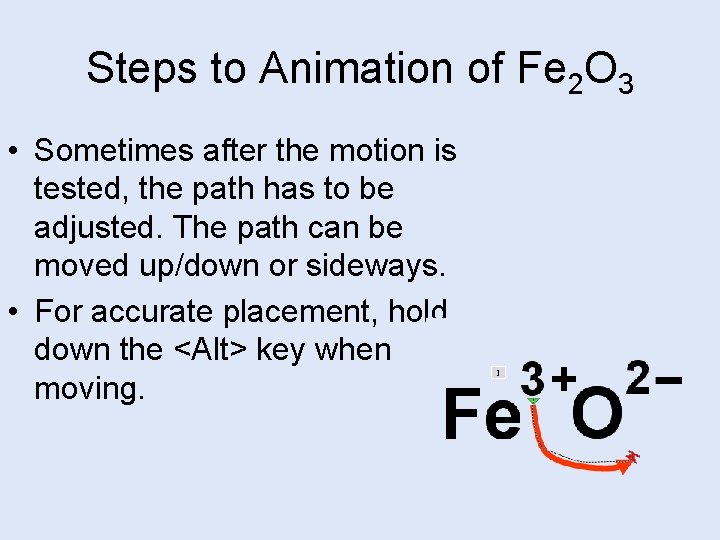
Steps to Animation of Fe 2 O 3 • Sometimes after the motion is tested, the path has to be adjusted. The path can be moved up/down or sideways. • For accurate placement, hold down the <Alt> key when moving.
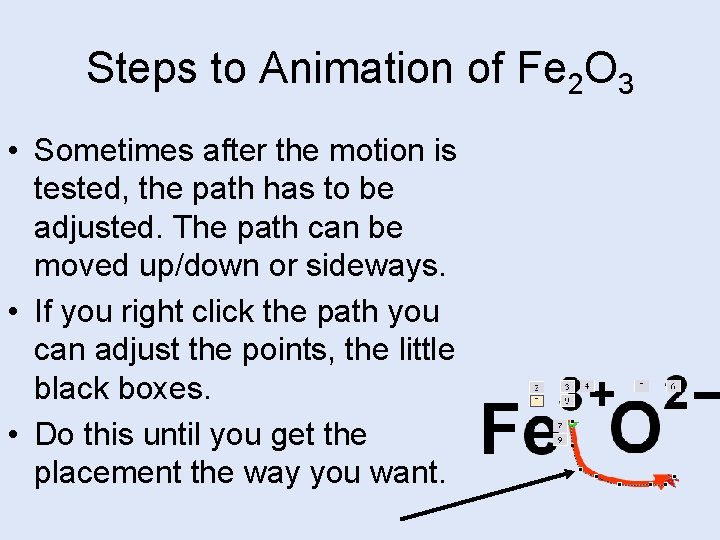
Steps to Animation of Fe 2 O 3 • Sometimes after the motion is tested, the path has to be adjusted. The path can be moved up/down or sideways. • If you right click the path you can adjust the points, the little black boxes. • Do this until you get the placement the way you want.
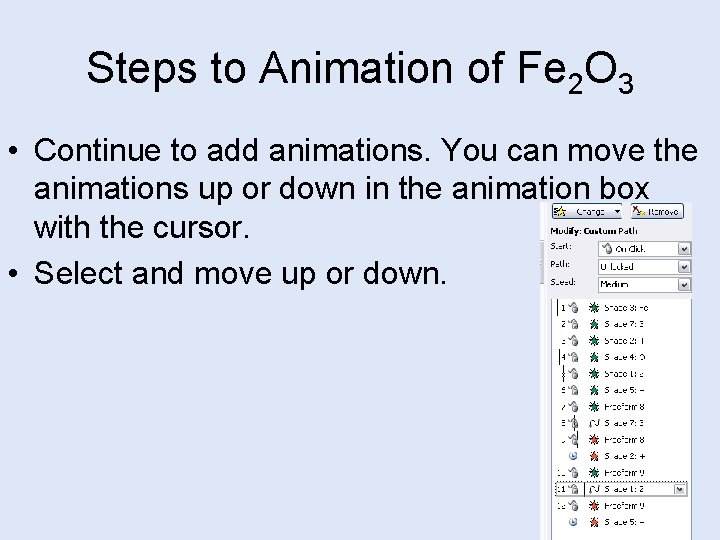
Steps to Animation of Fe 2 O 3 • Continue to add animations. You can move the animations up or down in the animation box with the cursor. • Select and move up or down.
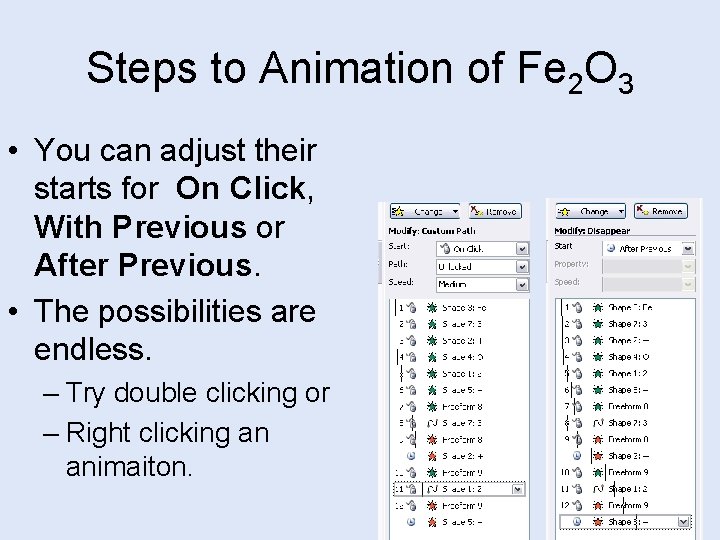
Steps to Animation of Fe 2 O 3 • You can adjust their starts for On Click, With Previous or After Previous. • The possibilities are endless. – Try double clicking or – Right clicking an animaiton.
Animation with Crisscross Iron (III) Oxide again 3+ Fe O 2–
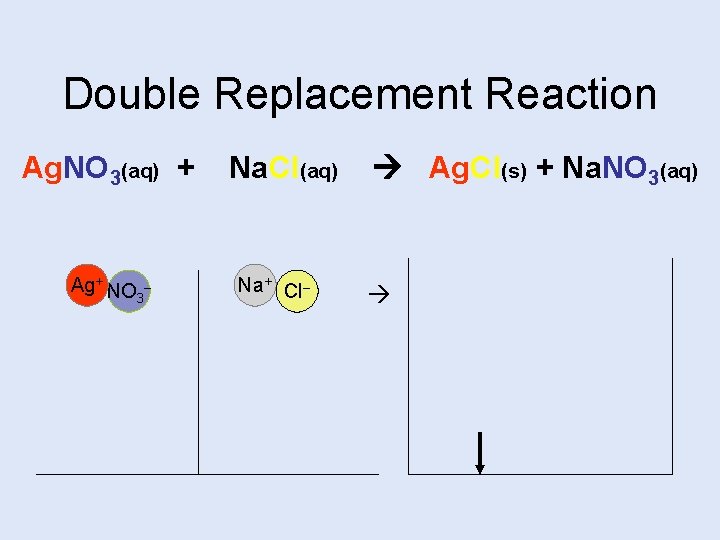
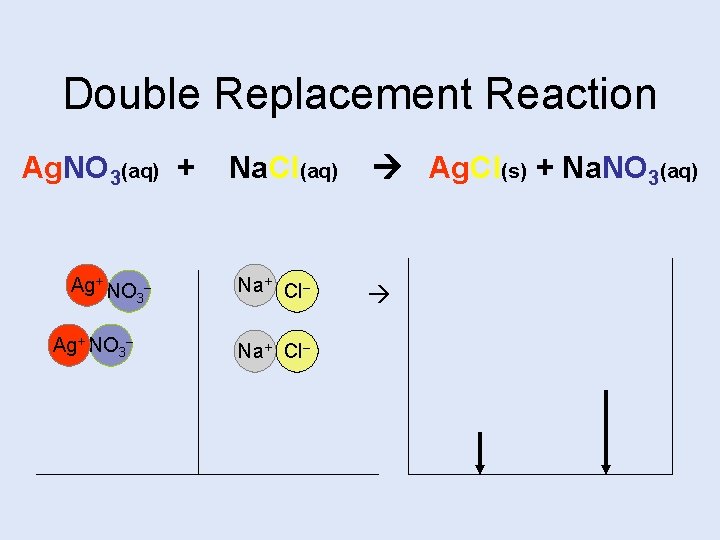
A few more • Following – Double displacement reaction using Flinn’s colors for “Keep Your Eye on the Ions” • These are little colored spheres some of which are magnetic. – Formation of Ionic Compounds
Double Replacement Reaction Ag. NO 3(aq) + Ag+ NO 3 – Na. Cl(aq) Na+ Cl– Ag. Cl(s) + Na. NO 3(aq)
Double Replacement Reaction Ag. NO 3(aq) + Ag+ NO 3– 3 – Na. Cl(aq) Na+ Cl– Ag. Cl(s) + Na. NO 3(aq)
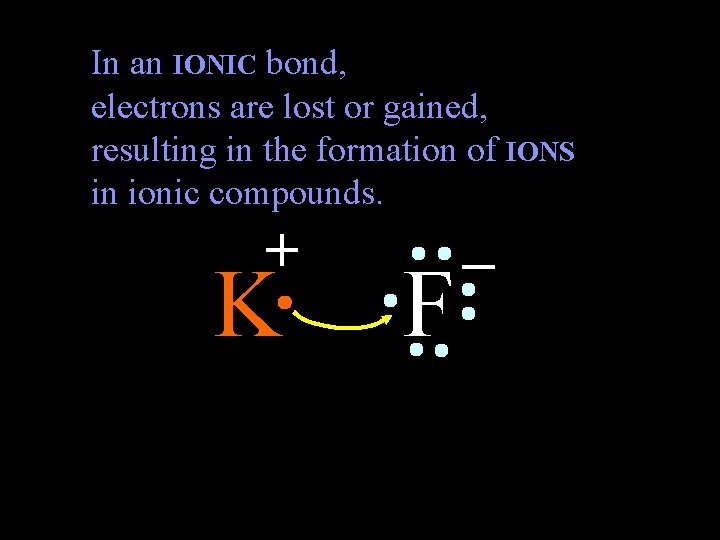
In an IONIC bond, electrons are lost or gained, resulting in the formation of IONS in ionic compounds. + K F –
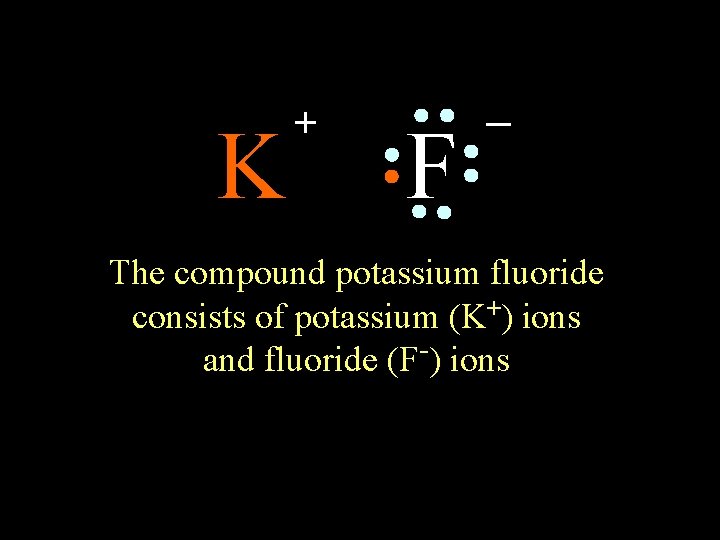
K + F _ The compound potassium fluoride consists of potassium (K+) ions and fluoride (F-) ions
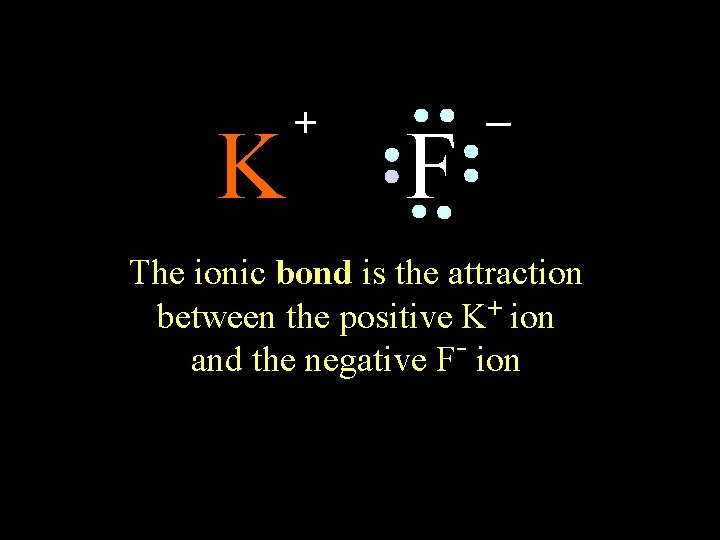
K + F _ The ionic bond is the attraction between the positive K+ ion and the negative F- ion
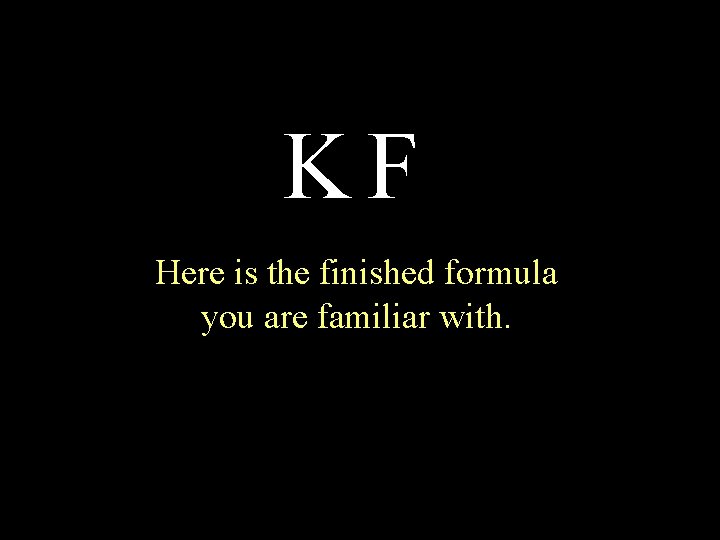
KF Here is the finished formula you are familiar with.
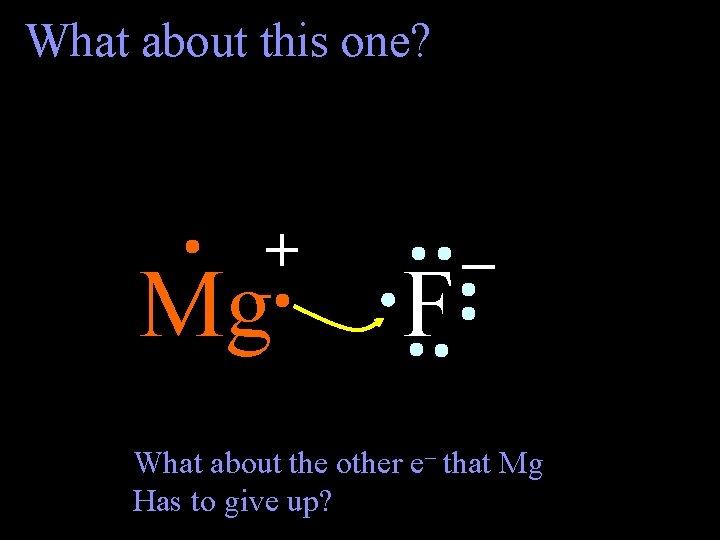
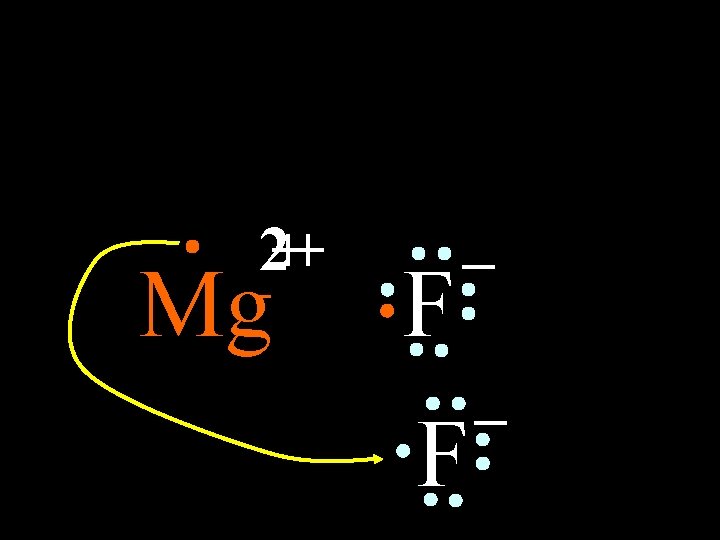
What about this one? + Mg F – What about the other e– that Mg Has to give up?
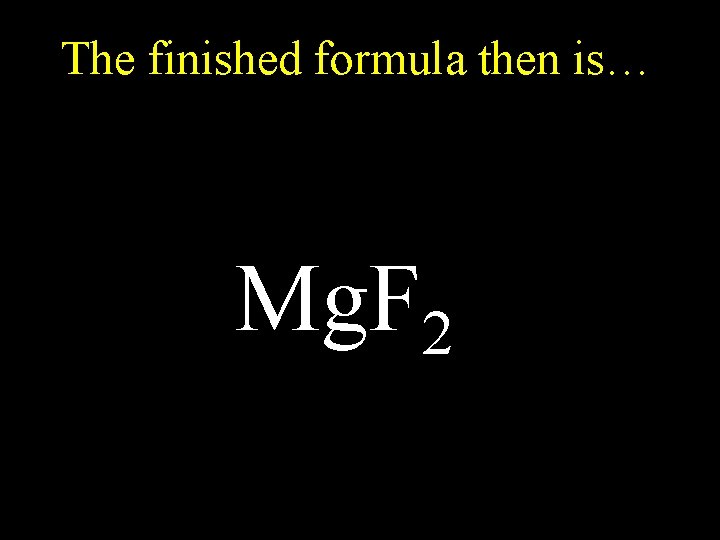
The finished formula then is… Mg. F 2
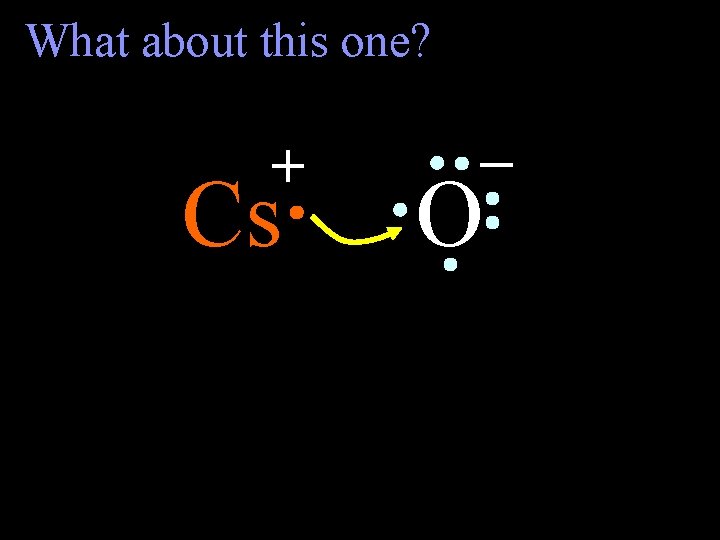
What about this one? + Cs – O
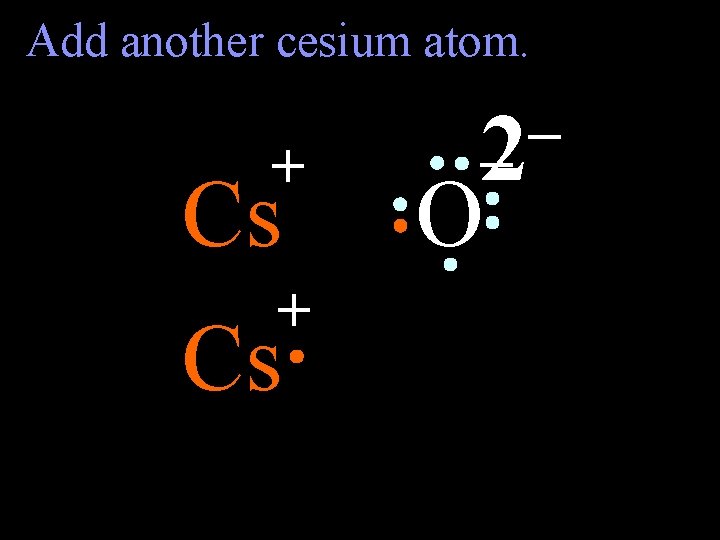
Add another cesium atom. + Cs – – 2 O
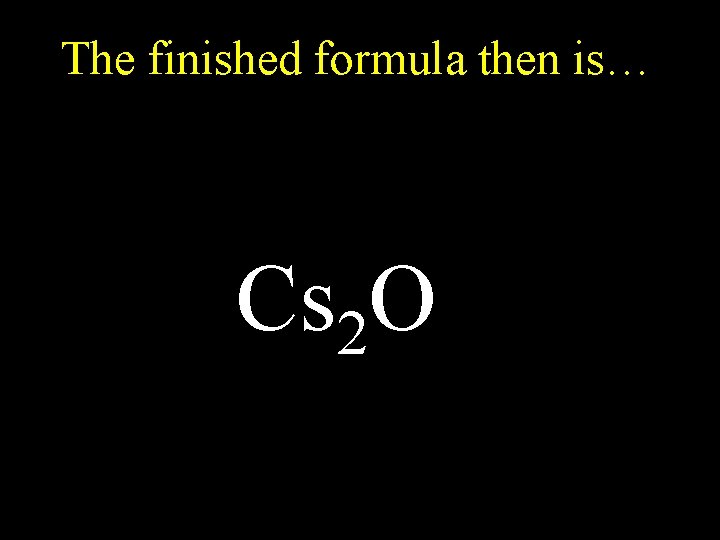
The finished formula then is… Cs 2 O
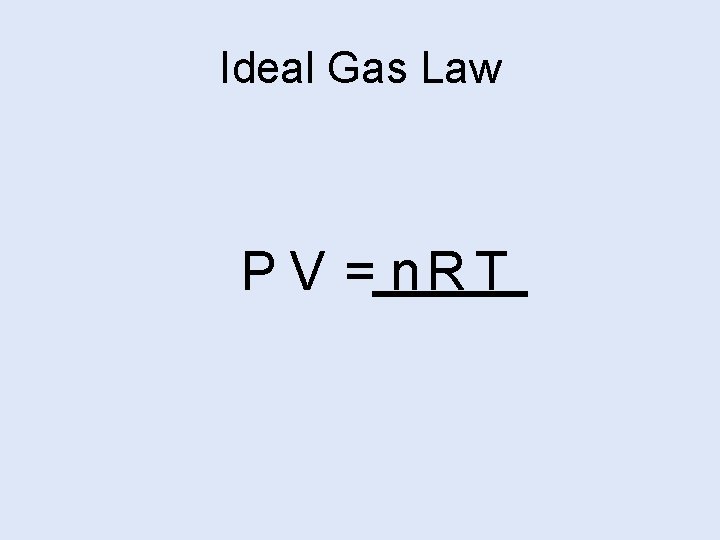
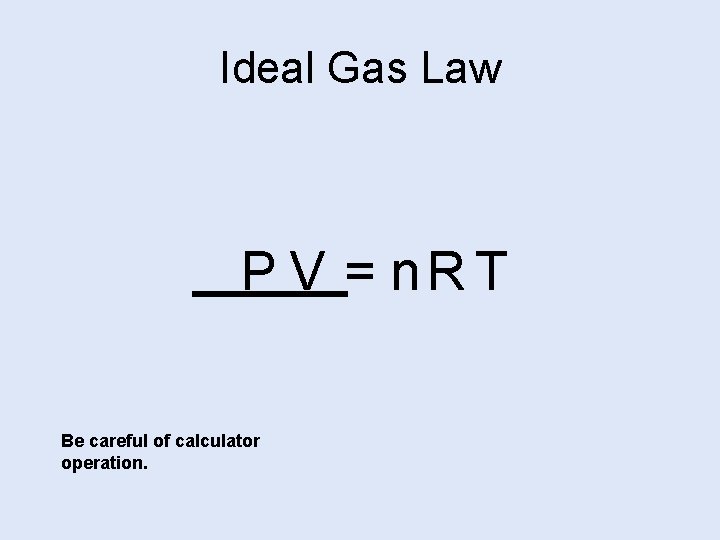
Ideal Gas Law P V = n. R T
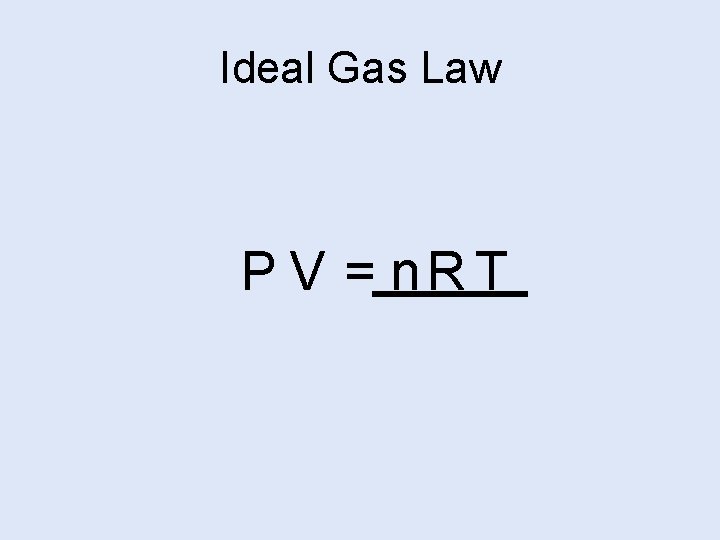
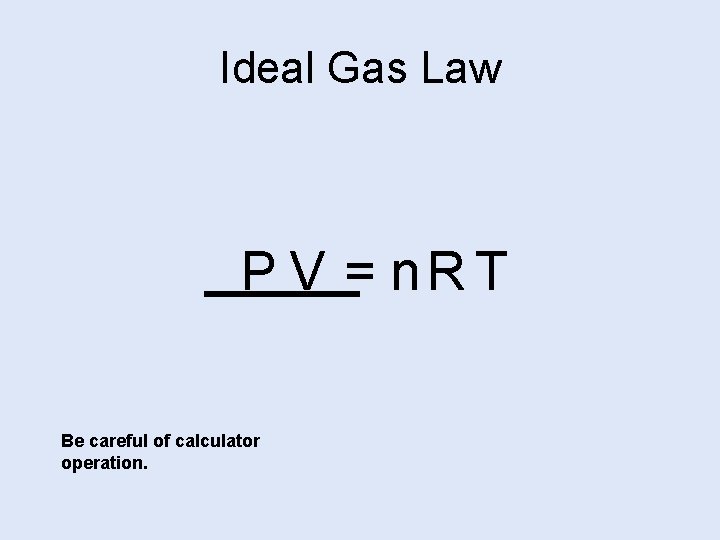
Ideal Gas Law P V = n. R T
Ideal Gas Law P V = n. R T Be careful of calculator operation.
Ideal Gas Law P V = n. R T Be careful of calculator operation.