
Curriculum Update BCCAT Articulation Meetings 2019 Curriculum Design

Curriculum Update BCCAT Articulation Meetings 2019

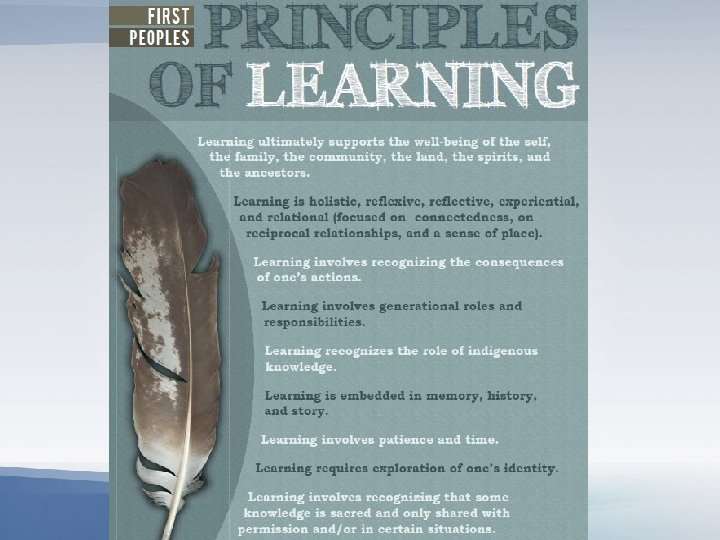
Curriculum Design - Guiding Principles CONCEPT-BASED, COMPETENCY-DRIVEN CURRICULUM… • • Core Competencies are explicit • in redesign Focus on the important concepts • and big ideas inherent in the discipline • Emphasize higher order learning and deeper learning Integrate and embed First • Peoples Principles of Learning and Aboriginal knowledge and world views Reduce the prescriptive nature of curriculum Allow for flexibility and choice for teachers and student Enable teachers to be creative and innovative in their design of learning experiences Align assessment and evaluation with the redesign of the curriculum
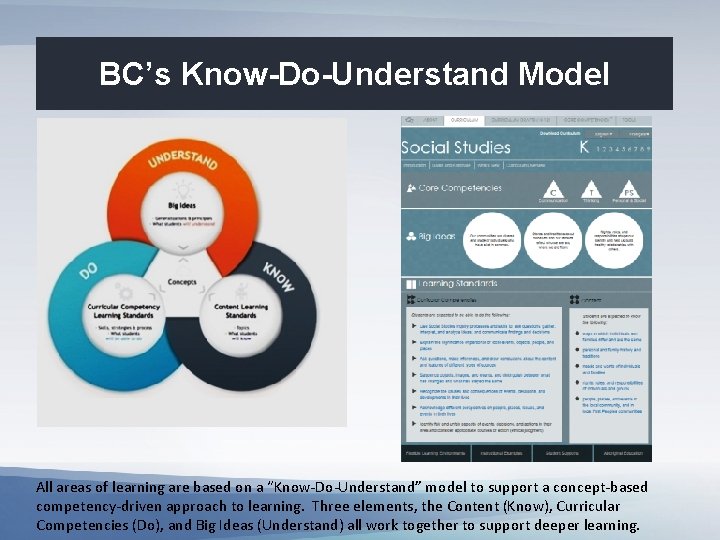
BC’s Know-Do-Understand Model All areas of learning are based on a “Know-Do-Understand” model to support a concept-based competency-driven approach to learning. Three elements, the Content (Know), Curricular Competencies (Do), and Big Ideas (Understand) all work together to support deeper learning.
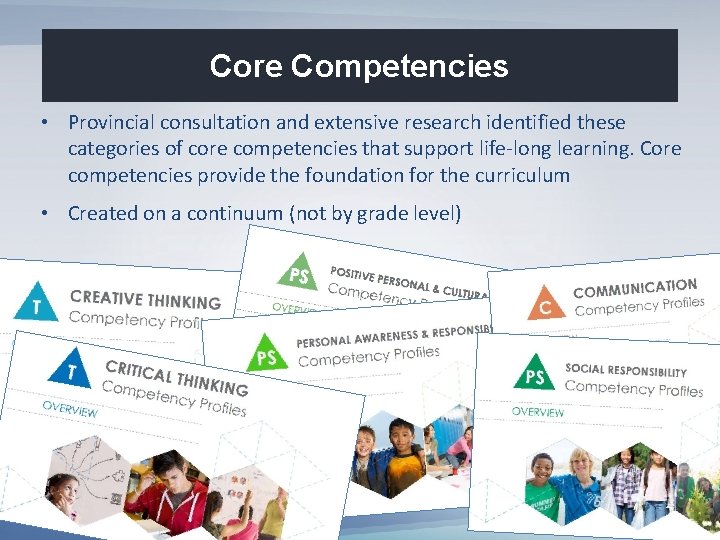
Core Competencies • Provincial consultation and extensive research identified these categories of core competencies that support life-long learning. Core competencies provide the foundation for the curriculum • Created on a continuum (not by grade level)
Graduation Requirements WHAT’S STAYING THE SAME? HIGH AND MEASURABLE STANDARDS • Current 80 credits (20 courses) to graduate: • 52 required credits (13 courses) • 28 elective credits (7 courses) • Reporting policy • Letter grades and percentages WHAT’S CHANGING? STUDENTS BETTER PREPARED WITH LITERACIES AND COMPETENCIES REQUIRED FOR THE FUTURE • Updated curriculum in all subjects and courses • Mandatory assessments: Numeracy and Literacy STUDENTS BETTER PREPARED FOR POST-SECONDARY AND CAREERS • 8 flexible credits in Career Education • Piloting new Careers strategy
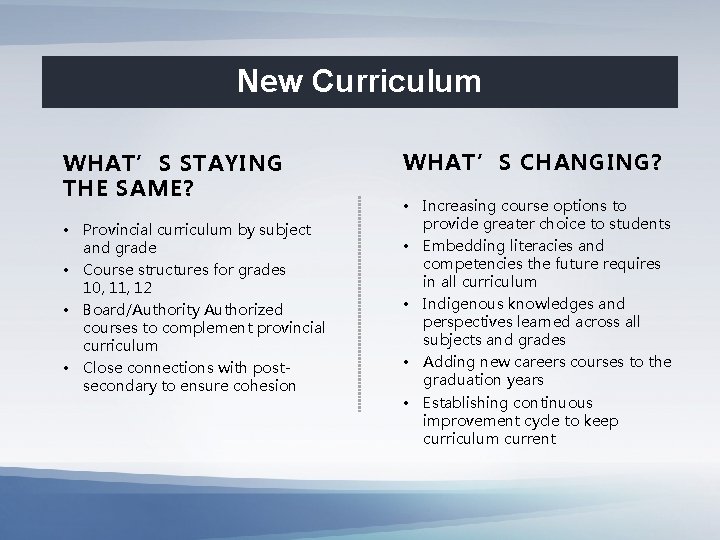
New Curriculum WHAT’S STAYING THE SAME? • Provincial curriculum by subject and grade • Course structures for grades 10, 11, 12 • Board/Authority Authorized courses to complement provincial curriculum • Close connections with postsecondary to ensure cohesion WHAT’S CHANGING? • Increasing course options to provide greater choice to students • Embedding literacies and competencies the future requires in all curriculum • Indigenous knowledges and perspectives learned across all subjects and grades • Adding new careers courses to the graduation years • Establishing continuous improvement cycle to keep curriculum current
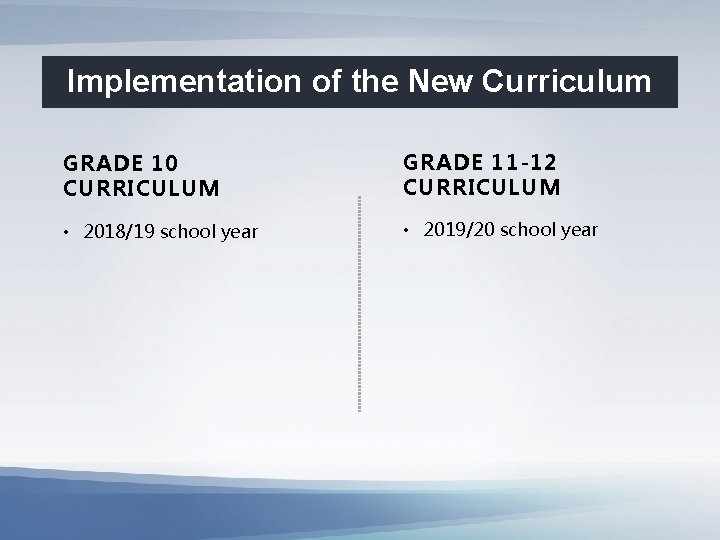
Implementation of the New Curriculum GRADE 10 CURRICULUM GRADE 11 -12 CURRICULUM • 2018/19 school year • 2019/20 school year
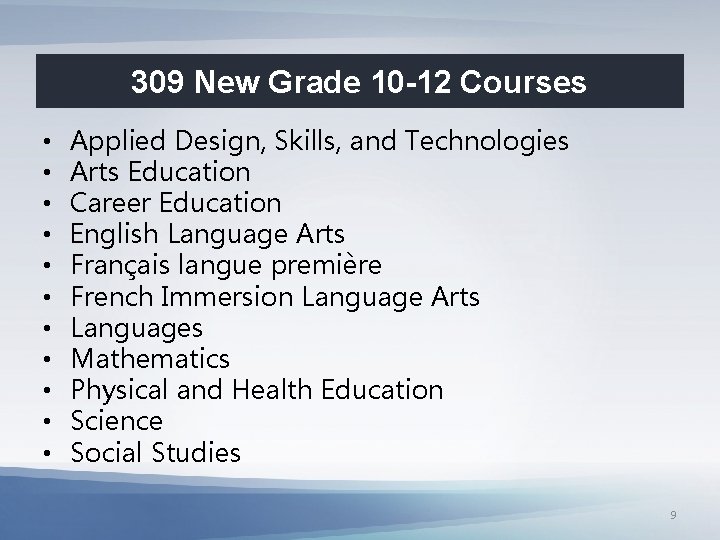
309 New Grade 10 -12 Courses • • • Applied Design, Skills, and Technologies Arts Education Career Education English Language Arts Français langue première French Immersion Language Arts Languages Mathematics Physical and Health Education Science Social Studies 9
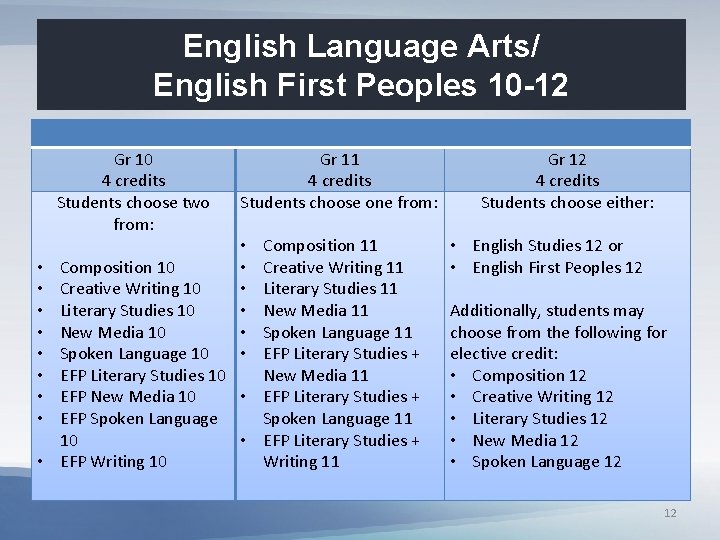
English Language Arts/ English First Peoples 10 -12 Gr 10 4 credits Students choose two from: Gr 11 4 credits Students choose one from: Composition 11 • Composition 10 Creative Writing 11 • Creative Writing 10 Literary Studies 11 • Literary Studies 10 New Media 11 • New Media 10 Spoken Language 11 • Spoken Language 10 EFP Literary Studies + • EFP Literary Studies 10 New Media 11 • EFP New Media 10 • EFP Literary Studies + • EFP Spoken Language 11 10 • EFP Literary Studies + • EFP Writing 10 Writing 11 • • • Gr 12 4 credits Students choose either: • English Studies 12 or • English First Peoples 12 Additionally, students may choose from the following for elective credit: • Composition 12 • Creative Writing 12 • Literary Studies 12 • New Media 12 • Spoken Language 12 12
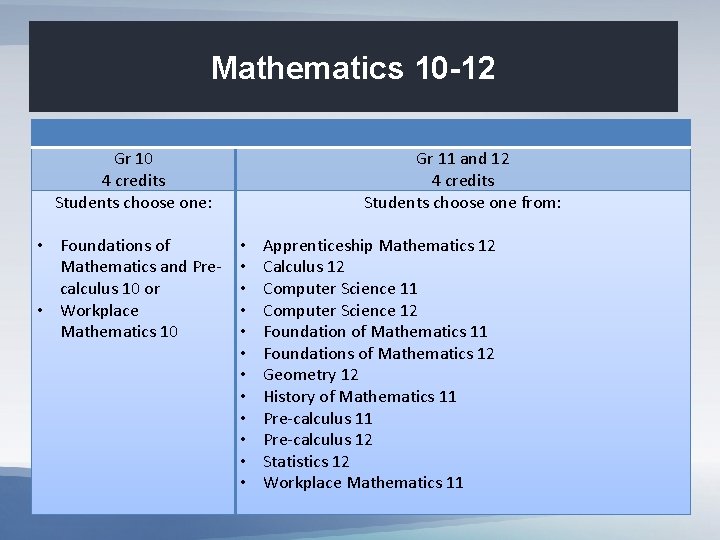
Mathematics 10 -12 Gr 10 4 credits Students choose one: • Foundations of Mathematics and Precalculus 10 or • Workplace Mathematics 10 Gr 11 and 12 4 credits Students choose one from: • • • Apprenticeship Mathematics 12 Calculus 12 Computer Science 11 Computer Science 12 Foundation of Mathematics 11 Foundations of Mathematics 12 Geometry 12 History of Mathematics 11 Pre-calculus 12 Statistics 12 Workplace Mathematics 11
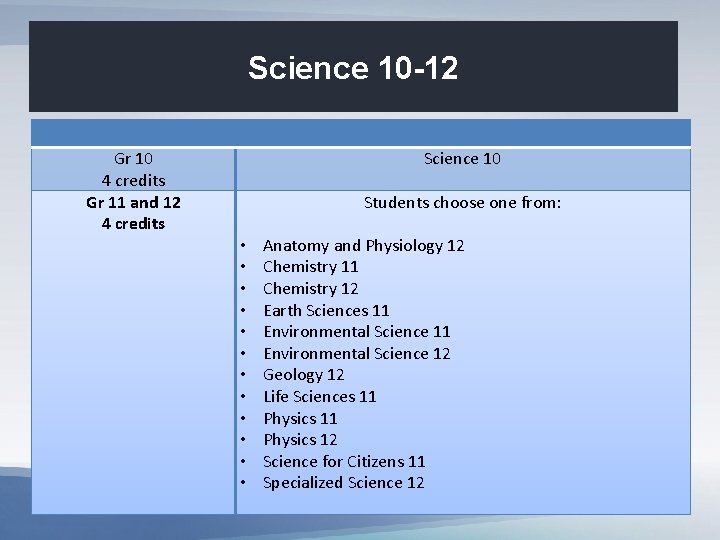
Science 10 -12 Gr 10 4 credits Gr 11 and 12 4 credits Science 10 Students choose one from: • • • Anatomy and Physiology 12 Chemistry 11 Chemistry 12 Earth Sciences 11 Environmental Science 12 Geology 12 Life Sciences 11 Physics 12 Science for Citizens 11 Specialized Science 12
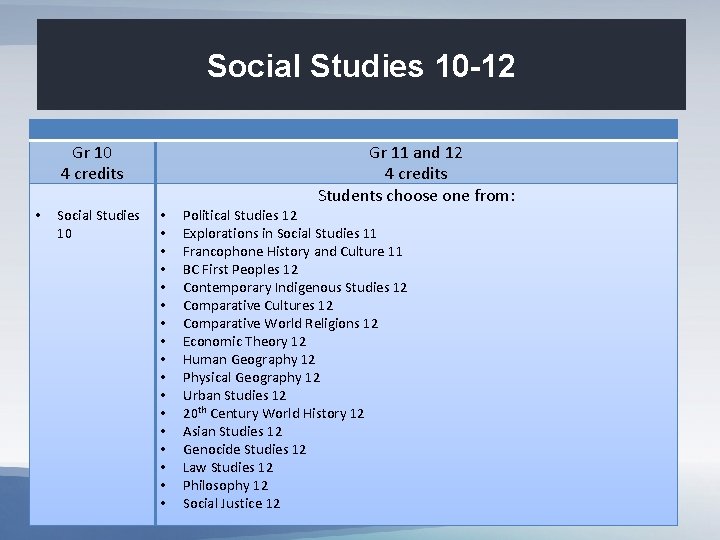
Social Studies 10 -12 Gr 10 4 credits • Social Studies 10 • • • • • Gr 11 and 12 4 credits Students choose one from: Political Studies 12 Explorations in Social Studies 11 Francophone History and Culture 11 BC First Peoples 12 Contemporary Indigenous Studies 12 Comparative Cultures 12 Comparative World Religions 12 Economic Theory 12 Human Geography 12 Physical Geography 12 Urban Studies 12 20 th Century World History 12 Asian Studies 12 Genocide Studies 12 Law Studies 12 Philosophy 12 Social Justice 12
BC Curriculum Comparison Guide https: //curriculum. gov. bc. ca/sites/curriculum. g ov. bc. ca/files/pdf/Book_2_BC_Curric_Comparis on_Aug_29. pdf 14
Next Steps • July 2019: Grade 11 -12 curriculum mandated for the start of the school year • Curriculum review and revision cycle to be established: – adhering to our design focus and principles – collaborative model – continuous improvement – online feedback process – schedule and further website information with be forthcoming 15

Questions? Comments? 16
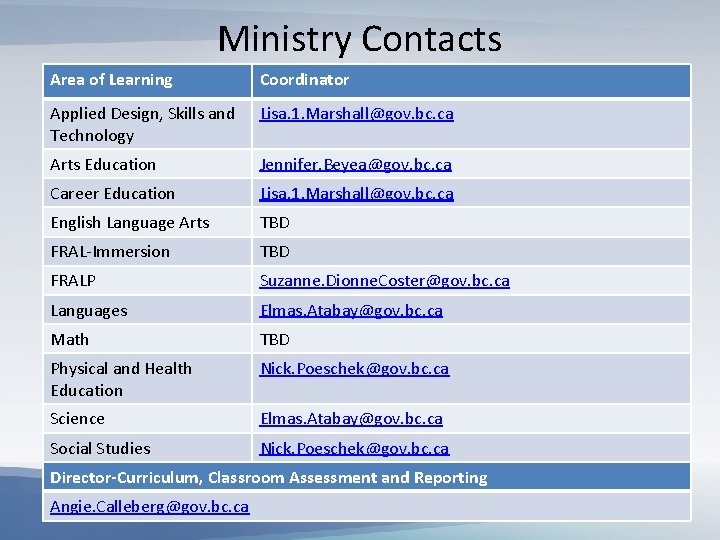
Ministry Contacts Area of Learning Coordinator Applied Design, Skills and Technology Lisa. 1. Marshall@gov. bc. ca Arts Education Jennifer. Beyea@gov. bc. ca Career Education Lisa. 1. Marshall@gov. bc. ca English Language Arts TBD FRAL-Immersion TBD FRALP Suzanne. Dionne. Coster@gov. bc. ca Languages Elmas. Atabay@gov. bc. ca Math TBD Physical and Health Education Nick. Poeschek@gov. bc. ca Science Elmas. Atabay@gov. bc. ca Social Studies Nick. Poeschek@gov. bc. ca Director-Curriculum, Classroom Assessment and Reporting Angie. Calleberg@gov. bc. ca 17
- Slides: 17