
Curriculum Theory Perspectives Models Instructional Designs Instructional Design
- Slides: 20
Curriculum Theory, Perspectives, Models & Instructional Designs Instructional Design Perspectives 1/1/2020 Cindy Barnes
Curriculum Theory/Instructional Design/Development Models Curriculum and instructional planning is a complex process. Initial ideas are first generated, broadened, and then narrowed into a set instructional patterns. Thinking of it in linear format might help. • • Curriculum Theories – What students will learn Curriculum Perspectives – Behavioral, Cognitive or Constructivism Curriculum Models – Approach to the perspectives are subject, learning and/or problem centered learning Instructional Design – How students will learn
What is Curriculum Theory Curriculum is the structure and schedule of courses which is generally referred to scope and sequence. I like to use the analogy of the road map and the GPS as the assessments. John Franklin Bobbitt’s “The Curriculum” published in 1918 mentions curriculum as an idea that has its roots in the Latin word ‘race-course’. He also explained curriculum as the course of deeds and experiences through which children grow up into adults and get going for success in the society. We will not discuss explicit curriculum in class, but it is essential to understand the concept of curriculum.
Different Perspectives • Behavioral - Instructor designs the learning environment. Ensure the environment has the right stimuli to promote learning. • Cognitive - Instructor manages problem solving and structured discovery activities, especially with group learning strategies. • Constructivism or Developmental Instructor mentors peer interaction and continuity of building on known concepts.
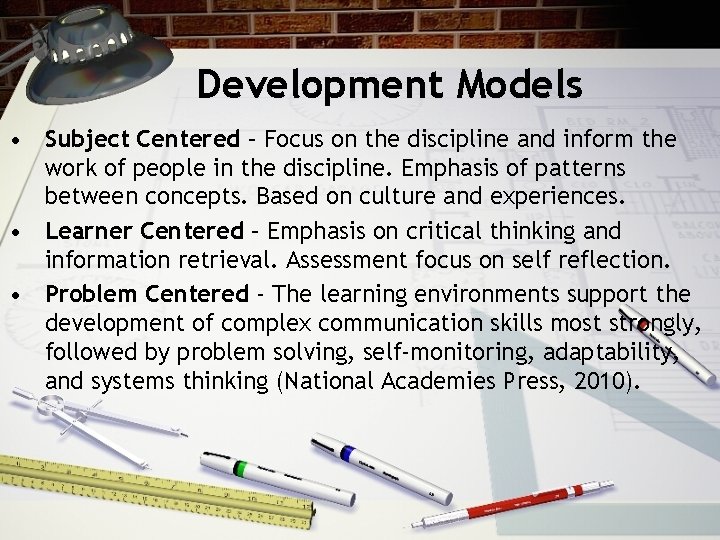
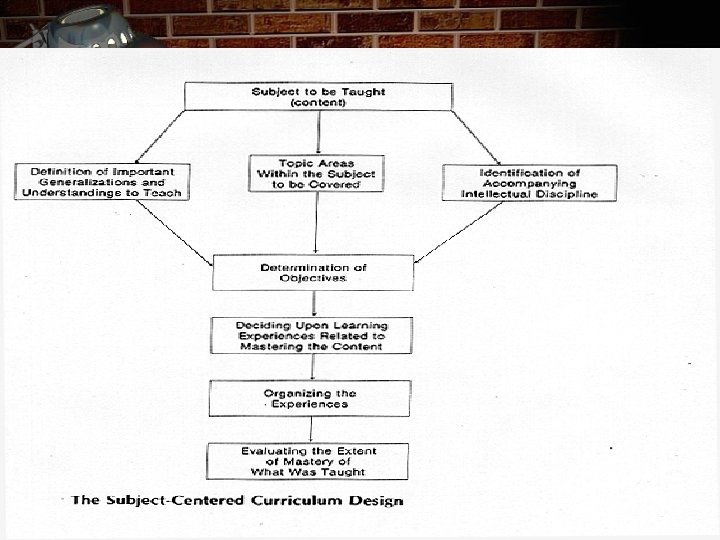
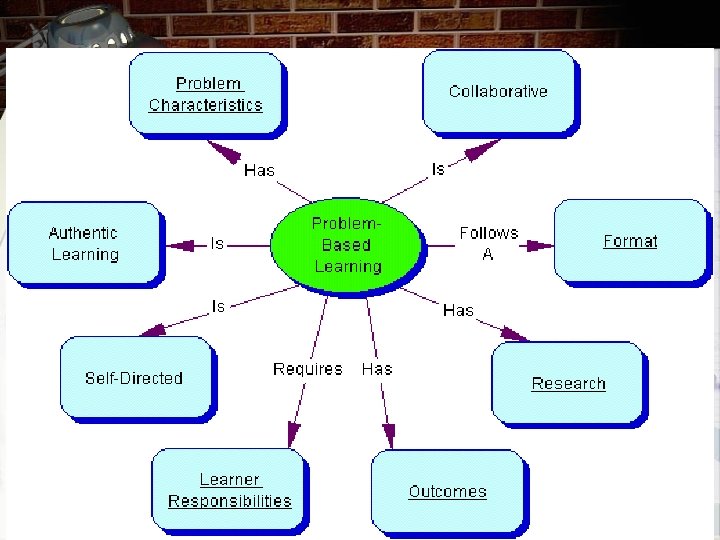
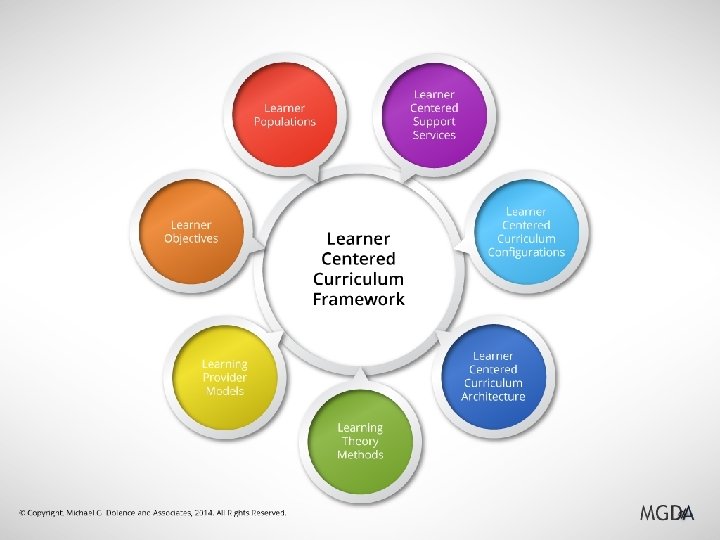
Development Models • Subject Centered – Focus on the discipline and inform the work of people in the discipline. Emphasis of patterns between concepts. Based on culture and experiences. • Learner Centered – Emphasis on critical thinking and information retrieval. Assessment focus on self reflection. • Problem Centered - The learning environments support the development of complex communication skills most strongly, followed by problem solving, self-monitoring, adaptability, and systems thinking (National Academies Press, 2010).
What is Instructional Design “Models, like myths and metaphors, help us to make sense of our world. Whether derived from whim or from serious research, a model offers its user a means of comprehending an otherwise incomprehensible problem” (Ryder, 2014. para. 1)
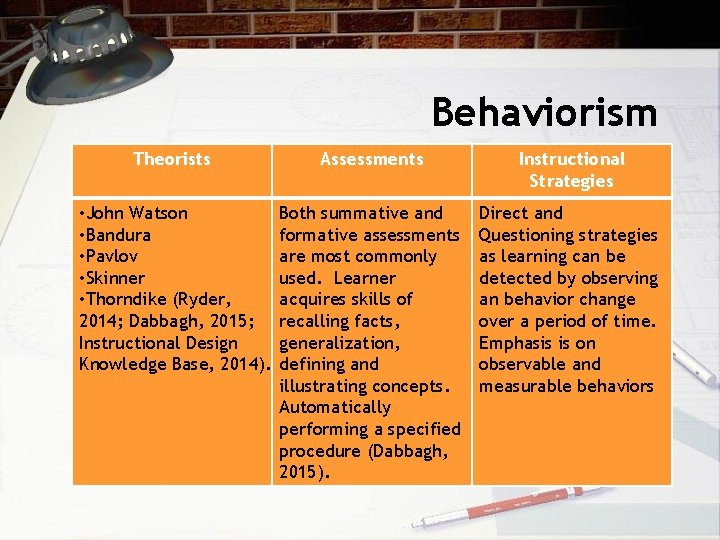
Behaviorism Theorists Assessments Instructional Strategies • John Watson • Bandura • Pavlov • Skinner • Thorndike (Ryder, 2014; Dabbagh, 2015; Instructional Design Knowledge Base, 2014). Both summative and formative assessments are most commonly used. Learner acquires skills of recalling facts, generalization, defining and illustrating concepts. Automatically performing a specified procedure (Dabbagh, 2015). Direct and Questioning strategies as learning can be detected by observing an behavior change over a period of time. Emphasis is on observable and measurable behaviors
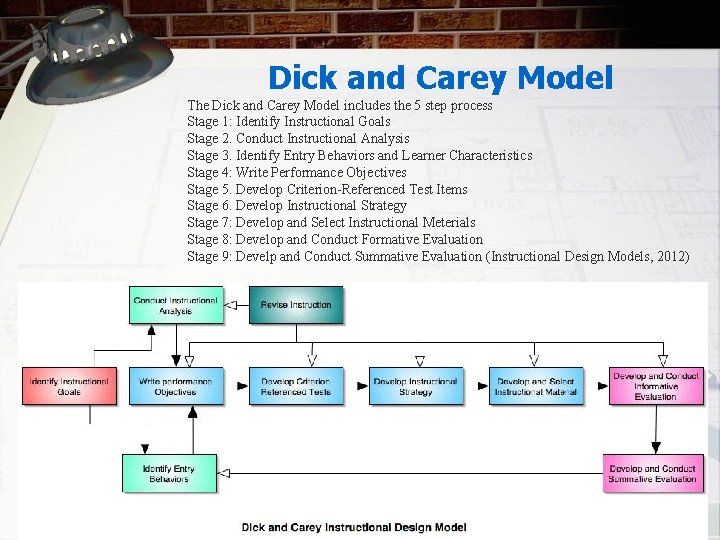
Dick and Carey Model The Dick and Carey Model includes the 5 step process Stage 1: Identify Instructional Goals Stage 2. Conduct Instructional Analysis Stage 3. Identify Entry Behaviors and Learner Characteristics Stage 4: Write Performance Objectives Stage 5. Develop Criterion-Referenced Test Items Stage 6. Develop Instructional Strategy Stage 7: Develop and Select Instructional Meterials Stage 8: Develop and Conduct Formative Evaluation Stage 9: Develp and Conduct Summative Evaluation (Instructional Design Models, 2012)
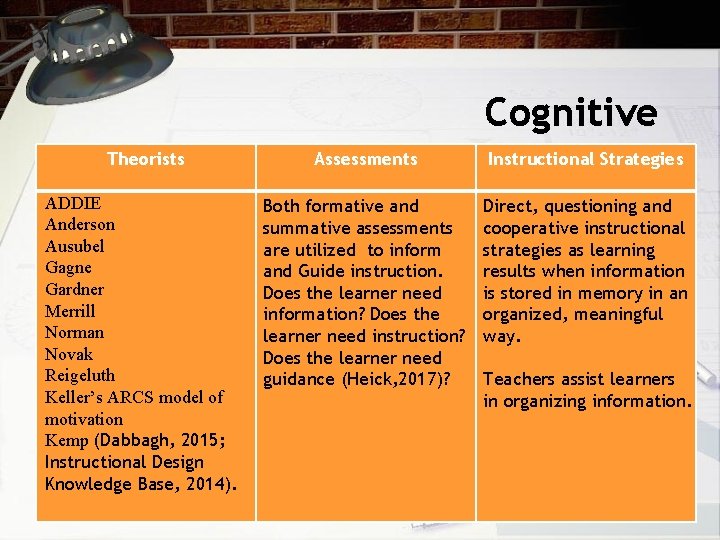
Cognitive Theorists Assessments Instructional Strategies ADDIE Anderson Ausubel Gagne Gardner Merrill Norman Novak Reigeluth Keller’s ARCS model of motivation Kemp (Dabbagh, 2015; Instructional Design Knowledge Base, 2014). Both formative and summative assessments are utilized to inform and Guide instruction. Does the learner need information? Does the learner need instruction? Does the learner need guidance (Heick, 2017)? Direct, questioning and cooperative instructional strategies as learning results when information is stored in memory in an organized, meaningful way. Teachers assist learners in organizing information.
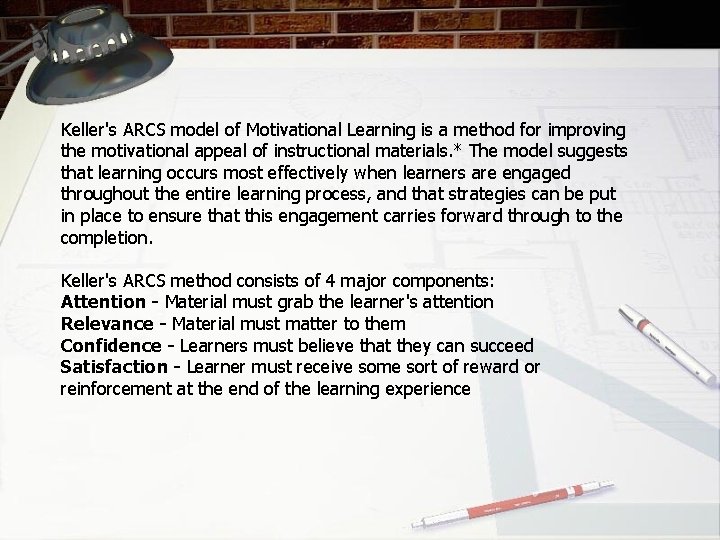
Keller's ARCS model of Motivational Learning is a method for improving the motivational appeal of instructional materials. * The model suggests that learning occurs most effectively when learners are engaged throughout the entire learning process, and that strategies can be put in place to ensure that this engagement carries forward through to the completion. Keller's ARCS method consists of 4 major components: Attention - Material must grab the learner's attention Relevance - Material must matter to them Confidence - Learners must believe that they can succeed Satisfaction - Learner must receive some sort of reward or reinforcement at the end of the learning experience
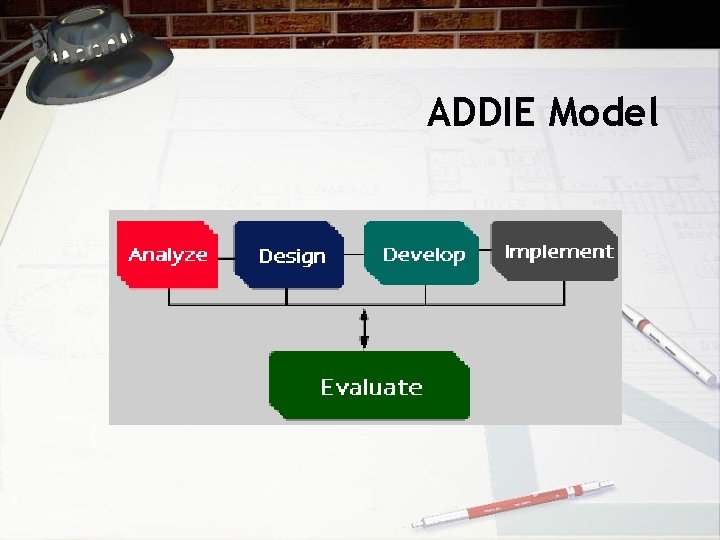
ADDIE Model
ADDIE Phases Analyze - This is the foundation for all other phases of instructional design. The purpose of this phase is to define the problem, identify the source of the problem and determine possible solutions. Design - This phase uses the outputs from the Analyze phase to plan a strategy for developing the instruction. Develop - This phase uses the output from the Analyze and Design phases to develop instructional materials. All the media content will also be generated with any supporting documentation. Implement - This is the phase in which one actually delivers the instruction. The purpose is to ensure the effective and efficient delivery of instruction. Evaluate - This phase measures the effectiveness and efficiency of the instruction. Evaluation can be either Formative or Summative.
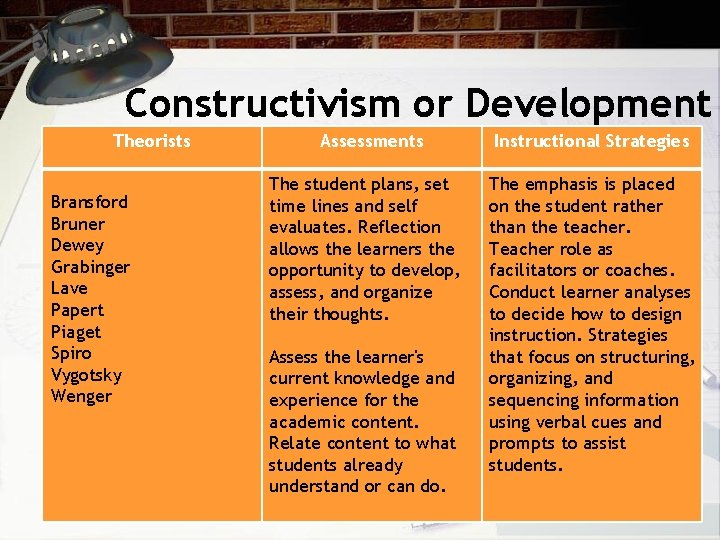
Constructivism or Development Theorists Bransford Bruner Dewey Grabinger Lave Papert Piaget Spiro Vygotsky Wenger Assessments The student plans, set time lines and self evaluates. Reflection allows the learners the opportunity to develop, assess, and organize their thoughts. Assess the learner's current knowledge and experience for the academic content. Relate content to what students already understand or can do. Instructional Strategies The emphasis is placed on the student rather than the teacher. Teacher role as facilitators or coaches. Conduct learner analyses to decide how to design instruction. Strategies that focus on structuring, organizing, and sequencing information using verbal cues and prompts to assist students.
Conclusions An understanding and incorporation of learning theory is needed when designing instruction because it adds focus and direction to the process. Instructional designers should address their goals and intentions of designing instruction in order to best incorporate learning theory within their programs. This requires considering the learner’s needs and characteristics, content and context, the strengths and weaknesses of the learning theory considering the scope of the instruction as well as the designer’s own intentions, preferences, and expectations.
References Bobbitt, F. (1918). The Curriculum: a summary of the development concerning theory of the curriculum. Boston: Houghton Mifflin Dabbagh, N. (2015). The instructional design knowledge base. George Mason University, Instructional Technology Program. Retrieved from http: //cehdclass. gmu. edu/ndabbagh/Resources/IDKB/models_theories. htm Heick, T. (October 30, 2017). What is the cognitive load theory? A definition for teachers. Retrieved from https: //teachthought. com/learning/cognitive-load-theorydefinition-teachers/ Instructional Design Central. (2012). Instructional design models. Retrieved from http: //www. instructionaldesigncentral. com/htm/IDC_instructionaldesignmodels. htm
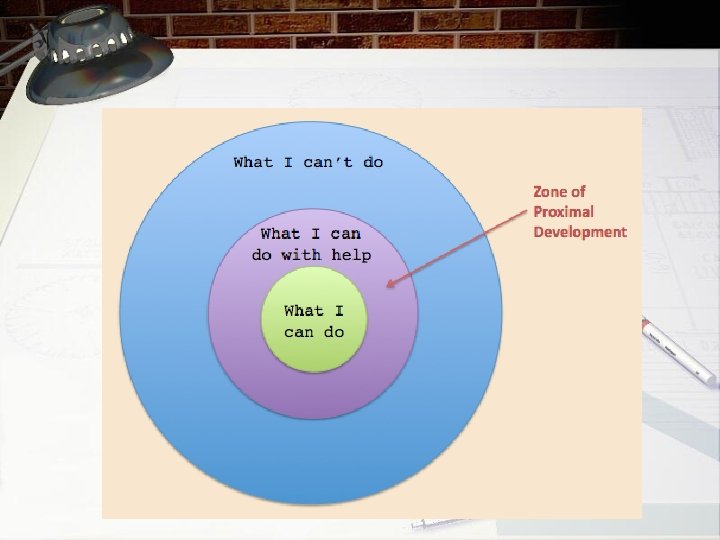
References Continued Instructional Design Knowledge Base. (2014). Select instructional models/theories to develop instructional prototypes. Retrieved from http: //cehdclass. gmu. edu/ndabbagh/Resources/IDKB/models_theories. htm Mc. Leod, S. A. (2012). Zone of Proximal Development. Retrieved from www. simplypsychology. org/Zone-of-Proximal-Development. html National Academies Press. (2010). Exploring the intersection of science education and 21 st Century skills: A workshop summary. Retrieved from https: //www. nap. edu/read/12771/chapter/5 Ornstein A. C. & Hunkins, F. P. (2004). Curriculum foundations, principles and issues. (3 rd ed)). Boston: Allyn and Bacon. Ryder, M. (2014). Instructional design models. University of Colorado at Denver: School of education. Retrieved from http: //carbon. ucdenver. edu/~mryder/itc_data/idmodels. html