
Curriculum The First Lecture Meaning of Curriculum Facets
- Slides: 11
Curriculum
The First Lecture �Meaning of Curriculum �Facets of Curriculum �Functions of the Curriculum
Meaning of Curriculum �Curriculum is the base on education on which the teaching-learning process is planned and implemented. �It is the totality of all learning to which students are exposed during their study in the school.
Some Important Definitions �The sum total of student activities which the school sponsors for the purpose of achieving its objectives. �All of the directed learning experiences of children and youth under the influence of the school. �All the experience which a pupil has under the guidance of the school. �A tool in the hands of the artist (the teacher) to mould his material (the pupil) in accordance with his ideal in his studio (the school).
Some Important Definitions �The total structure of ideas and activities developed by an educational institution to meet the learning needs of students and to achieve desired educational aims. �A body of prescribed experiences under school supervision, designed to provide an individual with the best possible training and experience to fit him for the society or to qualify him for a trade or a profession.
Some Important Definitions �Etymologically, the word “curriculum” is derived from a Latin word ‘currere’ which means ‘the race course’ or a ‘runway’ which one takes to reach a goal. �Thus, curriculum is the instructional programme through which the pupils achieve their goals.
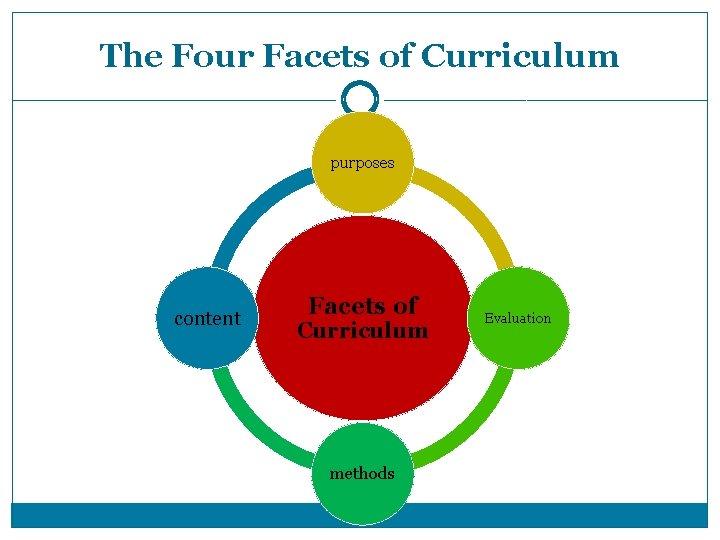
The Four Facets of Curriculum purposes content Facets of Curriculum methods Evaluation
Functions of the Curriculum School curriculum aims at promoting in the learner: 1. Language abilities and communication skills 2. Competencies and their applications in day-today life and learning 3. Knowledge, attitudes and habits necessary for keeping in conformity with normal developmental pattern 4. A proper understanding and healthy aptitude towards sex and its role in human life
Important social qualities such as friendliness, cooperativeness, self-discipline, self-control, selfcriticism, love for social justice, etc. 6. Moral and character values such as honesty, truthfulness, fearlessness, compassion, etc. 7. Pre-vocational/vocational skills, willingness to work hard necessary for increased productivity and job satisfaction 8. Ability to appreciate and discover beauty in various life situations 5.
9. Understanding of the environment and the need for conservation of its limited natural resources and energy 10. Appreciation of various consequences of overpopulation and the need of checking population growth 11. Understanding of the diverse cultural and social system of people living in different parts of the country and the country’s composite cultural heritage
12. Knowledge of national symbols 13. Capability of appreciating and tolerating differences 14. 15. 16. 17. 18. of various sorts Scientific temper characterized by spirit of inquiry and objectivity Knowledge of scientific methods of inquiry and its use in solving problems Appreciation of sacrifices and contribution made by the freedom fighters and social workers Divergent and independent thinking and ability to discover new relationships and combinations Qualities and characteristics necessary for selflearning and for life-long learning leading to creation of a learning society