
CURRICULUM REVISION DESIGN PROJECT Tina Adkins Nina Favor

- Slides: 16
CURRICULUM REVISION & DESIGN PROJECT Tina Adkins Nina Favor Kimber Sprik Lindsay Wiley Kimberlin Zelinsky NOVEMBER 2014
Grand Rapids Community College Associate Degree Nursing Program
Medical-Surgical Nursing V: Care of Persons with Complex Health Needs � Applies � Total the nursing process care � Adults with acute/critical illnesses, possibly facing major lifestyle changes � Clinical experience in acute care settings (GRCC, 2014)
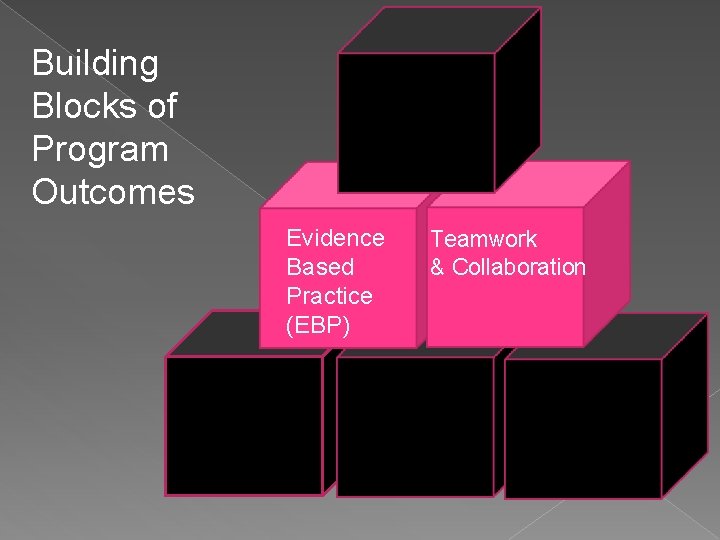
Building Blocks of Program Outcomes Evidence Based Practice (EBP) Teamwork & Collaboration
ACEN Standard 4: Curriculum � 4. 6 Reflects …interprofessional collaboration � 4. 10 Clinical experiences must be evidence- based (ACEN 2013)
QSEN: Teamwork & Collaboration � “Function effectively within nursing and inter-professional teams, fostering open communication, mutual respect, and shared decision-making” � Emphasize interprofessional collaboration during clinical experiences (QSEN 2014)
KSAs to demonstrate Teamwork & Collaboration � Knowledge: “Examine strategies for improving systems to support team functioning” � Skill: “Integrate the contributions of others. ” � Skill: “Assert own position/perspective in discussions about patient care” (QSEN 2014)
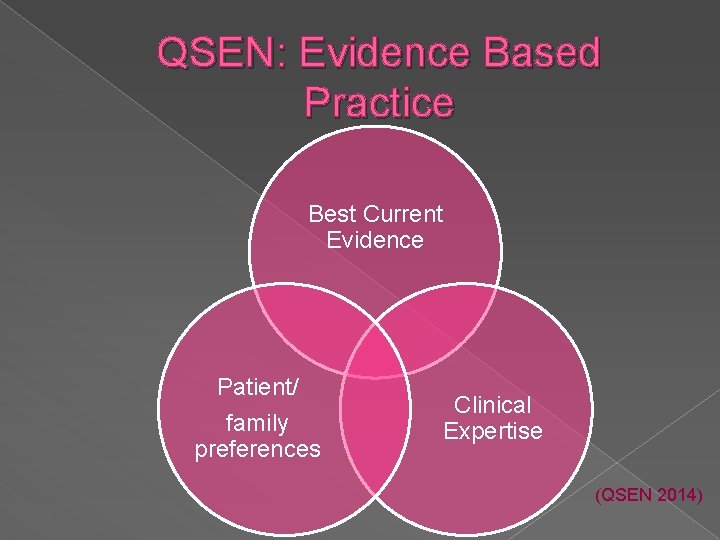
QSEN: Evidence Based Practice Best Current Evidence Patient/ family preferences Clinical Expertise (QSEN 2014)
KSAs to demonstrate EBP � Knowledge: “Describe how the strength and relevance of available evidence influences the choice of interventions” while caring for adults with complex health problems � Knowledge: Valid/invalid reasons to modify EBP based on clinical expertise, patient/family preferences
KSAs to demonstrate EBP � Skill: take note of routine practices that do not contribute to desired outcomes and question their rationale � Skill: Find the evidence (QSEN 2014)
Application of NLN Professional Practice Standards for Academic Nurse Educators � Competency I: Facilitate Learning › variety of teaching strategies › Collegial working relationships with various stakeholders � Competency IV: “Participate in curriculum Design…” › Changes made to reflect health care trends › Prepare graduates to practice in a complex, dynamic environment (NLN 2012)
Revised Outcomes Using Bloom’s Taxonomy � Students identify ways to improve the care of adults with acute/critical illnesses by integrating best practices of various members of the interdisciplinary health care team. › This involves synthesis, making a better care practice from individual parts of the team
Revised Outcomes Using Bloom’s Taxonomy � Students will effectively evaluate patient care in terms of EBP and communicate their observations among the interprofessional team members. › Highest level of learning in Bloom’s taxonomy › Involves application of EBP as well as collaboration
Intentionality in Learner. Centered Curriculum Design � Purposely focusing on certain aspects of the clinical experience � Intentionally � Greater connect aspects of learning focus on learner needs than on course structure � (Greer, Pokorny, Clay, Brown, & Steele, 2010)
Conclusion/Summary � GRCC Associate Degree Nursing Program � Need for greater incorporation of QSEN into the curriculum � Program outcomes & individual class revisions to thread competencies throughout � Bloom’s Taxonomy/Learner centered paradigm
References � � � Accreditation Commission for Education in Nursing. (2013). Accreditation manual. Retrieved from http: //www. acenursing. org/accreditation. Grand Rapids Community College. (2014) Associate degree nursing program. http: //cms. grcc. edu/nursingprograms/associatedegreenursingprogram manual/ Retrieved from Greer, A. , Pokorny, M. , Clay, M. , Brown, S. , & Steele, L. (2010). Learnercentered characteristics of nurse educators. International Journal of Nursing Education Scholarship, 7(1), doi: 10. 2202/1548 -923 X. 1710 National League for Nursing (NLN). (2012). The scope of practice for academic nurse educators. (2012 revision) New York, NY: nln. org Quality and safety education for nurses. (2014). Pre-licensure competencies. Retrieved from http: //qsen. org/competencies/pre-licensure-ksas/