
Curriculum intent implementation and impact Development work for
- Slides: 22
Curriculum: intent, implementation and impact Development work for the new inspection framework Sean Harford HMI National Director, Education Curriculum survey Slide 1
Session overview § Purposes and principles of the work § The framework for this survey § Definition of the curriculum § Overview of the research § No emerging findings yet, but… § … the emerging challenge. Curriculum survey Slide 2
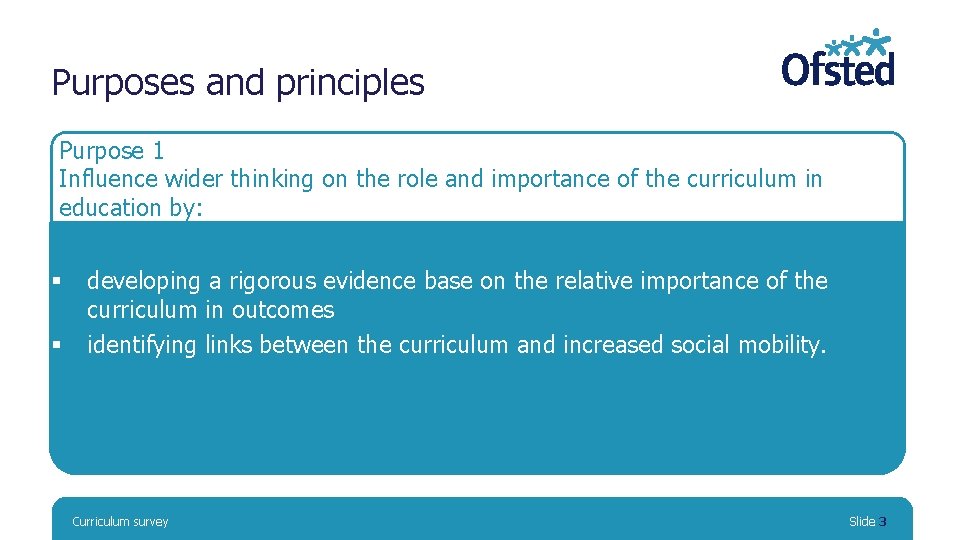
Purposes and principles Purpose 1 Influence wider thinking on the role and importance of the curriculum in education by: § § developing a rigorous evidence base on the relative importance of the curriculum in outcomes identifying links between the curriculum and increased social mobility. Curriculum survey Slide 3
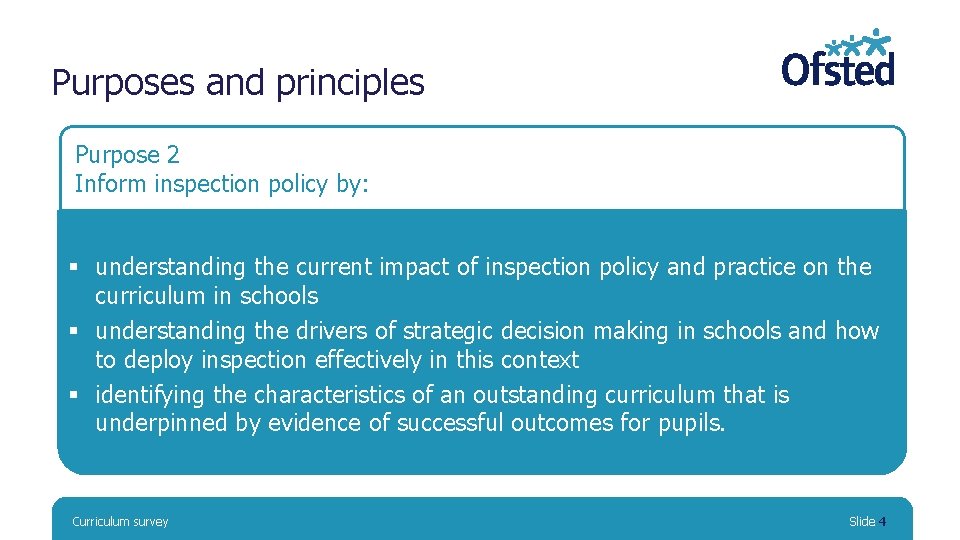
Purposes and principles Purpose 2 Inform inspection policy by: § understanding the current impact of inspection policy and practice on the curriculum in schools § understanding the drivers of strategic decision making in schools and how to deploy inspection effectively in this context § identifying the characteristics of an outstanding curriculum that is underpinned by evidence of successful outcomes for pupils. Curriculum survey Slide 4
Purposes and Principles Purpose 3 Inform policy making in the Df. E by: § testing the extent to which the curriculum at school and classroom level is influenced by national policy levers or other factors. Curriculum survey Slide 5
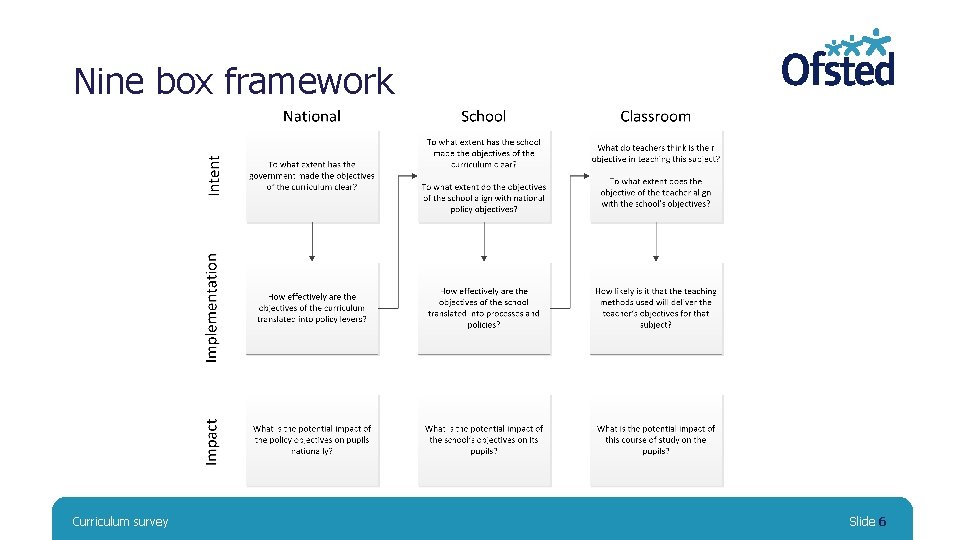
Nine box framework Curriculum survey Slide 6
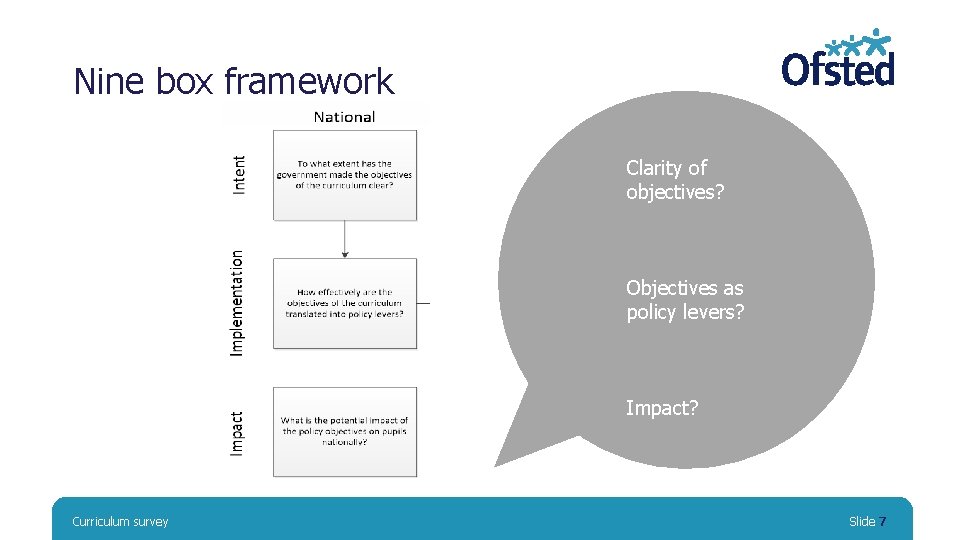
Nine box framework Clarity of objectives? Objectives as policy levers? Impact? Curriculum survey Slide 7
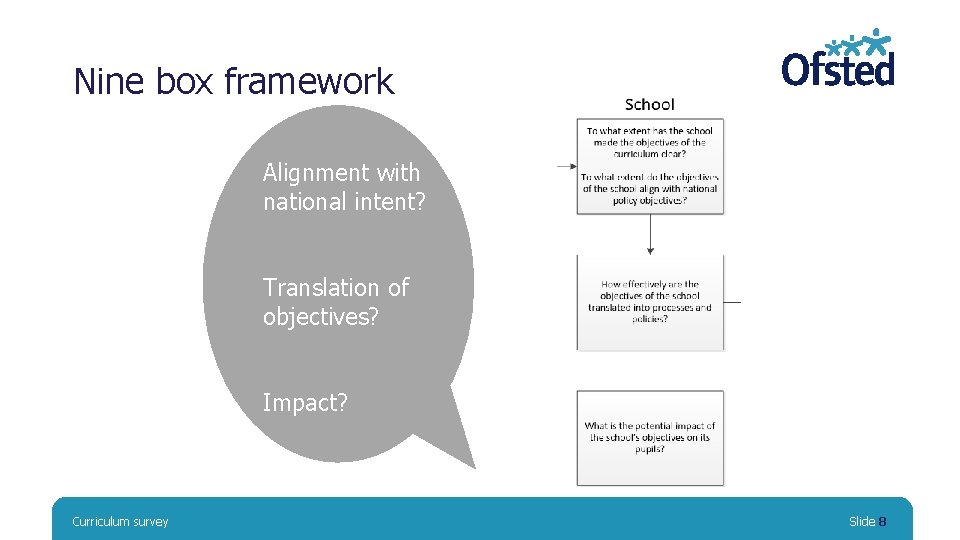
Nine box framework Alignment with national intent? Translation of objectives? Impact? Curriculum survey Slide 8
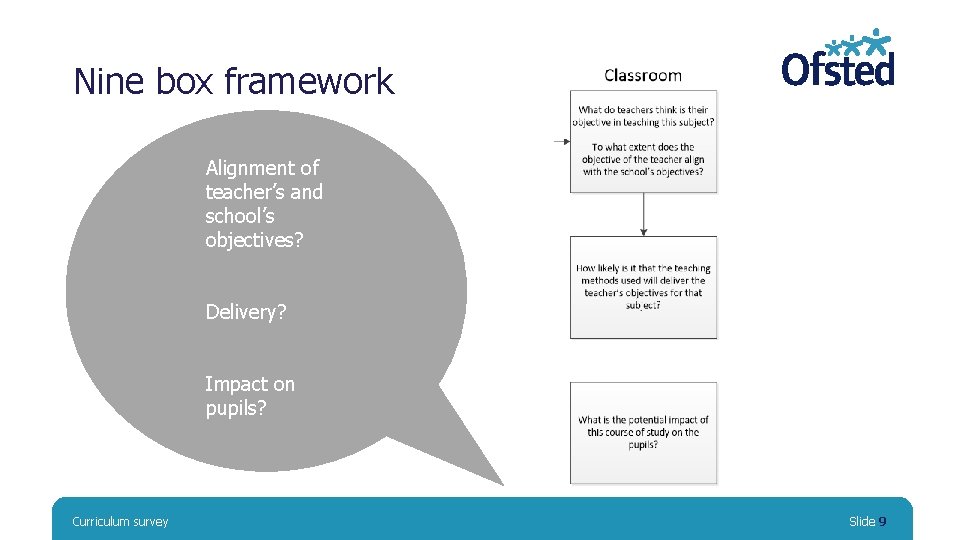
Nine box framework Alignment of teacher’s and school’s objectives? Delivery? Impact on pupils? Curriculum survey Slide 9
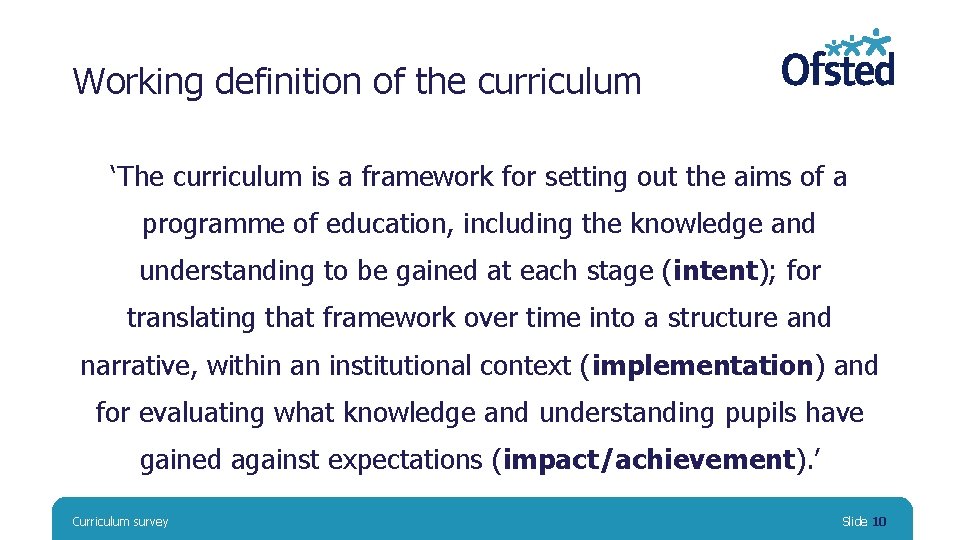
Working definition of the curriculum ‘The curriculum is a framework for setting out the aims of a programme of education, including the knowledge and understanding to be gained at each stage (intent); for translating that framework over time into a structure and narrative, within an institutional context (implementation) and for evaluating what knowledge and understanding pupils have gained against expectations (impact/achievement). ’ Curriculum survey Slide 10
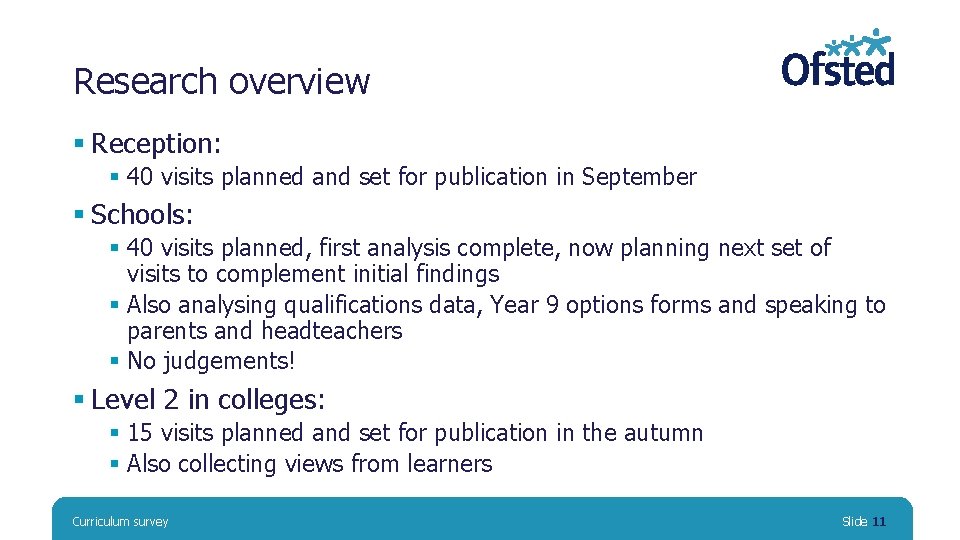
Research overview § Reception: § 40 visits planned and set for publication in September § Schools: § 40 visits planned, first analysis complete, now planning next set of visits to complement initial findings § Also analysing qualifications data, Year 9 options forms and speaking to parents and headteachers § No judgements! § Level 2 in colleges: § 15 visits planned and set for publication in the autumn § Also collecting views from learners Curriculum survey Slide 11
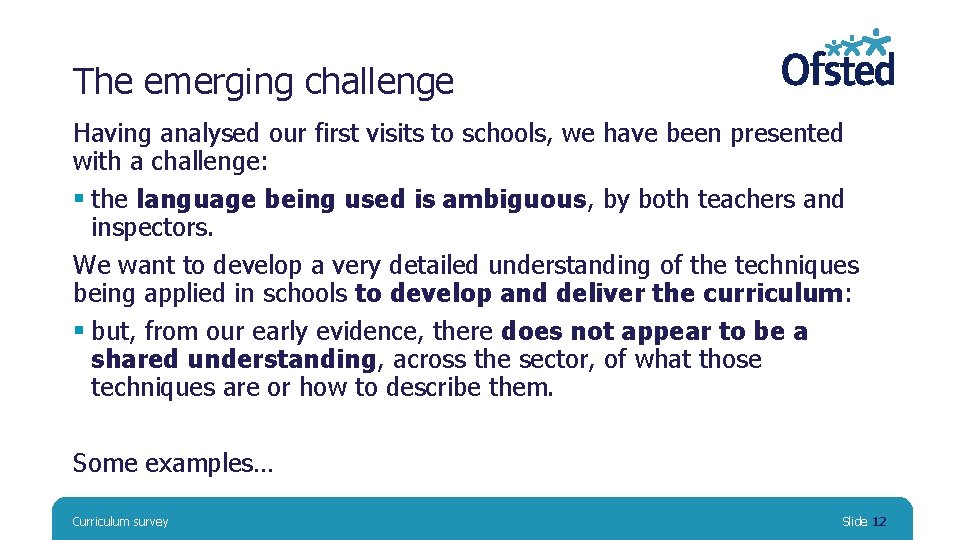
The emerging challenge Having analysed our first visits to schools, we have been presented with a challenge: § the language being used is ambiguous, by both teachers and inspectors. We want to develop a very detailed understanding of the techniques being applied in schools to develop and deliver the curriculum: § but, from our early evidence, there does not appear to be a shared understanding, across the sector, of what those techniques are or how to describe them. Some examples… Curriculum survey Slide 12
‘Skills’ This has wide-ranging interpretations: § skills involved with specific subjects or activities (e. g. reading skills) § what might be called ‘transferable skills’ (e. g. organisational skills, verbal communication skills, leadership skills) § ‘executive functions’ (e. g. memory, attention, inhibitory control). Curriculum survey Slide 13
‘Enrichment’ § This tends to refer to additional activities which enhance the curriculum, including visits from relevant members of the public that might relate to a particular topic and school visits. These may be aimed at particular groups of pupils (e. g. gifted and talented) or the whole class. § An alternative meaning is associated with those who have already mastered a particular concept or learning, and they therefore acquire understanding at a deeper level through enrichment. In this case, it may be related to asking more analytical questions, or ‘harder work’. This takes place during lessons, and is a way of extending the learning of those pupils. Curriculum survey Slide 14
‘Repetition’ This has several interpretations – repetition as practice, repetition as lack of progression, repetition as layering of knowledge, or repetition in different contexts. § Repetition of content could be a positive, where it enables children to practice so concepts can be embedded more deeply (‘intelligent practice’). § It could be a negative where poor planning or progression mapping leads to content being revisited as new. This may be a problem particularly in Year 7, when children from different primary schools have different levels of confidence in particular concepts, so some students may repeat specific prior learning. § Repetition of skills in different contexts could have a positive effect on learning. Current research on executive functions suggests that practising in a single context leads to improved working memory skills but may not transfer to other contexts. Curriculum survey Slide 15
‘Theme-based’ approaches Examples include: theme-based approaches; cross-curricular; topic; block teaching of themes; umbrella topic; imaginative learning projects; and completely integrated topic. § Ways of grouping subjects/knowledge/skills, but often with subtle differences. § A key difference is whether subjects are kept distinct § Subject matter can be grouped together, e. g. an overarching topic of ‘rivers’ may have lessons on changing state in distinct science lessons, and combining paint colours in art. § By contrast, in a ‘completely integrated topic’ the learning may be similar but without making reference to whether it’s a science lesson or an art lesson. Curriculum survey Slide 16
‘Broad and balanced’ § These terms are used frequently by schools and in evidence forms by inspectors, but there isn’t an indication of when a narrow, imbalanced curriculum becomes a broad, balanced curriculum. . . § … or whether this is age-dependent. § Also, the comments tend to refer to curriculum offering, and may not relate to the actual content of what pupils studying. Curriculum survey Slide 17
What kind of things do we need to clarify? § How do we describe the key points on the spectrum between teaching subjects discretely or merging subjects in topics or themes? § What are the most common patterns of variation or repetition of content? § What are the types of formative assessment and what impact do they have on the curriculum and vice versa? § How do we describe the interplay between repetition, progression and formative assessment that captures how these might be appropriately or inappropriately aligned? § What are the principal approaches to varying the pace of progression through the curriculum for pupils with different starting points and aptitudes? Curriculum survey Slide 18
The new framework § Build on the curriculum work § Build on other research work § Time to develop and engage with the sectors § Time for sectors to adjust, so… § …start in September 2019. Curriculum survey Slide 19
In the meantime, schools need to: § know their curriculum – design and intent § know how their curriculum is being implemented § know what impact their curriculum is having on pupils’ knowledge and understanding. Need for numbers? That’s up to the school – best way of ‘knowing’ (not ‘demonstrating’) the above? Curriculum survey Slide 20
Thank you! Curriculum survey Slide 21
Ofsted on the web and on social media www. gov. uk/ofsted https: //reports. ofsted. gov. uk www. linkedin. com/company/ofsted www. youtube. com/ofstednews www. slideshare. net/ofstednews www. twitter. com/ofstednews Curriculum survey Slide 22