
Curriculum Information Bright Elementary School Objective The purpose
Curriculum Information Bright Elementary School
Objective: The purpose of presentation is to inform parents on the expectations of the Indiana Academic Standards, what instructional strategies teachers are using to teach these standards, and the assessment measures used to determine students’ level of understanding.
Sunman-Dearborn Community School Corporation Mission: Our mission is to provide a safe, innovative, and challenging environment designed to prepare students for their future through Stewardship, Data-Driven Decision Making, Collaboration, Shared Leadership, and Commitment. Vision: Reflecting on our core values of stewardship, data driven decision making, collaboration, shared leadership, and commitment the vision of Sunman-Dearborn Community Schools is: Surpassing expectations and inspiring excellence in every student, every day. Bright Elementary School Mission Statement: Bright Elementary provides opportunities for quality education. Staff and parents cooperate to maintain a secure learning environment and instill the desire to become kind, responsible, lifelong learners.
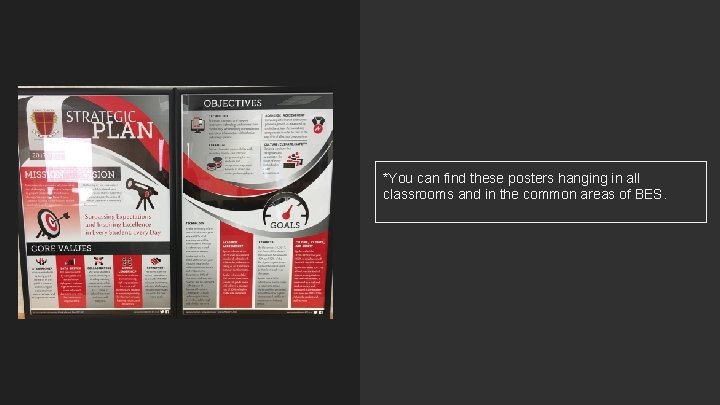
*You can find these posters hanging in all classrooms and in the common areas of BES.
Indiana Academic Standards “Standards outline what students need to know, understand, and be able to do. ” In April of 2014, the Indiana State Board of Education approved the adoption of new standards for English/Language Arts and Mathematics. The science standards were adopted in the spring of 2016. These new standards are the result of a process designed to identify, evaluate, synthesize, and create high-quality, rigorous standards for Indiana students. They have been validated as college and career ready so students who successfully master these objectives by the time they graduate from high school will be ready to go directly into the workplace or a postsecondary educational opportunity without the need of remediation. Academic standards are benchmark measures that define what students should know and be able to do at specified grade levels beginning in kindergarten and progressing through grade twelve. The standards are promulgated as state regulations. To check out the standards for each subject area and grade level, refer to the Indiana Department of Education website. http: //www. doe. in. gov/standards
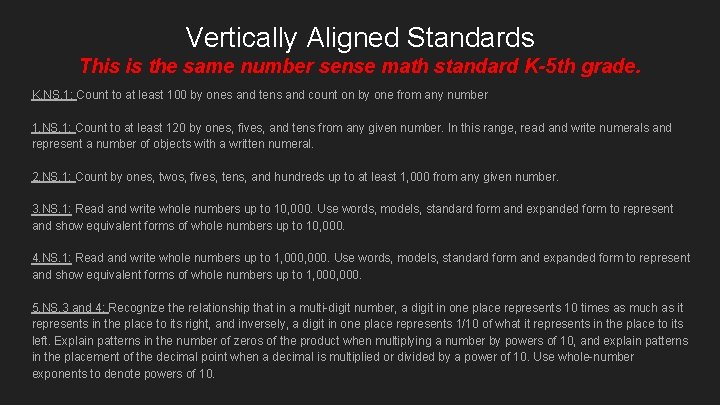
Vertically Aligned Standards This is the same number sense math standard K-5 th grade. K. NS. 1: Count to at least 100 by ones and tens and count on by one from any number 1. NS. 1: Count to at least 120 by ones, fives, and tens from any given number. In this range, read and write numerals and represent a number of objects with a written numeral. 2. NS. 1: Count by ones, twos, fives, tens, and hundreds up to at least 1, 000 from any given number. 3. NS. 1: Read and write whole numbers up to 10, 000. Use words, models, standard form and expanded form to represent and show equivalent forms of whole numbers up to 10, 000. 4. NS. 1: Read and write whole numbers up to 1, 000. Use words, models, standard form and expanded form to represent and show equivalent forms of whole numbers up to 1, 000. 5. NS. 3 and 4: Recognize the relationship that in a multi-digit number, a digit in one place represents 10 times as much as it represents in the place to its right, and inversely, a digit in one place represents 1/10 of what it represents in the place to its left. Explain patterns in the number of zeros of the product when multiplying a number by powers of 10, and explain patterns in the placement of the decimal point when a decimal is multiplied or divided by a power of 10. Use whole-number exponents to denote powers of 10.
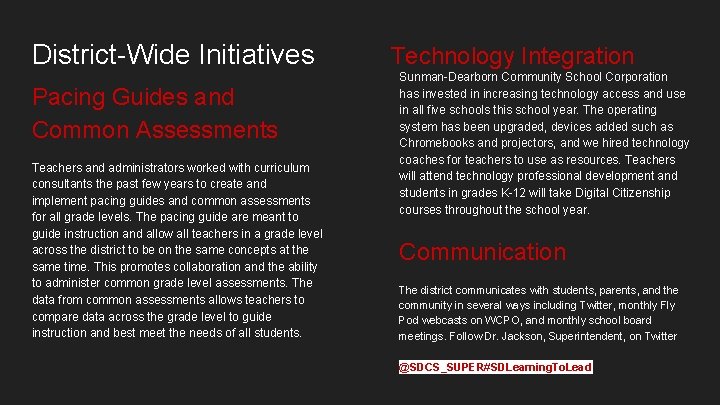
District-Wide Initiatives Pacing Guides and Common Assessments Teachers and administrators worked with curriculum consultants the past few years to create and implement pacing guides and common assessments for all grade levels. The pacing guide are meant to guide instruction and allow all teachers in a grade level across the district to be on the same concepts at the same time. This promotes collaboration and the ability to administer common grade level assessments. The data from common assessments allows teachers to compare data across the grade level to guide instruction and best meet the needs of all students. Technology Integration Sunman-Dearborn Community School Corporation has invested in increasing technology access and use in all five schools this school year. The operating system has been upgraded, devices added such as Chromebooks and projectors, and we hired technology coaches for teachers to use as resources. Teachers will attend technology professional development and students in grades K-12 will take Digital Citizenship courses throughout the school year. Communication The district communicates with students, parents, and the community in several ways including Twitter, monthly Fly Pod webcasts on WCPO, and monthly school board meetings. Follow Dr. Jackson, Superintendent, on Twitter @SDCS_SUPER#SDLearning. To. Lead
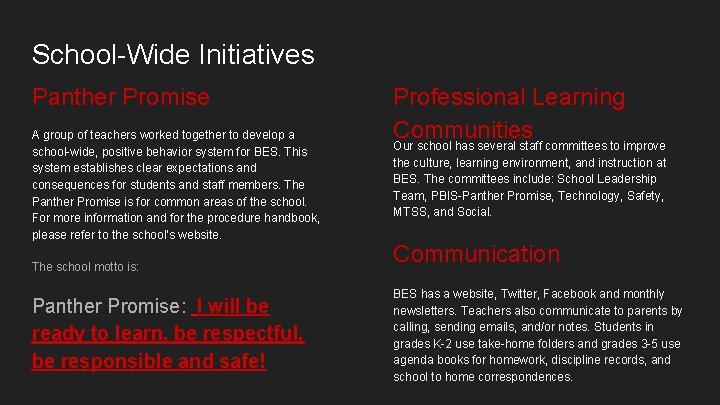
School-Wide Initiatives Panther Promise A group of teachers worked together to develop a school-wide, positive behavior system for BES. This system establishes clear expectations and consequences for students and staff members. The Panther Promise is for common areas of the school. For more information and for the procedure handbook, please refer to the school’s website. The school motto is: Panther Promise: I will be ready to learn, be respectful, be responsible and safe! Professional Learning Communities Our school has several staff committees to improve the culture, learning environment, and instruction at BES. The committees include: School Leadership Team, PBIS-Panther Promise, Technology, Safety, MTSS, and Social. Communication BES has a website, Twitter, Facebook and monthly newsletters. Teachers also communicate to parents by calling, sending emails, and/or notes. Students in grades K-2 use take-home folders and grades 3 -5 use agenda books for homework, discipline records, and school to home correspondences.
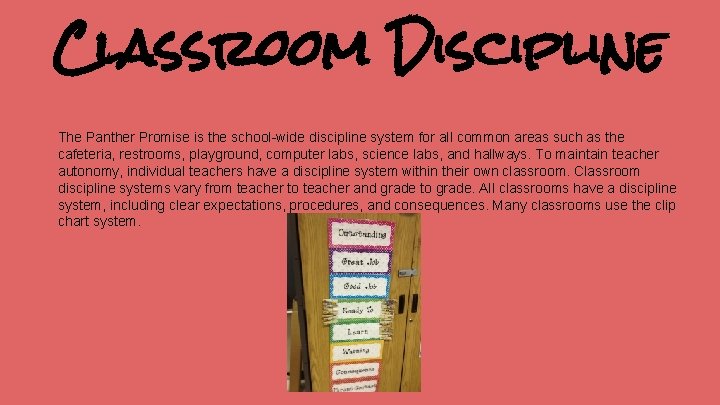
Classroom Discipline The Panther Promise is the school-wide discipline system for all common areas such as the cafeteria, restrooms, playground, computer labs, science labs, and hallways. To maintain teacher autonomy, individual teachers have a discipline system within their own classroom. Classroom discipline systems vary from teacher to teacher and grade to grade. All classrooms have a discipline system, including clear expectations, procedures, and consequences. Many classrooms use the clip chart system.
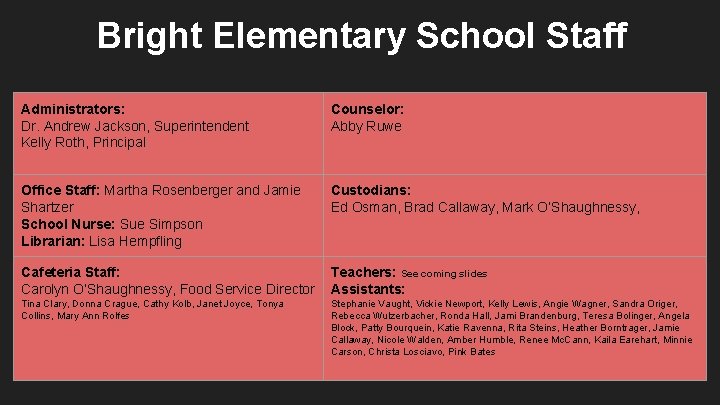
Bright Elementary School Staff Administrators: Dr. Andrew Jackson, Superintendent Kelly Roth, Principal Counselor: Abby Ruwe Office Staff: Martha Rosenberger and Jamie Shartzer School Nurse: Sue Simpson Librarian: Lisa Hempfling Custodians: Ed Osman, Brad Callaway, Mark O’Shaughnessy, Cafeteria Staff: Carolyn O’Shaughnessy, Food Service Director Teachers: See coming slides Assistants: Tina Clary, Donna Crague, Cathy Kolb, Janet Joyce, Tonya Collins, Mary Ann Rolfes Stephanie Vaught, Vickie Newport, Kelly Lewis, Angie Wagner, Sandra Origer, Rebecca Wulzerbacher, Ronda Hall, Jami Brandenburg, Teresa Bolinger, Angela Block, Patty Bourquein, Katie Ravenna, Rita Steins, Heather Borntrager, Jamie Callaway, Nicole Walden, Amber Humble, Renee Mc. Cann, Kaila Earehart, Minnie Carson, Christa Losciavo, Pink Bates
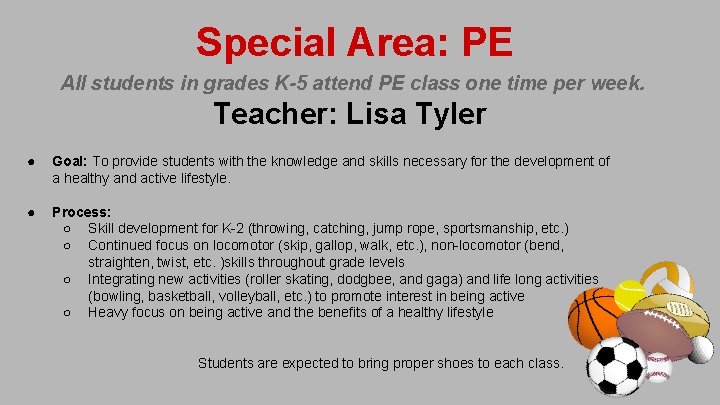
Special Area: PE All students in grades K-5 attend PE class one time per week. Teacher: Lisa Tyler ● Goal: To provide students with the knowledge and skills necessary for the development of a healthy and active lifestyle. ● Process: ○ Skill development for K-2 (throwing, catching, jump rope, sportsmanship, etc. ) ○ Continued focus on locomotor (skip, gallop, walk, etc. ), non-locomotor (bend, straighten, twist, etc. )skills throughout grade levels ○ Integrating new activities (roller skating, dodgbee, and gaga) and life long activities (bowling, basketball, volleyball, etc. ) to promote interest in being active ○ Heavy focus on being active and the benefits of a healthy lifestyle Students are expected to bring proper shoes to each class.
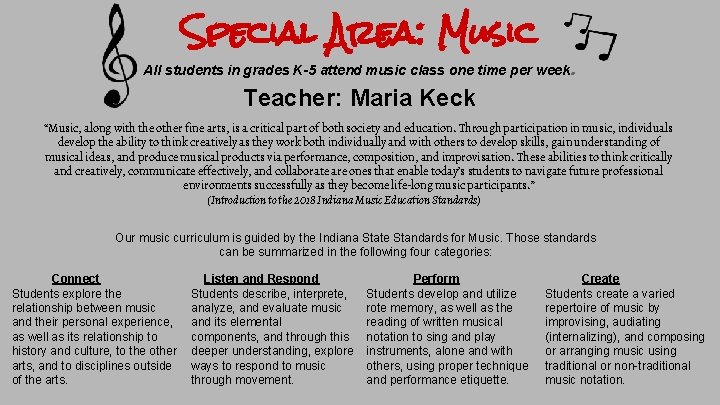
Special Area: Music All students in grades K-5 attend music class one time per week. Teacher: Maria Keck “Music, along with the other fine arts, is a critical part of both society and education. Through participation in music, individuals develop the ability to think creatively as they work both individually and with others to develop skills, gain understanding of musical ideas, and produce musical products via performance, composition, and improvisation. These abilities to think critically and creatively, communicate effectively, and collaborate are ones that enable today’s students to navigate future professional environments successfully as they become life-long music participants. ” (Introduction to the 2018 Indiana Music Education Standards) Our music curriculum is guided by the Indiana State Standards for Music. Those standards can be summarized in the following four categories: Connect Students explore the relationship between music and their personal experience, as well as its relationship to history and culture, to the other arts, and to disciplines outside of the arts. Listen and Respond Students describe, interprete, analyze, and evaluate music and its elemental components, and through this deeper understanding, explore ways to respond to music through movement. Perform Students develop and utilize rote memory, as well as the reading of written musical notation to sing and play instruments, alone and with others, using proper technique and performance etiquette. Create Students create a varied repertoire of music by improvising, audiating (internalizing), and composing or arranging music using traditional or non-traditional music notation.
Special Area: Art All students in grades K-5 attend art class one time per week. Teacher: Carla Daugherty ● Goal : To provide students with the knowledge, skills, and confidence necessary for creative development in visual arts. ● Processes : ○ Students will be introduced to new mediums and explore using them. ○ Students will learn the elements of art and principles of design and how to apply them to 2 D and 3 D art. ○ Students will work on improving their craftsmanship from year to year. ○ Students will be able to be creative while also adhereing to basic guidelines. ○ Students will learn the proper and safe use of art tools and materials, and be respectful of their own and other’s art pieces. ○ Students will learn how to critique a piece of artwork (their own and someone else’s). Students are expected to bring necessary materials to class depending on what the project requires (pencil, variety of coloring supplies, and/or art shirt).
Special Area: Library All students in grades K-5 attend library class one time per week. Librarian: Lisa Hempling ● Students will be able to check out a book each week. ● Mrs. Hempfling shares stories and reinforces literacy concepts through active discussions. ● BES will host book fairs in the Fall and Spring where students can purchase books.
Special Area: Computer All students in grades K-5 attend computer class one time per week. Teacher: Grade Level Assistants Students will learn basic keyboarding skills, how to conduct research, create word processing and digital presentations, take computerbased assessments, and more. All students will participate in a Digital Citizenship program. Those lessons will be taught by classroom teachers.
Kindergarten Teachers: Kristen Hallahan Shawna Leising Diana Coffman Karen Schebler Goals: ● To master all kindergarten skills in math, reading, writing, science, and social studies. ● Develop positive social skills ● Becoming lifelong learners
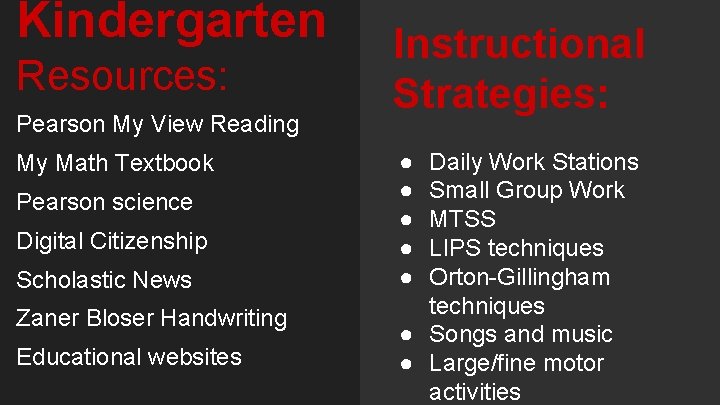
Kindergarten Resources: Pearson My View Reading My Math Textbook Pearson science Digital Citizenship Scholastic News Zaner Bloser Handwriting Educational websites Instructional Strategies: ● ● ● Daily Work Stations Small Group Work MTSS LIPS techniques Orton-Gillingham techniques ● Songs and music ● Large/fine motor activities
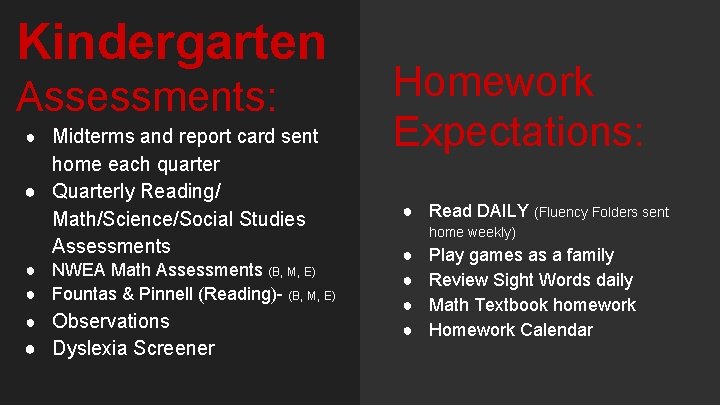
Kindergarten Assessments: ● Midterms and report card sent home each quarter ● Quarterly Reading/ Math/Science/Social Studies Assessments ● NWEA Math Assessments (B, M, E) ● Fountas & Pinnell (Reading)- (B, M, E) ● Observations ● Dyslexia Screener Homework Expectations: ● Read DAILY (Fluency Folders sent home weekly) ● ● Play games as a family Review Sight Words daily Math Textbook homework Homework Calendar
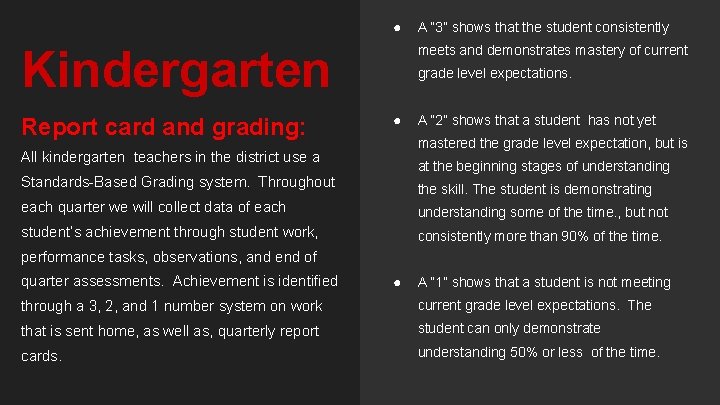
● Kindergarten Report card and grading: A “ 3” shows that the student consistently meets and demonstrates mastery of current grade level expectations. ● A “ 2” shows that a student has not yet mastered the grade level expectation, but is All kindergarten teachers in the district use a at the beginning stages of understanding Standards-Based Grading system. Throughout the skill. The student is demonstrating each quarter we will collect data of each understanding some of the time. , but not student’s achievement through student work, consistently more than 90% of the time. performance tasks, observations, and end of quarter assessments. Achievement is identified ● A “ 1” shows that a student is not meeting through a 3, 2, and 1 number system on work current grade level expectations. The that is sent home, as well as, quarterly report student can only demonstrate cards. understanding 50% or less of the time.
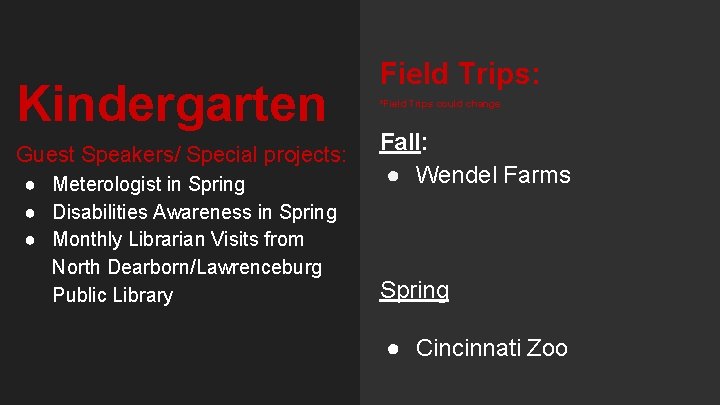
Kindergarten Guest Speakers/ Special projects: ● Meterologist in Spring ● Disabilities Awareness in Spring ● Monthly Librarian Visits from North Dearborn/Lawrenceburg Public Library Field Trips: *Field Trips could change Fall: ● Wendel Farms Spring ● Cincinnati Zoo
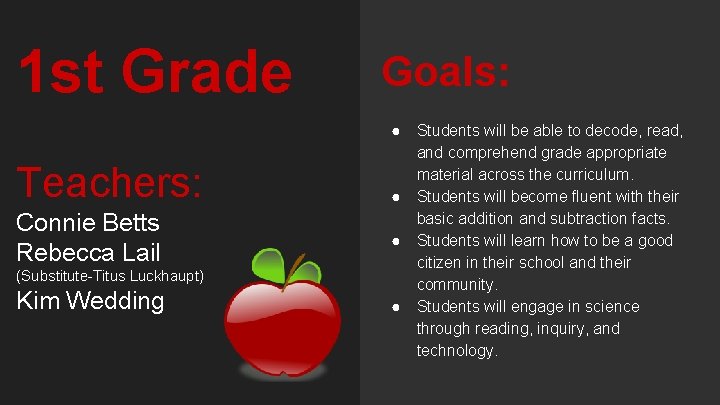
1 st Grade Goals: ● Teachers: Connie Betts Rebecca Lail ● ● (Substitute-Titus Luckhaupt) Kim Wedding ● Students will be able to decode, read, and comprehend grade appropriate material across the curriculum. Students will become fluent with their basic addition and subtraction facts. Students will learn how to be a good citizen in their school and their community. Students will engage in science through reading, inquiry, and technology.
1 st Grade Resources: Instructional Strategies: ● Pre-test to determine prior knowledge ● Differentiate by providing activities that challenge all students. ● Pearson My View Reading ● My Math Textbook ● My World Social Studies ● Provide purpose for learning by making connections to student’s experiences and the world around them ● Engage students in meaningful activities that promote understanding ● Provide students with the opportunity to share what they have learned through ● Scholastic News ● ● Interactive Science these instructional activities Post-test to determine mastery of skills and plan for interventions and differentiation
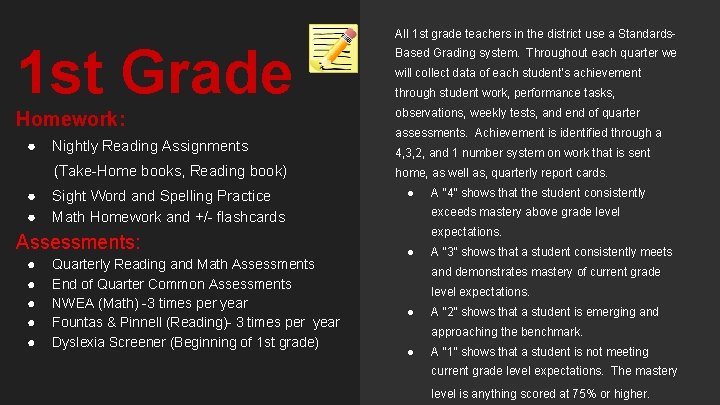
1 st Grade Homework: ● Nightly Reading Assignments (Take-Home books, Reading book) ● ● Sight Word and Spelling Practice Math Homework and +/- flashcards Assessments: ● ● ● Quarterly Reading and Math Assessments End of Quarter Common Assessments NWEA (Math) -3 times per year Fountas & Pinnell (Reading)- 3 times per year Dyslexia Screener (Beginning of 1 st grade) All 1 st grade teachers in the district use a Standards. Based Grading system. Throughout each quarter we will collect data of each student’s achievement through student work, performance tasks, observations, weekly tests, and end of quarter assessments. Achievement is identified through a 4, 3, 2, and 1 number system on work that is sent home, as well as, quarterly report cards. ● A “ 4” shows that the student consistently exceeds mastery above grade level expectations. ● A “ 3” shows that a student consistently meets and demonstrates mastery of current grade level expectations. ● A “ 2” shows that a student is emerging and approaching the benchmark. ● A “ 1” shows that a student is not meeting current grade level expectations. The mastery level is anything scored at 75% or higher.
1 st Grade Guest Speakers/ Special projects: ● Miss Molly Recycling Presentation from Dearborn County Recycling ● Jennifer Ketchmark/WCPO Meteorology Presentation ● Time Line Project Field Trips: *Field Trips could change ● 1 st semester: Cincinnati Museum ● 2 nd semester: TBD
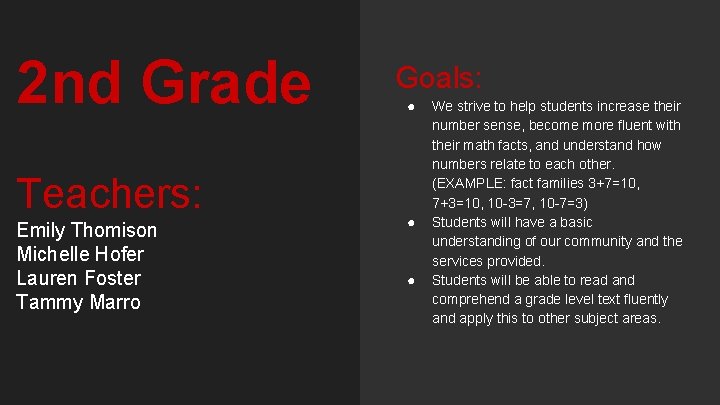
2 nd Grade Teachers: Emily Thomison Michelle Hofer Lauren Foster Tammy Marro Goals: ● ● ● We strive to help students increase their number sense, become more fluent with their math facts, and understand how numbers relate to each other. (EXAMPLE: fact families 3+7=10, 7+3=10, 10 -3=7, 10 -7=3) Students will have a basic understanding of our community and the services provided. Students will be able to read and comprehend a grade level text fluently and apply this to other subject areas.
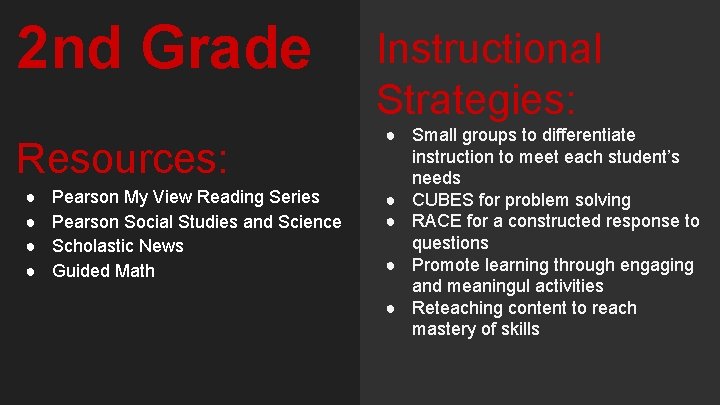
2 nd Grade Resources: ● ● Pearson My View Reading Series Pearson Social Studies and Science Scholastic News Guided Math Instructional Strategies: ● Small groups to differentiate instruction to meet each student’s needs ● CUBES for problem solving ● RACE for a constructed response to questions ● Promote learning through engaging and meaningul activities ● Reteaching content to reach mastery of skills
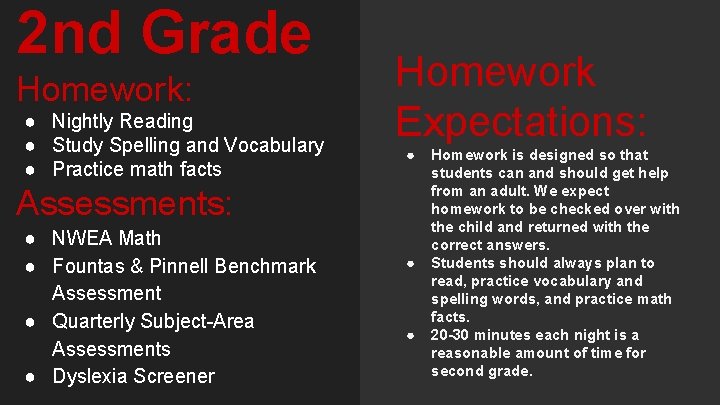
2 nd Grade Homework: ● Nightly Reading ● Study Spelling and Vocabulary ● Practice math facts Homework Expectations: ● Assessments: ● NWEA Math ● Fountas & Pinnell Benchmark Assessment ● Quarterly Subject-Area Assessments ● Dyslexia Screener ● ● Homework is designed so that students can and should get help from an adult. We expect homework to be checked over with the child and returned with the correct answers. Students should always plan to read, practice vocabulary and spelling words, and practice math facts. 20 -30 minutes each night is a reasonable amount of time for second grade.
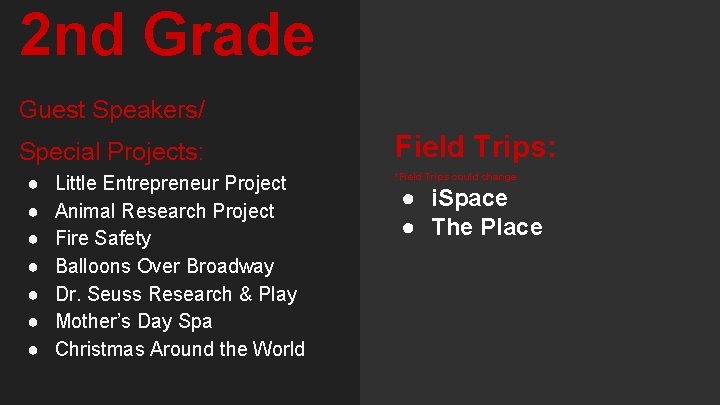
2 nd Grade Guest Speakers/ Special Projects: ● ● ● ● Little Entrepreneur Project Animal Research Project Fire Safety Balloons Over Broadway Dr. Seuss Research & Play Mother’s Day Spa Christmas Around the World Field Trips: *Field Trips could change ● i. Space ● The Place
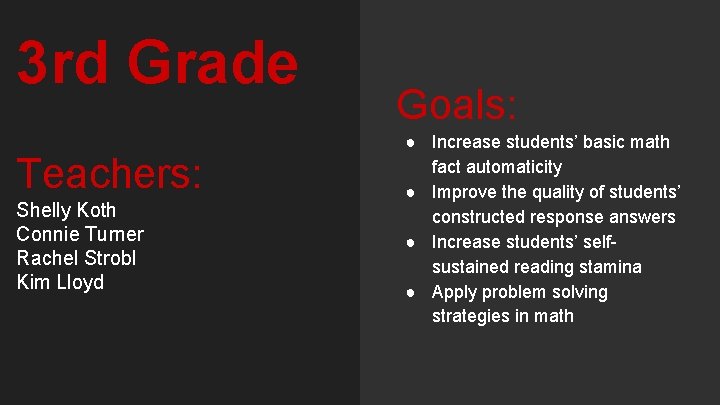
3 rd Grade Teachers: Shelly Koth Connie Turner Rachel Strobl Kim Lloyd Goals: ● Increase students’ basic math fact automaticity ● Improve the quality of students’ constructed response answers ● Increase students’ selfsustained reading stamina ● Apply problem solving strategies in math
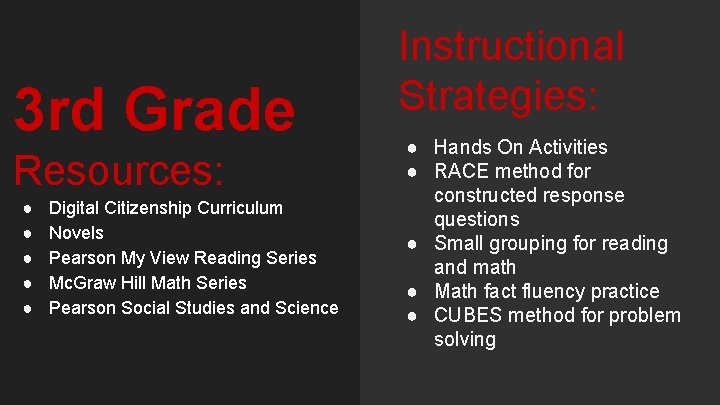
3 rd Grade Resources: ● ● ● Digital Citizenship Curriculum Novels Pearson My View Reading Series Mc. Graw Hill Math Series Pearson Social Studies and Science Instructional Strategies: ● Hands On Activities ● RACE method for constructed response questions ● Small grouping for reading and math ● Math fact fluency practice ● CUBES method for problem solving
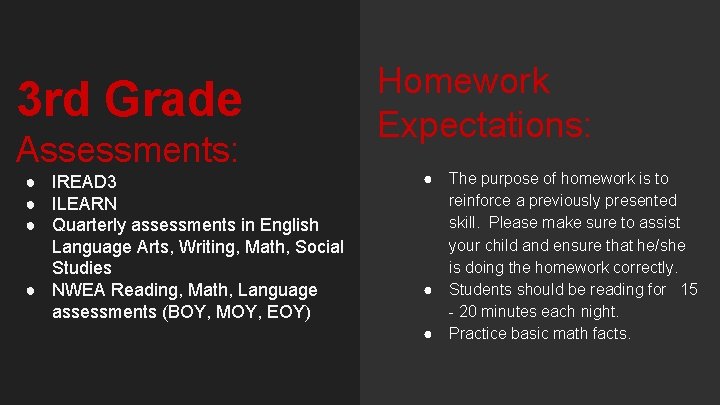
3 rd Grade Assessments: ● IREAD 3 ● ILEARN ● Quarterly assessments in English Language Arts, Writing, Math, Social Studies ● NWEA Reading, Math, Language assessments (BOY, MOY, EOY) Homework Expectations: ● ● ● The purpose of homework is to reinforce a previously presented skill. Please make sure to assist your child and ensure that he/she is doing the homework correctly. Students should be reading for 15 - 20 minutes each night. Practice basic math facts.
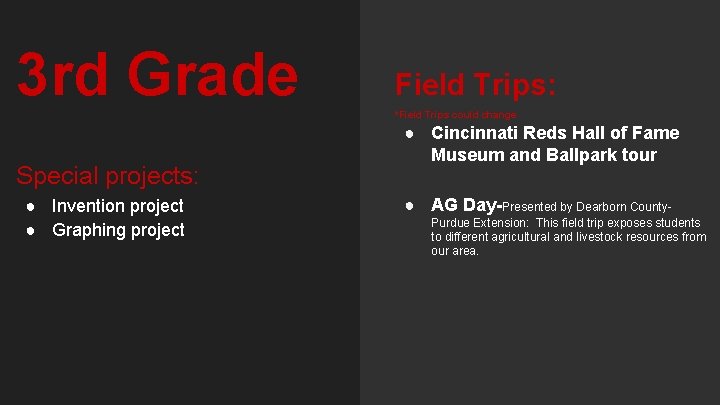
3 rd Grade Field Trips: *Field Trips could change Special projects: ● Invention project ● Graphing project ● Cincinnati Reds Hall of Fame Museum and Ballpark tour ● AG Day-Presented by Dearborn County. Purdue Extension: This field trip exposes students to different agricultural and livestock resources from our area.
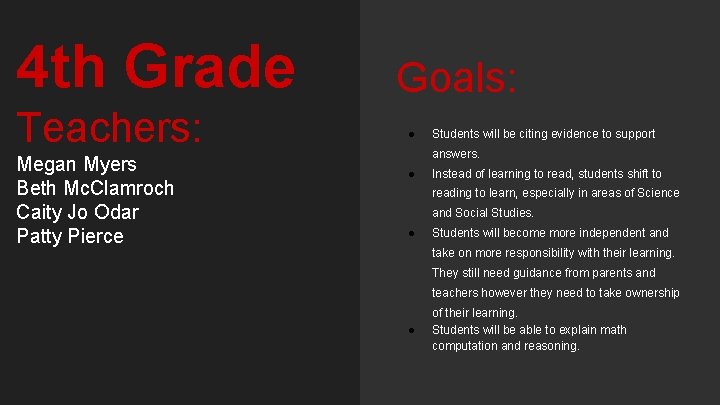
4 th Grade Teachers: Megan Myers Beth Mc. Clamroch Caity Jo Odar Patty Pierce Goals: ● Students will be citing evidence to support answers. ● Instead of learning to read, students shift to reading to learn, especially in areas of Science and Social Studies. ● Students will become more independent and take on more responsibility with their learning. They still need guidance from parents and teachers however they need to take ownership ● of their learning. Students will be able to explain math computation and reasoning.
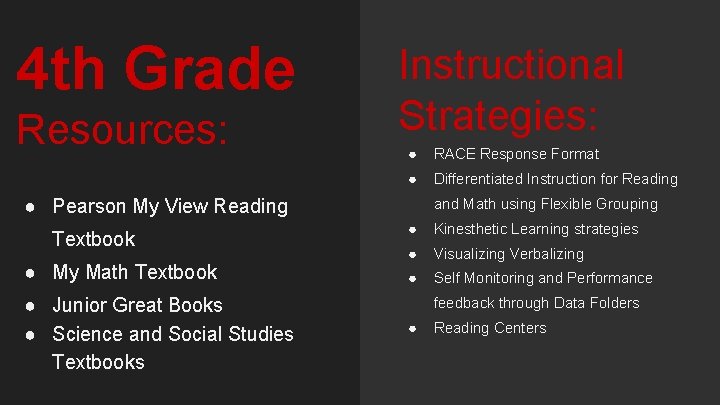
4 th Grade Resources: Instructional Strategies: ● RACE Response Format ● Differentiated Instruction for Reading ● Pearson My View Reading Textbook ● My Math Textbook ● Junior Great Books ● Science and Social Studies Textbooks and Math using Flexible Grouping ● Kinesthetic Learning strategies ● Visualizing Verbalizing ● Self Monitoring and Performance feedback through Data Folders ● Reading Centers
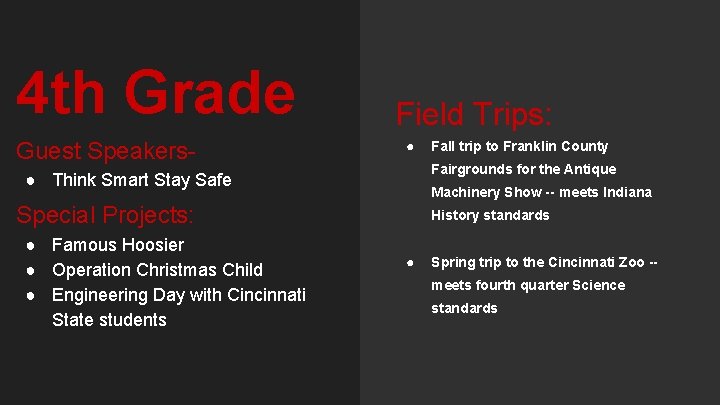
4 th Grade Guest Speakers- Field Trips: ● Fairgrounds for the Antique ● Think Smart Stay Safe Machinery Show -- meets Indiana Special Projects: ● Famous Hoosier ● Operation Christmas Child ● Engineering Day with Cincinnati State students Fall trip to Franklin County History standards ● Spring trip to the Cincinnati Zoo -meets fourth quarter Science standards
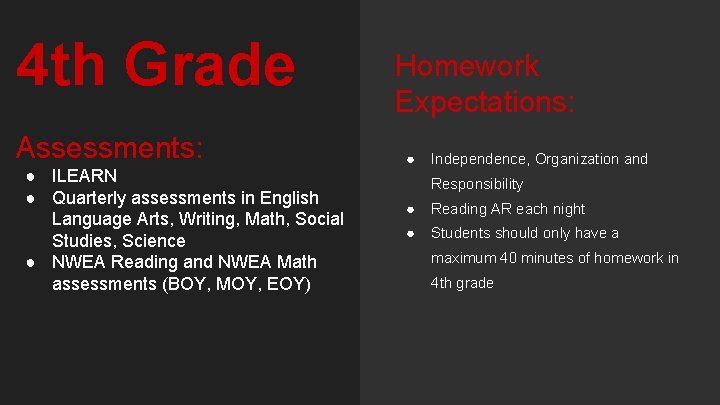
4 th Grade Assessments: ● ILEARN ● Quarterly assessments in English Language Arts, Writing, Math, Social Studies, Science ● NWEA Reading and NWEA Math assessments (BOY, MOY, EOY) Homework Expectations: ● Independence, Organization and Responsibility ● Reading AR each night ● Students should only have a maximum 40 minutes of homework in 4 th grade
5 th Grade Teachers: Chris Vennemeier Gretchen Ernst Brooke Stenger Angie Neff Goals: ● Foster organizational skills and agenda usage to be independent learners ● Practice and act by the Panther Promise to be role models for younger students. ● To empower them with learning tools to become lifelong learners. ● Mastery of 5 th grade College and Career Ready standards.
Instructional Strategies: 5 th Grade ● Frameworks to create a constructed response: Examples: RACE-(restate, answer, cite, explain) ● Phonetics to improve spelling ● Use of dictionary and thesaurus to enhance vocabulary: definitions, parts of speech, synonyms, antonyms, affixes. ● Differentiation to help meet needs of individual students. ● Mnemonic devices to aid in remembering.
Homework Expectations 5 th Grade Assessments: ● ILEARN ● Quarterly assessments in English Language Arts, Writing, Math, Social Studies, Science ● NWEA Reading and NWEA Math assessments (BOY, MOY, EOY) ● By using the agenda, students become responsible: bringing home what is needed and completing it. This helps them become good communicators between home and school. ● Stay organized: putting work in the correct place to bring home and to return to school. ● Complete any work not finished at school that is due. ● study for tests ● Read 20 minutes each night for AR
5 th Grade Guest Speakers/Special projects: ● Get Real about Tobacco Field Trips: *Field Trips could change ● Cincinnati Cyclones Day of Science ● Pick a Book ● S-D Middle School visit ● States Project ● ECHS Drama Production
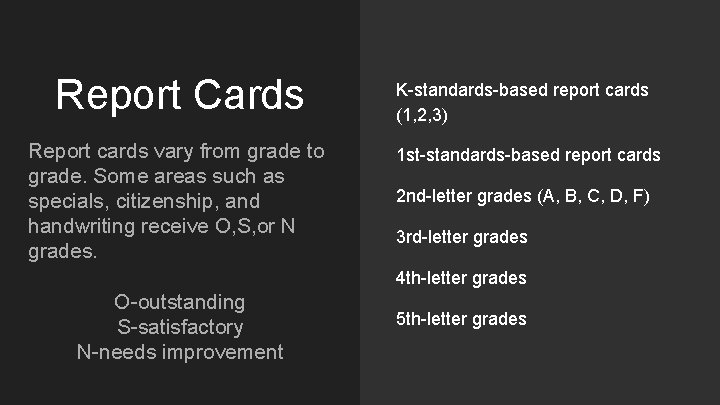
Report Cards Report cards vary from grade to grade. Some areas such as specials, citizenship, and handwriting receive O, S, or N grades. K-standards-based report cards (1, 2, 3) 1 st-standards-based report cards 2 nd-letter grades (A, B, C, D, F) 3 rd-letter grades 4 th-letter grades O-outstanding S-satisfactory N-needs improvement 5 th-letter grades
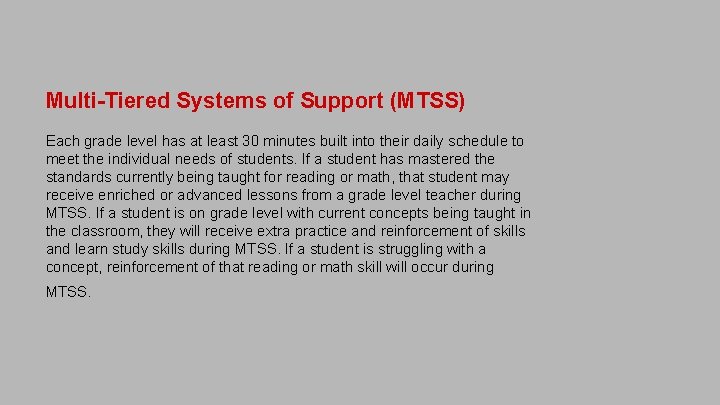
Multi-Tiered Systems of Support (MTSS) Each grade level has at least 30 minutes built into their daily schedule to meet the individual needs of students. If a student has mastered the standards currently being taught for reading or math, that student may receive enriched or advanced lessons from a grade level teacher during MTSS. If a student is on grade level with current concepts being taught in the classroom, they will receive extra practice and reinforcement of skills and learn study skills during MTSS. If a student is struggling with a concept, reinforcement of that reading or math skill will occur during MTSS.
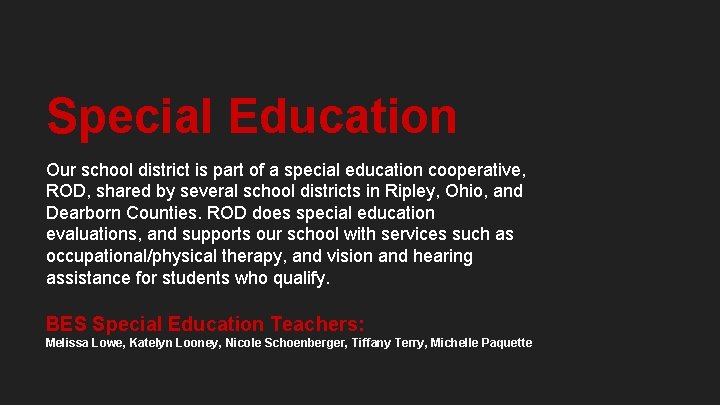
Special Education Our school district is part of a special education cooperative, ROD, shared by several school districts in Ripley, Ohio, and Dearborn Counties. ROD does special education evaluations, and supports our school with services such as occupational/physical therapy, and vision and hearing assistance for students who qualify. BES Special Education Teachers: Melissa Lowe, Katelyn Looney, Nicole Schoenberger, Tiffany Terry, Michelle Paquette
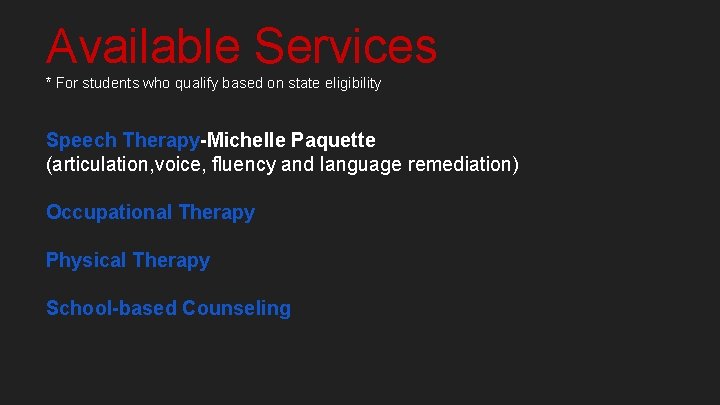
Available Services * For students who qualify based on state eligibility Speech Therapy-Michelle Paquette (articulation, voice, fluency and language remediation) Occupational Therapy Physical Therapy School-based Counseling
High Ability Sunman-Dearborn Community School Corporation has adopted the School Cluster Group Model (SCGM) to service identified high ability students in the general education classroom. SCGM benefits all students making it easier for teachers to differentiate instruction. All students are given multiple assessments each school year to determine eligibility for high ability services. If you would like more information about high ability, see the handbook on the district website under the info. tab or contact Barb Katenkamp the district High Ability Student Services Coordinator. www. sunmandearborn. k 12. in. us
School Counseling Abby Ruwe is the counselor at BES. Some of their roles include facilitating MTSS and special education referral process, providing support to families who are seeking resources or assistance, and providing individual, group, and classroom counseling to students to help them succeed in school.
School Nurse ● Sue Simpson is our school nurse. She can provide basic first aid treatment for accidents that occur at school and administer Tylenol, with consent, for low grade fevers that come on at school. ● If students need to take medicine at school, please send the medicine in the original container with a note. ● Vision screenings are done for students in grades K, 1 st, 3 rd, 5 th, and upon teacher referral. Hearing screenings are done for grades K, 1 st, 4 th, and upon teacher referral.
Ways to get involved… ● ● ● PTO (First Thursday of the month) Classroom Volunteer Field Trip Chaperone Party Volunteer Lunch Guest School Board Meetings (second Thursday of the month)
Special School-Wide Functions *This is a list of things we have done in the past. Functions will vary from year to year. ● ● ● ● Special Convocations Fundraisers Veteran’s Day Music Concerts Movie Nights (PTO) Spring Carnival (PTO) Special Areas Showcase
Questions? ? Please feel free to contact any staff member with questions about BES Elementary School. Contact information can be found on the school’s website.
- Slides: 50