
Curriculum development Importance of development Creating a set
- Slides: 12
Curriculum development �Importance of development - Creating a set of rules - Planning ahead of time - Implementation of the Stage 6 syllabus - The end product/ project �Valuing the HSC - Strongly scaffold by the BOS - Important to cover all content for the HSC and school assessments
Ub. D backwards Mapping Resources �Identify desired results - What you want the students to learn - Determine acceptable evidence - How you will get students to show learning - Assessments etc. Plan learning experience and instruction - Assess student progress -
What is Project Based Learning? �Students make decisions within a prescribed framework. �There’s a problem or challenge without a predetermined solution. �Students design the process for reaching a solution. �Students are responsible for accessing and managing the information they gather. �Evaluation takes place continuously. �Students regularly reflect on what they’re doing. �A final product (not necessarily material) is produced and is evaluated for quality. �The classroom has an atmosphere that tolerates error and change.
How can PBL be used in stage 6? �Implementing projects related to units of work �Through the use of PBL, Students are able to fulfil the outcomes listed in the stage 6 syllabus predominately through their major work and group focused activities.
Interactive Teaching Resources: definition �Encourages maximum amount of interaction between teachers and students �Ideally with a 70/30 split between student participation and lecture structure �Goal: Develop students character, provide confidence and motivation to express ideas, opinions and emotions
Benefits �More effective than traditional teaching methods �Uses continuous engagement to create a more effective way to engage contemporary students �Motivates students to learn and have ownership over this learning �Provides the students to teach peers, thus enhancing their own learning �Creates a sense of community within a classroom �Teaches collaboration and cooperation/ ‘life’ skills
Implementation �Start simply and build this process EG: learning partners � Small group projects � Whole class projects • Method of implementation – Summative – identifying/test student knowledge gained – Formative – assign task directly to students – Motivation – create an environment to elicit student response • Eg: total physical response – students retain more through a physical setting • Pair students to discuss pros/cons of topic • Encourage experimentation – don’t be afraid to make mistakes = learning • For conclusion of lesson: summarise lesson with one word and review lesson accurately
Examples �Test tournament �Youtube video quizes �Interactive game learning/Gamified learning �Role playing �Pop culture statistics
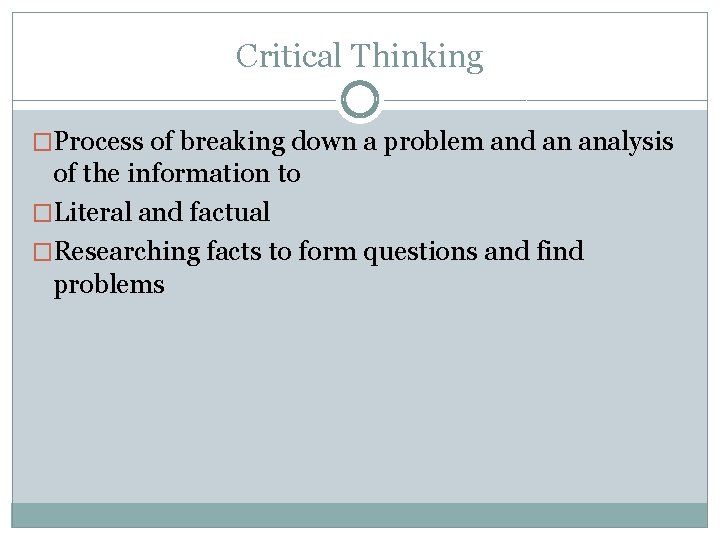
Critical Thinking �Process of breaking down a problem and an analysis of the information to �Literal and factual �Researching facts to form questions and find problems
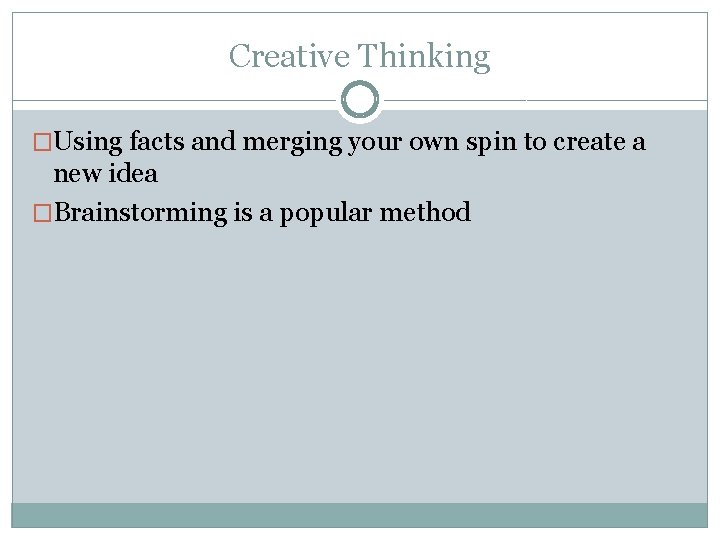
Creative Thinking �Using facts and merging your own spin to create a new idea �Brainstorming is a popular method
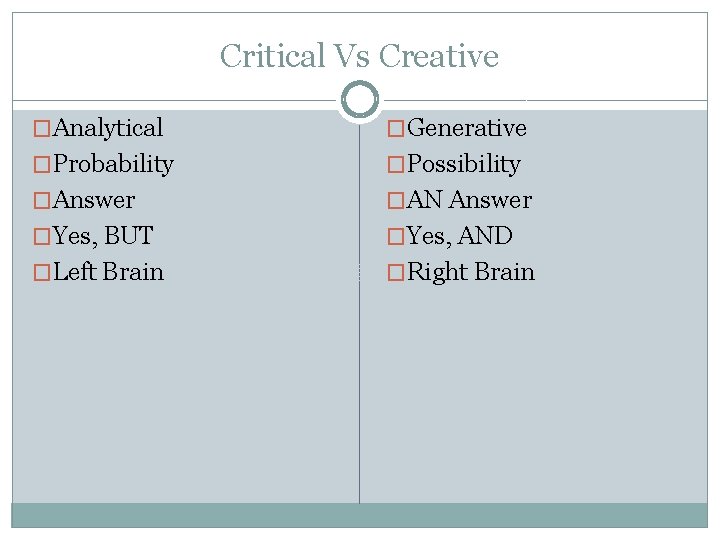
Critical Vs Creative �Analytical �Generative �Probability �Possibility �Answer �AN Answer �Yes, BUT �Yes, AND �Left Brain �Right Brain
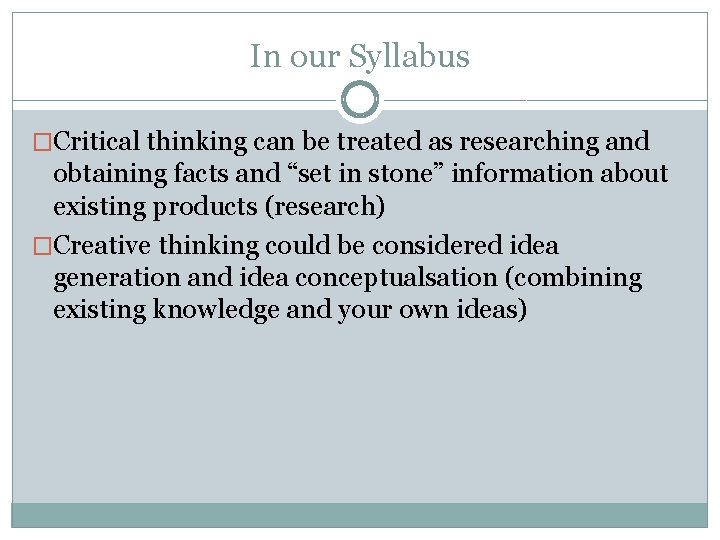
In our Syllabus �Critical thinking can be treated as researching and obtaining facts and “set in stone” information about existing products (research) �Creative thinking could be considered idea generation and idea conceptualsation (combining existing knowledge and your own ideas)