
Curriculum design Social and behavioral Sciences Team members
Curriculum design: Social and behavioral Sciences Team members Dr Thilakavathi Dr Krishnendu Dr Prabhdeep Kaur Dr Prabhu Dr Biju Soman Facilitator: Evangeline Harris Stefanakis
Curriculum design Beginning and approach • Existing curriculum – Existing curriculum has been conducted for one year. • Feedback from course coordinator: Situational factors Curriculum designed by experts and given to coordinator Conducted by multiple external faculty Lectures on designated topics Need for active learning and include other teaching strategies for certain topics. – Need for removing topics covered by other courses – – • Beginnings – Identified a note taker and used LCD – Brainstorming and involving all participants

Significant learning Move from lectures to active learning Revised goals and objectives using levels of learning Teaching / learning activities Promote student participation using films, field visits and case based teaching Assessments Measurable objectives to plan assessments
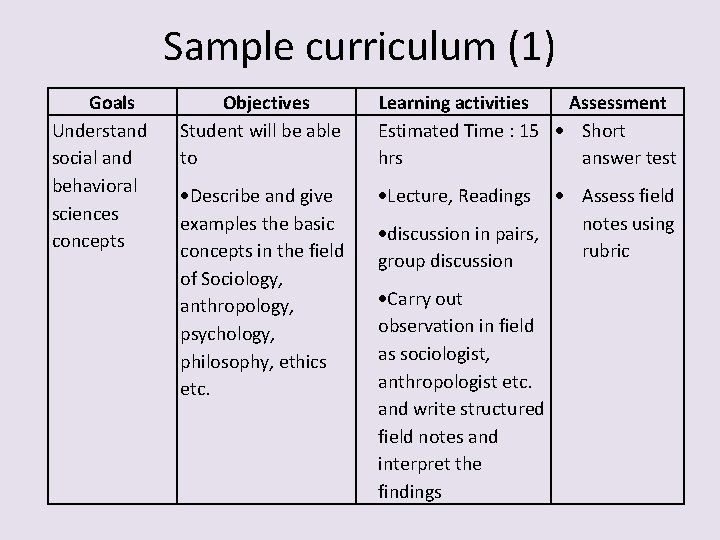
Sample curriculum (1) Goals Understand social and behavioral sciences concepts Objectives Student will be able to Learning activities Assessment Estimated Time : 15 Short hrs answer test Describe and give examples the basic concepts in the field of Sociology, anthropology, psychology, philosophy, ethics etc. Lecture, Readings Assess field notes using discussion in pairs, rubric group discussion Carry out observation in field as sociologist, anthropologist etc. and write structured field notes and interpret the findings
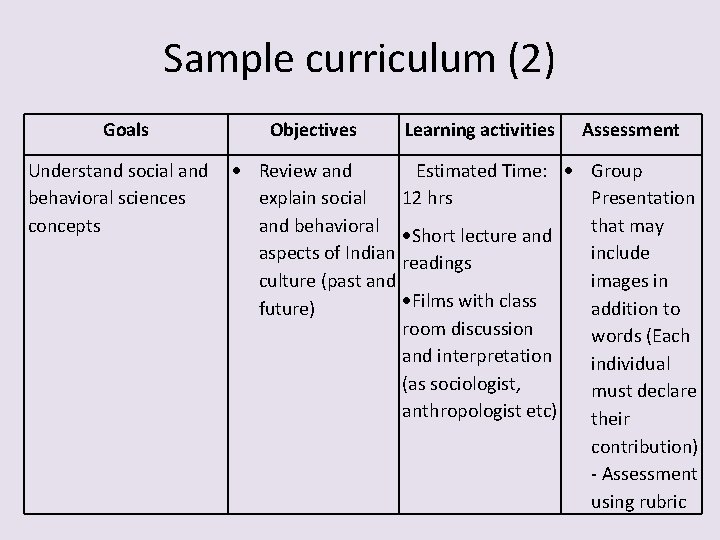
Sample curriculum (2) Goals Understand social and behavioral sciences concepts Objectives Learning activities Assessment Review and Estimated Time: Group explain social 12 hrs Presentation and behavioral Short lecture and that may aspects of Indian readings include culture (past and images in Films with class future) addition to room discussion words (Each and interpretation individual (as sociologist, must declare anthropologist etc) their contribution) - Assessment using rubric
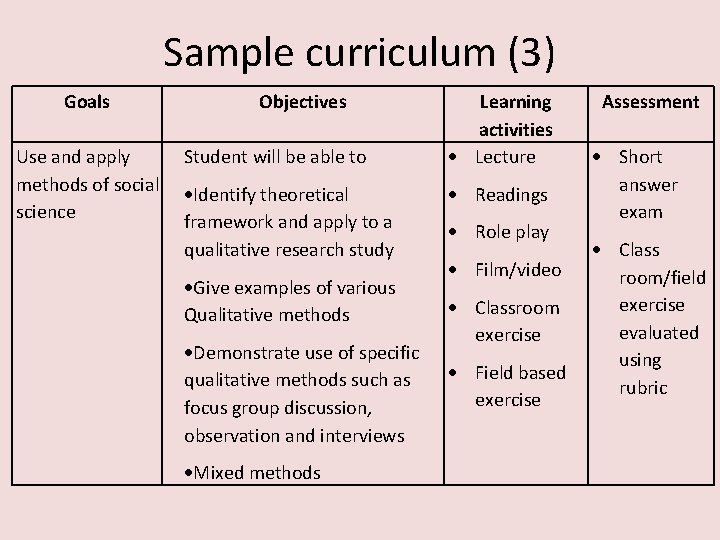
Sample curriculum (3) Goals Use and apply methods of social science Objectives Student will be able to Identify theoretical framework and apply to a qualitative research study Give examples of various Qualitative methods Demonstrate use of specific qualitative methods such as focus group discussion, observation and interviews Mixed methods Learning activities Lecture Readings Role play Film/video Classroom exercise Field based exercise Assessment Short answer exam Class room/field exercise evaluated using rubric
Reflections as a group • Helped us make it more interesting, made the process faster • Guided and focused • Identified feasible areas where we could achieve measurable outcomes • New experience to develop curriculum as a group and this experience can be used to revise our own courses
Reflections as individuals • Identifying measurable objectives • Understanding the importance of using different participatory methods • Shifting from one directional learning to participatory approach • Emphasizing role of assessment • Using matrix approach from goals to assessment
- Slides: 8