
Curriculum and Assessment Writing Project Writing CCLSAligned Unit
- Slides: 62
Curriculum and Assessment Writing Project: Writing CCLS-Aligned Unit Assessments
Guiding Questions 2 1. What is happening nationally with assessment and the Common Core? 2. What is our philosophy on assessment? 3. What is the assessment creation process for ELA and Mathematics?
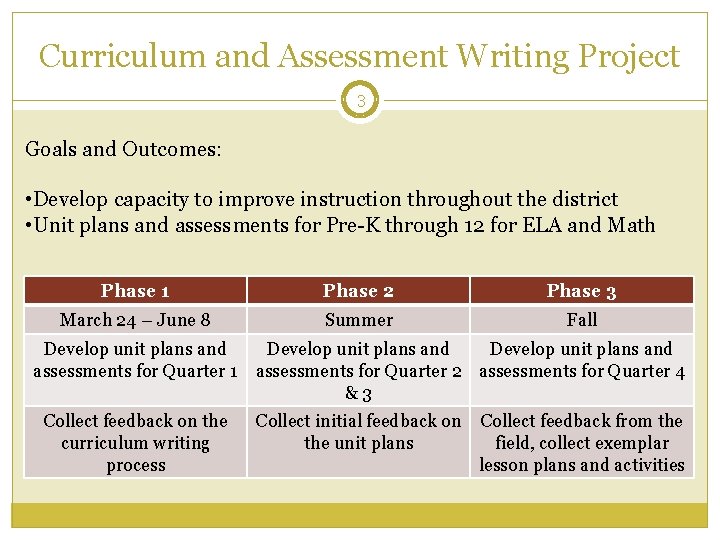
Curriculum and Assessment Writing Project 3 Goals and Outcomes: • Develop capacity to improve instruction throughout the district • Unit plans and assessments for Pre-K through 12 for ELA and Math Phase 1 Phase 2 Phase 3 March 24 – June 8 Summer Fall Develop unit plans and assessments for Quarter 1 assessments for Quarter 2 assessments for Quarter 4 &3 Collect feedback on the curriculum writing process Collect initial feedback on the unit plans Collect feedback from the field, collect exemplar lesson plans and activities
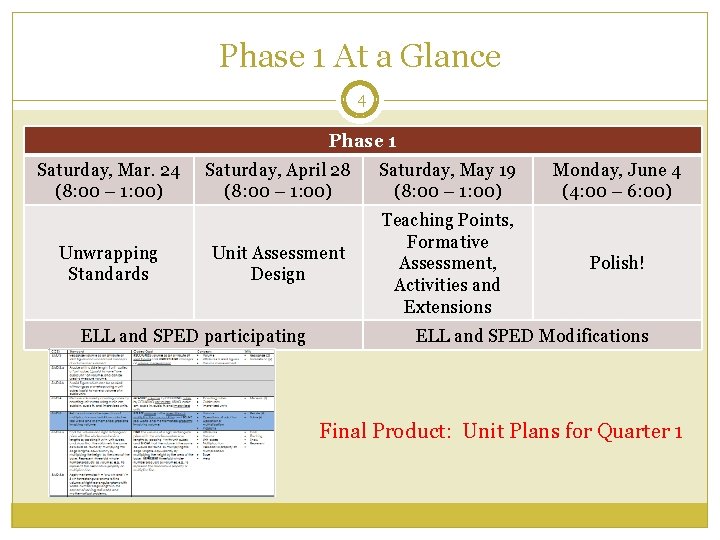
Phase 1 At a Glance 4 Phase 1 Saturday, Mar. 24 (8: 00 – 1: 00) Unwrapping Standards Saturday, April 28 (8: 00 – 1: 00) Saturday, May 19 (8: 00 – 1: 00) Monday, June 4 (4: 00 – 6: 00) Unit Assessment Design Teaching Points, Formative Assessment, Activities and Extensions Polish! ELL and SPED participating ELL and SPED Modifications Final Product: Unit Plans for Quarter 1
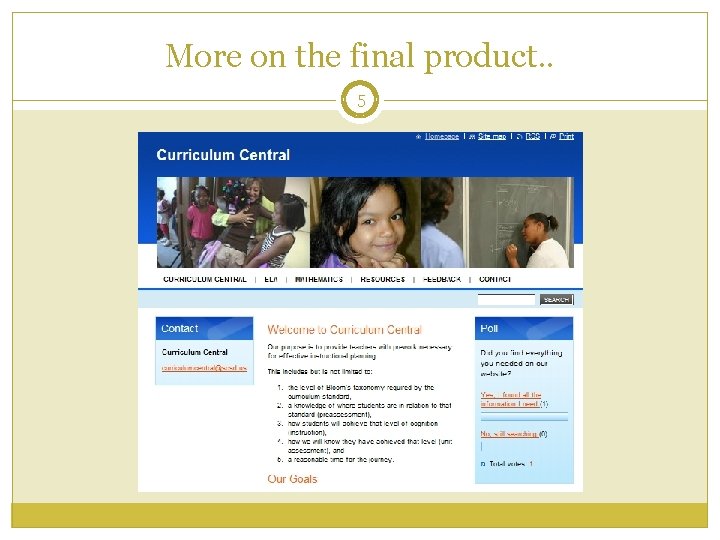
More on the final product. . 5
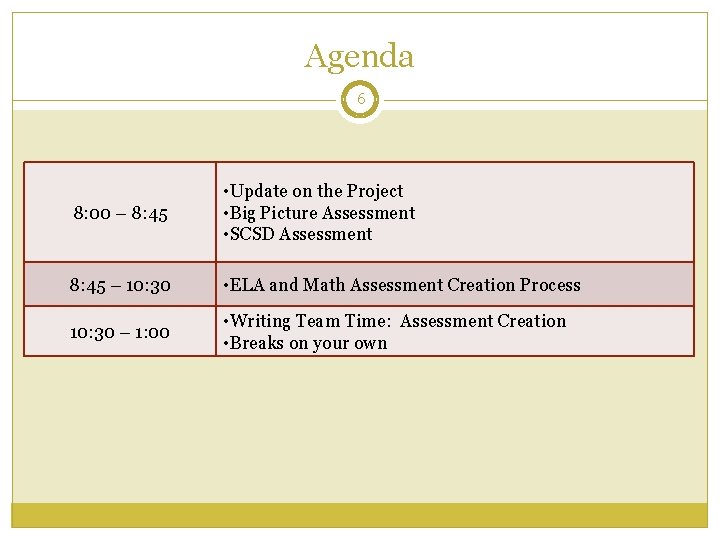
Agenda 6 8: 00 – 8: 45 • Update on the Project • Big Picture Assessment • SCSD Assessment 8: 45 – 10: 30 • ELA and Math Assessment Creation Process 10: 30 – 1: 00 • Writing Team Time: Assessment Creation • Breaks on your own
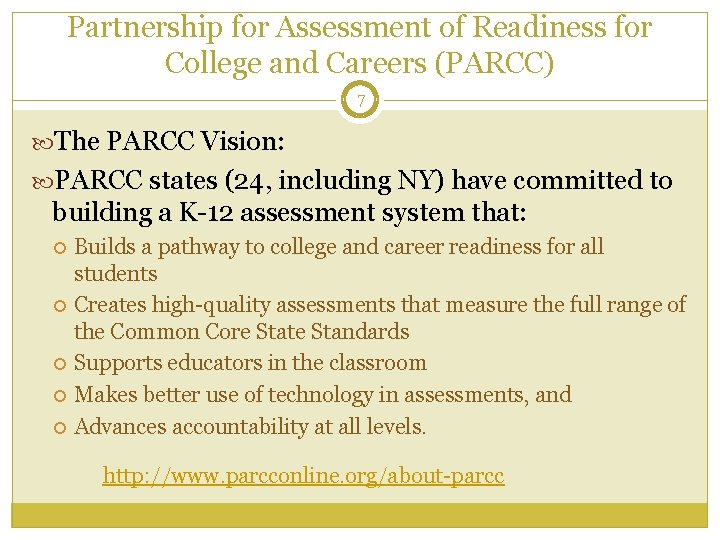
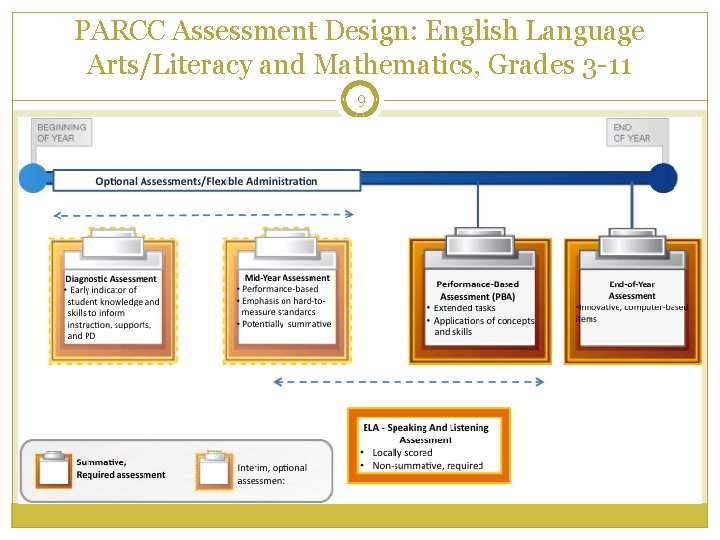
Partnership for Assessment of Readiness for College and Careers (PARCC) 7 The PARCC Vision: PARCC states (24, including NY) have committed to building a K-12 assessment system that: Builds a pathway to college and career readiness for all students Creates high-quality assessments that measure the full range of the Common Core State Standards Supports educators in the classroom Makes better use of technology in assessments, and Advances accountability at all levels. http: //www. parcconline. org/about-parcc
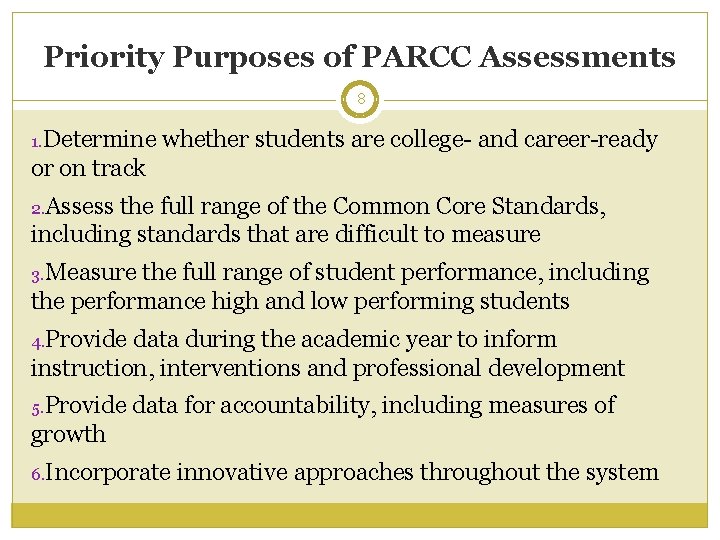
Priority Purposes of PARCC Assessments 8 1. Determine whether students are college- and career-ready or on track 2. Assess the full range of the Common Core Standards, including standards that are difficult to measure 3. Measure the full range of student performance, including the performance high and low performing students 4. Provide data during the academic year to inform instruction, interventions and professional development 5. Provide data for accountability, including measures of growth 6. Incorporate innovative approaches throughout the system
PARCC Assessment Design: English Language Arts/Literacy and Mathematics, Grades 3 -11 9
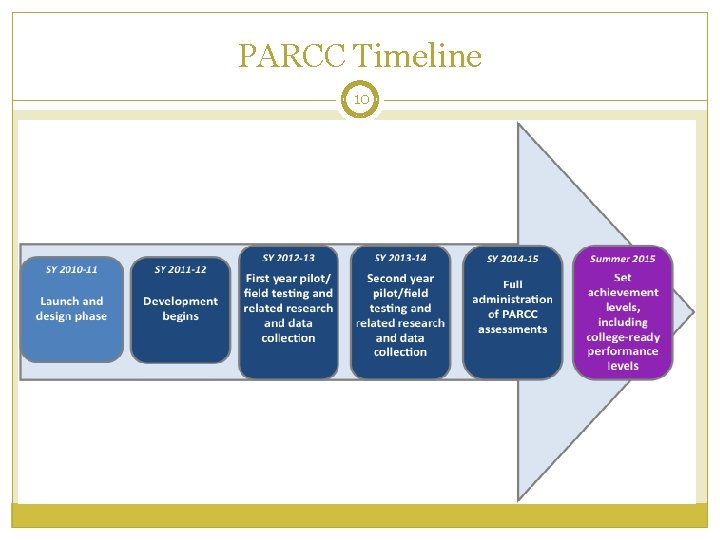
PARCC Timeline 10
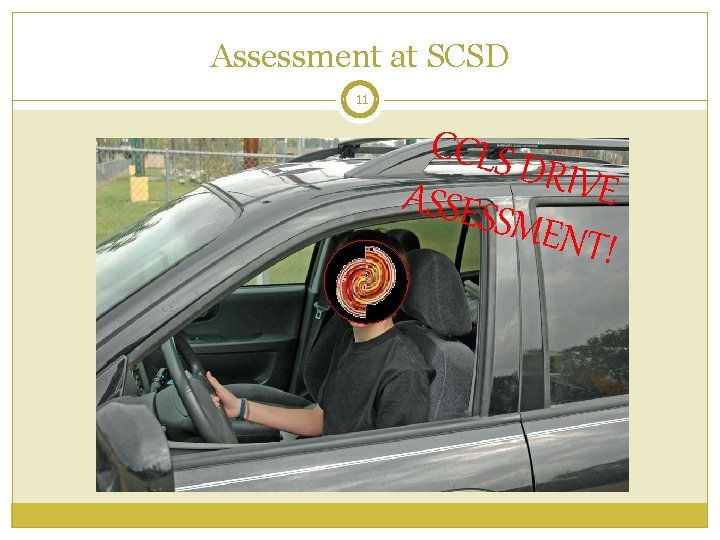
Assessment at SCSD 11 ? CCLS D R I VE ASSES SMEN T!
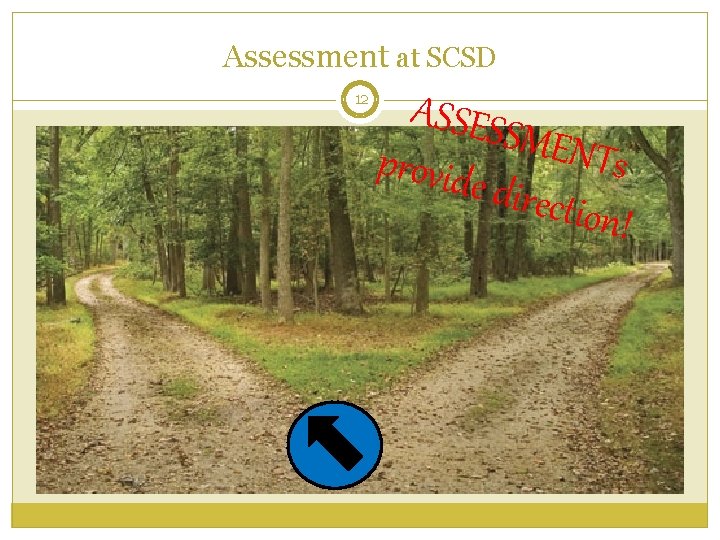
Assessment at SCSD 12 YOU ARE HERE ASSES SMEN Ts provid e direc tion!
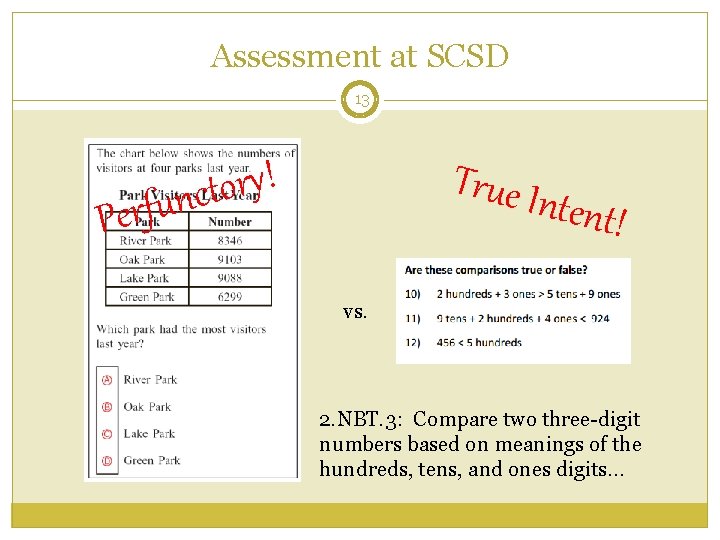
Assessment at SCSD 13 Pe ! y r o t c n u rf True In tent! vs. 2. NBT. 3: Compare two three-digit numbers based on meanings of the hundreds, tens, and ones digits…
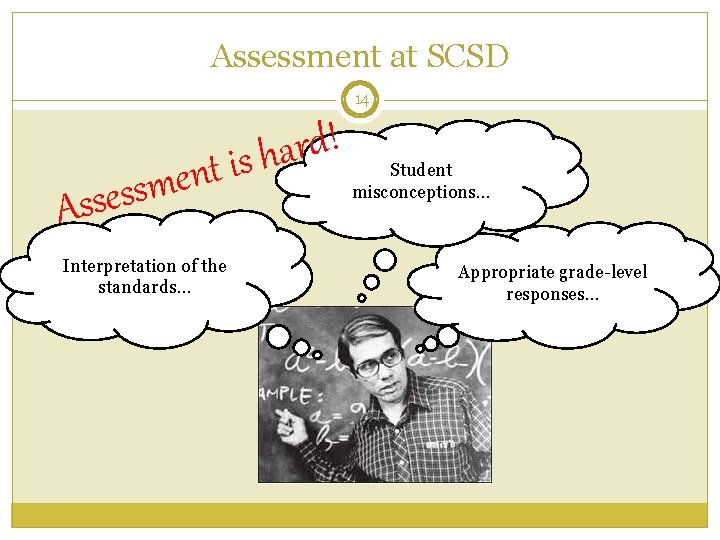
Assessment at SCSD 14 ! d r a h s i t n e m s s e s s A Interpretation of the standards… Student misconceptions… Appropriate grade-level responses…
Assessment at SCSD 15 Modification to assessments for ELL and students with disabilities must be made to interpret results correctly. We need to make sure modifications are appropriate to disabilities and language levels without watering-down grade level standards.
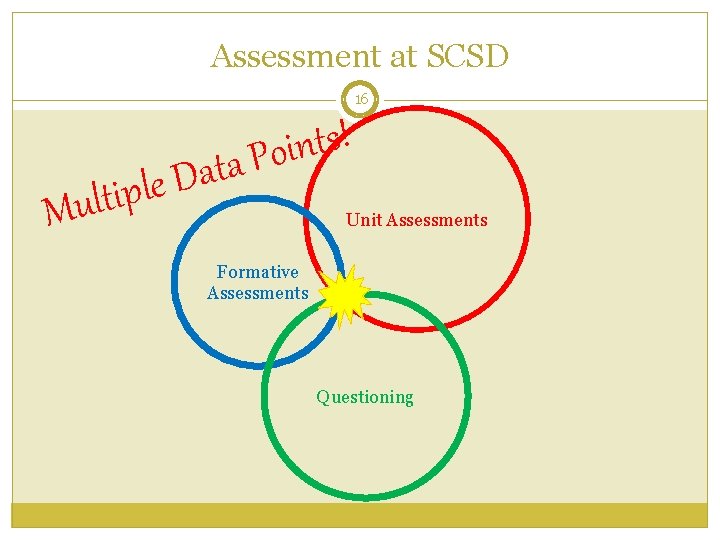
Assessment at SCSD 16 ! s t n i o P ta a D e l p i t l Mu Unit Assessments Formative Assessments Questioning
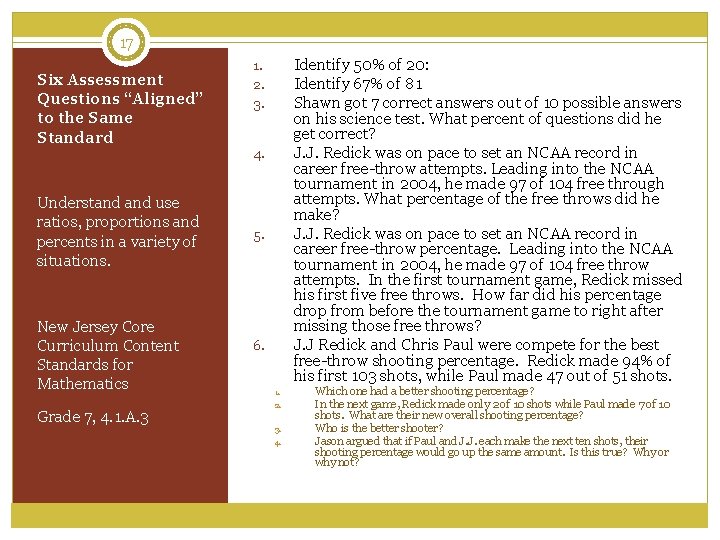
17 Six Assessment Questions “Aligned” to the Same Standard Understand use ratios, proportions and percents in a variety of situations. New Jersey Core Curriculum Content Standards for Mathematics Grade 7, 4. 1. A. 3 Identify 50% of 20: Identify 67% of 81 Shawn got 7 correct answers out of 10 possible answers on his science test. What percent of questions did he get correct? J. J. Redick was on pace to set an NCAA record in career free-throw attempts. Leading into the NCAA tournament in 2004, he made 97 of 104 free through attempts. What percentage of the free throws did he make? J. J. Redick was on pace to set an NCAA record in career free-throw percentage. Leading into the NCAA tournament in 2004, he made 97 of 104 free throw attempts. In the first tournament game, Redick missed his first five free throws. How far did his percentage drop from before the tournament game to right after missing those free throws? J. J Redick and Chris Paul were compete for the best free-throw shooting percentage. Redick made 94% of his first 103 shots, while Paul made 47 out of 51 shots. 1. 2. 3. 4. 5. 6. 1. 2. 3. 4. Which one had a better shooting percentage? In the next game, Redick made only 2 of 10 shots while Paul made 7 of 10 shots. What are their new overall shooting percentage? Who is the better shooter? Jason argued that if Paul and J. J. each make the next ten shots, their shooting percentage would go up the same amount. Is this true? Why or why not?
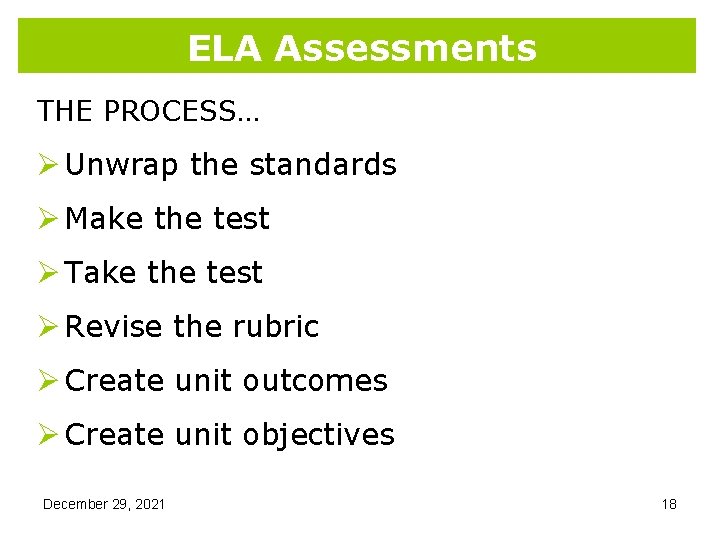
ELA Assessments THE PROCESS… Ø Unwrap the standards Ø Make the test Ø Take the test Ø Revise the rubric Ø Create unit outcomes Ø Create unit objectives December 29, 2021 18
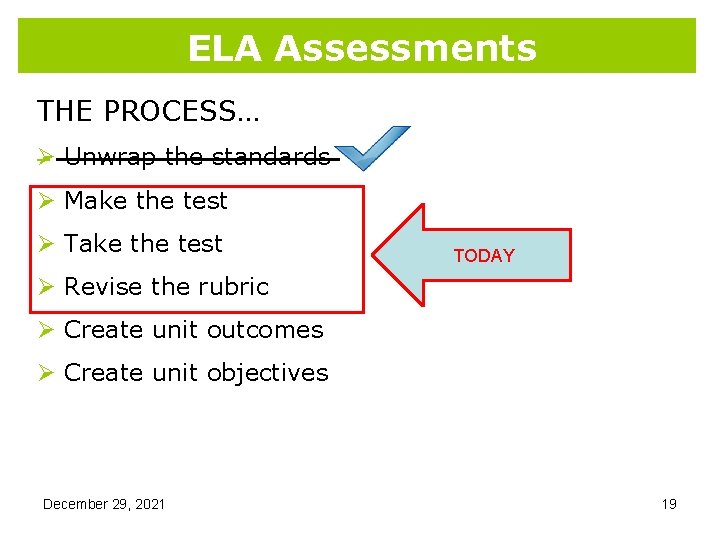
ELA Assessments THE PROCESS… Ø Unwrap the standards Ø Make the test Ø Take the test TODAY Ø Revise the rubric Ø Create unit outcomes Ø Create unit objectives December 29, 2021 19
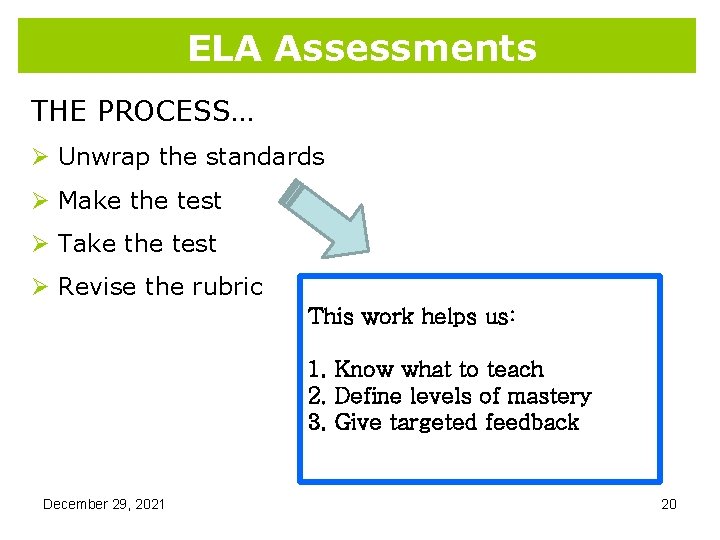
ELA Assessments THE PROCESS… Ø Unwrap the standards Ø Make the test Ø Take the test Ø Revise the rubric This work helps us: 1. Know what to teach 2. Define levels of mastery 3. Give targeted feedback December 29, 2021 20
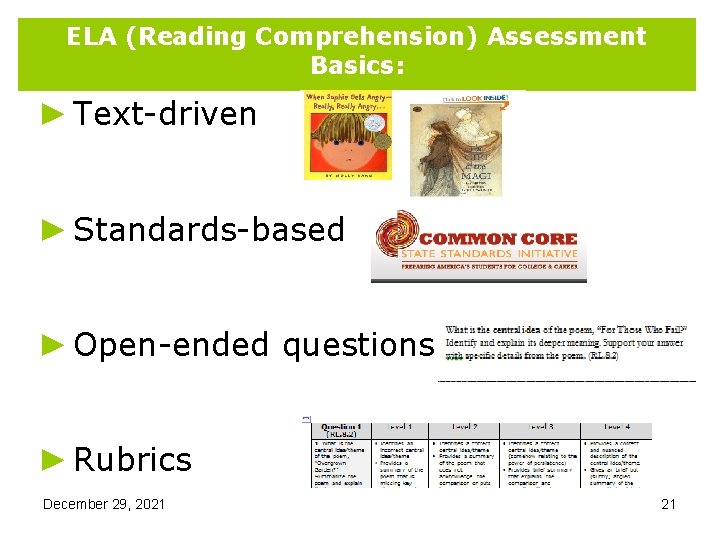
ELA (Reading Comprehension) Assessment Basics: ► Text-driven ► Standards-based ► Open-ended questions ► Rubrics December 29, 2021 21
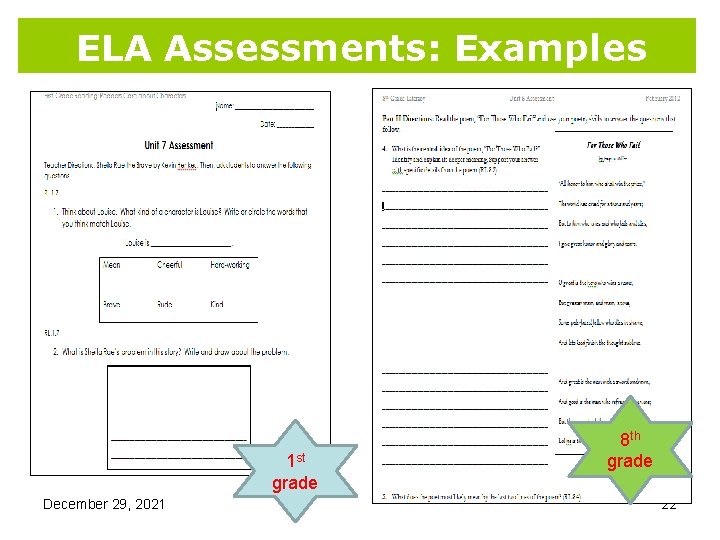
ELA Assessments: Examples 1 st grade December 29, 2021 8 th grade 22
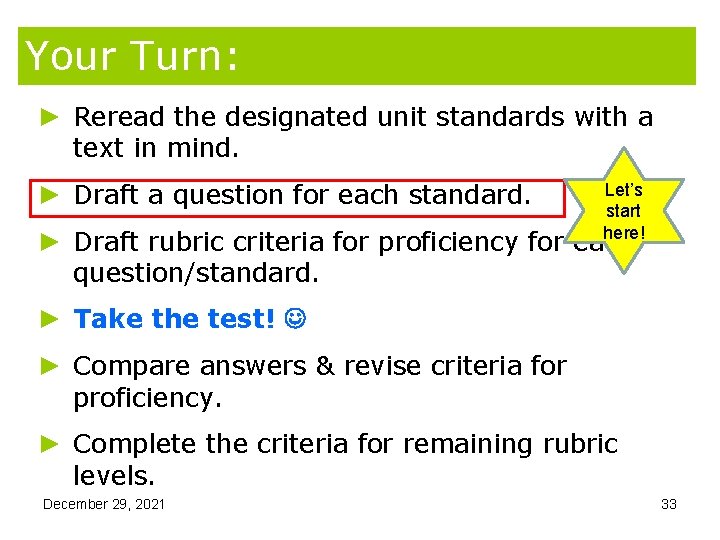
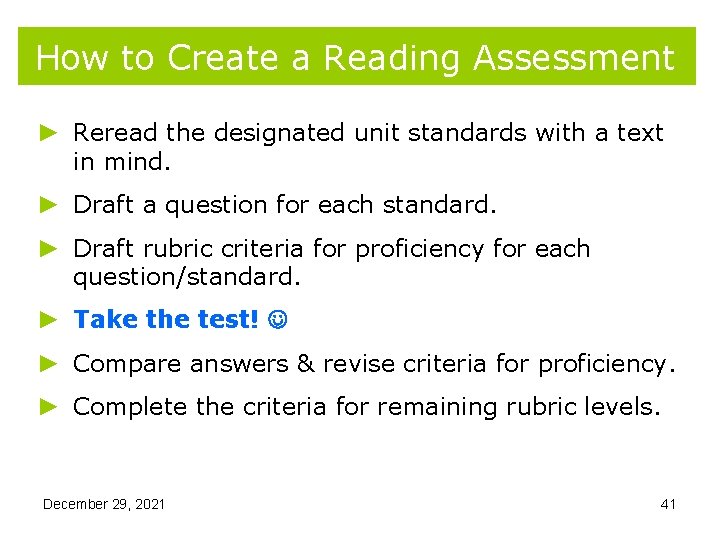
How to Create a Reading Assessment ► Reread the designated unit standards with a text in mind. ► Draft a question for each standard. ► Draft rubric criteria for proficiency for each question/standard. ► Take the test! ► Compare answers & revise criteria for proficiency. ► Complete the criteria for remaining rubric levels. December 29, 2021 23
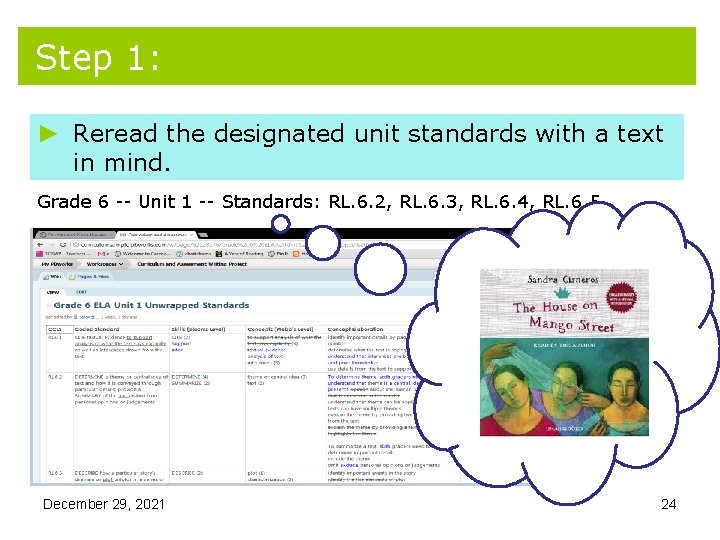
Step 1: ► Reread the designated unit standards with a text in mind. Grade 6 -- Unit 1 -- Standards: RL. 6. 2, RL. 6. 3, RL. 6. 4, RL. 6. 5 December 29, 2021 24
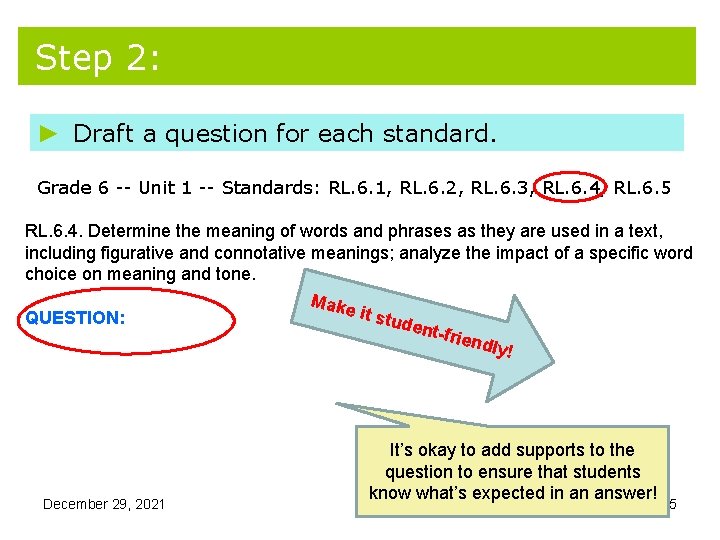
Step 2: ► Draft a question for each standard. Grade 6 -- Unit 1 -- Standards: RL. 6. 1, RL. 6. 2, RL. 6. 3, RL. 6. 4, RL. 6. 5 RL. 6. 4. Determine the meaning of words and phrases as they are used in a text, including figurative and connotative meanings; analyze the impact of a specific word choice on meaning and tone. Make it stu QUESTION: dent -frien dly! December 29, 2021 It’s okay to add supports to the question to ensure that students know what’s expected in an answer! 25
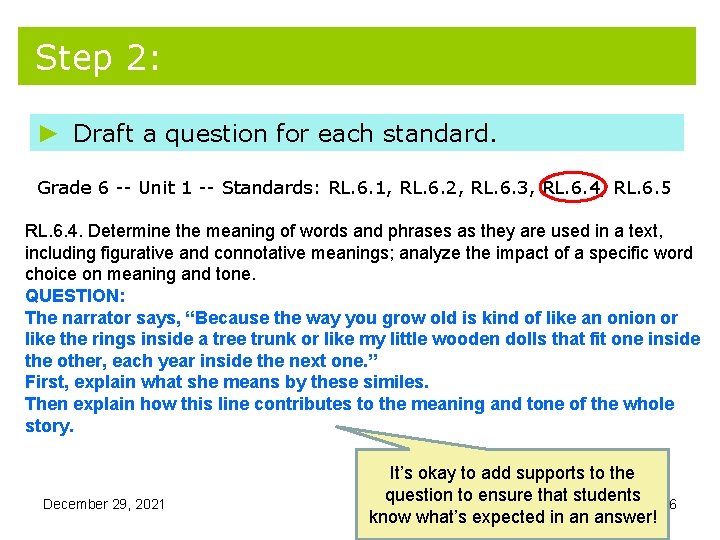
Step 2: ► Draft a question for each standard. Grade 6 -- Unit 1 -- Standards: RL. 6. 1, RL. 6. 2, RL. 6. 3, RL. 6. 4, RL. 6. 5 RL. 6. 4. Determine the meaning of words and phrases as they are used in a text, including figurative and connotative meanings; analyze the impact of a specific word choice on meaning and tone. QUESTION: The narrator says, “Because the way you grow old is kind of like an onion or like the rings inside a tree trunk or like my little wooden dolls that fit one inside the other, each year inside the next one. ” First, explain what she means by these similes. Then explain how this line contributes to the meaning and tone of the whole story. December 29, 2021 It’s okay to add supports to the question to ensure that students 26 know what’s expected in an answer!
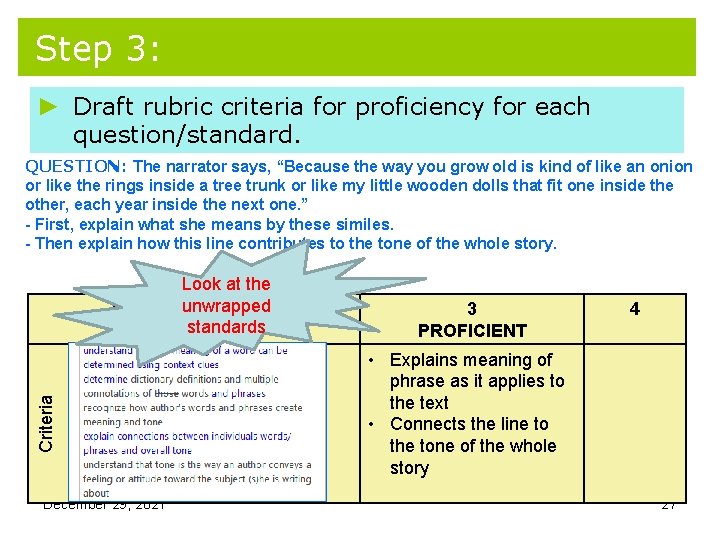
Step 3: ► Draft rubric criteria for proficiency for each question/standard. QUESTION: The narrator says, “Because the way you grow old is kind of like an onion or like the rings inside a tree trunk or like my little wooden dolls that fit one inside the other, each year inside the next one. ” - First, explain what she means by these similes. - Then explain how this line contributes to the tone of the whole story. Criteria Look at the 1 unwrapped standards December 29, 2021 2 3 PROFICIENT 4 • Explains meaning of phrase as it applies to the text • Connects the line to the tone of the whole story 27
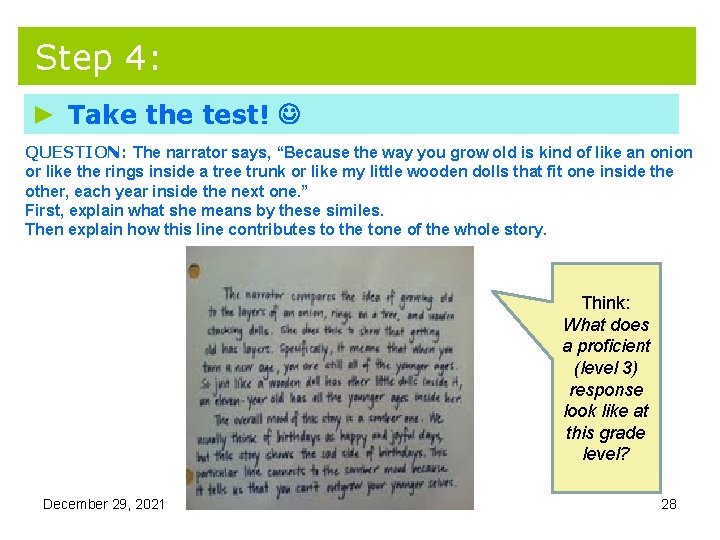
Step 4: ► Take the test! QUESTION: The narrator says, “Because the way you grow old is kind of like an onion or like the rings inside a tree trunk or like my little wooden dolls that fit one inside the other, each year inside the next one. ” First, explain what she means by these similes. Then explain how this line contributes to the tone of the whole story. Think: What does a proficient (level 3) response look like at this grade level? December 29, 2021 28
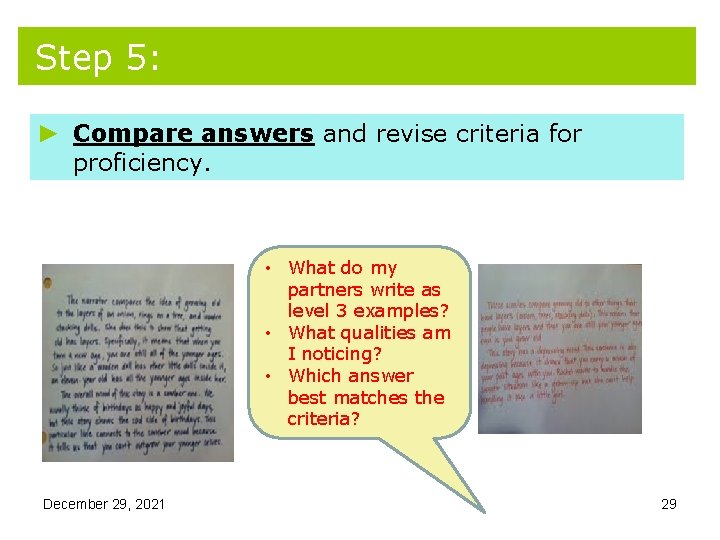
Step 5: ► Compare answers and revise criteria for proficiency. • What do my partners write as level 3 examples? • What qualities am I noticing? • Which answer best matches the criteria? December 29, 2021 29
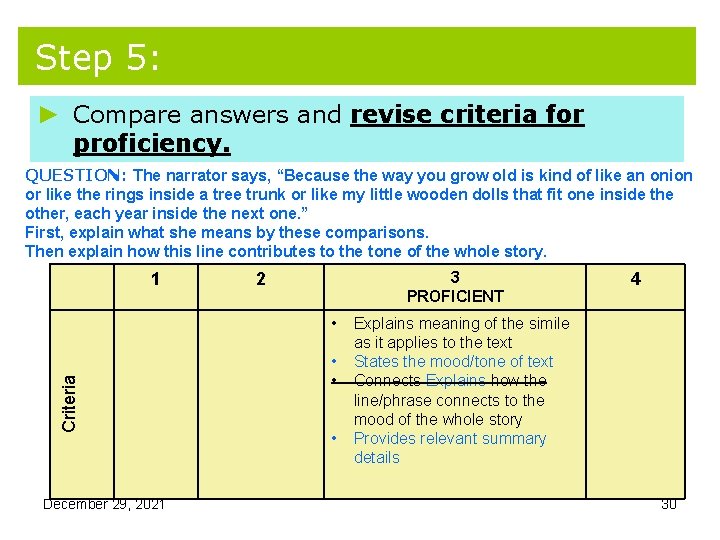
Step 5: ► Compare answers and revise criteria for proficiency. QUESTION: The narrator says, “Because the way you grow old is kind of like an onion or like the rings inside a tree trunk or like my little wooden dolls that fit one inside the other, each year inside the next one. ” First, explain what she means by these comparisons. Then explain how this line contributes to the tone of the whole story. 1 3 PROFICIENT 2 Criteria • December 29, 2021 • • • 4 Explains meaning of the simile as it applies to the text States the mood/tone of text Connects Explains how the line/phrase connects to the mood of the whole story Provides relevant summary details 30
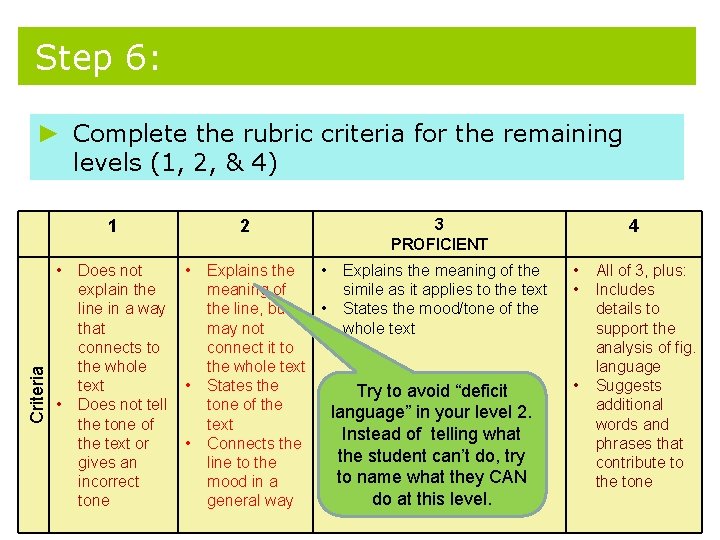
Step 6: ► Complete the rubric criteria for the remaining levels (1, 2, & 4) 1 • Criteria Does not explain the line in a way that connects to the whole text • Does not tell the tone of the text or gives an incorrect tone 29, 2021 December 2 • • • 3 PROFICIENT Explains the • Explains the meaning of simile as it applies to the text the line, but • States the mood/tone of the may not whole text connect it to the whole text States the Try to avoid “deficit tone of the language” in your level 2. text Instead of telling what Connects the student can’t do, try line to the to name what they CAN mood in a do at this level. general way 4 • • • All of 3, plus: Includes details to support the analysis of fig. language Suggests additional words and phrases that contribute to the tone 31
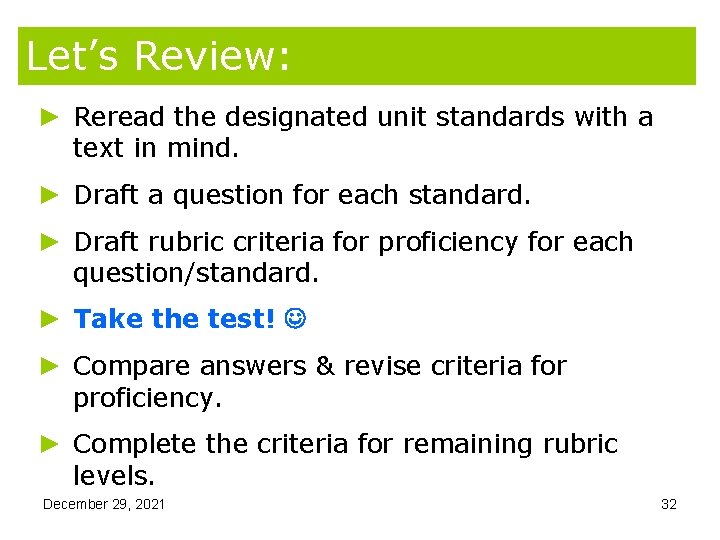
Let’s Review: ► Reread the designated unit standards with a text in mind. ► Draft a question for each standard. ► Draft rubric criteria for proficiency for each question/standard. ► Take the test! ► Compare answers & revise criteria for proficiency. ► Complete the criteria for remaining rubric levels. December 29, 2021 32
Your Turn: ► Reread the designated unit standards with a text in mind. ► Draft a question for each standard. Let’s start here! ► Draft rubric criteria for proficiency for each question/standard. ► Take the test! ► Compare answers & revise criteria for proficiency. ► Complete the criteria for remaining rubric levels. December 29, 2021 33
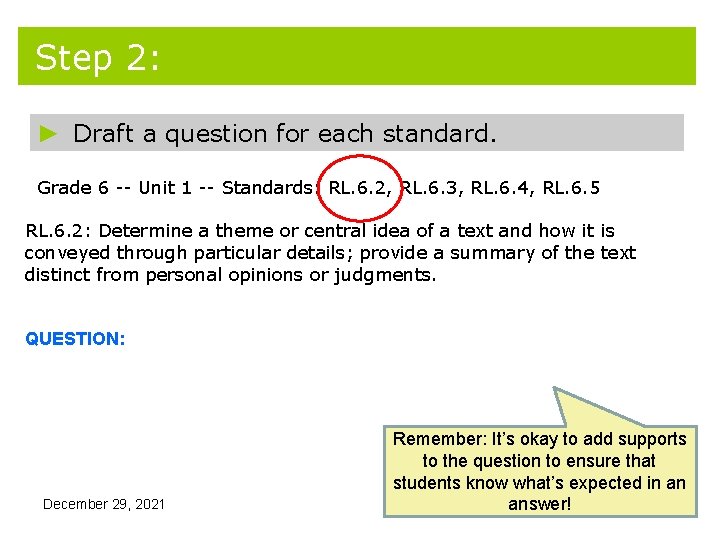
Step 2: ► Draft a question for each standard. Grade 6 -- Unit 1 -- Standards: RL. 6. 2, RL. 6. 3, RL. 6. 4, RL. 6. 5 RL. 6. 2: Determine a theme or central idea of a text and how it is conveyed through particular details; provide a summary of the text distinct from personal opinions or judgments. QUESTION: December 29, 2021 Remember: It’s okay to add supports to the question to ensure that students know what’s expected in an 34 answer!
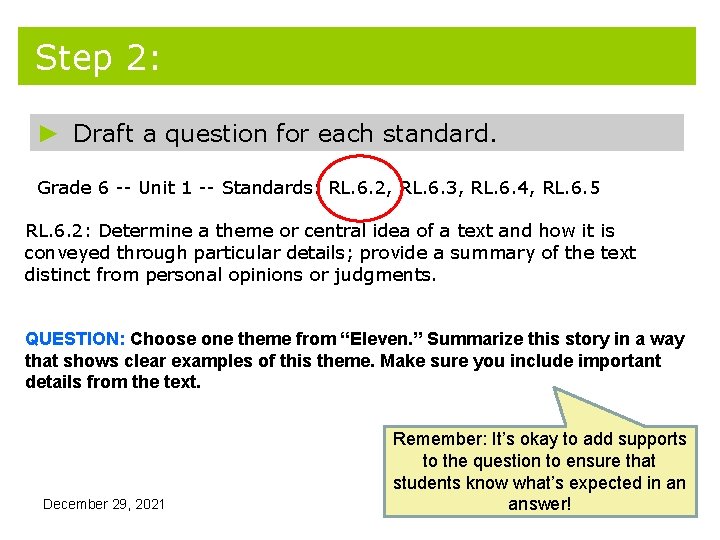
Step 2: ► Draft a question for each standard. Grade 6 -- Unit 1 -- Standards: RL. 6. 2, RL. 6. 3, RL. 6. 4, RL. 6. 5 RL. 6. 2: Determine a theme or central idea of a text and how it is conveyed through particular details; provide a summary of the text distinct from personal opinions or judgments. QUESTION: Choose one theme from “Eleven. ” Summarize this story in a way that shows clear examples of this theme. Make sure you include important details from the text. December 29, 2021 Remember: It’s okay to add supports to the question to ensure that students know what’s expected in an 35 answer!
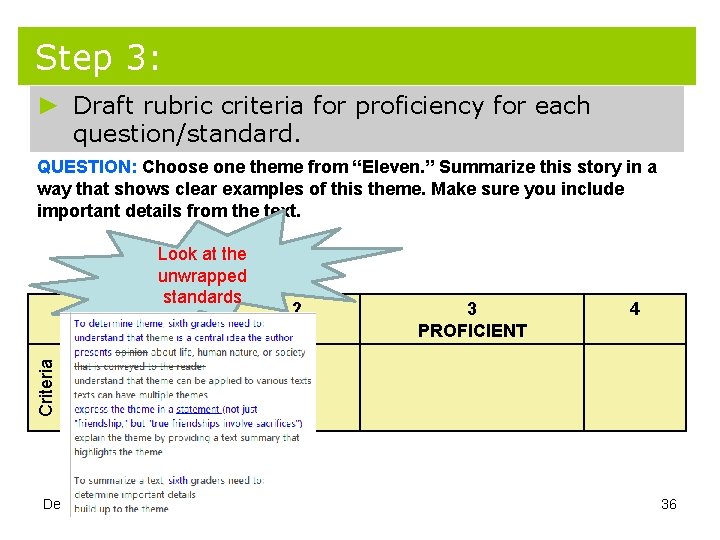
Step 3: ► Draft rubric criteria for proficiency for each question/standard. QUESTION: Choose one theme from “Eleven. ” Summarize this story in a way that shows clear examples of this theme. Make sure you include important details from the text. 2 3 PROFICIENT 4 Criteria Look at the unwrapped standards 1 December 29, 2021 36
Step 4: ► Take the test! QUESTION: Choose one theme from “Eleven. ” Summarize this story in a way that shows clear examples of this theme. Make sure you include important details from the text. Think: What does a proficient (level 3) response look like at this grade level? December 29, 2021 37
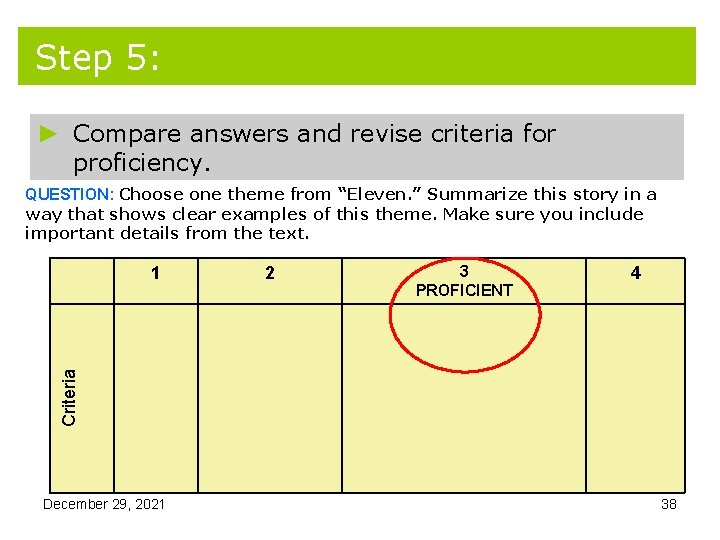
Step 5: ► Compare answers and revise criteria for proficiency. QUESTION: Choose one theme from “Eleven. ” Summarize this story in a way that shows clear examples of this theme. Make sure you include important details from the text. 2 3 PROFICIENT 4 Criteria 1 December 29, 2021 38
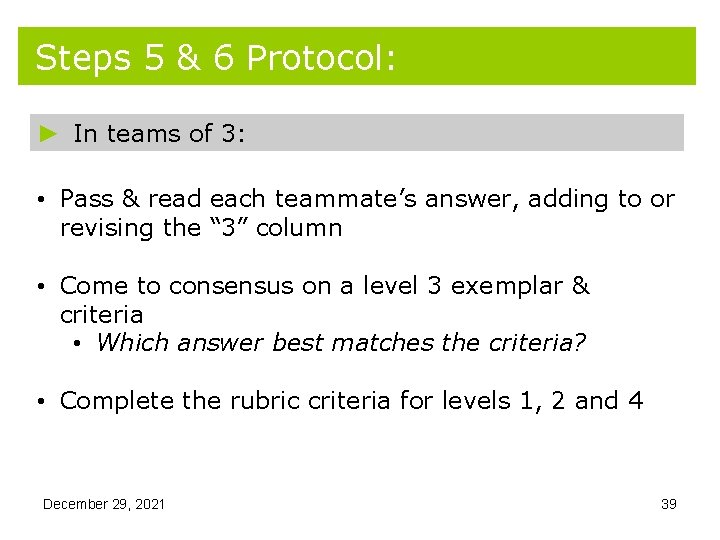
Steps 5 & 6 Protocol: ► In teams of 3: • Pass & read each teammate’s answer, adding to or revising the “ 3” column • Come to consensus on a level 3 exemplar & criteria • Which answer best matches the criteria? • Complete the rubric criteria for levels 1, 2 and 4 December 29, 2021 39
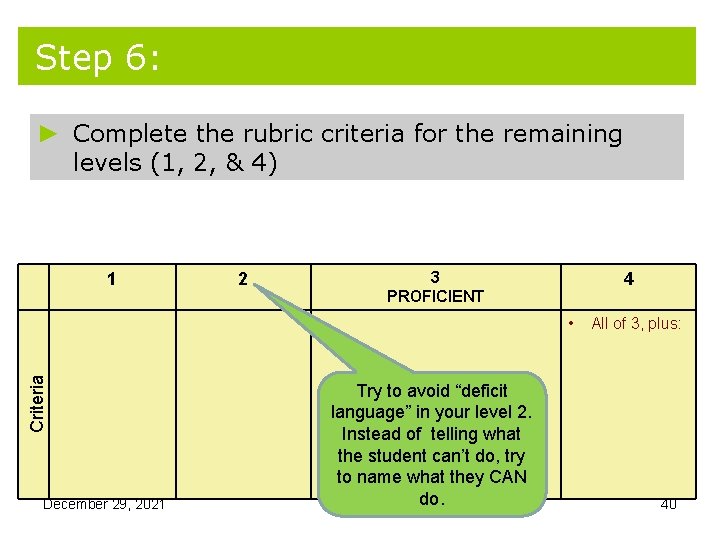
Step 6: ► Complete the rubric criteria for the remaining levels (1, 2, & 4) 1 3 PROFICIENT 2 Criteria • December 29, 2021 4 • Try to avoid “deficit language” in your level 2. Instead of telling what the student can’t do, try to name what they CAN do. All of 3, plus: 40
How to Create a Reading Assessment ► Reread the designated unit standards with a text in mind. ► Draft a question for each standard. ► Draft rubric criteria for proficiency for each question/standard. ► Take the test! ► Compare answers & revise criteria for proficiency. ► Complete the criteria for remaining rubric levels. December 29, 2021 41
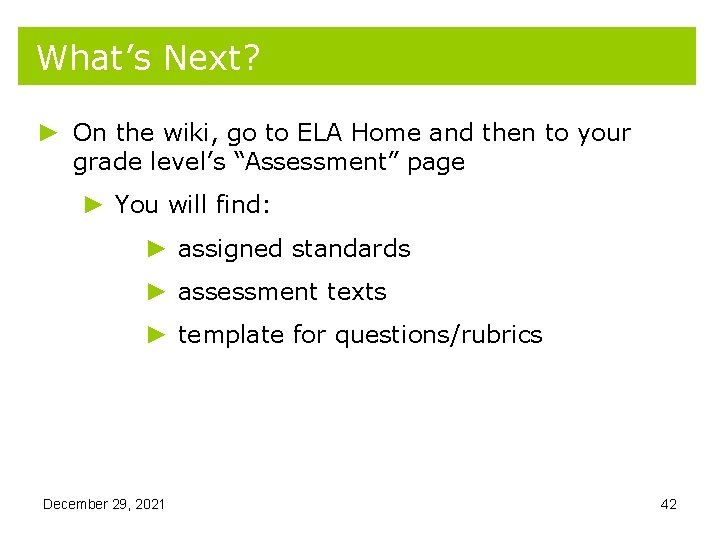
What’s Next? ► On the wiki, go to ELA Home and then to your grade level’s “Assessment” page ► You will find: ► assigned standards ► assessment texts ► template for questions/rubrics December 29, 2021 42
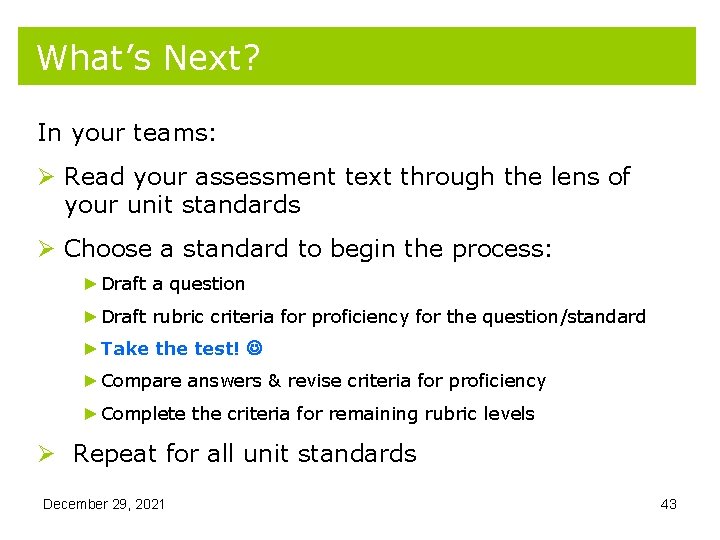
What’s Next? In your teams: Ø Read your assessment text through the lens of your unit standards Ø Choose a standard to begin the process: ►Draft a question ►Draft rubric criteria for proficiency for the question/standard ►Take the test! ►Compare answers & revise criteria for proficiency ►Complete the criteria for remaining rubric levels Ø Repeat for all unit standards December 29, 2021 43
Homework ► Pluses and Deltas ► Be on the lookout for more information on informational assessment createion ► Next Curriculum and Assessment Writing Project Meeting is May 19 th from 8: 00 – 1: 00! December 29, 2021 44
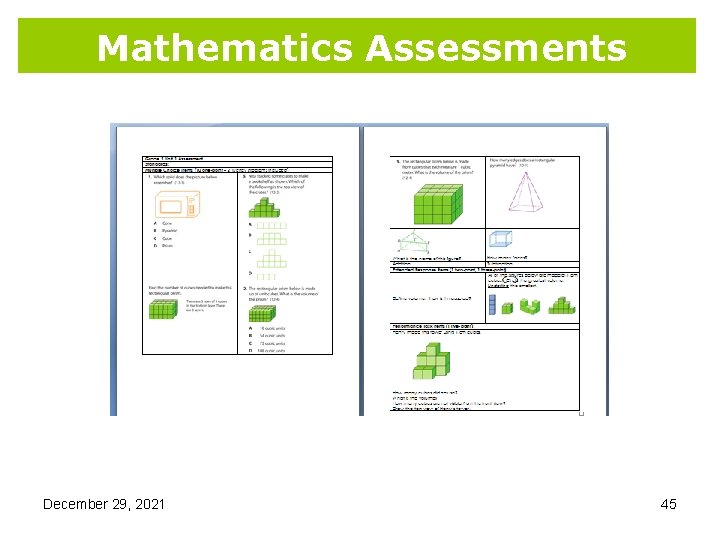
Mathematics Assessments December 29, 2021 45
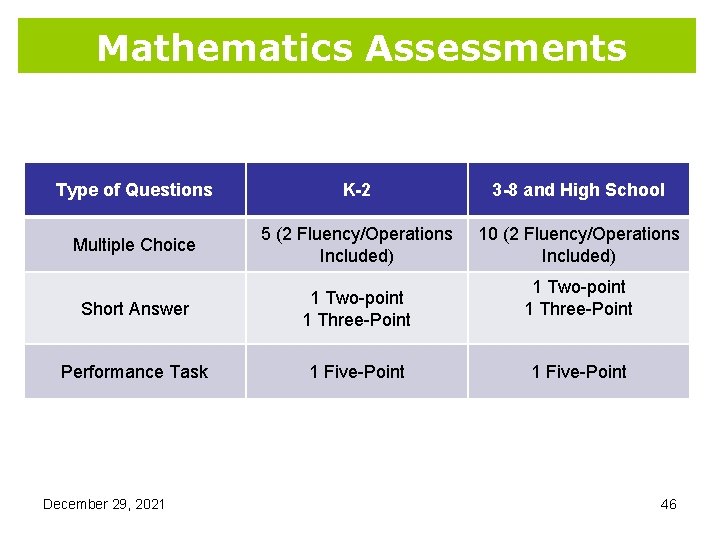
Mathematics Assessments Type of Questions K-2 3 -8 and High School Multiple Choice 5 (2 Fluency/Operations Included) 10 (2 Fluency/Operations Included) Short Answer 1 Two-point 1 Three-Point Performance Task 1 Five-Point December 29, 2021 1 Two-point 1 Three-Point 1 Five-Point 46
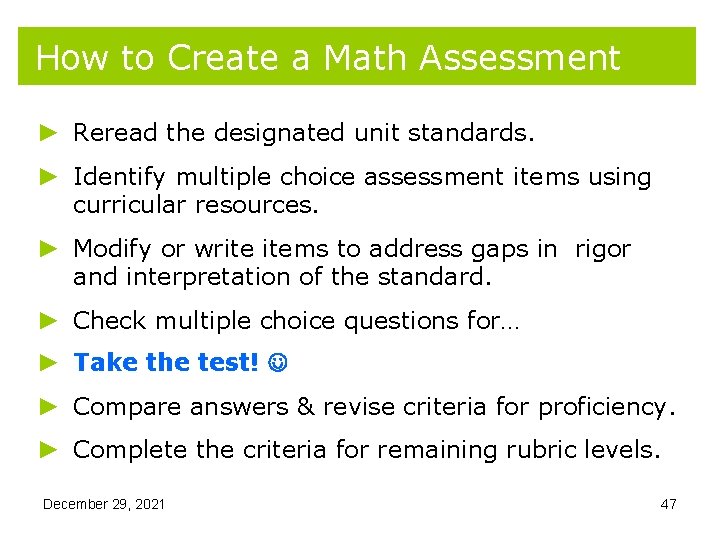
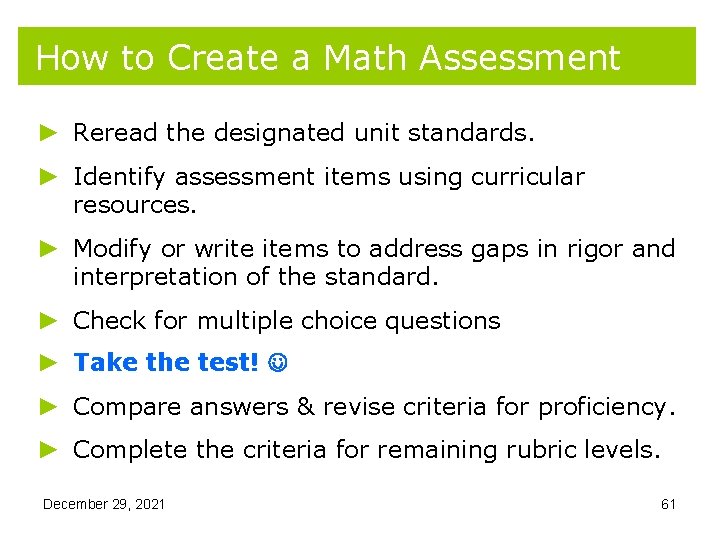
How to Create a Math Assessment ► Reread the designated unit standards. ► Identify multiple choice assessment items using curricular resources. ► Modify or write items to address gaps in rigor and interpretation of the standard. ► Check multiple choice questions for… ► Take the test! ► Compare answers & revise criteria for proficiency. ► Complete the criteria for remaining rubric levels. December 29, 2021 47
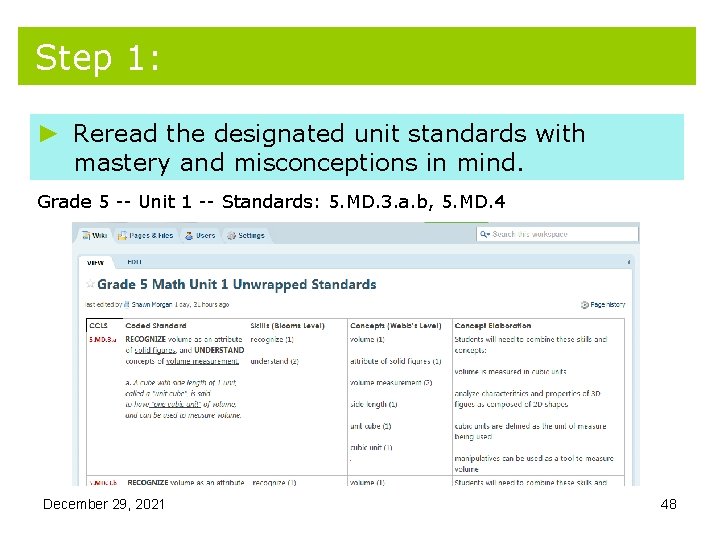
Step 1: ► Reread the designated unit standards with mastery and misconceptions in mind. Grade 5 -- Unit 1 -- Standards: 5. MD. 3. a. b, 5. MD. 4 December 29, 2021 48
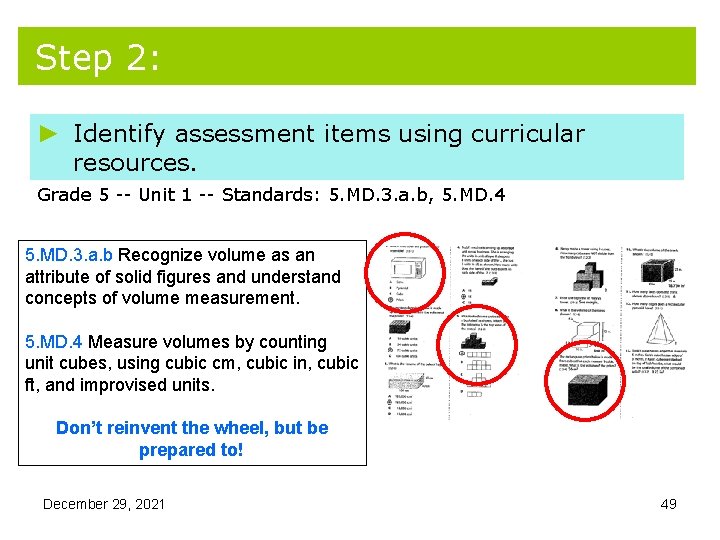
Step 2: ► Identify assessment items using curricular resources. Grade 5 -- Unit 1 -- Standards: 5. MD. 3. a. b, 5. MD. 4 5. MD. 3. a. b Recognize volume as an attribute of solid figures and understand concepts of volume measurement. 5. MD. 4 Measure volumes by counting unit cubes, using cubic cm, cubic in, cubic ft, and improvised units. Don’t reinvent the wheel, but be prepared to! December 29, 2021 49
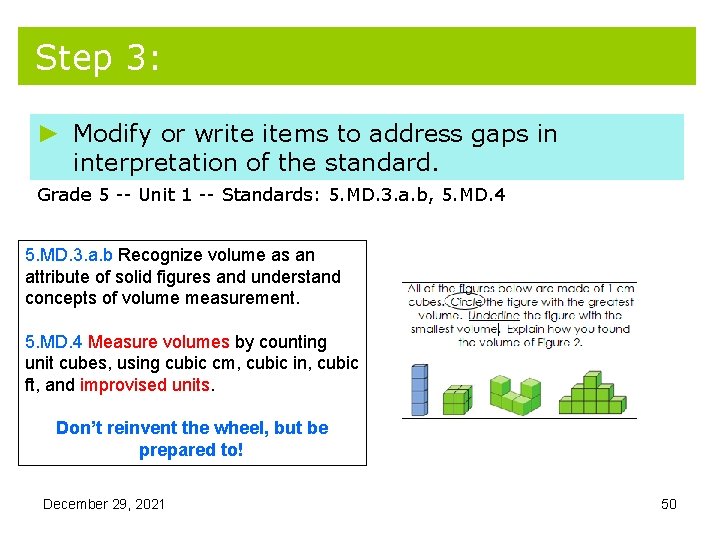
Step 3: ► Modify or write items to address gaps in interpretation of the standard. Grade 5 -- Unit 1 -- Standards: 5. MD. 3. a. b, 5. MD. 4 5. MD. 3. a. b Recognize volume as an attribute of solid figures and understand concepts of volume measurement. 5. MD. 4 Measure volumes by counting unit cubes, using cubic cm, cubic in, cubic ft, and improvised units. Don’t reinvent the wheel, but be prepared to! December 29, 2021 50
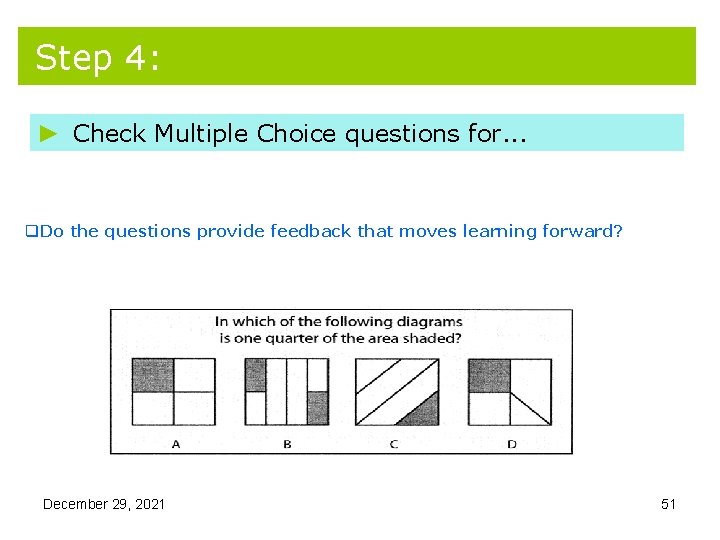
Step 4: ► Check Multiple Choice questions for. . . q. Do the questions provide feedback that moves learning forward? December 29, 2021 51
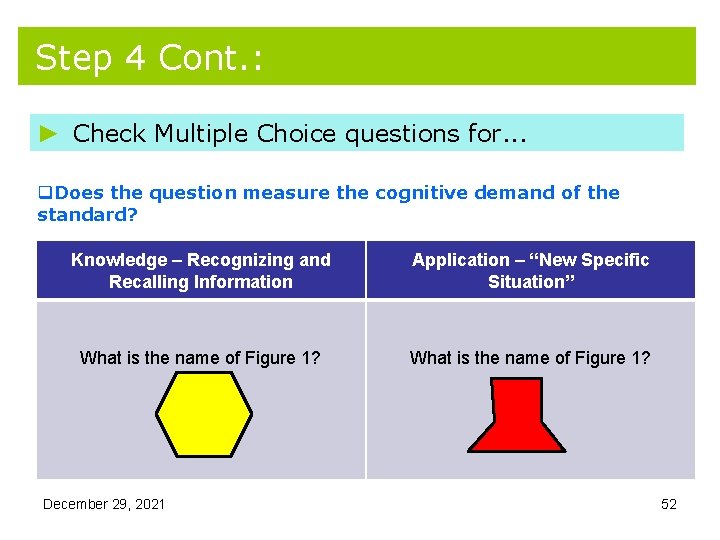
Step 4 Cont. : ► Check Multiple Choice questions for. . . q. Does the question measure the cognitive demand of the standard? Knowledge – Recognizing and Recalling Information Application – “New Specific Situation” What is the name of Figure 1? December 29, 2021 52
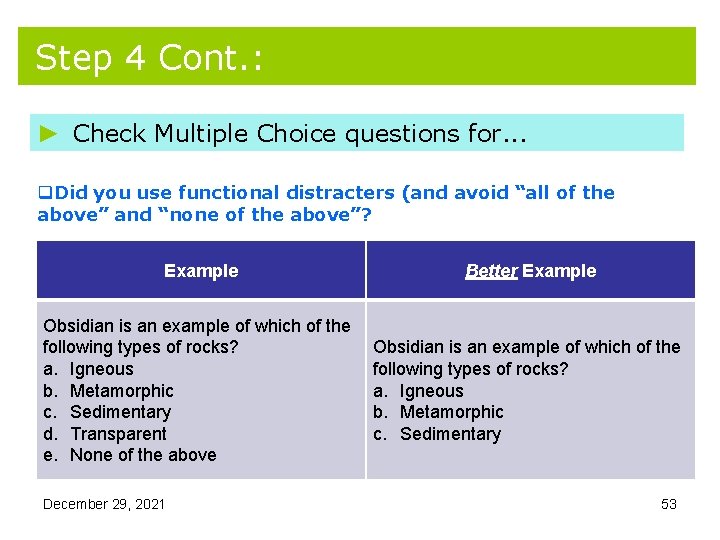
Step 4 Cont. : ► Check Multiple Choice questions for. . . q. Did you use functional distracters (and avoid “all of the above” and “none of the above”? Example Better Example Obsidian is an example of which of the following types of rocks? a. Igneous b. Metamorphic c. Sedimentary d. Transparent e. None of the above Obsidian is an example of which of the following types of rocks? a. Igneous b. Metamorphic c. Sedimentary December 29, 2021 53
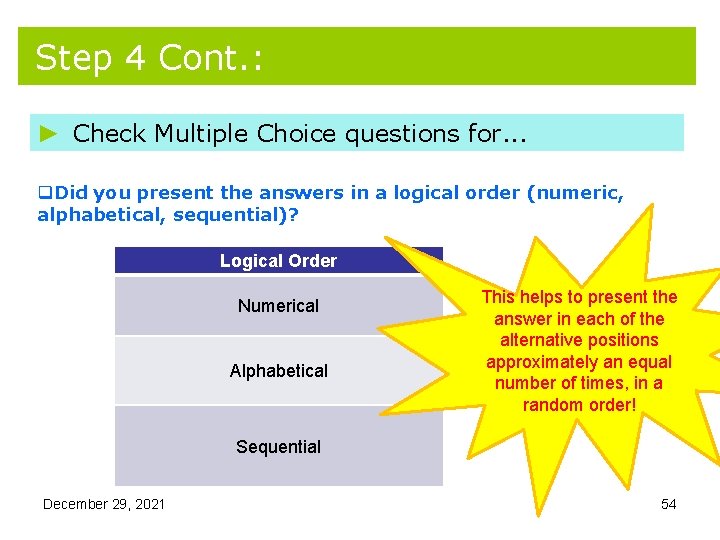
Step 4 Cont. : ► Check Multiple Choice questions for. . . q. Did you present the answers in a logical order (numeric, alphabetical, sequential)? Logical Order Numerical Alphabetical This helps to present the answer in each of the alternative positions approximately an equal number of times, in a random order! Sequential December 29, 2021 54
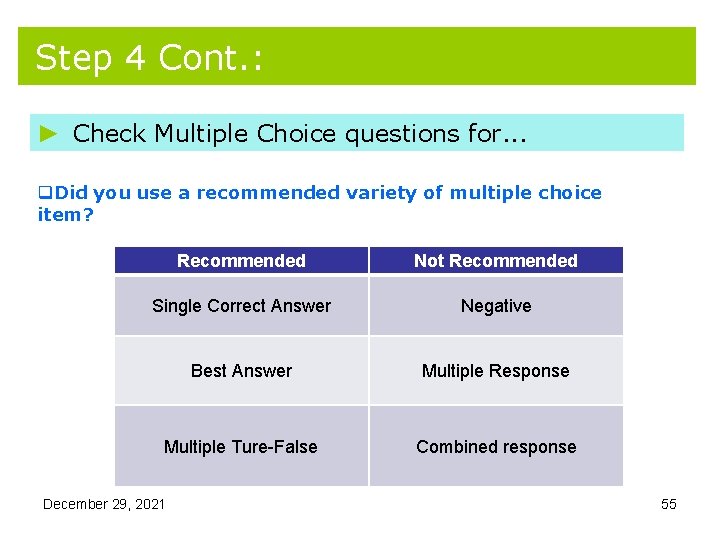
Step 4 Cont. : ► Check Multiple Choice questions for. . . q. Did you use a recommended variety of multiple choice item? Recommended Not Recommended Single Correct Answer Negative Best Answer Multiple Response Multiple Ture-False Combined response December 29, 2021 55
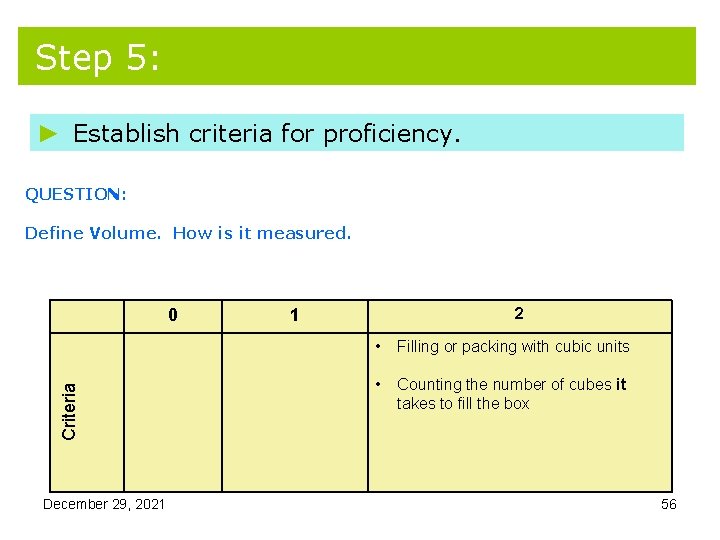
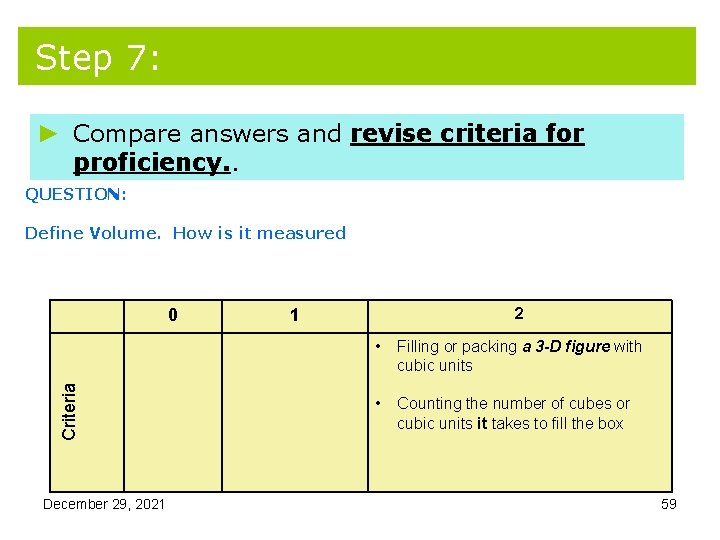
Step 5: ► Establish criteria for proficiency. QUESTION: Define Volume. How is it measured. Criteria 0 December 29, 2021 2 1 • Filling or packing with cubic units • Counting the number of cubes it takes to fill the box 56
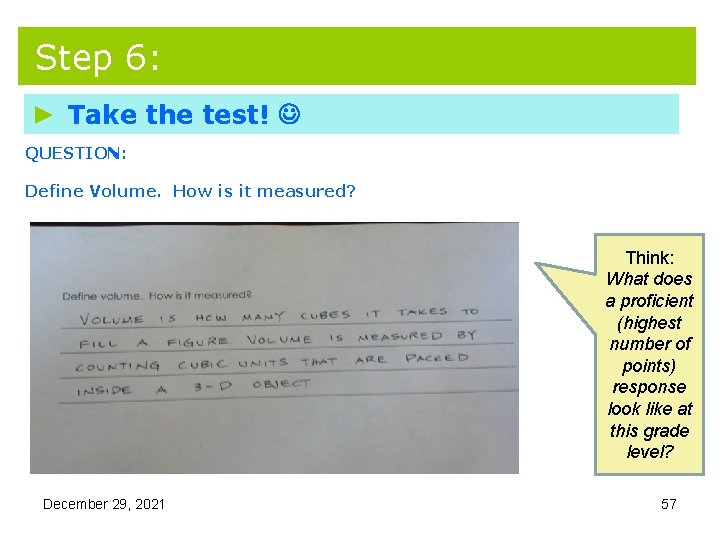
Step 6: ► Take the test! QUESTION: Define Volume. How is it measured? Think: What does a proficient (highest number of points) response look like at this grade level? December 29, 2021 57
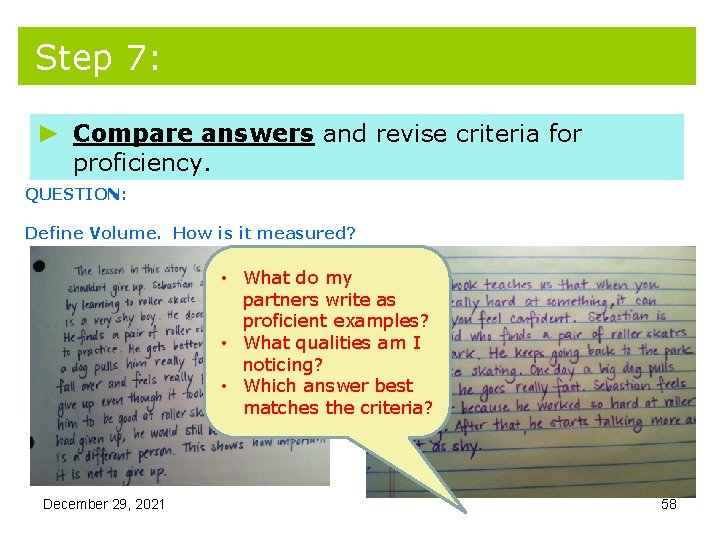
Step 7: ► Compare answers and revise criteria for proficiency. QUESTION: Define Volume. How is it measured? • What do my partners write as proficient examples? • What qualities am I noticing? • Which answer best matches the criteria? December 29, 2021 58
Step 7: ► Compare answers and revise criteria for proficiency. . QUESTION: Define Volume. How is it measured Criteria 0 December 29, 2021 2 1 • Filling or packing a 3 -D figure with cubic units • Counting the number of cubes or cubic units it takes to fill the box 59
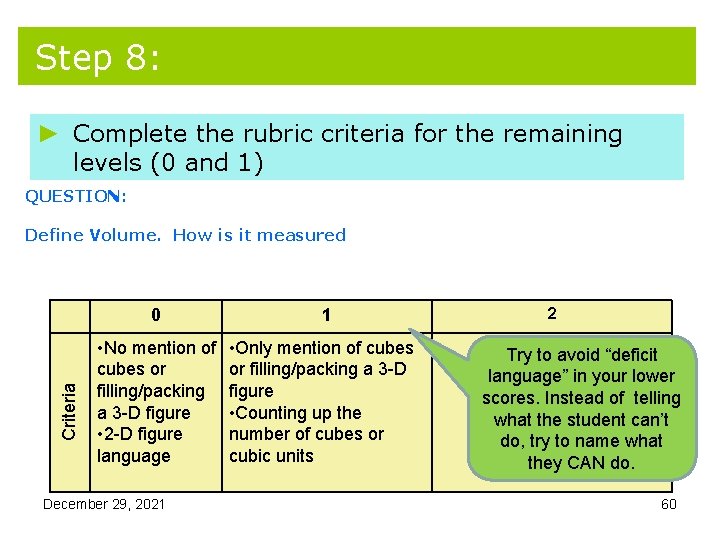
Step 8: ► Complete the rubric criteria for the remaining levels (0 and 1) QUESTION: Criteria Define Volume. How is it measured 0 1 • No mention of cubes or filling/packing a 3 -D figure • 2 -D figure language • Only mention of cubes or filling/packing a 3 -D figure • Counting up the number of cubes or cubic units December 29, 2021 2 Try to avoid “deficit language” in your lower scores. Instead of telling what the student can’t do, try to name what they CAN do. 60
How to Create a Math Assessment ► Reread the designated unit standards. ► Identify assessment items using curricular resources. ► Modify or write items to address gaps in rigor and interpretation of the standard. ► Check for multiple choice questions ► Take the test! ► Compare answers & revise criteria for proficiency. ► Complete the criteria for remaining rubric levels. December 29, 2021 61
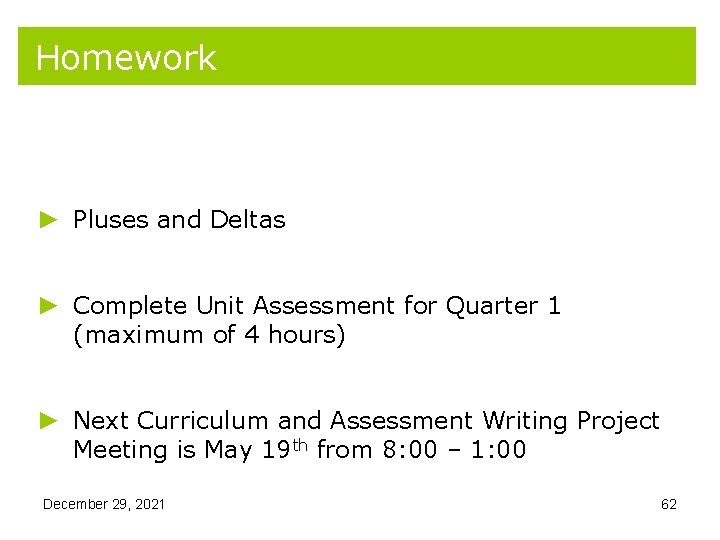
Homework ► Pluses and Deltas ► Complete Unit Assessment for Quarter 1 (maximum of 4 hours) ► Next Curriculum and Assessment Writing Project Meeting is May 19 th from 8: 00 – 1: 00 December 29, 2021 62