
Curriculum and Assessment Design Training plans Leadership 1
- Slides: 8
Curriculum and Assessment Design Training plans: Leadership 1. Gaining an overview
1. Gaining an overview Session aims • Understand the key events from the last 30 years of curriculum and assessment design. • Identify the key approaches to curriculum and assessment design.
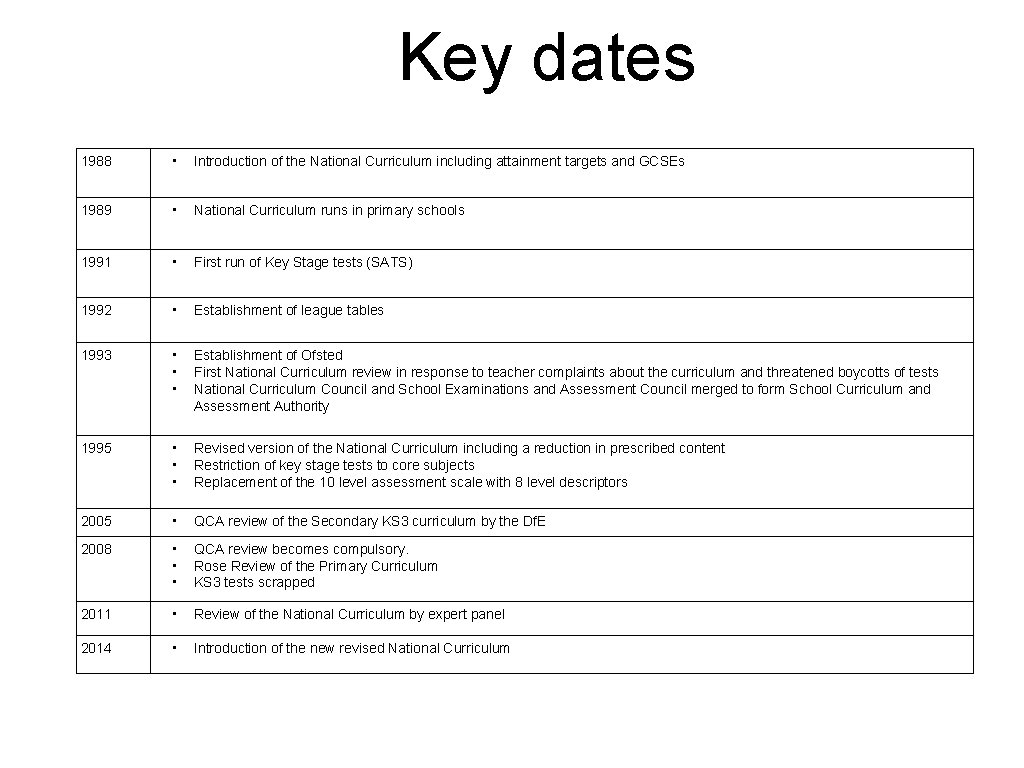
Key dates 1988 • Introduction of the National Curriculum including attainment targets and GCSEs 1989 • National Curriculum runs in primary schools 1991 • First run of Key Stage tests (SATS) 1992 • Establishment of league tables 1993 • • • Establishment of Ofsted First National Curriculum review in response to teacher complaints about the curriculum and threatened boycotts of tests National Curriculum Council and School Examinations and Assessment Council merged to form School Curriculum and Assessment Authority 1995 • • • Revised version of the National Curriculum including a reduction in prescribed content Restriction of key stage tests to core subjects Replacement of the 10 level assessment scale with 8 level descriptors 2005 • QCA review of the Secondary KS 3 curriculum by the Df. E 2008 • • • QCA review becomes compulsory. Rose Review of the Primary Curriculum KS 3 tests scrapped 2011 • Review of the National Curriculum by expert panel 2014 • Introduction of the new revised National Curriculum
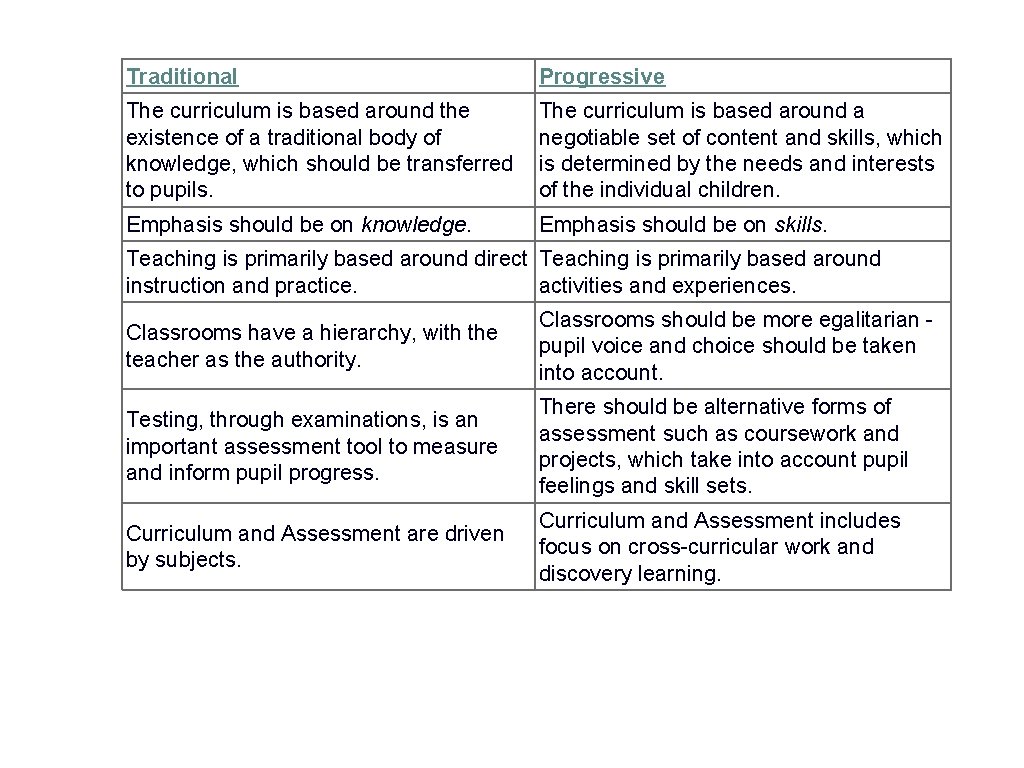
Traditional Progressive The curriculum is based around the existence of a traditional body of knowledge, which should be transferred to pupils. The curriculum is based around a negotiable set of content and skills, which is determined by the needs and interests of the individual children. Emphasis should be on knowledge. Emphasis should be on skills. Teaching is primarily based around direct Teaching is primarily based around instruction and practice. activities and experiences. Classrooms have a hierarchy, with the teacher as the authority. Classrooms should be more egalitarian pupil voice and choice should be taken into account. Testing, through examinations, is an important assessment tool to measure and inform pupil progress. There should be alternative forms of assessment such as coursework and projects, which take into account pupil feelings and skill sets. Curriculum and Assessment are driven by subjects. Curriculum and Assessment includes focus on cross-curricular work and discovery learning.
Significant moments • Introduction of the National Curriculum: what does this mean for the school curriculum? • National Curriculum Levels: introduction, revision, removal. What can we learn about assessment from the story of levels? • National Curriculum Review/GCSE reform. How has curriculum content changed? How have the demands for assessment changed? • Re-emergence of the Traditionalist vs Progressive debate. What does this mean for curriculum and assessment design?
Taking a stance What are our takes on these key issues/comparisons? • National Curriculum: school curriculum • National assessment: school assessment • Standardised tests: projects and coursework • Traditional and Progressive approaches to curriculum and assessment
Common mistakes How do we avoid them? • Designing a school curriculum based on a specification/National Curriculum • Lowering expectations through target setting and differentiated curriculum • Creating a false ‘shared language’ of assessment • Forgoing troublesome knowledge in favour of exam skills
Feedback, embed, evaluate • Self-assessment - what are our common training needs? • Our stances and our systems - how does our curriculum and assessment currently fit? • What next? Making an action plan.