
Current Topics In Data Engineering 2019 Current Topics
- Slides: 1
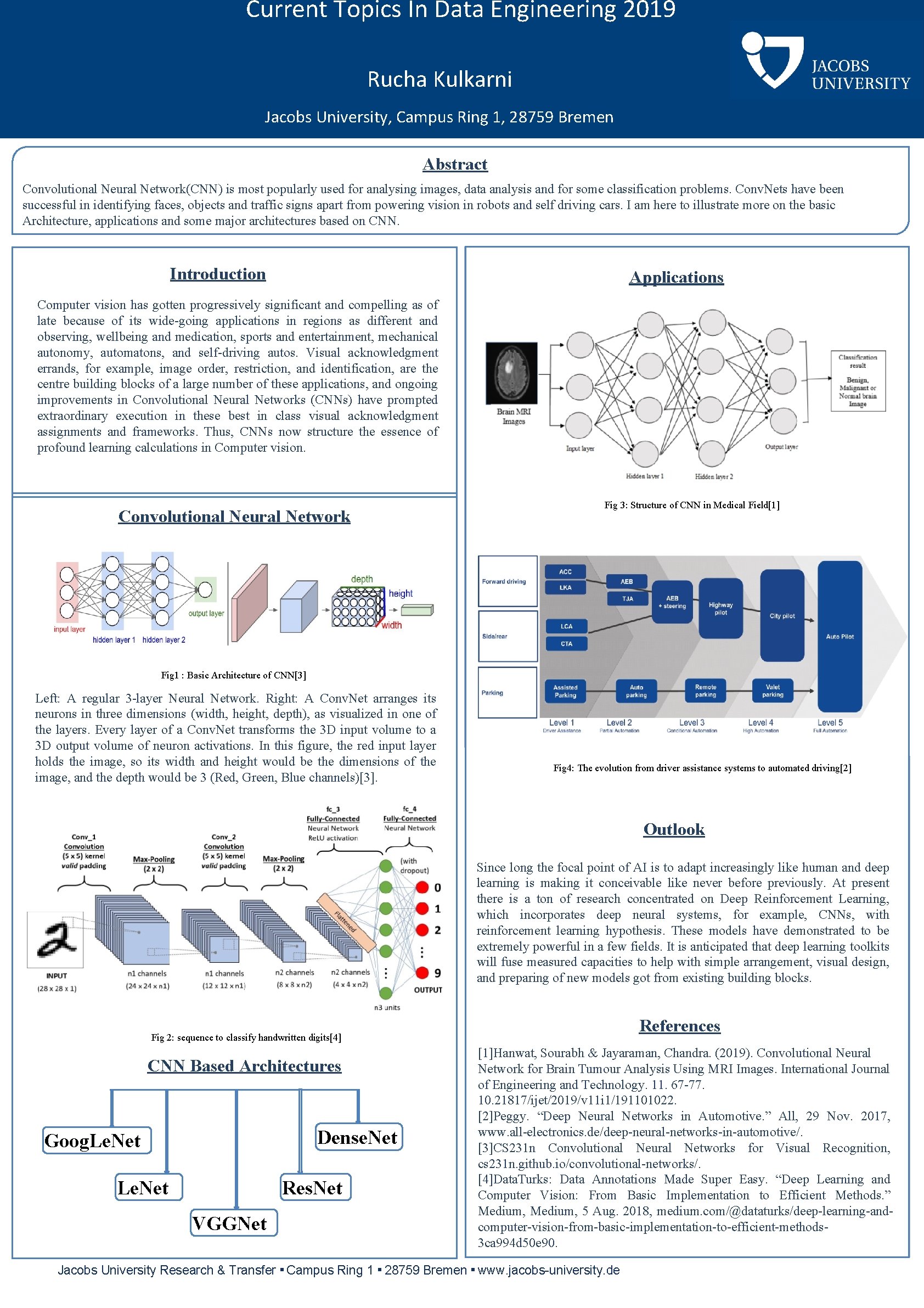
Current Topics In Data Engineering 2019 Current Topics of Data Engineering 2018 Rucha. Title Kulkarni Jacobs University, Campus Ring 1, 28759 Bremen your name Abstract Convolutional Neural Network(CNN) is most popularly used for analysing images, data analysis and for some classification problems. Conv. Nets have been successful in identifying faces, objects and traffic signs apart from powering vision in robots and self driving cars. I am here to illustrate more on the basic Architecture, applications and some major architectures based on CNN. Introduction Example Applications Computer vision has gotten progressively significant and compelling as of late because of its wide-going applications in regions as different and observing, wellbeing and medication, sports and entertainment, mechanical autonomy, automatons, and self-driving autos. Visual acknowledgment errands, for example, image order, restriction, and identification, are the centre building blocks of a large number of these applications, and ongoing improvements in Convolutional Neural Networks (CNNs) have prompted extraordinary execution in these best in class visual acknowledgment assignments and frameworks. Thus, CNNs now structure the essence of profound learning calculations in Computer vision. Abstract Convolutional Neural Network(CNN) is most popularly used for analysing images, data analysis and for some classification problems. Conv. Nets have been successful in identifying faces, objects and traffic signs apart from powering vision in robots and self driving cars. I am here to illustrate more on the applications and architecture of CNN. Fig 3: Structure of CNN in Medical Field[1] Convolutional Neural Network Fig 1 : Basic Architecture of CNN[3] Left: A regular 3 -layer Neural Network. Right: A Conv. Net arranges its neurons in three dimensions (width, height, depth), as visualized in one of the layers. Every layer of a Conv. Net transforms the 3 D input volume to a 3 D output volume of neuron activations. In this figure, the red input layer holds the image, so its width and height would be the dimensions of the image, and the depth would be 3 (Red, Green, Blue channels)[3]. Fig 4: The evolution from driver assistance systems to automated driving[2] Outlook Method Outlook Since long the focal point of AI is to adapt increasingly like human and deep learning is making it conceivable like never before previously. At present there is a ton of research concentrated on Deep Reinforcement Learning, which incorporates deep neural systems, for example, CNNs, with reinforcement learning hypothesis. These models have demonstrated to be extremely powerful in a few fields. It is anticipated that deep learning toolkits will fuse measured capacities to help with simple arrangement, visual design, and preparing of new models got from existing building blocks. References Fig 2: sequence to classify handwritten digits[4] CNN Based Architectures [1]Hanwat, Sourabh & Jayaraman, Chandra. (2019). Convolutional Neural Network for Brain Tumour Analysis Using MRI Images. International Journal of Engineering and Technology. 11. 67 -77. 10. 21817/ijet/2019/v 11 i 1/191101022. [2]Peggy. “Deep Neural Networks in Automotive. ” All, 29 Nov. 2017, www. all-electronics. de/deep-neural-networks-in-automotive/. [3]CS 231 n Convolutional Neural Networks for Visual Recognition, cs 231 n. github. io/convolutional-networks/. [4]Data. Turks: Data Annotations Made Super Easy. “Deep Learning and Computer Vision: From Basic Implementation to Efficient Methods. ” Medium, 5 Aug. 2018, medium. com/@dataturks/deep-learning-andcomputer-vision-from-basic-implementation-to-efficient-methods 3 ca 994 d 50 e 90. References: Dense. Net Goog. Le. Net Res. Net VGGNet Jacobs University Research & Transfer ■ Campus Ring 1 ■ 28759 Bremen ■ www. jacobs-university. de