
Current Themes of Nuclear Research and how the

- Slides: 41
Current Themes of Nuclear Research and how the ELI photonuclear pillar could contribute to them Exploring nuclei with lasers SFB 634 Collaborative Research Center TUD Research Center of Excellence Nuclear and Radiation Physics 1. Feb. 2010 Norbert Pietralla Director Institut für Kernphysik Darmstadt University of Technology (TUD) Norbert Pietralla TU Darmstadt 1
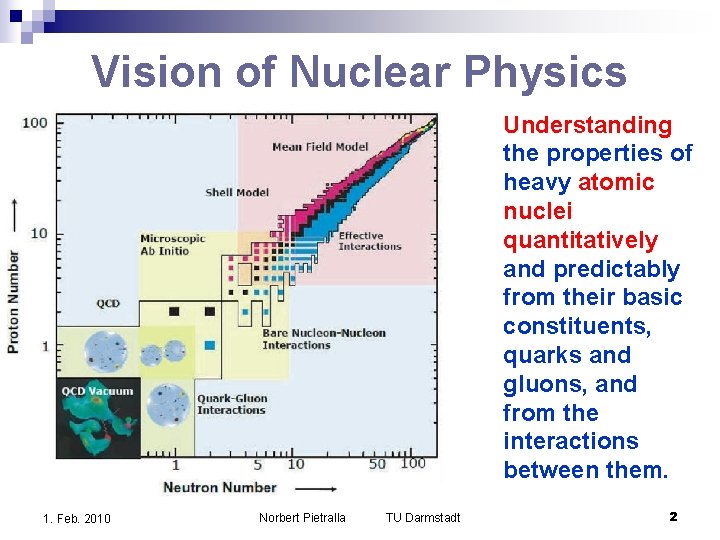
Vision of Nuclear Physics Understanding the properties of heavy atomic nuclei quantitatively and predictably from their basic constituents, quarks and gluons, and from the interactions between them. 1. Feb. 2010 Norbert Pietralla TU Darmstadt 2
Recent Progress n Systematic derivation of structural form of nucleon interaction from QCD in Chiral Perturbation Theory n Unique low-energy NN-potential Vlow-k from Renormalization Group approach n Non-perturbative all-order calculations from selfconsistent iteration methods for nuclear many-body systems n Advanced many-body techniques, e. g. , No-Core Shell Model, Monte-Carlo Shell Model, … 1. Feb. 2010 Norbert Pietralla TU Darmstadt 3
But still… n Present theory still needs phenomenology for quantitative reliability n Phenomenology requires input from data n The less is known, the worse does theory n Quest for „extreme“ conditions… 1. Feb. 2010 Norbert Pietralla TU Darmstadt 4
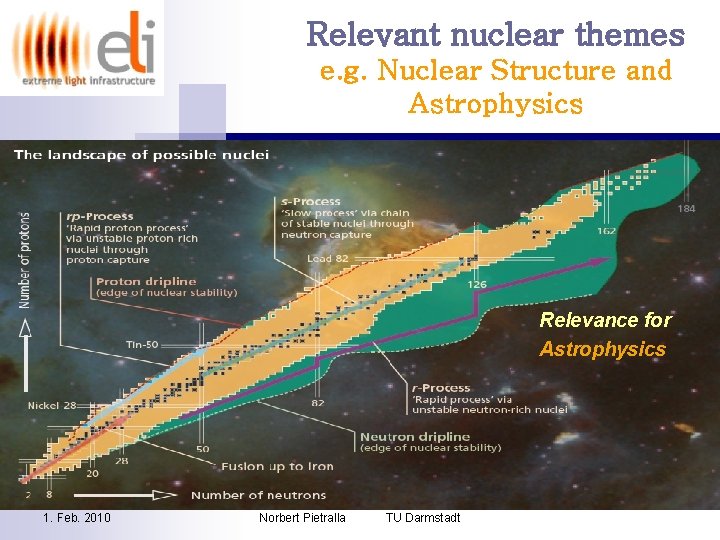
Relevant nuclear themes e. g. Nuclear Structure and Astrophysics Relevance for Astrophysics 1. Feb. 2010 Norbert Pietralla TU Darmstadt
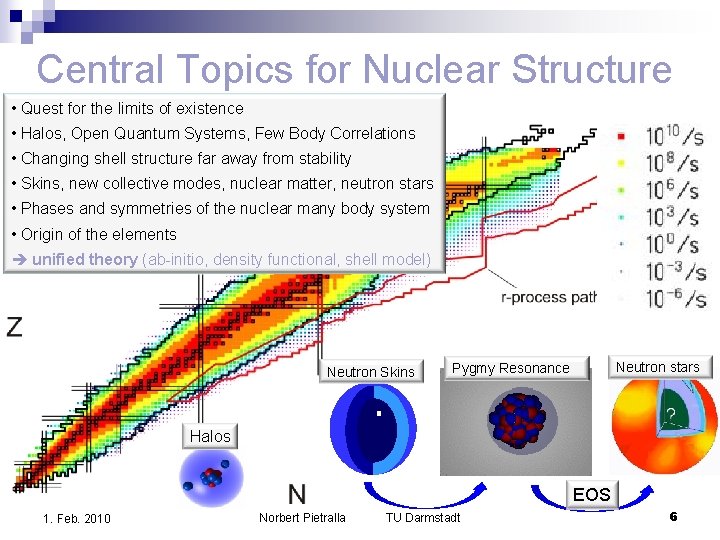
Central Topics for Nuclear Structure • Quest for the limits of existence • Halos, Open Quantum Systems, Few Body Correlations • Changing shell structure far away from stability • Skins, new collective modes, nuclear matter, neutron stars • Phases and symmetries of the nuclear many body system • Origin of the elements unified theory (ab-initio, density functional, shell model) Neutron Skins Neutron stars Pygmy Resonance Halos EOS 1. Feb. 2010 Norbert Pietralla TU Darmstadt 6
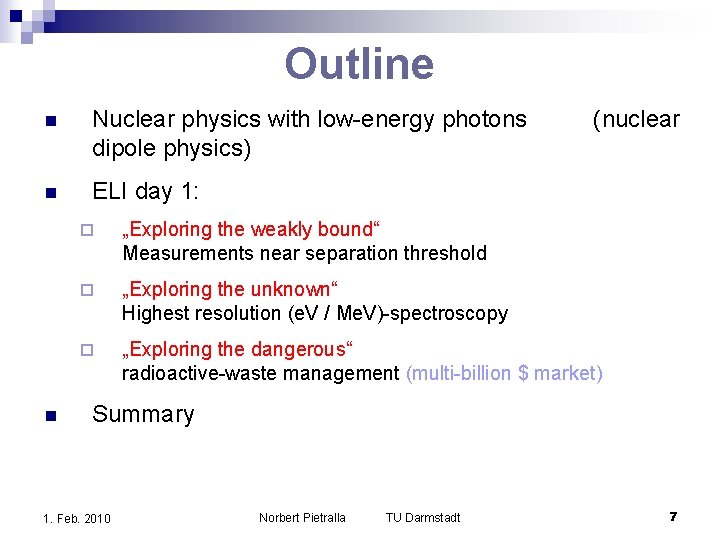
Outline n Nuclear physics with low-energy photons dipole physics) n ELI day 1: n (nuclear ¨ „Exploring the weakly bound“ Measurements near separation threshold ¨ „Exploring the unknown“ Highest resolution (e. V / Me. V)-spectroscopy ¨ „Exploring the dangerous“ radioactive-waste management (multi-billion $ market) Summary 1. Feb. 2010 Norbert Pietralla TU Darmstadt 7
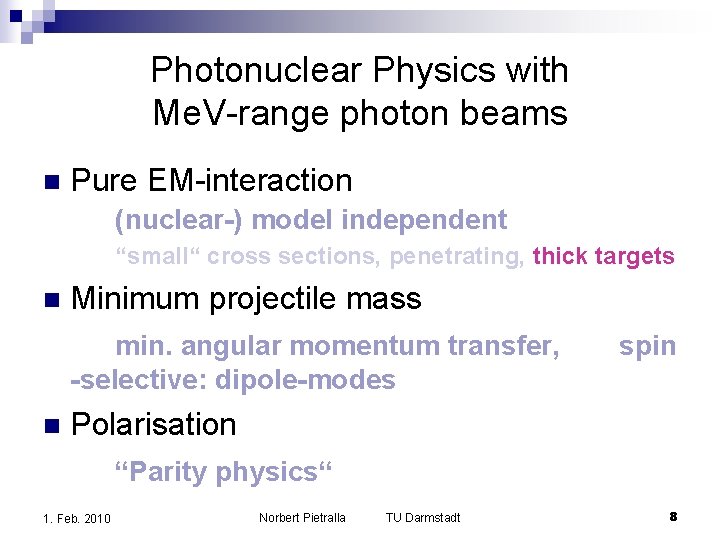
Photonuclear Physics with Me. V-range photon beams n Pure EM-interaction (nuclear-) model independent “small“ cross sections, penetrating, thick targets n Minimum projectile mass min. angular momentum transfer, -selective: dipole-modes n spin Polarisation “Parity physics“ 1. Feb. 2010 Norbert Pietralla TU Darmstadt 8
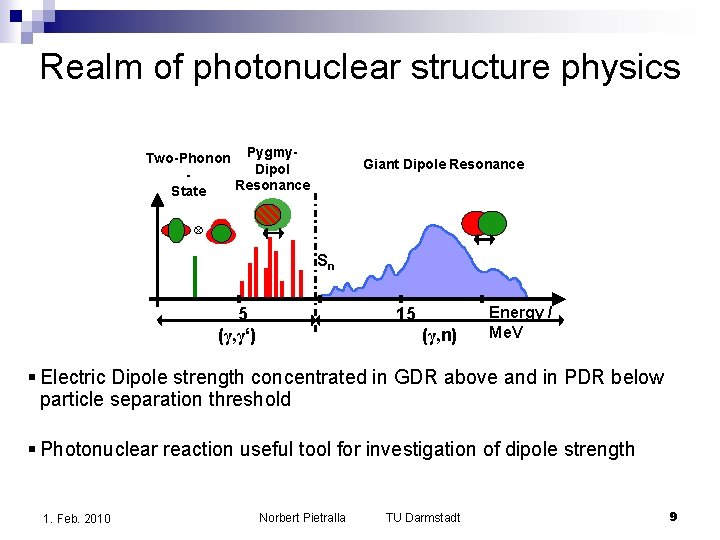
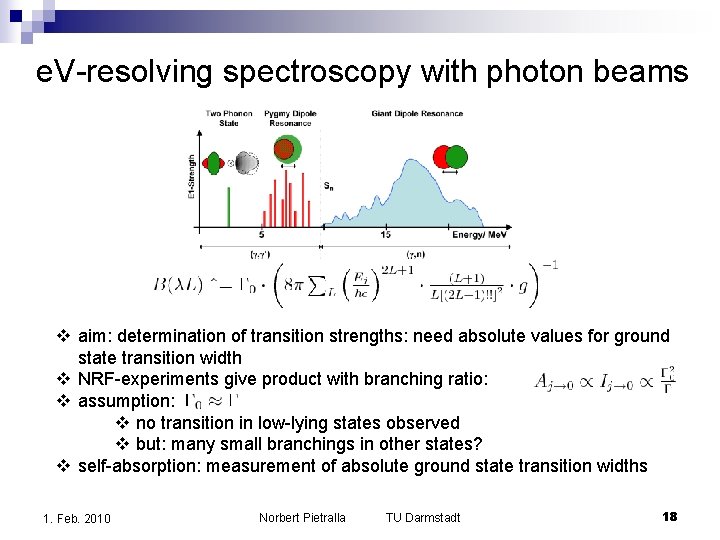
Realm of photonuclear structure physics Two-Phonon Pygmy. Dipol Resonance State Giant Dipole Resonance x Sn 5 (γ, γ‘) 15 (γ, n) Energy / Me. V Electric Dipole strength concentrated in GDR above and in PDR below particle separation threshold Photonuclear reaction useful tool for investigation of dipole strength 1. Feb. 2010 Norbert Pietralla TU Darmstadt 9
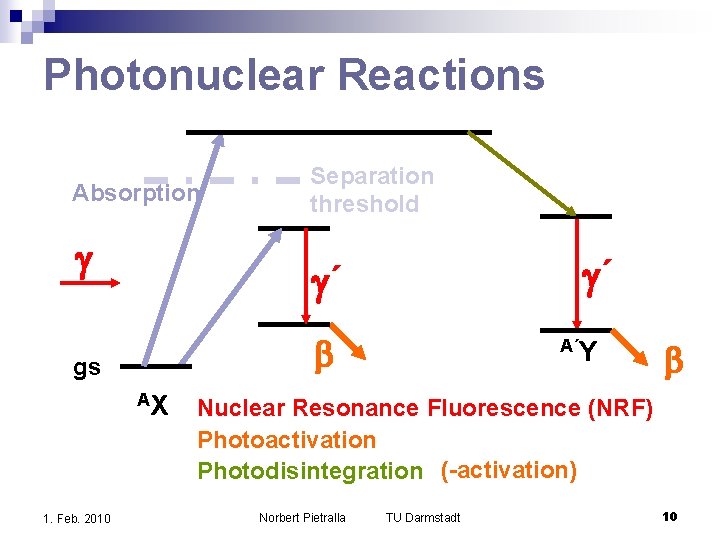
Photonuclear Reactions Absorption ´ ´ gs AX 1. Feb. 2010 Separation threshold A´Y Nuclear Resonance Fluorescence (NRF) Photoactivation Photodisintegration (-activation) Norbert Pietralla TU Darmstadt 10
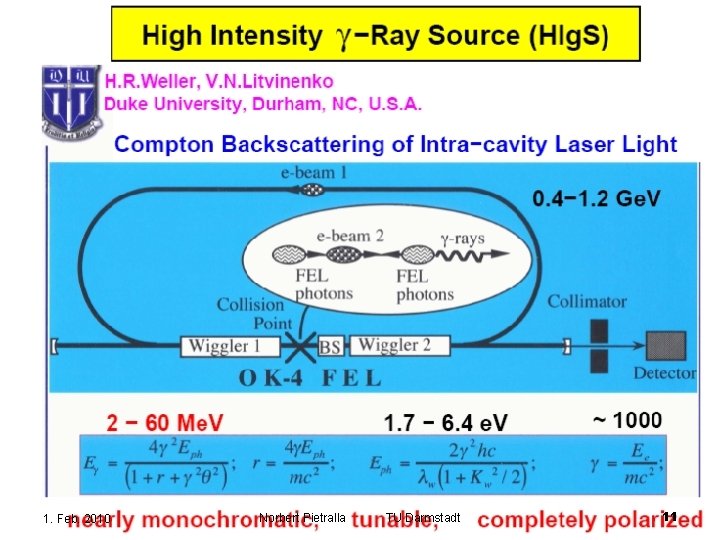
1. Feb. 2010 Norbert Pietralla TU Darmstadt 11
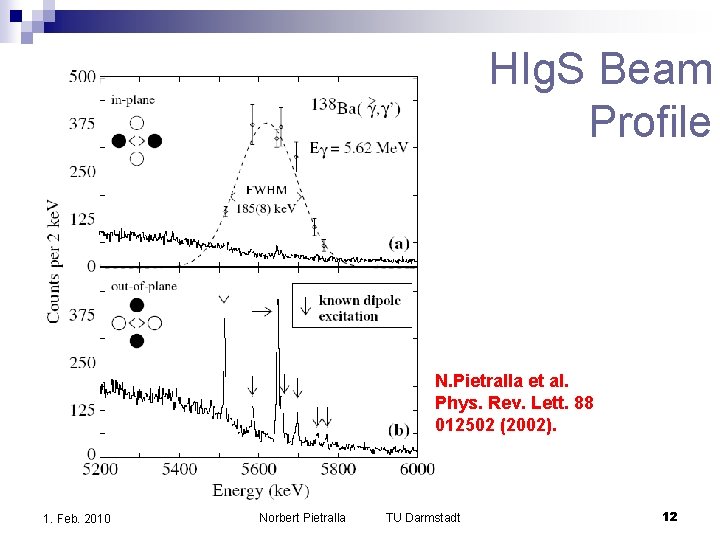
HIg. S Beam Profile N. Pietralla et al. Phys. Rev. Lett. 88 012502 (2002). 1. Feb. 2010 Norbert Pietralla TU Darmstadt 12
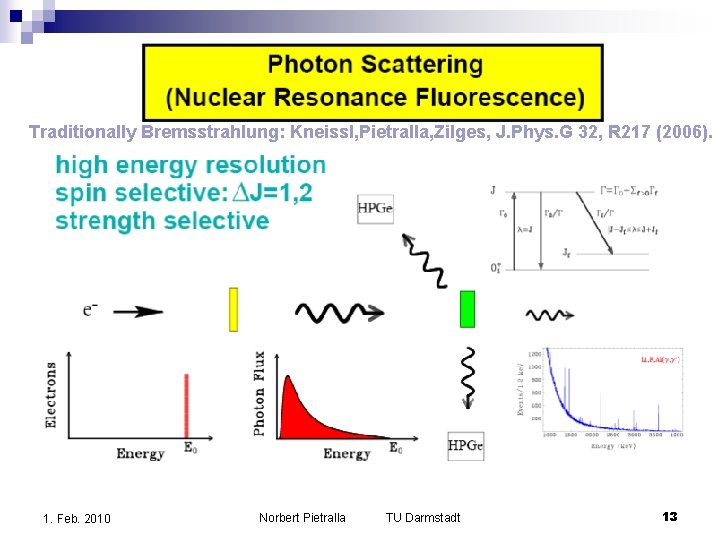
Traditionally Bremsstrahlung: Kneissl, Pietralla, Zilges, J. Phys. G 32, R 217 (2006). 1. Feb. 2010 Norbert Pietralla TU Darmstadt 13
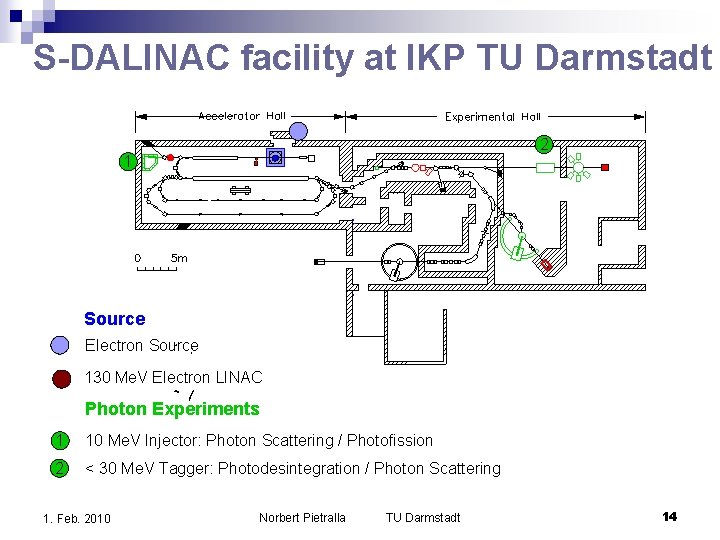
S-DALINAC facility at IKP TU Darmstadt i 2 1 Source Electron Source 130 Me. V Electron LINAC Photon Experiments 1 10 Me. V Injector: Photon Scattering / Photofission 2 < 30 Me. V Tagger: Photodesintegration / Photon Scattering 1. Feb. 2010 Norbert Pietralla TU Darmstadt 14
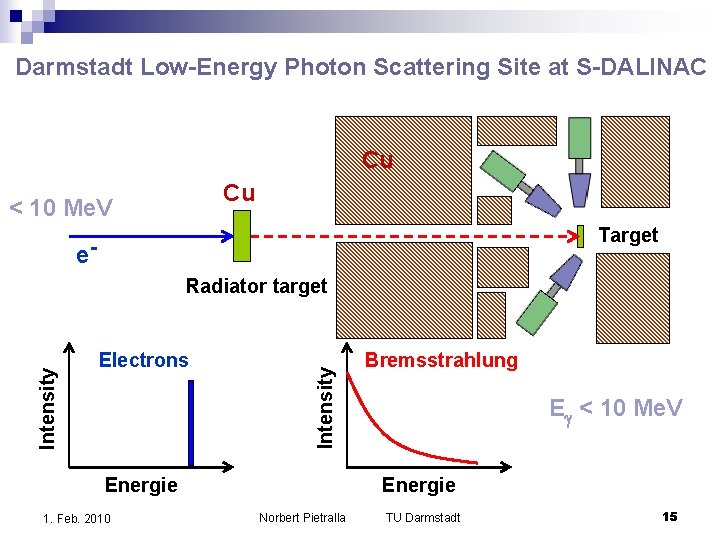
Darmstadt Low-Energy Photon Scattering Site at S-DALINAC Ge(HP) Cu -detectors Cu < 10 Me. V Target e- Electrons Intensity Radiator target Energie 1. Feb. 2010 Bremsstrahlung E < 10 Me. V Energie Norbert Pietralla TU Darmstadt 15
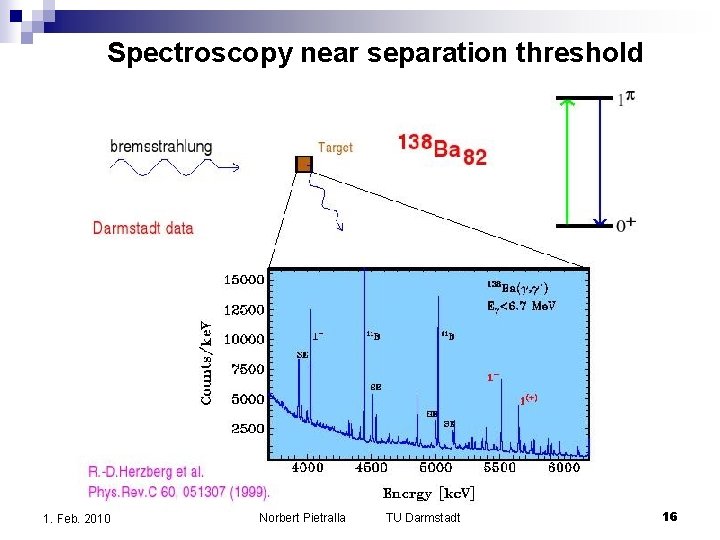
Spectroscopy near separation threshold 1. Feb. 2010 Norbert Pietralla TU Darmstadt 16
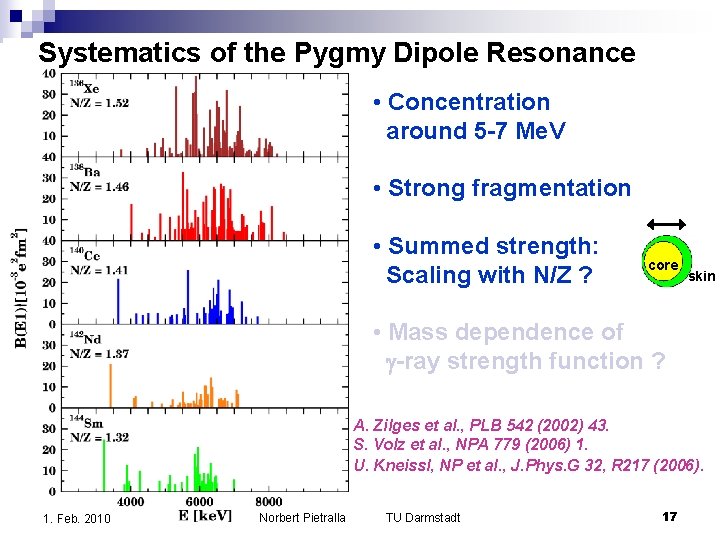
Systematics of the Pygmy Dipole Resonance • Concentration around 5 -7 Me. V • Strong fragmentation • Summed strength: Scaling with N/Z ? core skin • Mass dependence of -ray strength function ? A. Zilges et al. , PLB 542 (2002) 43. S. Volz et al. , NPA 779 (2006) 1. U. Kneissl, NP et al. , J. Phys. G 32, R 217 (2006). 1. Feb. 2010 Norbert Pietralla TU Darmstadt 17
e. V-resolving spectroscopy with photon beams v aim: determination of transition strengths: need absolute values for ground state transition width v NRF-experiments give product with branching ratio: v assumption: v no transition in low-lying states observed v but: many small branchings in other states? v self-absorption: measurement of absolute ground state transition widths 1. Feb. 2010 Norbert Pietralla TU Darmstadt 18
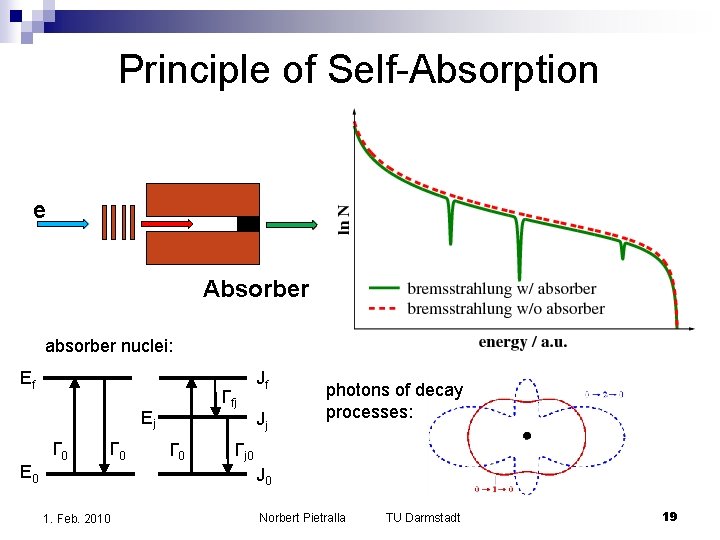
Principle of Self-Absorption e Absorber absorber nuclei: Ef Γfj Ej E 0 Γ 0 Γ 0 Jf Jj photons of decay processes: Γj 0 J 0 1. Feb. 2010 Norbert Pietralla TU Darmstadt 19
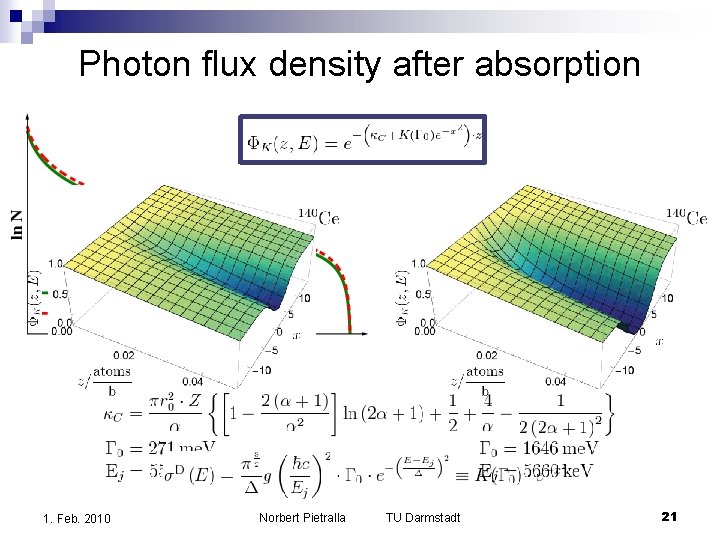
Photon flux density after absorption 1. Feb. 2010 Norbert Pietralla TU Darmstadt 21
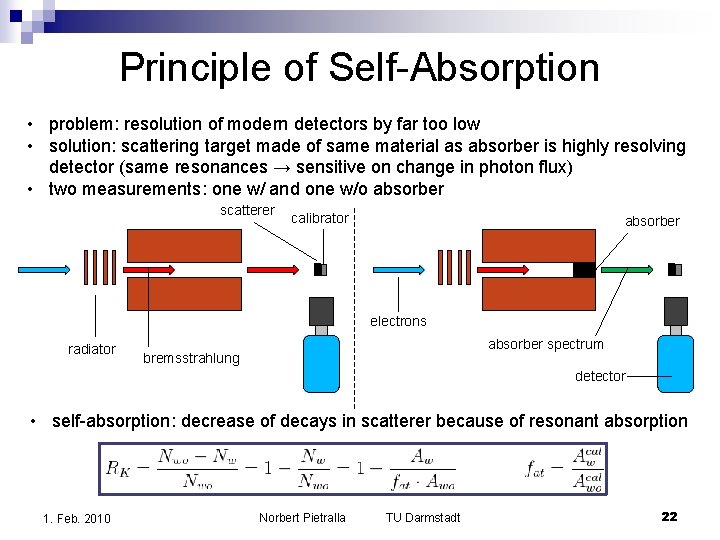
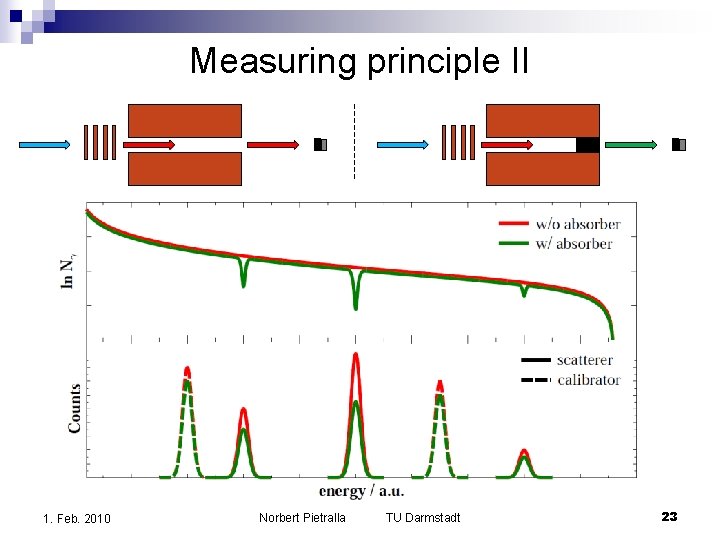
Principle of Self-Absorption • problem: resolution of modern detectors by far too low • solution: scattering target made of same material as absorber is highly resolving detector (same resonances → sensitive on change in photon flux) • two measurements: one w/ and one w/o absorber scatterer calibrator absorber electrons radiator absorber spectrum bremsstrahlung detector • self-absorption: decrease of decays in scatterer because of resonant absorption 1. Feb. 2010 Norbert Pietralla TU Darmstadt 22
Measuring principle II 1. Feb. 2010 Norbert Pietralla TU Darmstadt 23
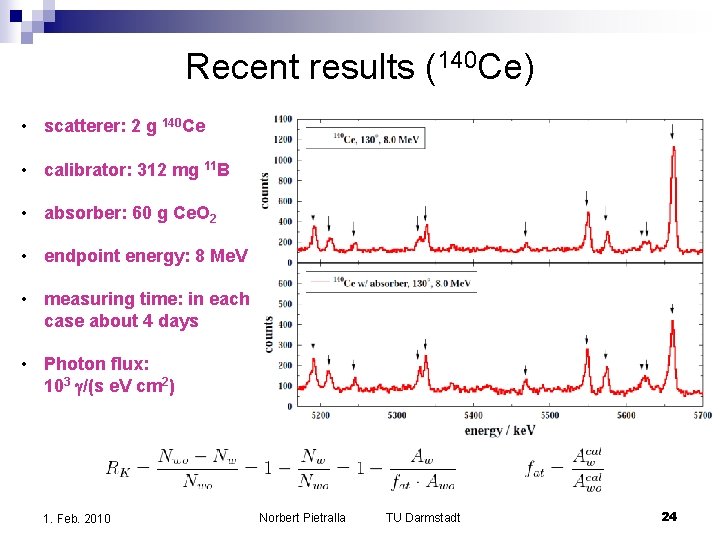
Recent results (140 Ce) • scatterer: 2 g 140 Ce • calibrator: 312 mg 11 B • absorber: 60 g Ce. O 2 • endpoint energy: 8 Me. V • measuring time: in each case about 4 days • Photon flux: 103 /(s e. V cm 2) 1. Feb. 2010 Norbert Pietralla TU Darmstadt 24
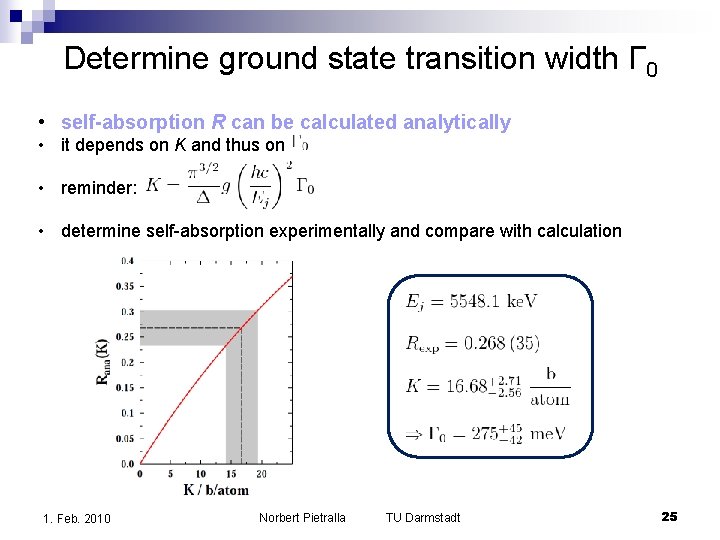
Determine ground state transition width Γ 0 • self-absorption R can be calculated analytically • it depends on K and thus on • reminder: • determine self-absorption experimentally and compare with calculation 1. Feb. 2010 Norbert Pietralla TU Darmstadt 25
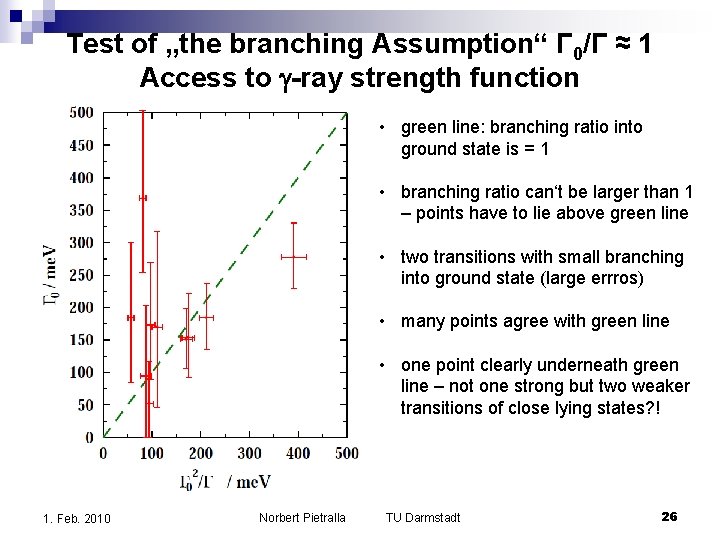
Test of „the branching Assumption“ Γ 0/Γ ≈ 1 Access to -ray strength function • green line: branching ratio into ground state is = 1 • branching ratio can‘t be larger than 1 – points have to lie above green line • two transitions with small branching into ground state (large errros) • many points agree with green line • one point clearly underneath green line – not one strong but two weaker transitions of close lying states? ! 1. Feb. 2010 Norbert Pietralla TU Darmstadt 26
Potential for ELI photonuclear pillar‘s high-flux high-resolution -ray beam n n Improvement by 3 orders of magnitude in photon flux is feasible Will open up new horizons for photonuclear research ¨ Nuclear dipole strength near threshold ¨ Fine structure of quadrupole response ¨ Energy resolution on Doppler-width scale ¨ Detection of hazardous material in bulk matter ¨ New approaches… 1. Feb. 2010 Norbert Pietralla TU Darmstadt 27
Summary Nuclear structure physics with -ray beams is a vivid field with high discovery potential n ELI can become a major facility in this field n Needs: - energy-tunable, high-flux, highrep. rate, high-resolution, polarized -ray beam from LASER-Compton backscattering n All this should be possible at ELI ! n 1. Feb. 2010 Norbert Pietralla TU Darmstadt 28
Thank you ! 1. Feb. 2010 Norbert Pietralla TU Darmstadt 29
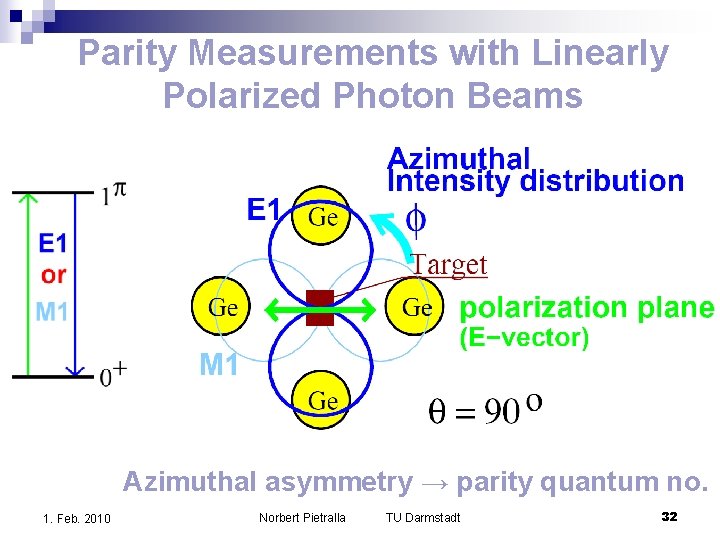
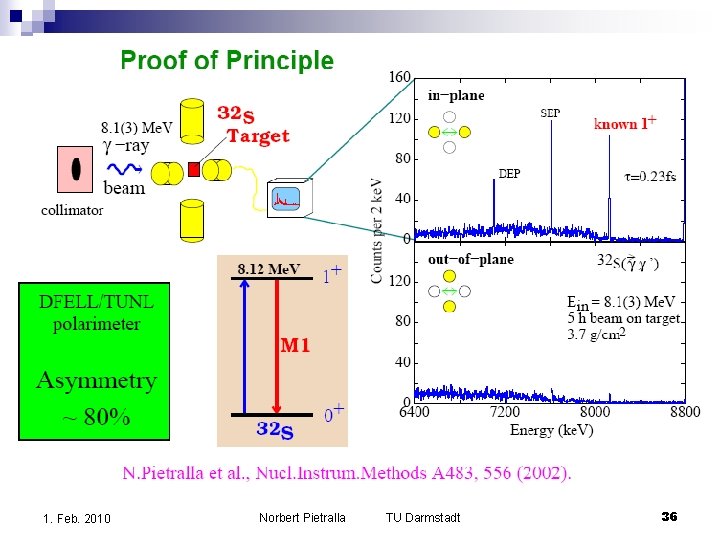
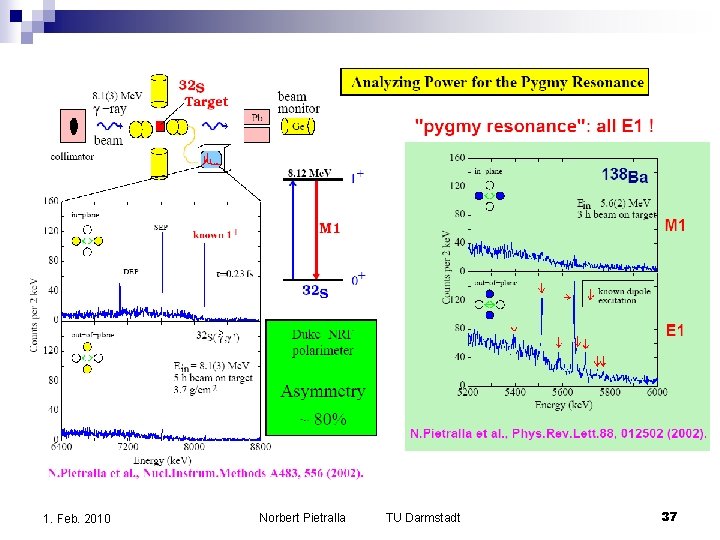
Parity Measurements with Linearly Polarized Photon Beams Azimuthal asymmetry → parity quantum no. 1. Feb. 2010 Norbert Pietralla TU Darmstadt 32
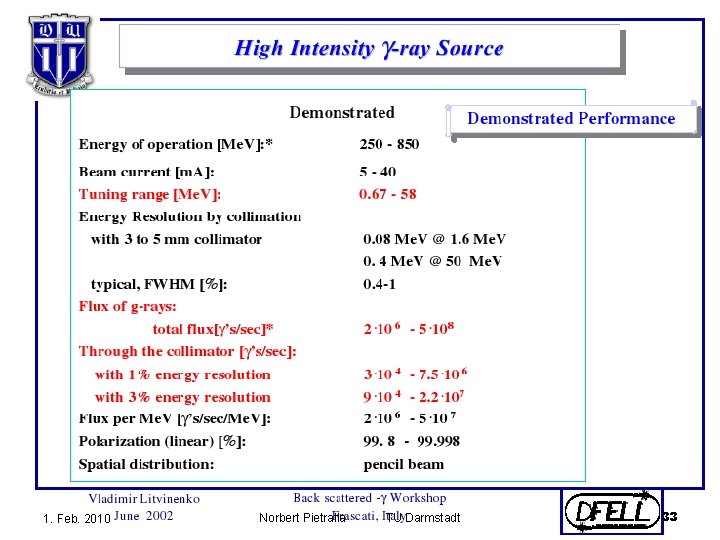
1. Feb. 2010 Norbert Pietralla TU Darmstadt 33
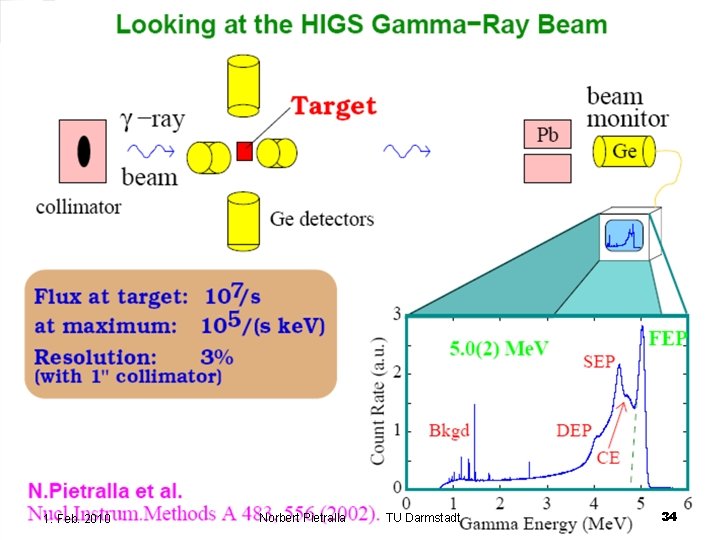
1. Feb. 2010 Norbert Pietralla TU Darmstadt 34
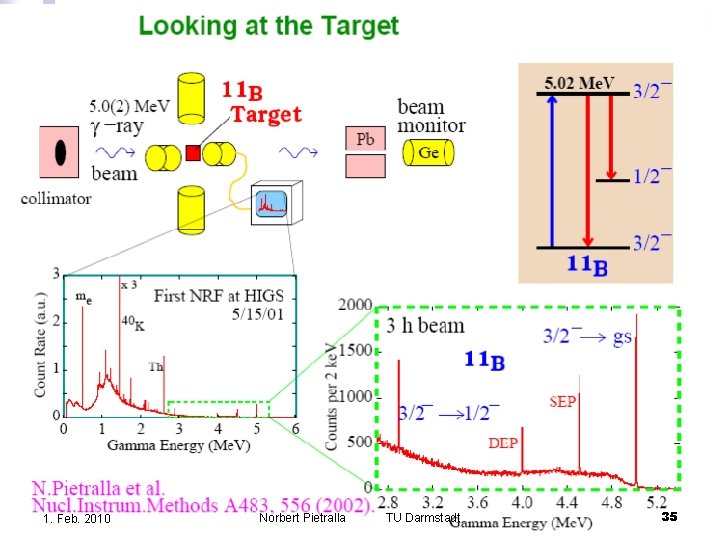
1. Feb. 2010 Norbert Pietralla TU Darmstadt 35
1. Feb. 2010 Norbert Pietralla TU Darmstadt 36
1. Feb. 2010 Norbert Pietralla TU Darmstadt 37
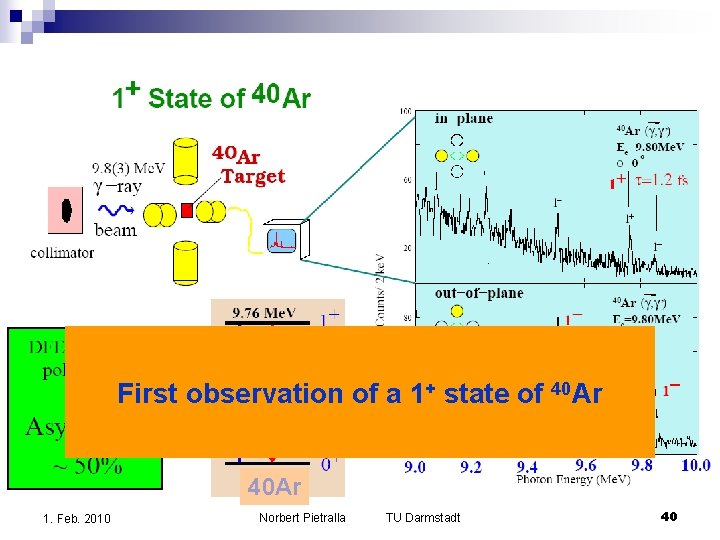
First observation of a 1+ state of 40 Ar 1. Feb. 2010 Norbert Pietralla TU Darmstadt 40
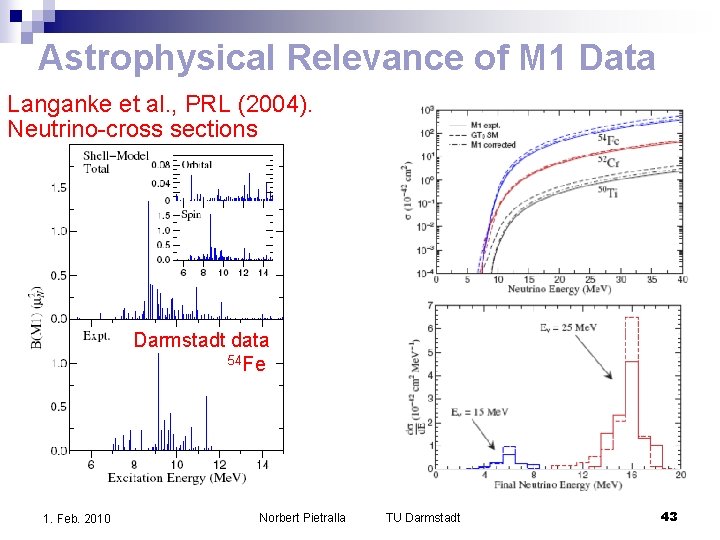
Astrophysical Relevance of M 1 Data Langanke et al. , PRL (2004). Neutrino-cross sections Darmstadt data 54 Fe 1. Feb. 2010 Norbert Pietralla TU Darmstadt 43
1. Feb. 2010 Norbert Pietralla TU Darmstadt 47
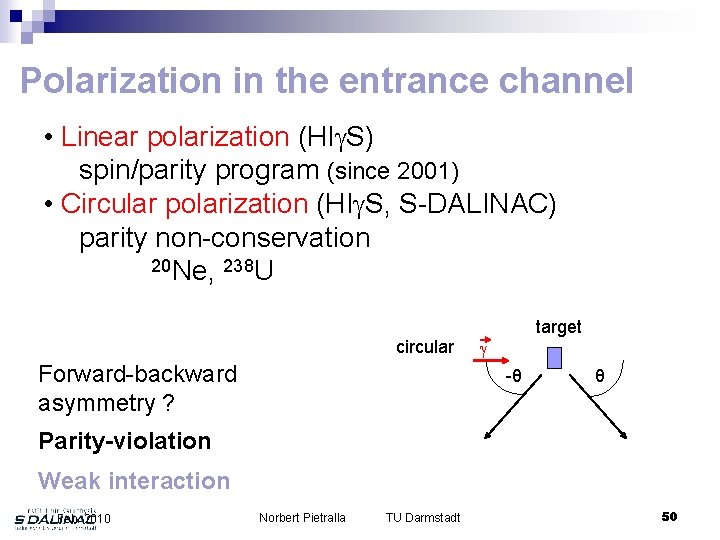
Polarization in the entrance channel • Linear polarization (HI S) spin/parity program (since 2001) • Circular polarization (HI S, S-DALINAC) parity non-conservation 20 Ne, 238 U circular Forward-backward asymmetry ? target -θ θ Parity-violation Weak interaction 1. Feb. 2010 Norbert Pietralla TU Darmstadt 50
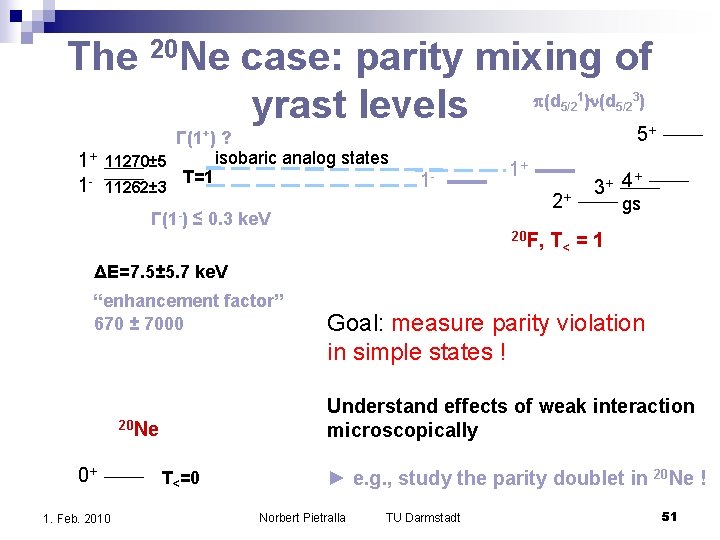
The 20 Ne case: parity mixing of p(d )n(d ) yrast levels 1 5/2 Γ(1+) ? isobaric analog states 1+ 11270± 5 1 - 11262± 3 T=1 Γ(1 -) 3 5/2 5+ 1 - ≤ 0. 3 ke. V 1+ 2+ 20 F, + 3+ 4 gs T< = 1 ΔE=7. 5± 5. 7 ke. V “enhancement factor” 670 ± 7000 Understand effects of weak interaction microscopically 20 Ne 0+ 1. Feb. 2010 Goal: measure parity violation in simple states ! T<=0 ► e. g. , study the parity doublet in 20 Ne ! Norbert Pietralla TU Darmstadt 51
From US-NSAC-charge: “Nuclear Physics with the Rare Isotope Accelerator” Themes and challenges of Modern Science • Complexity out of simplicity How the world, with all its apparent complexity and diversity can be constructed out of a few elementary building blocks and their interactions • Simplicity out of complexity How the world of complex systems can display such astonishing regularity and simplicity • Understanding the nature of the physical universe • Manipulating nature for the benefit of mankind Nuclei: Two-fluid, many-body, strongly-interacting, quantal systems provide 53 Norbert Pietralla 1. Feb. 2010 wonderful laboratories for frontier research TU in. Darmstadt all four areas
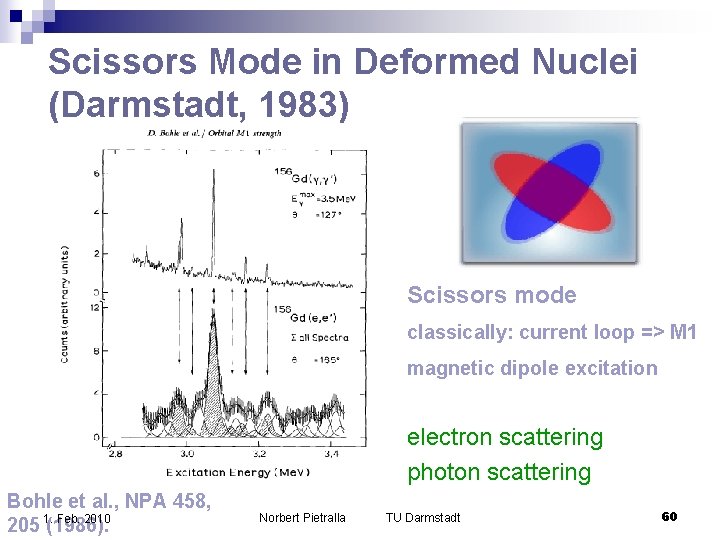
Scissors Mode in Deformed Nuclei (Darmstadt, 1983) Scissors mode classically: current loop => M 1 magnetic dipole excitation electron scattering photon scattering Bohle et al. , NPA 458, Feb. 2010 205 1. (1986). Norbert Pietralla TU Darmstadt 60