
CURRENT STATUS ENERGY TRANSITION SOLOMON ISLANDS BACKGROUND GENERAL
CURRENT STATUS ENERGY TRANSITION SOLOMON ISLANDS
BACKGROUND
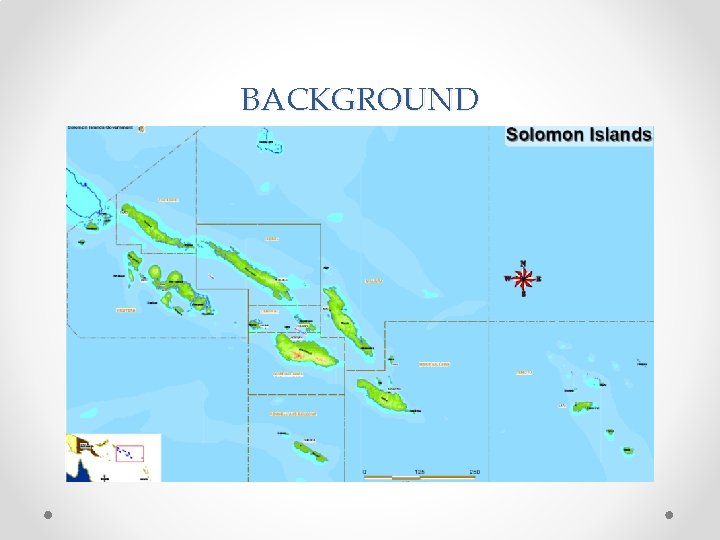
GENERAL INFORMATION • Population - > 700, 000 with over 80% of the population spread over tropical isolated islands • Resources – forestry, agriculture and fisheries • In 2009 the government acknowledge only 16% has access to electricity. If the rural areas are considered the percentage will fall below 5% • RE – electricity supply 0. 6% • Heavily dependent on petroleum products • RE – great potential
ENERGY DIVISION • Vision - “Unlocking the development potential of Solomon Islands' economic base through a dynamic and effective energy sector”. • The Mission of Energy Division is: “Provides the base for appropriate coordination, planning, promotion, development and management, and efficient use of energy resources”
Energy sector broader policy outcome • Strengthen the energy sector leadership and planning • Increase access to electricity in urban households to 80% by 2020. • Increase access to electricity in rural households to 35% by 2020 • Increase the use of renewable energy sources for power generation in urban and rural areas to 50% by 2020. • Improve energy efficiency and conservation in all sectors by 10. 7% by 2019.
POLICIES AND STRATEGIES 1. PLANNING AND LEADERSHIP 1. 1 Leadership is strengthened through an approved high-level multisectoral coordinating mechanism supported by legislation • Support the regulation of the energy sector – off-grid and on-grid electrification. • review the energy legislation and enacting of the Energy Act. 2. ELECTRIC POWER - URBAN 2. 1 Improve the capacity and condition of the Honiara and outstations network 2. 2 Develop and implement energy efficiency & conservation 2. 3 Extend existing networks to surrounding rural communities where feasible
continue 3. ELECTRIC POWER – RURAL 3. 1 Increase the supply of modern energy services in rural schools, telecommunication and health centers. • Improve and increase the use of solar and hydro power. • Encourage public / private partnership for power generation 3. 2 Planned and sustainable energy development consistent with government objective 3. 3 Develop a renewable energy policy and rural electrification policy • Implement the Rural Electrification Master Plan (JICA-funded project)
continue 4. RENEWABLE ENERGY 4. 1 Establish an appropriate, reliable, affordable and sustainable energy-based power supply systems. • Improve SIEA energy services through off grids (hydro and solar) and generating plants • Develop appropriate frameworks for independent power producers. 4. 2 Increase productivity in rural communities with the use of renewable energy services. • Encourage Renewable Energy Services Company (RESCO's) involvement in productive uses of renewable energy sources. 4. 3 Develop renewable energy policy instruments to meet the renewable energy targets
continue • Net metering policies and standards • benefits to financial institutions to provide concessional loans and term extension funds for renewable energy electrification projects. • training and capacity building on new renewable energy technologies. 4. 5 Develop an appropriate framework for access to land for renewable energy developments 5. PETROLEUM 5. 1 A reliable supply of quality petroleum products at landed cost is supplied to all people in Solomon Islands. 6. EFFICIENCY & CONSERVATION 6. 1 Promote energy efficiency and conservation measures at government, residential, commercial and industrial sectors
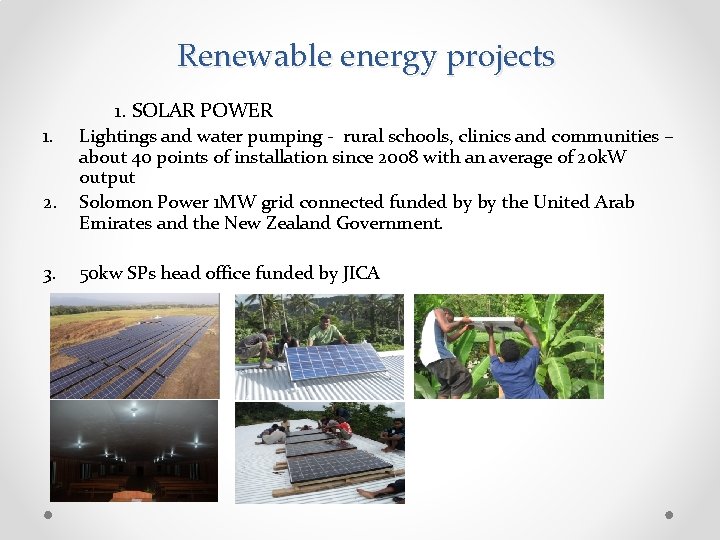
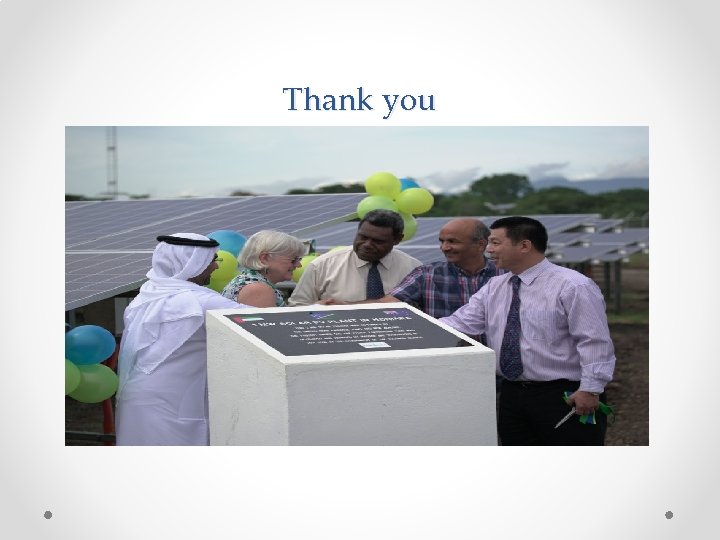
Renewable energy projects 1. SOLAR POWER 1. 2. 3. Lightings and water pumping - rural schools, clinics and communities – about 40 points of installation since 2008 with an average of 20 k. W output Solomon Power 1 MW grid connected funded by by the United Arab Emirates and the New Zealand Government. 50 kw SPs head office funded by JICA
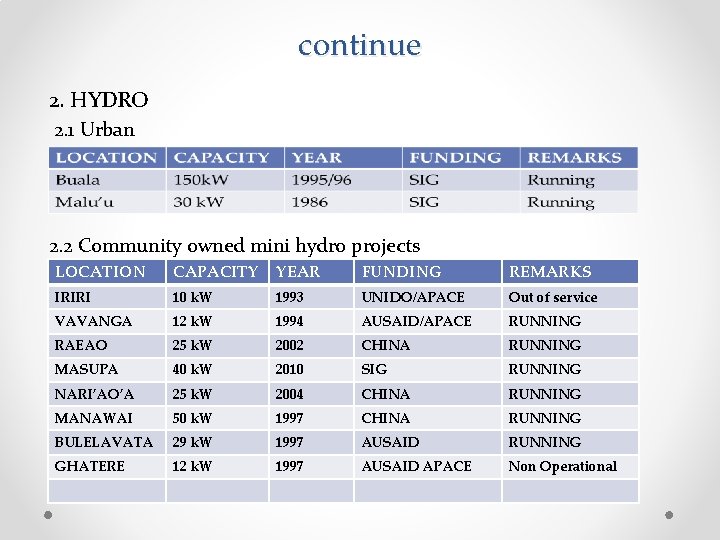
continue 2. HYDRO 2. 1 Urban 2. 2 Community owned mini hydro projects LOCATION CAPACITY YEAR FUNDING REMARKS IRIRI 10 k. W 1993 UNIDO/APACE Out of service VAVANGA 12 k. W 1994 AUSAID/APACE RUNNING RAEAO 25 k. W 2002 CHINA RUNNING MASUPA 40 k. W 2010 SIG RUNNING NARI’AO’A 25 k. W 2004 CHINA RUNNING MANAWAI 50 k. W 1997 CHINA RUNNING BULELAVATA 29 k. W 1997 AUSAID RUNNING GHATERE 12 k. W 1997 AUSAID APACE Non Operational
continue
continue 3. Biofuel Solomon Power 350 k. W generator (blend of 80% coconut oil and 20%) diesel for Auki funded by ADB
RE in progress • In progress are five (5) PV conversion projects at existing Solomon power Provincial Stations. These projects will be funded by the Asian Development Bank with a total capacity of about 2 MW. • Solomon Power Hybrid projects (PV, Battery and Diesel back up) at three provincial sub station, two of these sites will be commissioned by the first quarter of 2017 • Currently we are doing studies on about 15 sites for new hybrid sites to be funded under Italian government. • Tina hydro - 20 megawatt • Fiu Hydro 360 k. W, SIG and ADB funded project • Geothermal – Savo geothermal 20 MW

Success • Solomon Power - installation and commissioning of the PV grid connect at Honiara funded by the United Arab Emirates and the New Zealand Government. • PV installation in operation at the SP’s Head Office installed and funded by the Japanese Government. • Italian government funding for 15 hybrid sites • Tina river hydro project – first concessional loan awarded by IRENA and Abu Dhadi Fund for Development (ADFD) • Fiu hydro – ADB and SIG funded – ground work completed
Challenges Geographical characteristics of the country Land issues No proper/lack of energy national database Capacity for planning the development of the energy sector, set the right policy framework for investment, etc. • Finance and technical capacity to design, install and maintain RE systems • •
Expectations • To acquire knowledge and capacity in development of policies and plans to utilize available renewable energy resources. • The organization should be able to elevate capacity to plan, manage and identify the role of regulators to supervise energy transition through successful participants in such program. • The training will assist the Government in its plan to increase use of renewable energy and accessibility to grid –based electricity.
Thank you
- Slides: 18