
CURRENT STATUS AND PROBLEMS AFFECTING AGRICULTURAL RESEARCH IN
CURRENT STATUS AND PROBLEMS AFFECTING AGRICULTURAL RESEARCH IN BURUNDI INSTITUTE OF AGRONOMIC SCIENCES OF BURUNDI (ISABU)
Types of agricultural research carried out in Burundi 1. Agricultural Research (Agri-breeding) o ISABU (Institute of Agronomic Sciences of Burundi) o IRAZ (Agronomic and Zootechnical Research Institute) o The faculties of agricultural sciences of university institutions (FABI, FACAGRO / NGOZI) o The programs of CGIARs located in Burundi (IRRI, IITA, Bioversity, ILRI, etc. ) 2. Food Technology Research o CNTA (National Center for Food Technology) o ISABU (PVPAE, embryonic stage) 3. Animal Health Research o National veterinary laboratory
Institute of Agronomic Sciences of Burundi v Public administrative establishment, placed under the supervision of the Minister in charge of Agriculture and Livestock; v Created by legislative ordinance n ° B 7 / 11 of June 22, 1962 v The order of its creation has been reviewed by o Decree No. 100/202 of 9/15/2014 reorganizing ISABU and o Ministerial Order No. 710/1862 of 11/28/2014, organizing the ISABU services.
Vision, Mission and Mandate v Vision: To contribute to the establishment of a dynamic agricultural sector based on innovations, knowledge and approaches that meet the needs of users of research results v Mission: To promote the scientific development of agriculture and animal husbandry in Burundi. v National mandate to coordinate agricultural research in Burundi. In this capacity, ISABU guides research initiatives, centralizes and validates their results before transferring (Giving them back) to the services and partners in charge of extension for their use and adoption.
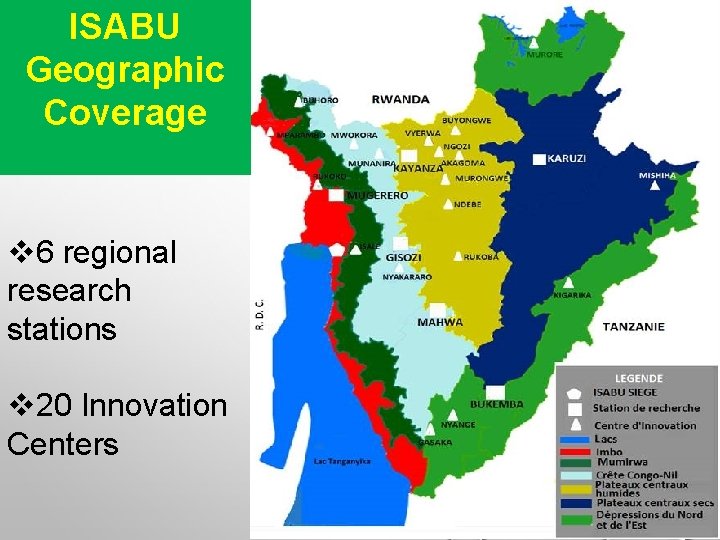
ISABU Geographic Coverage v 6 regional research stations v 20 Innovation Centers
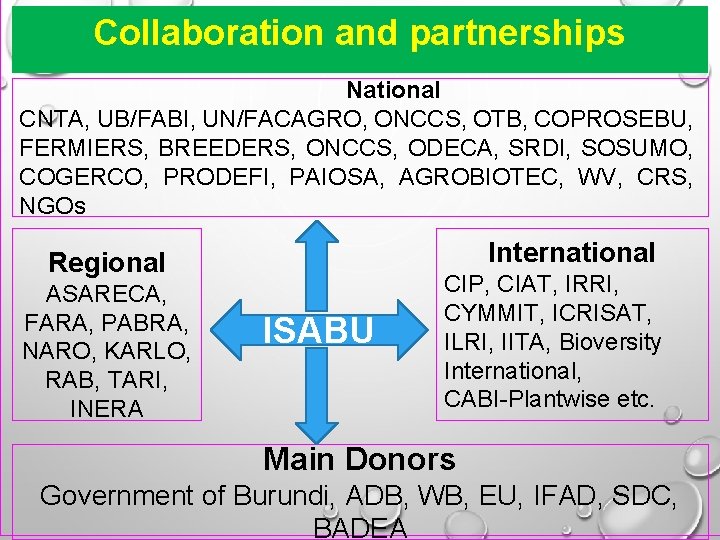
. Collaboration and partnerships National CNTA, UB/FABI, UN/FACAGRO, ONCCS, OTB, COPROSEBU, FERMIERS, BREEDERS, ONCCS, ODECA, SRDI, SOSUMO, COGERCO, PRODEFI, PAIOSA, AGROBIOTEC, WV, CRS, NGOs International Regional ASARECA, FARA, PABRA, NARO, KARLO, RAB, TARI, INERA ISABU CIP, CIAT, IRRI, CYMMIT, ICRISAT, ILRI, IITA, Bioversity International, CABI-Plantwise etc. Main Donors Government of Burundi, ADB, WB, EU, IFAD, SDC, BADEA
Area of intervention 1. Food crops and oilseeds 2. Industrial crops for export 3. Horticulture 4. Indigenous and medicinal cultures 5. Improvement of livestock performance (breeding) 6. Agricultural and livestock products promotion 7. Agrarian systems and rural economy 8. Agriculture and environment 9. Laboratories 10. Prebase seeds 11. Scientific documentation and communication 12. Biometrics and Computing
Opportunities for Agricultural Research in Burundi v Burundi's partnership agreements with research organizations at the National, regional and international levels; v The existence of the National Development Plan (NDP/PND) of Burundi [2018 -2027], strategies and sector policies favorable for agricultural research; v The existence of an Agricultural Research Master Plan (ARMP/PDRA) Strategic vision 2021 -2030 v The manifest desire of the Government of Burundi to make science, technology and research a tool
Constraints/challenges of agricultural research in Burundi 1. Low level of investment and funding for research; 2. Less adapted infrastructure and equipment; 3. Low capacity in human resources (researchers) having acquired in-depth knowledge in their fields of expertise. 4. Lack of a body for guidance, regulation and coordination of agricultural research institutes and centers in Burundi (Each center works for itself).
Constraints/challenges of agricultural research in Burundi 5. Low level of understanding of the concept of "research" by policy makers, 6. An imbalance in salaries between research institutions which often leads to the instability of human resources, 7. Low scientific diversity: Several areas of research do not have specialist researchers. (Livestock, industrial crops, horticulture, laboratories, Processing etc. ). 8. Lack of control of climate change (irrigation system, greenhouse agriculture, food conservation, etc. )
What to do 1. Establish a national strategy for training and rational management of human resources by priority area (UNIVERSITY) 2. Review financial system by priority (GOVERNMENT) 3. Put in place strategies to circumvent climate change (ALL) 4. Identify priority research areas (RESEARCH INSTITUTES) 5. Evolve towards market agriculture (mindset change )
- Slides: 11