
Current State of the Community Ice Sheet Model

- Slides: 28
Current State of the Community Ice Sheet Model Stephen Price 1, Bill Lipscomb 1, Jesse Johnson 2 Tony Payne 3, Ian Rutt 4, Magnus Hagdorn 5 1 COSIM Project, Fluid Dynamics and Solid Mechanics Group, Los Alamos National Laboratory 2 Department 3 Bristol of Computer Sciences, University of Montana Glaciology Centre, School of Geographical Sciences, University of Bristol 4 School of the Environment and Society, Swansea University 5 School of Geo. Sciences, University of Edinburgh Climate, Ocean, and Sea Ice Modeling Project
Motivation for improved Ice Sheet Models Current models do not capture observed ice sheet behaviour 1, because: (1) Fundamental physics are missing (e. g. simplified gov. equations, negating realistic simulation of outlet glaciers and ice streams) (2) Processes of fundamental importance are not accounted for (e. g. simplified, static treatment of basal boundary conditions, ignoring atmos. and ocean coupling, explicit hydrology, etc. ) Accurate predictions of future sea-level rise will require advanced models which can demonstrate skill at reproducing and explaining recent dramatic ice sheet behaviors. 1 IPCC (2007)
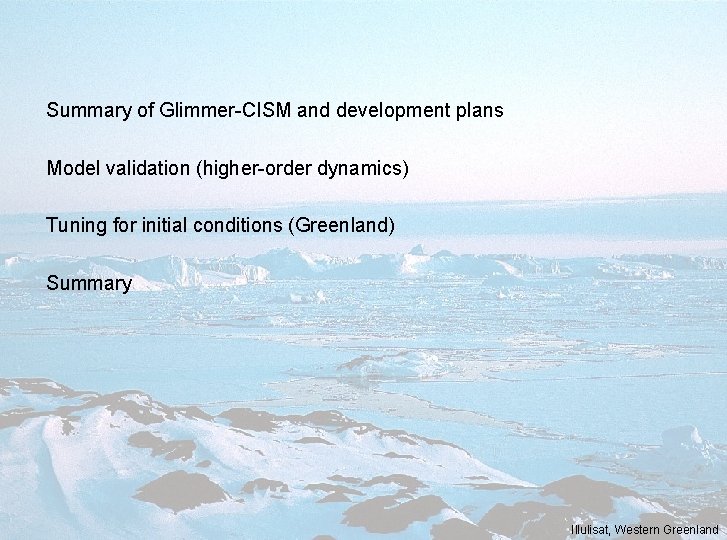
Summary of Glimmer-CISM and development plans Model validation (higher-order dynamics) Tuning for initial conditions (Greenland) Summary Illulisat, Western Greenland
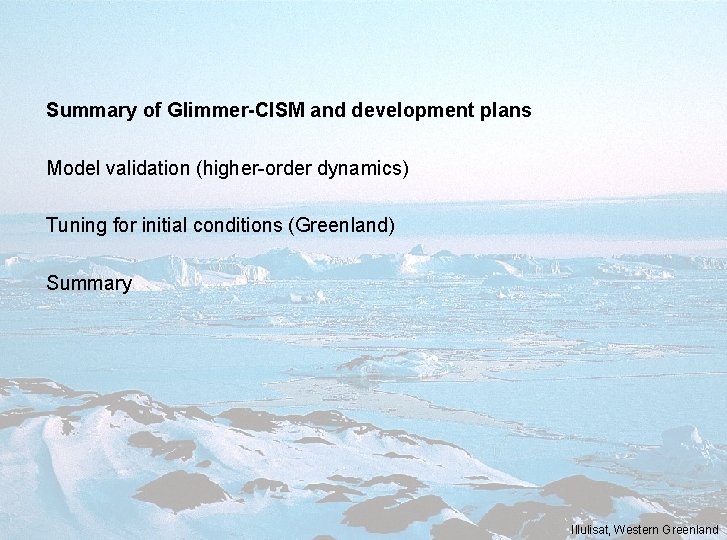
Summary of Glimmer-CISM and development plans Model validation (higher-order dynamics) Tuning for initial conditions (Greenland) Summary Illulisat, Western Greenland
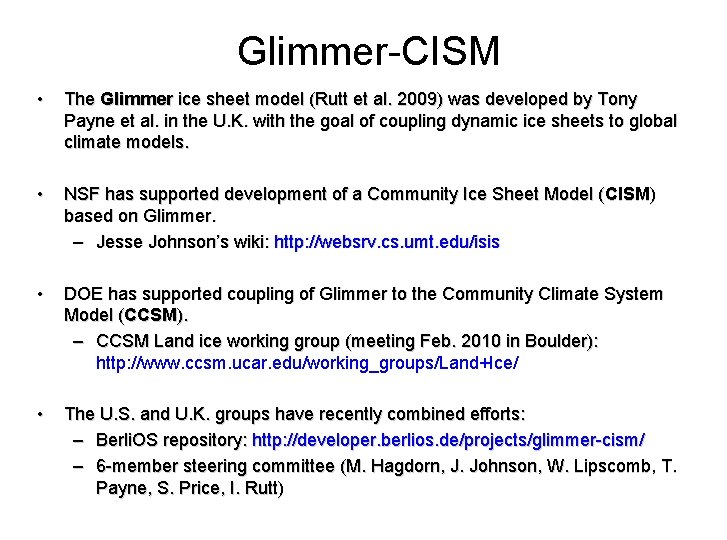
Glimmer-CISM • The Glimmer ice sheet model (Rutt et al. 2009) was developed by Tony Payne et al. in the U. K. with the goal of coupling dynamic ice sheets to global climate models. • NSF has supported development of a Community Ice Sheet Model (CISM) based on Glimmer. – Jesse Johnson’s wiki: http: //websrv. cs. umt. edu/isis • DOE has supported coupling of Glimmer to the Community Climate System Model (CCSM). – CCSM Land ice working group (meeting Feb. 2010 in Boulder): http: //www. ccsm. ucar. edu/working_groups/Land+Ice/ • The U. S. and U. K. groups have recently combined efforts: – Berli. OS repository: http: //developer. berlios. de/projects/glimmer-cism/ – 6 -member steering committee (M. Hagdorn, J. Johnson, W. Lipscomb, T. Payne, S. Price, I. Rutt)
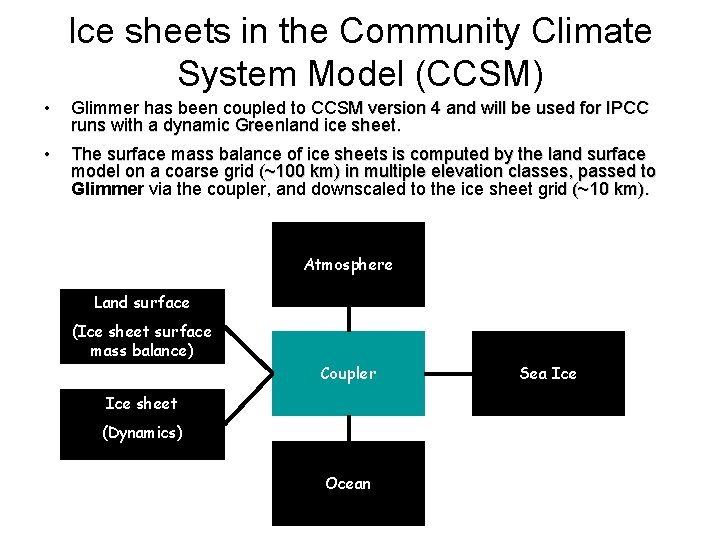
Ice sheets in the Community Climate System Model (CCSM) • Glimmer has been coupled to CCSM version 4 and will be used for IPCC runs with a dynamic Greenland ice sheet. • The surface mass balance of ice sheets is computed by the land surface model on a coarse grid (~100 km) in multiple elevation classes, passed to Glimmer via the coupler, and downscaled to the ice sheet grid (~10 km). Atmosphere Land surface (Ice sheet surface mass balance) Coupler Ice sheet (Dynamics) Ocean Sea Ice
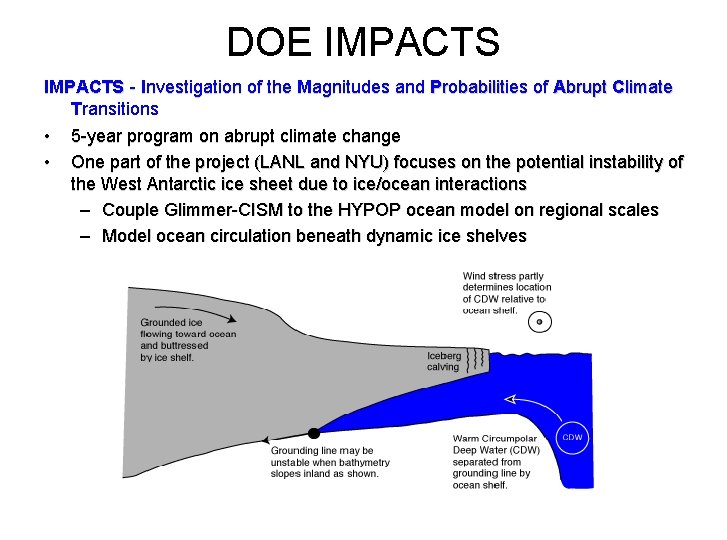
DOE IMPACTS - Investigation of the Magnitudes and Probabilities of Abrupt Climate Transitions • 5 -year program on abrupt climate change • One part of the project (LANL and NYU) focuses on the potential instability of the West Antarctic ice sheet due to ice/ocean interactions – Couple Glimmer-CISM to the HYPOP ocean model on regional scales – Model ocean circulation beneath dynamic ice shelves
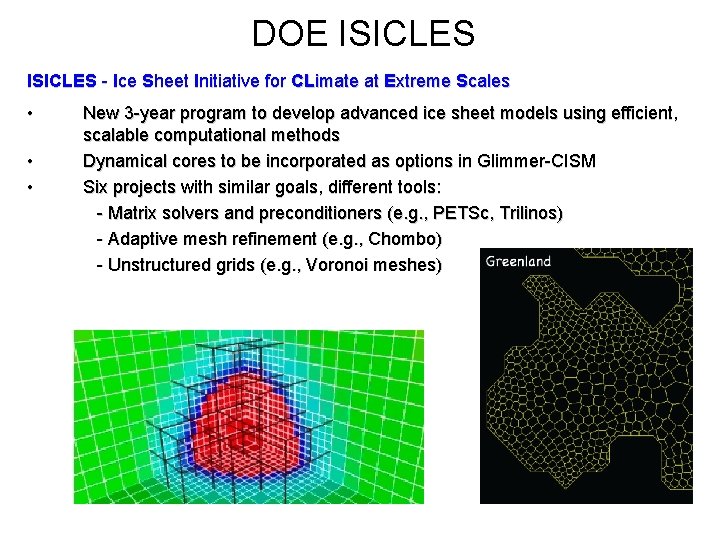
DOE ISICLES - Ice Sheet Initiative for CLimate at Extreme Scales • • • New 3 -year program to develop advanced ice sheet models using efficient, scalable computational methods Dynamical cores to be incorporated as options in Glimmer-CISM Six projects with similar goals, different tools: - Matrix solvers and preconditioners (e. g. , PETSc, Trilinos) - Adaptive mesh refinement (e. g. , Chombo) - Unstructured grids (e. g. , Voronoi meshes)
Summary of Glimmer-CISM and development plans Model validation (higher-order dynamics) Tuning for initial conditions (Greenland) Summary Illulisat, Western Greenland
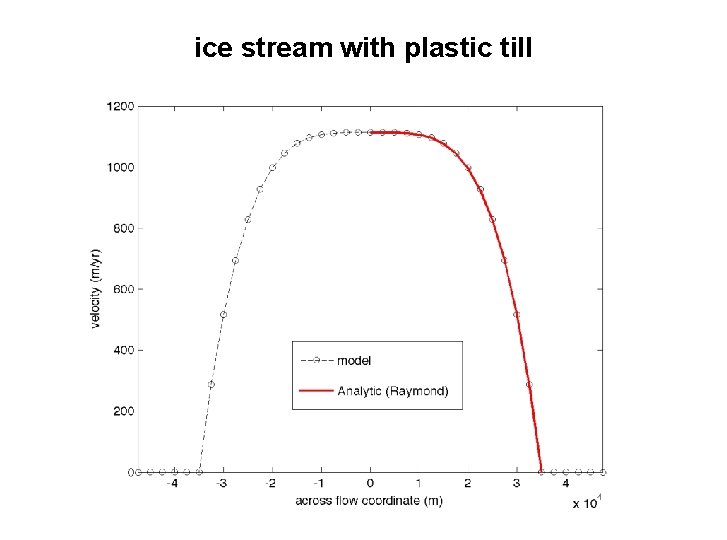
ice stream with plastic till
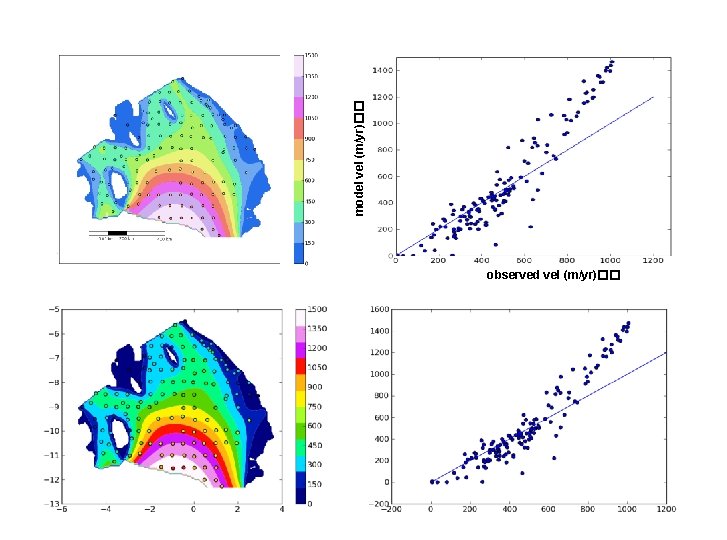
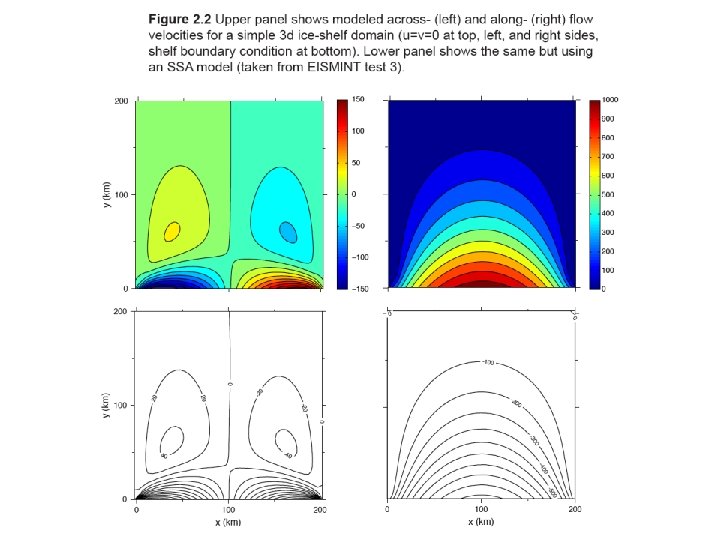
model vel (m/yr)�� observed vel (m/yr)��
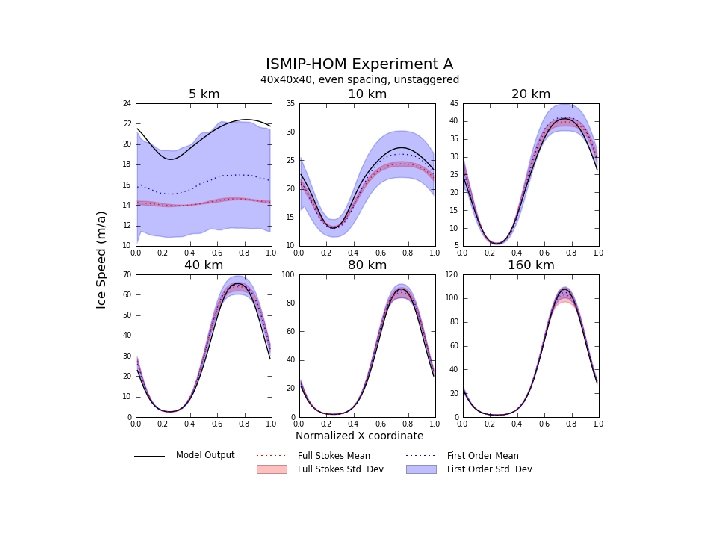
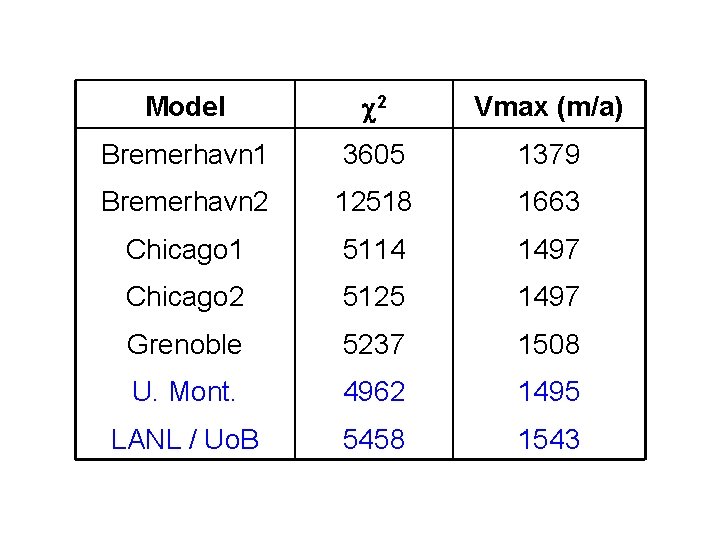
Model 2 Vmax (m/a) Bremerhavn 1 3605 1379 Bremerhavn 2 12518 1663 Chicago 1 5114 1497 Chicago 2 5125 1497 Grenoble 5237 1508 U. Mont. 4962 1495 LANL / Uo. B 5458 1543
Summary of Glimmer-CISM and development plans Model validation (higher-order dynamics) Tuning for initial conditions (Greenland) Summary field camp, central Greenland
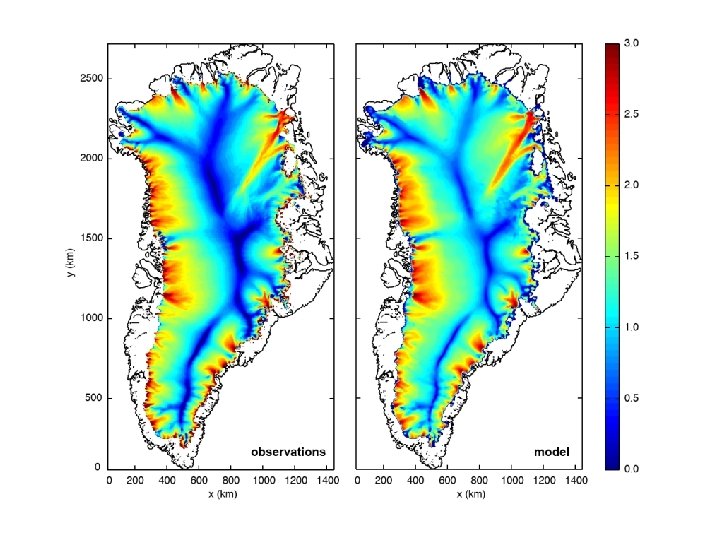
Tuning Procedure - Skipping the details, we have a simple procedure that allows us to “tune” basal sliding parameters to match a target velocity field - The resulting ice velocity, viscosity, and temperature fields are in a steady-state with modern day geometry, temperature, and geothermal flux fields (as well as those are known) - The result should be useful as an initial condition for a range of perturbation studies How do model and target 1 velocity fields compare? 1 Here, GIS balance velocities from Bamber et al. (J. Glac. , 46, 2000)
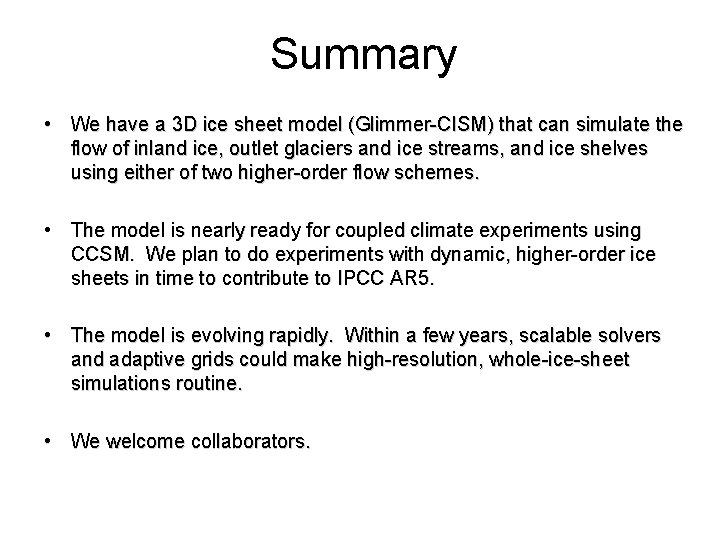
Summary • We have a 3 D ice sheet model (Glimmer-CISM) that can simulate the flow of inland ice, outlet glaciers and ice streams, and ice shelves using either of two higher-order flow schemes. • The model is nearly ready for coupled climate experiments using CCSM. We plan to do experiments with dynamic, higher-order ice sheets in time to contribute to IPCC AR 5. • The model is evolving rapidly. Within a few years, scalable solvers and adaptive grids could make high-resolution, whole-ice-sheet simulations routine. • We welcome collaborators.
EXTRA
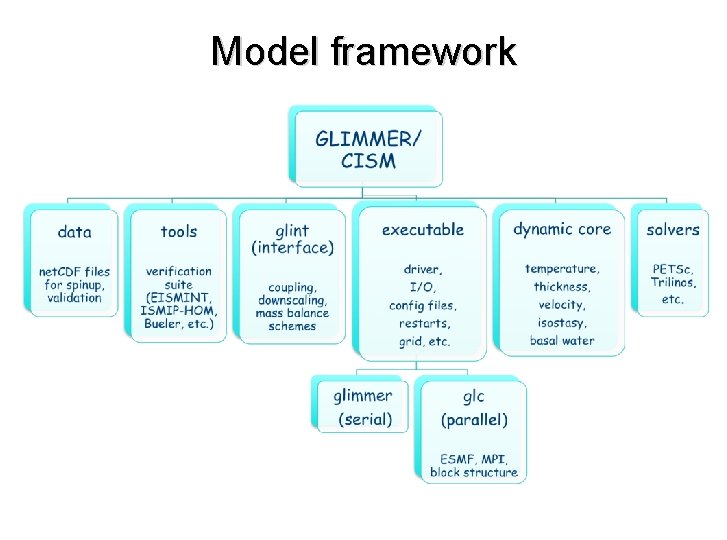
Model framework
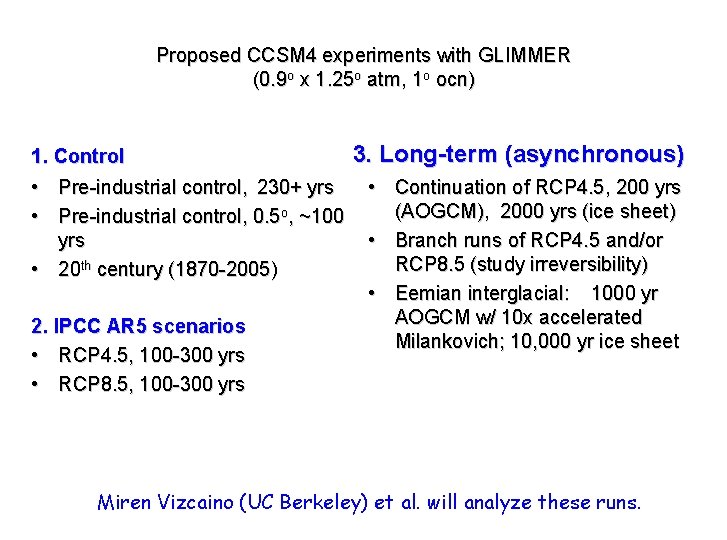
Proposed CCSM 4 experiments with GLIMMER (0. 9 o x 1. 25 o atm, 1 o ocn) 1. Control • Pre-industrial control, 230+ yrs • Pre-industrial control, 0. 5 o, ~100 yrs • 20 th century (1870 -2005) 2. IPCC AR 5 scenarios • RCP 4. 5, 100 -300 yrs • RCP 8. 5, 100 -300 yrs 3. Long-term (asynchronous) • Continuation of RCP 4. 5, 200 yrs (AOGCM), 2000 yrs (ice sheet) • Branch runs of RCP 4. 5 and/or RCP 8. 5 (study irreversibility) • Eemian interglacial: 1000 yr AOGCM w/ 10 x accelerated Milankovich; 10, 000 yr ice sheet Miren Vizcaino (UC Berkeley) et al. will analyze these runs.
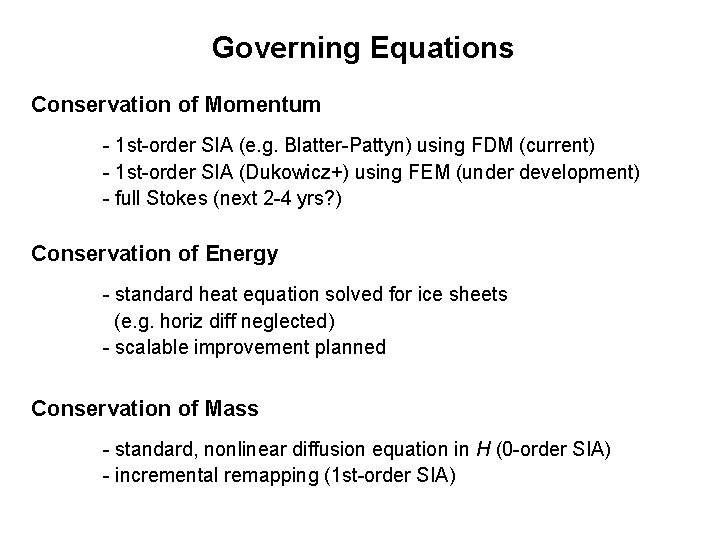
Governing Equations Conservation of Momentum - 1 st-order SIA (e. g. Blatter-Pattyn) using FDM (current) - 1 st-order SIA (Dukowicz+) using FEM (under development) - full Stokes (next 2 -4 yrs? ) Conservation of Energy - standard heat equation solved for ice sheets (e. g. horiz diff neglected) - scalable improvement planned Conservation of Mass - standard, nonlinear diffusion equation in H (0 -order SIA) - incremental remapping (1 st-order SIA)
Equations of Stress Equilibrium in Cartesian Coordinates (Stokes Flow) Assume static balance of forces by ignoring acceleration
… apply some scaling based on H/L …
First-Order SIA … integrate w. r. t. z to get explicit expression for P…
First Order SIA …integrate in vertical from upper sfc through depth …
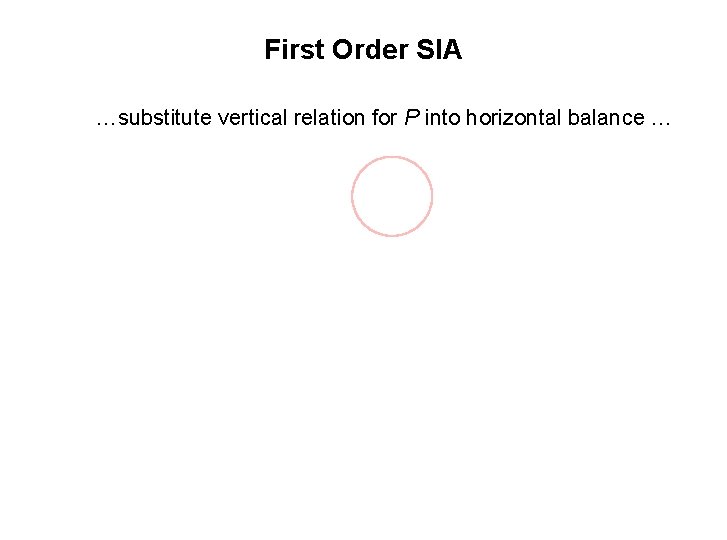
First Order SIA …substitute vertical relation for P into horizontal balance …
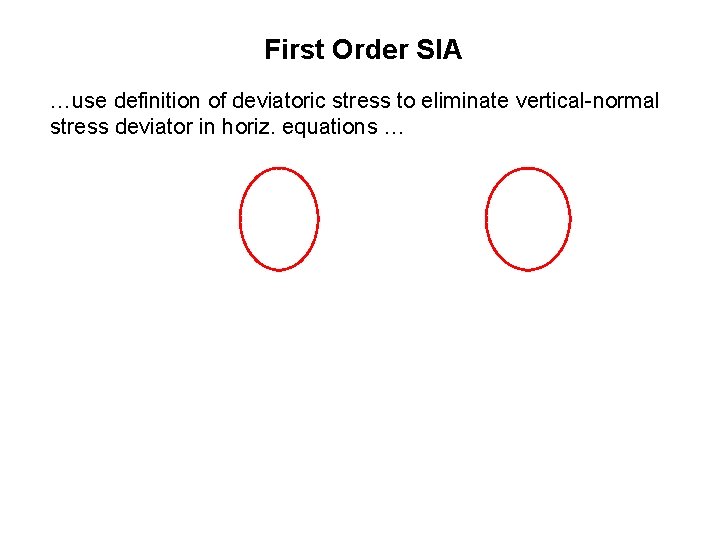
First Order SIA …use definition of deviatoric stress to eliminate vertical-normal stress deviator in horiz. equations …