
Current Research Regarding Timeout An Autism in Education
- Slides: 40
Current Research Regarding Time-out An Autism in Education (AIE) Partnership Information Paper
Why was it important to write this paper? �Time-out is a tricky subject. �Do we really want to dive into that discussion? �Shouldn’t we focus on positive, proactive support plans? . . . but sometimes behaviour happens.
Why does this matter? �Learning �learning can only happen in a safe and secure environment �Safety �keeping people safe (all students and staff) �Effectiveness �Strategies that are being called “time-out” are being used in schools and may or may not be doing what they are intended to do
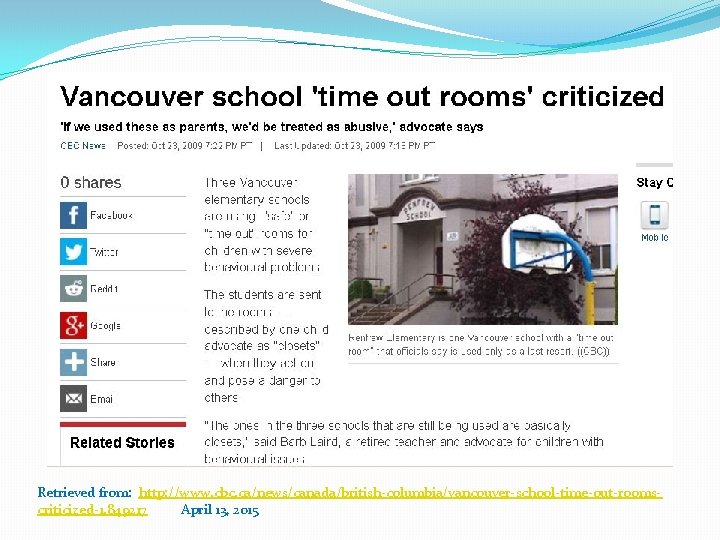
Retrieved from: http: //www. cbc. ca/news/canada/british-columbia/vancouver-school-time-out-roomscriticized-1. 849217 April 13, 2015
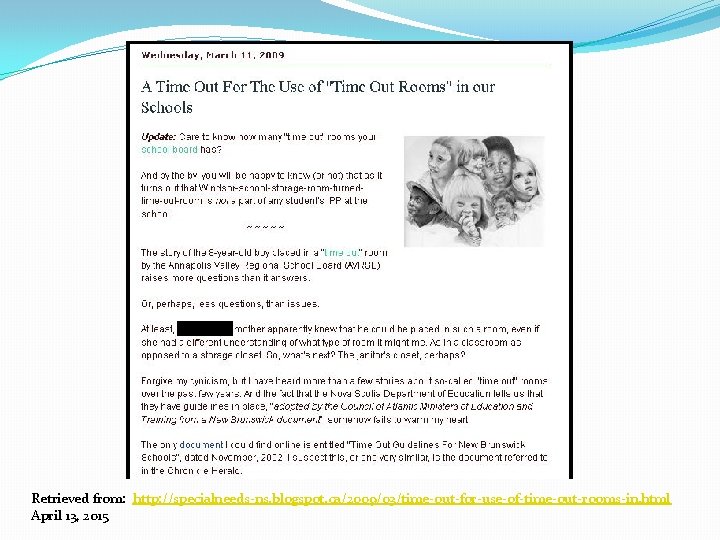
Retrieved from: http: //specialneeds-ns. blogspot. ca/2009/03/time-out-for-use-of-time-out-rooms-in. html April 13, 2015
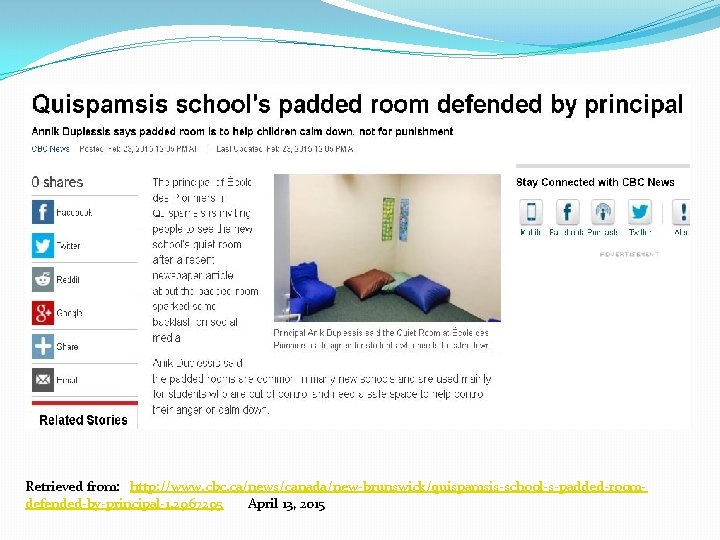
Retrieved from: http: //www. cbc. ca/news/canada/new-brunswick/quispamsis-school-s-padded-roomdefended-by-principal-1. 2967295 April 13, 2015
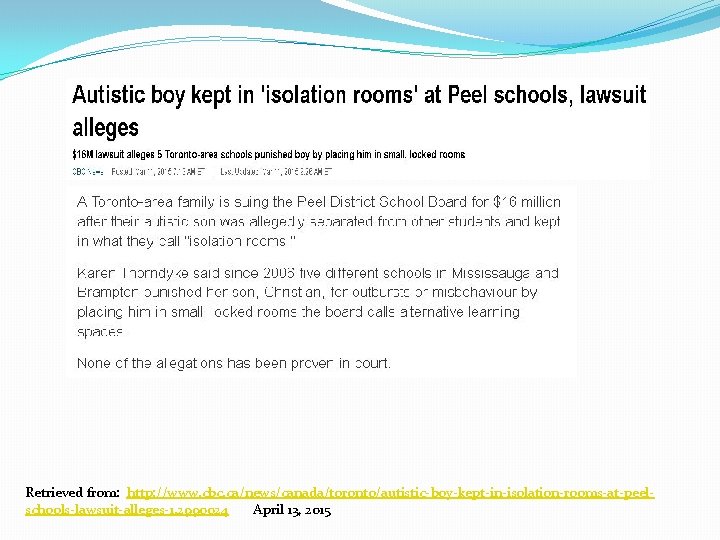
Retrieved from: http: //www. cbc. ca/news/canada/toronto/autistic-boy-kept-in-isolation-rooms-at-peelschools-lawsuit-alleges-1. 2990024 April 13, 2015
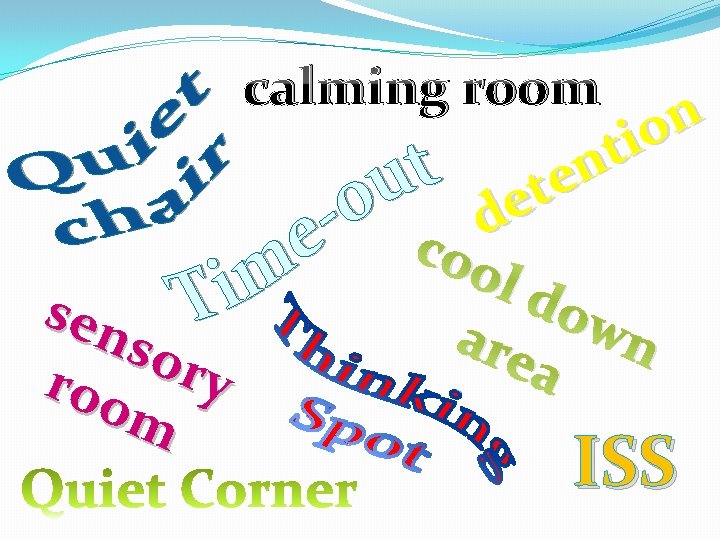
calming room n o i t n e t e d coo l do sen w a sor rea n roo y m ISS
Questions That Arise about Time-out �(When and why) are we using “time-out”? �What behaviours result in this consequence? �Where does the student go? �How is it determined when the student should go there? �What happens once the student gets there? �What really is the purpose of time-out? �Should time-out be used in schools?
What time-out really is. . .
What is Time-out? �Time-out from positive reinforcement �In behavioural terms, a punishment procedure �Does not necessarily require removal of the student �Continuum of strategies intended to reduce problem behaviour �Non-exclusion (inclusion) time-out �Exclusion time-out
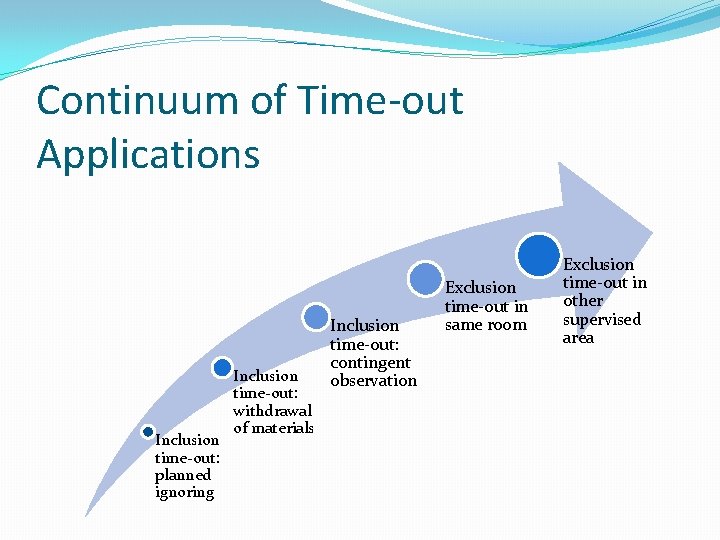
Continuum of Time-out Applications Inclusion time-out: planned ignoring Inclusion time-out: withdrawal of materials Inclusion time-out: contingent observation Exclusion time-out in same room Exclusion time-out in other supervised area
Non-exclusion Time-out The student remains in the learning environment, but access to reinforcement is not available �Planned ignoring �Withdrawal of materials �Contingent observation
Exclusion Time-out The student is removed from the reinforcing activity and is not permitted to participate in or watch the activity �May be in the same room, but where unable to see activity/classmates (physical space and set-up are considerations) �May be in another supervised location within the school
Time-out? Just as important as understanding what time-out IS, is understanding what time -out IS NOT
Time-out? �Student working independently in a distraction-free environment? �Danny �Individual one-to-one instruction or practice? �Marco �Student requests to go to a separate area for a break? �Paula
Time-out? �Having a student sit on a chair in the classroom away from classmates? �Jack �Sending a student to sit or stand in the hallway? �Lise �Sending a student to the principal’s office? �Elizabeth �Sending a student to a separate room? �Bradley
What does the research tell us about time-out?
Examining the research �Time-out procedures, if used correctly, can be effective in reducing a variety of problem behaviors, particularly with younger students �Less intrusive time-out strategies may be as effective, or more effective, than more intrusive strategies for reducing some behaviours �The function of the behaviour matters
(Where) does timeout fit in an intervention plan?
Considerations �School-wide positive behaviour supports �Some types of less restrictive, inclusionary time-out strategies are used on a regular basis in schools �Provincial policies, guidelines, documents and terminology
Top Tips �Don’t interact with the student in time-out �Don’t talk about the student in front of him/her �Don’t have a conversation on any topic, with anybody, while you are supervising the student
Top Tips �When it’s over, it’s over �Reinforce desirable behaviours as soon as possible �set up the opportunity for desirable behaviour to happen �enrich the time-in environment �Research doesn’t support a lengthy time-out � 1 -4 minutes often effective �Less lost teaching time and more time to reinforce desired behaviours
If a time-out procedure is being considered, research indicates that there a number of key factors to consider.
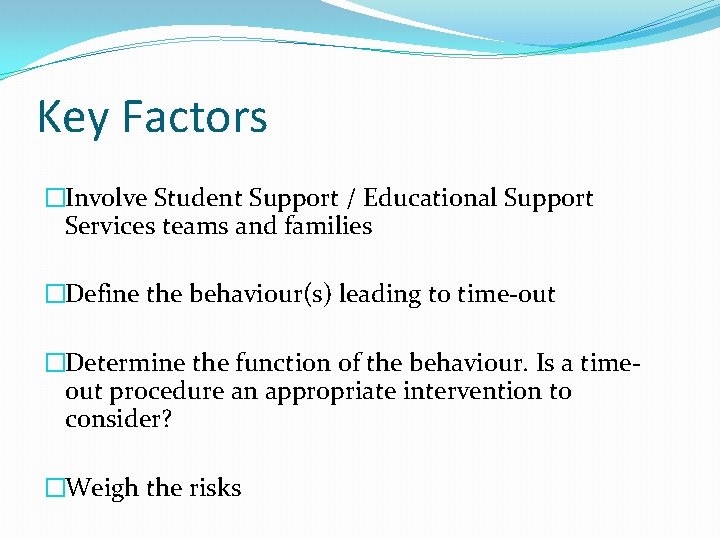
Key Factors �Involve Student Support / Educational Support Services teams and families �Define the behaviour(s) leading to time-out �Determine the function of the behaviour. Is a timeout procedure an appropriate intervention to consider? �Weigh the risks
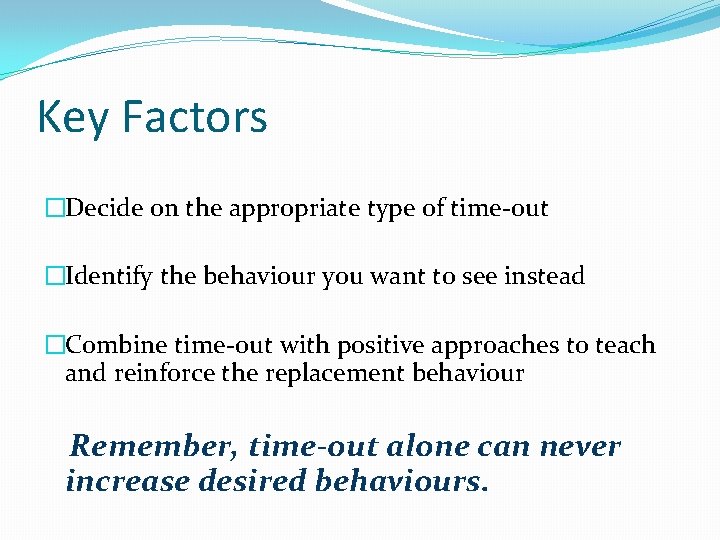
Key Factors �Decide on the appropriate type of time-out �Identify the behaviour you want to see instead �Combine time-out with positive approaches to teach and reinforce the replacement behaviour Remember, time-out alone can never increase desired behaviours.
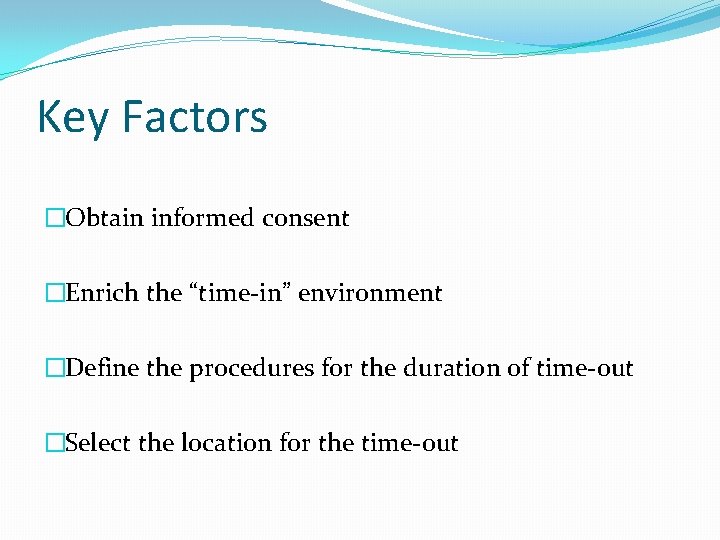
Key Factors �Obtain informed consent �Enrich the “time-in” environment �Define the procedures for the duration of time-out �Select the location for the time-out
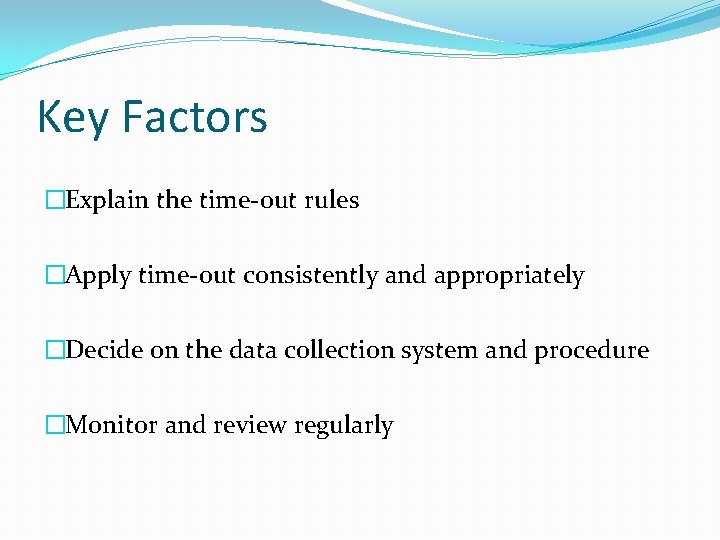
Key Factors �Explain the time-out rules �Apply time-out consistently and appropriately �Decide on the data collection system and procedure �Monitor and review regularly
Seclusion and Physical Restraint
What is Seclusion? �“Time-out” and “seclusion” are not the same thing �Definition of seclusion
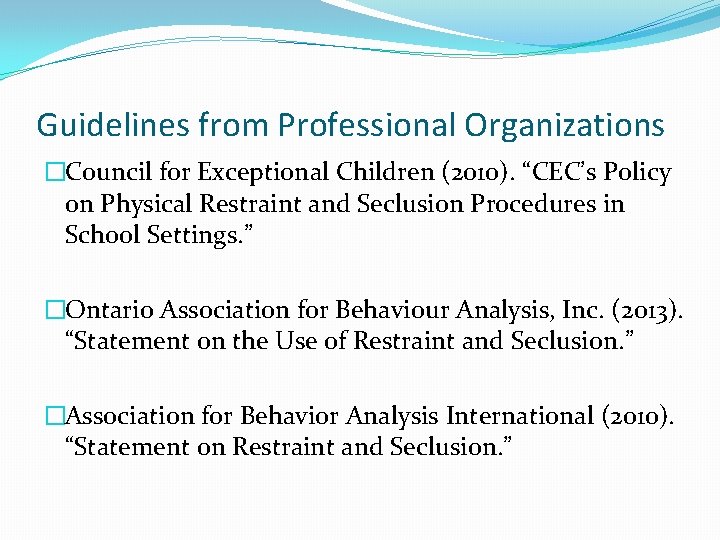
Guidelines from Professional Organizations �Council for Exceptional Children (2010). “CEC’s Policy on Physical Restraint and Seclusion Procedures in School Settings. ” �Ontario Association for Behaviour Analysis, Inc. (2013). “Statement on the Use of Restraint and Seclusion. ” �Association for Behavior Analysis International (2010). “Statement on Restraint and Seclusion. ”
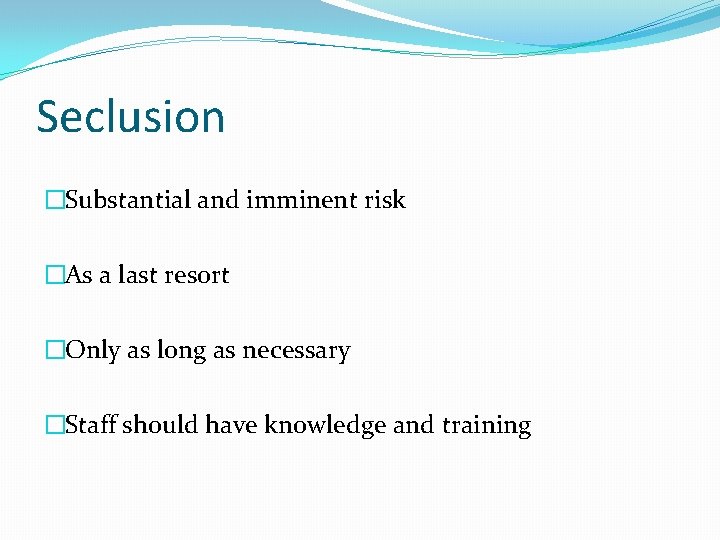
Seclusion �Substantial and imminent risk �As a last resort �Only as long as necessary �Staff should have knowledge and training
Seclusion (cont’d) The literature recommends that emergency seclusion procedures should not be used when. . . �The substantial safety risk no longer exists �Any known medical, physical, or psychological condition would make the procedures dangerous for that student �The student is engaging in self-injury (without adequate protection)
Seclusion (cont’d) Experts tend to recommend that emergency seclusion procedures should be limited to situations in which. . . �an individual is engaging in behaviour that presents a substantial and imminent risk to himself/herself or others �a behavioural outburst happens unexpectedly and safety must be maintained in that moment In rare situations where frequent violent behaviour is anticipated, additional planning and supports are required.
Take-away Messages
Keep in Mind. . . �Time-out involves a continuum of strategies �When used effectively, time-out reduces or stops a behaviour by removing access to a reinforcing item, event, situation, person �Provincial and school board/district policies and guidelines
Keep in Mind. . . �Time-out is, by definition, a behaviour-reduction strategy; as such, it can only be used to reduce undesirable behaviours �Time-out alone can never teach new, alternative, desirable behaviours �Consent, documentation, and ongoing monitoring
For More Information �Autism in Education Information Paper �apsea. ca/aie �Provincial policies and guidelines �Provincial Directors of Student Services/Education Services and Provincial ASD Consultants/Learning Specialists
“Current Research Regarding Time-out” / « Recherches actuelles concernant le temps de retrait» information paper may be found in English and French on the Autism in Education website at: apsea. ca/aie Questions?
Terms of Use �This Power. Point presentation, along with the Autism in Education information papers, may be distributed and used for educational purposes and/or staff training. No changes to the content of this presentation should be made without written permission from APSEA’s Autism in Education Advisory Committee.