
Current Practices and Lessons Learned from Health Benefits
Current Practices and Lessons Learned from Health Benefits Plans in Peru Andre Medici (LCSHH – The World Bank) Roundtable Discussion on Universal Health Coverage in Latin America and the Caribbean: Health Benefits Plans – Washington (DC), December 6, 2013 THE WORLD BANK
Summary 1. Health Insurance Enrollment in Peru 2. Reviewing Benefits Plans in Peru 3. How Sustainable are the Benefits Plans in Peru? 4. Issues on the Current Design of the Benefits Plans 5. Recommendations
1. Health Insurance Enrollment in Peru
Health System Structure in Peru • Fragmented Pluralism based on Health Insurance • Two Major Insurances: ESSALUD (Covering formal labor market and families) and SIS (Covering informal labor market, poor and indigents) • Universal Health Coverage was mandated in 2009 with the AUS Law.
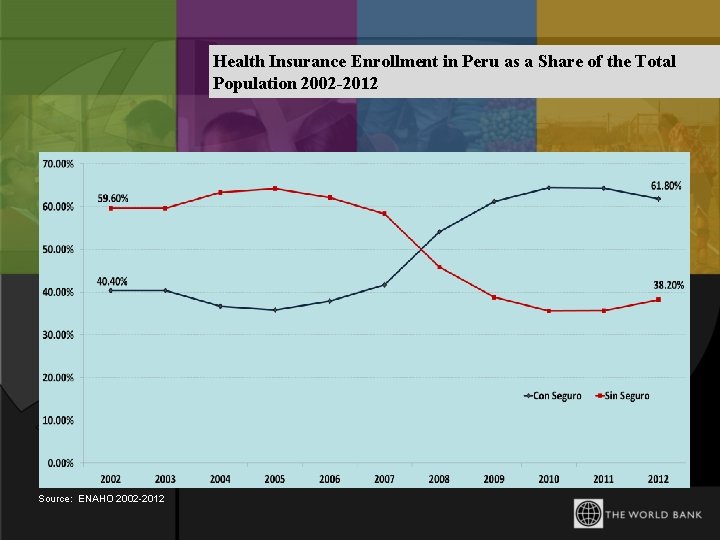
Health Insurance Enrollment in Peru as a Share of the Total Population 2002 -2012 Source: ENAHO 2002 -2012
Evolution of Health Insurance Enrollment by Poverty Level: 2002 -2012 Source: ENAHO 2002 -2012
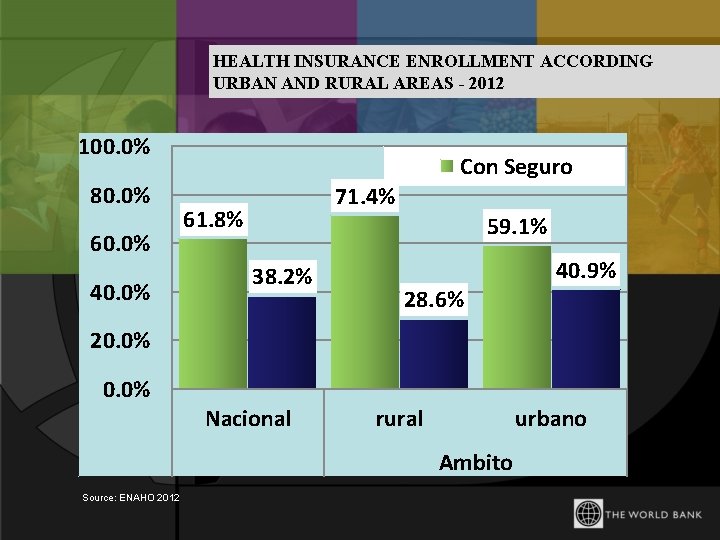
HEALTH INSURANCE ENROLLMENT ACCORDING URBAN AND RURAL AREAS - 2012 100. 0% 80. 0% 60. 0% 40. 0% Con Seguro 71. 4% 61. 8% 59. 1% 38. 2% 40. 9% 28. 6% 20. 0% Nacional rural urbano Ambito Source: ENAHO 2012
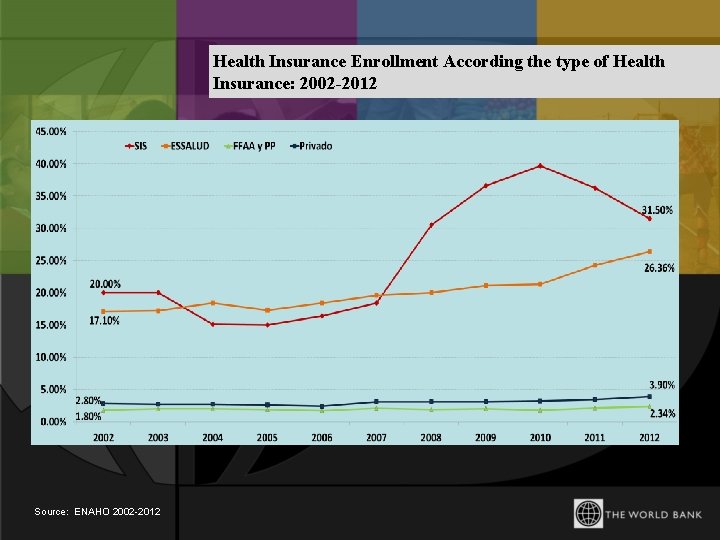
Health Insurance Enrollment According the type of Health Insurance: 2002 -2012 Source: ENAHO 2002 -2012
Regional Inequities in Health Insurance Enrollment - 2012 s. OURCE: ENAHO 2011
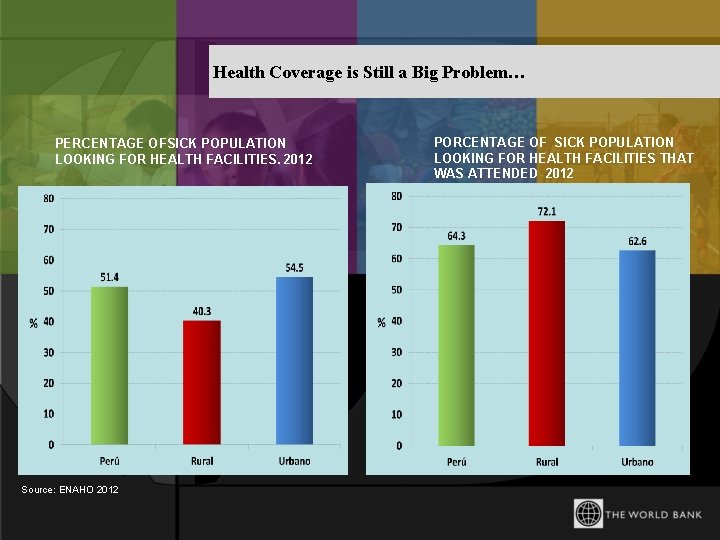
Health Coverage is Still a Big Problem… PERCENTAGE OFSICK POPULATION LOOKING FOR HEALTH FACILITIES. 2012 Source: ENAHO 2012 PORCENTAGE OF SICK POPULATION LOOKING FOR HEALTH FACILITIES THAT WAS ATTENDED 2012
Despite progresses, important events (like births) are not enough covered by health institutions in rural areas… Porcentage of Institutional Births Attended. ENDES 2000 -2012 Source: ENDES 2000 – 2012. INEI
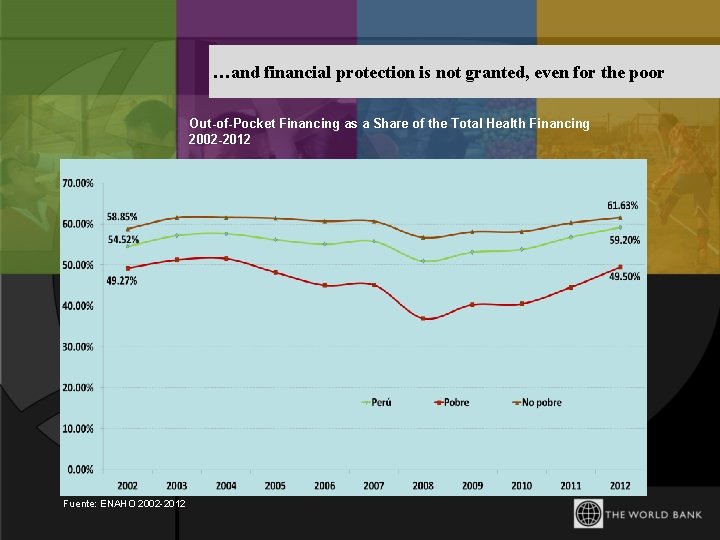
…and financial protection is not granted, even for the poor Out-of-Pocket Financing as a Share of the Total Health Financing 2002 -2012 Fuente: ENAHO 2002 -2012
2. Reviewing Benefits Packages in Peru
Main Health Benefits Plan in Peru SIS ESSALUD FISSAL
SIS BENEFIT PLAN • • 2002 – Decree DS 003 -2002 – Plans A, B and C (subsidiary, semi-contributive, contributive) – Exclusions (complication of infectious diseases, cancers, paralysis, strokes, heart attacks, violence, sequels; 2006 – Decree DS 006 -2006 – Differentiated exclusions according the type of plan; 2007 – Decree DS 004 -2007 – Prioritized List of Health Interventions (LPIS) – Subsidized and Semi-subsidized Plan – Exclusions (transplants, violence, sequels, paralysis); 2008 – RM No. 277 MINSA – Expansion of LPIS and reduction of exclusions 2009 – Decree DS 016 -2009 – Health Insurance Essential Plan (PEAS) – Linked with the Universal Health Coverage (AUS), based on 1, 169 diagnosis or health conditions, considered a minimum plan and could be combined with complementary health plans. 2010 – RJ 133 – 2010/SIS - PEAS Complementary Plans 2011 – RJ 093 – 2011/SIS – PEAS Extraordinary Coverage
ESSALUD BENEFIT PLAN • Different systems in ESSALUD: regular system and independent workers system • Regular System – To all formal workers and their families, including domestic workers and others – It is a open benefit plan including all health conditions related to promotion, prevention, health education, health risk controls, immunization, health care (ambulatory, hospital, rehabilitation), drugs and medicines, health products, exams and diagnostics. • Independent Workers System – Include all diagnosis existing in the SIS-PEAS plus 230 additional diagnosis.
FISSAL BENEFIT PLAN • FISSAL - Intangible Solidarity Fund for Health – Created in 2012 to finance patients with highly complex diseases such as cancer, kidney failure, birth defects, heart disease, hemophilia and other ailments, which would therefore require a high cost of treatment. • The treatments included intensive chemotherapy, surgery, transplants, valve changes, to be held in patients served in various health facilities. • Main Conditions are: cancer (colon, uterus, breast, stomach, prostate, leukemia, lymphatic), kidney chronic diseases, rare and orphan’s diseases. • FISSAL is the Fund that finance the Plan Esperanza, who was launched in 2012 as the Peruvian Strategy to treat cancer. However, FISSAL does not finance cancer prevention
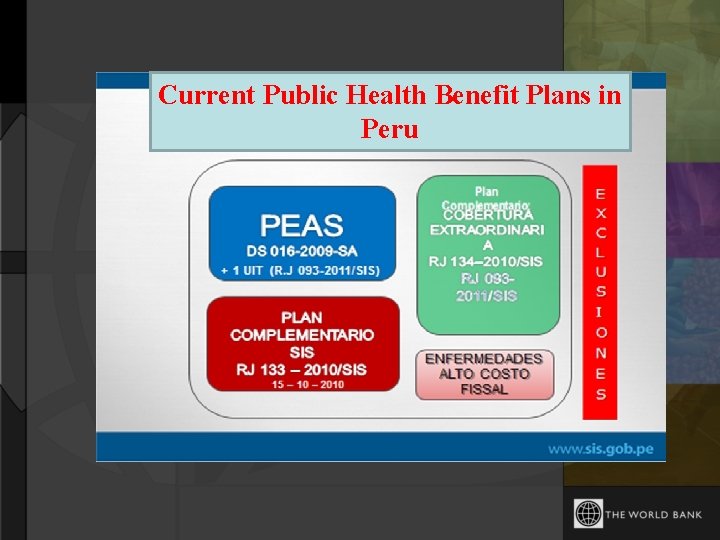
Current Public Health Benefit Plans in Peru
3. How Sustainable are Benefits Plans in Peru?
Difficult to know because: • Additionally to the PEAS, SIS offers broadened packages –complementary plan and catastrophic plan (covered by FISSAL)– that were not based on complete, explicit or well-defined criteria; • On ESSALUD side it is also important to define a sustainable benefit package and calculate its actuarial cost. • Once the benefits package is defined for both institutions, it is necessary to make an actuarial study of the costs of covering this plan considering not only the variable costs, but also the fixed costs. • On the supply side, even if it is possible to finance the benefits package there is several constraints to attend the demand due supply side constraints.
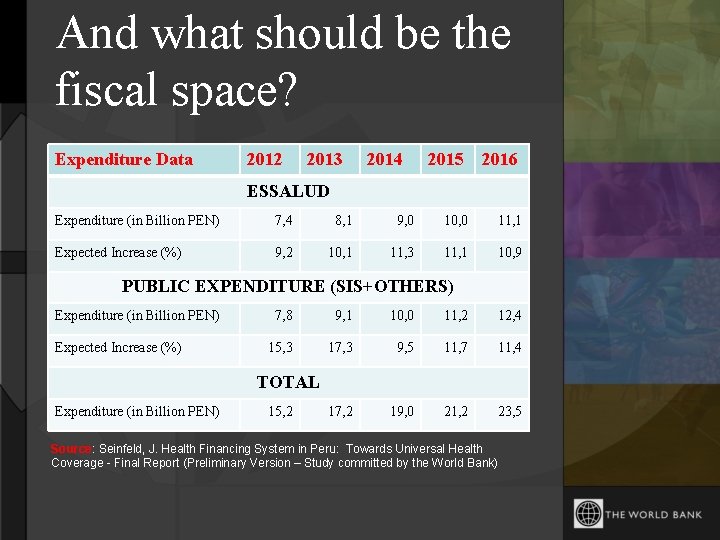
And what should be the fiscal space? Expenditure Data 2012 2013 2014 2015 2016 ESSALUD Expenditure (in Billion PEN) 7, 4 8, 1 9, 0 10, 0 11, 1 Expected Increase (%) 9, 2 10, 1 11, 3 11, 1 10, 9 PUBLIC EXPENDITURE (SIS+OTHERS) Expenditure (in Billion PEN) Expected Increase (%) 7, 8 9, 1 10, 0 11, 2 12, 4 15, 3 17, 3 9, 5 11, 7 11, 4 17, 2 19, 0 21, 2 23, 5 TOTAL Expenditure (in Billion PEN) 15, 2 Source: Seinfeld, J. Health Financing System in Peru: Towards Universal Health Coverage - Final Report (Preliminary Version – Study committed by the World Bank)
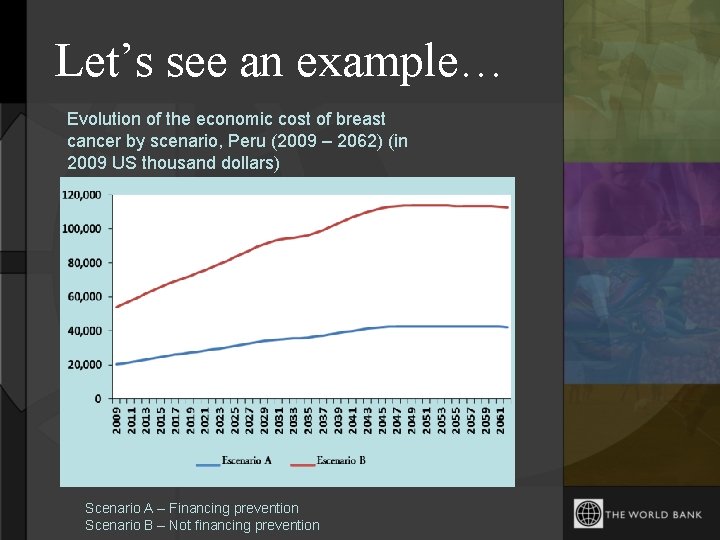
Let’s see an example… Evolution of the economic cost of breast cancer by scenario, Peru (2009 – 2062) (in 2009 US thousand dollars) Scenario A – Financing prevention Scenario B – Not financing prevention
4. Issues on the Current Design of the Benefits Plans
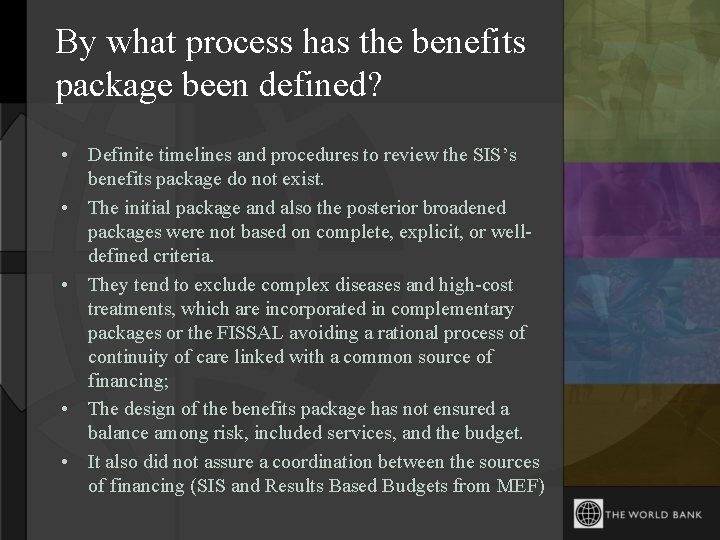
By what process has the benefits package been defined? • Definite timelines and procedures to review the SIS’s benefits package do not exist. • The initial package and also the posterior broadened packages were not based on complete, explicit, or welldefined criteria. • They tend to exclude complex diseases and high-cost treatments, which are incorporated in complementary packages or the FISSAL avoiding a rational process of continuity of care linked with a common source of financing; • The design of the benefits package has not ensured a balance among risk, included services, and the budget. • It also did not assure a coordination between the sources of financing (SIS and Results Based Budgets from MEF)
What is the relationship between the benefits plan, the needs of the beneficiaries and the budget? • There is no relationship among the number of SIS affiliates, the cost of the benefits package, and the provided funds; • The SIS budget is historically based, and the initial budget was determined without calculating the cost of the benefits package; • Congress has never amended the budget or examined whether the budget allocated by the MEF is sufficient to cover the costs of the SIS’s benefits package; • Any proposal to expand the budget to cover the costs of the SIS’s benefits package would require MEF approval;
How, then, is the equilibrium between SIS’s budget and services provided restored? • To contain costs, some health services are excluded and reimbursement rates are defined explicitly for public health establishments; • Nevertheless, there are no beneficiary caps or payment mechanisms that promote efficiency or effectiveness; • Fee-for-service, conversely, which actually incentivizes spending, exists at hospitals. The existence of a maximum budget results in implicit (not explicit) budget caps, and regional administrators must implement cost-control measures, such as ceasing to provide certain services, medicines, tests, and procedures. • Such measures often result in the practice of informal payments and copayments.
What is the solution that the government is looking for with the new health reform? • With the support of international agencies, the PEAS will use costing as a basis; • The SIS already contract a consultant firm to prepare an actuarial study based on the costing of the PEAS. • Calculations included epidemiological estimates of high-risk conditions based on a previous study of the disease burden, the standard care for packages associated with these conditions, and the cost of direct inputs plus an approximation of indirect costs. • Currently the government is expanding the financing for the PEAS but the effects of an increased budget for the PEAS must also take into account supply constraints. In poor and rural areas, there is a deficit of health services to effectively cover the broader PEAS package, which includes inpatient hospital services.
4. Recommendations
Management of the SIS Benefits Package • • • Integrating the several SIS packages and the FISSAL to organize the package in a continuum of care manner; Adjusting the package to reflect epidemiological transition, and should therefore include primary and secondary prevention of noncommunicable diseases in an integrated way; The package must account for regional differences in epidemiological profiles, supply of skills, demand for services, and cost. Increasing coordination through a special committee composed of representatives from the MOH, SIS, and the MEF. Implementing a multiyear budget process to effectively cover the benefits offered, and guarantee that no other risks or benefits will be added without a corresponding budget; Reviewing periodically of the benefits should be mandated, and the review should include established calculation procedures at approximate the cost-effectiveness of the package and an evaluation of the effect of incentives on efficiency.
Thanks amedici@worldbank. org (202) 458 -0314
- Slides: 30