
Current Issues in Mathematics Education Courses Assessment for

- Slides: 12
Current Issues in Mathematics Education Courses Assessment for Pre-service Teachers N. Leveille August 4, 2005 MAA Math. Fest 2005 1
Assessment for Pre-service Teachers The Principles and Standards for School Mathematics encourages K-12 teachers to use “many assessment techniques … including open-ended questions, constructed response tasks, performance tasks, observations, conversations, journals, and portfolios (NCTM, 2000, p. 23). MAA Math. Fest 2005 2
Assessment for Pre-service Teachers Pre-service teachers need the experience of their own mathematics knowledge being graded by different methods to prepare them for using a variety of assessment techniques in their own future teaching. MAA Math. Fest 2005 3
Charles, R. , Lester, F. , & O’Daffer. (1987). How to evaluate progress in problem solving. Reston, VA: The Council. A. Observing and Questioning pp. 16 -20 1. How did you…? 2. Why did you…? 3. What do you think…? B. Student Report pp. 24 -26 1. Describe how you solved the problem. 2. Tell about your thinking as you solved the problem. MAA Math. Fest 2005 4
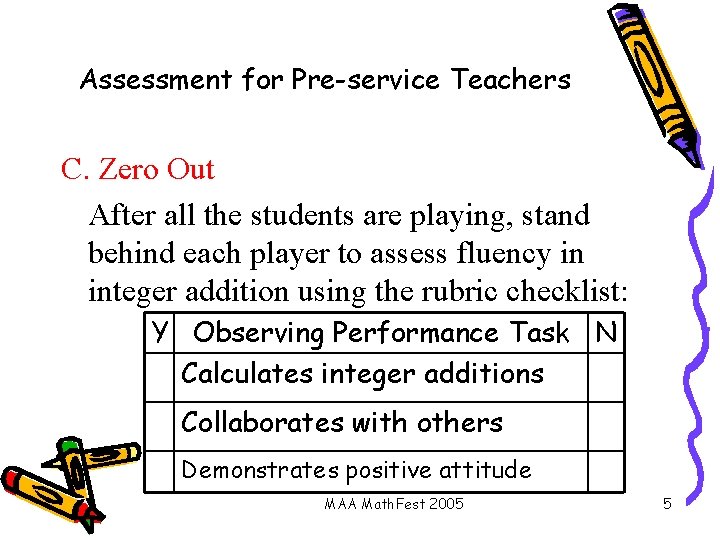
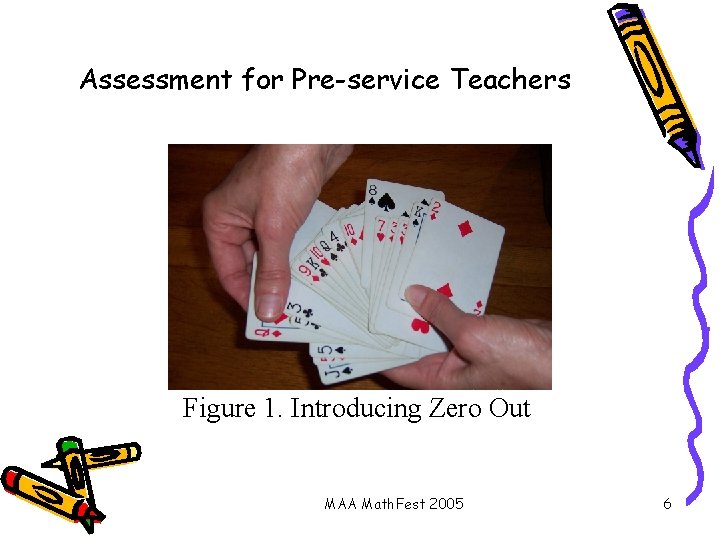
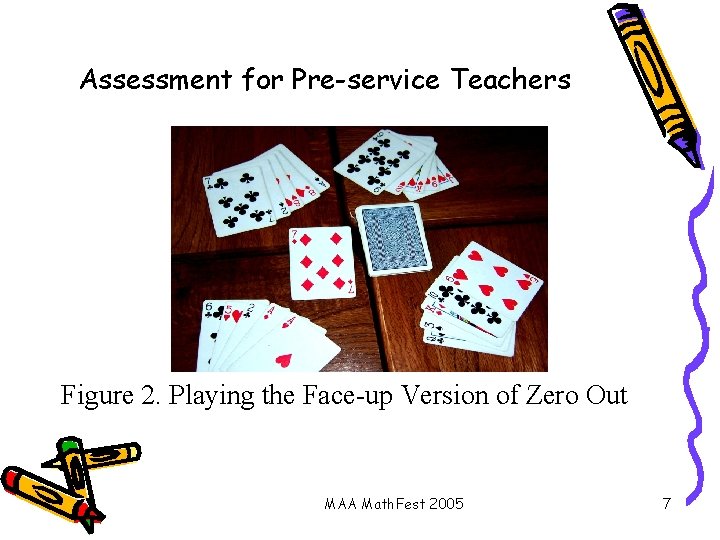
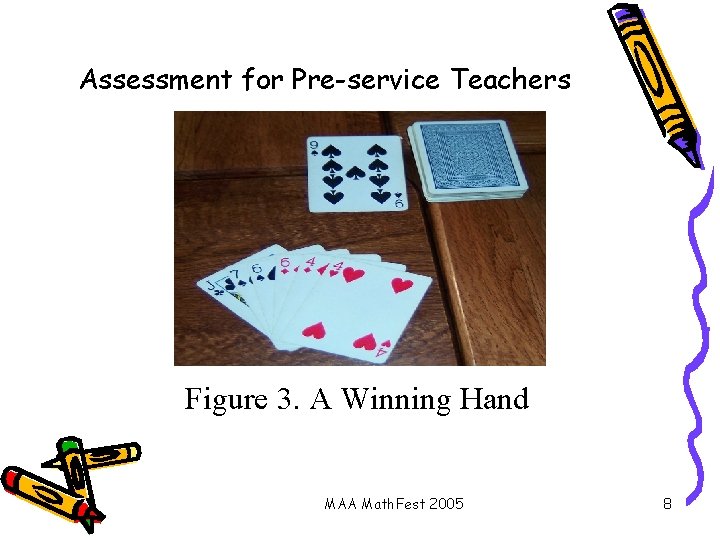
Assessment for Pre-service Teachers C. Zero Out After all the students are playing, stand behind each player to assess fluency in integer addition using the rubric checklist: Y Observing Performance Task N Calculates integer additions Collaborates with others Demonstrates positive attitude MAA Math. Fest 2005 5
Assessment for Pre-service Teachers Figure 1. Introducing Zero Out MAA Math. Fest 2005 6
Assessment for Pre-service Teachers Figure 2. Playing the Face-up Version of Zero Out MAA Math. Fest 2005 7
Assessment for Pre-service Teachers Figure 3. A Winning Hand MAA Math. Fest 2005 8
Foyle, H. (Ed. ). (1995). Interactive learning in the higher education classroom: Cooperative, collaborative, and active learning strategies. Washington, DC: National Education Assn. D. Think, Pair, Share pp. 226 -233 1. Assign partners and pose a question. 2. Allow a short period of time for individual reflection. 3. Partners discuss answers. 4. Instructor facilitates class discussion. MAA Math. Fest 2005 9
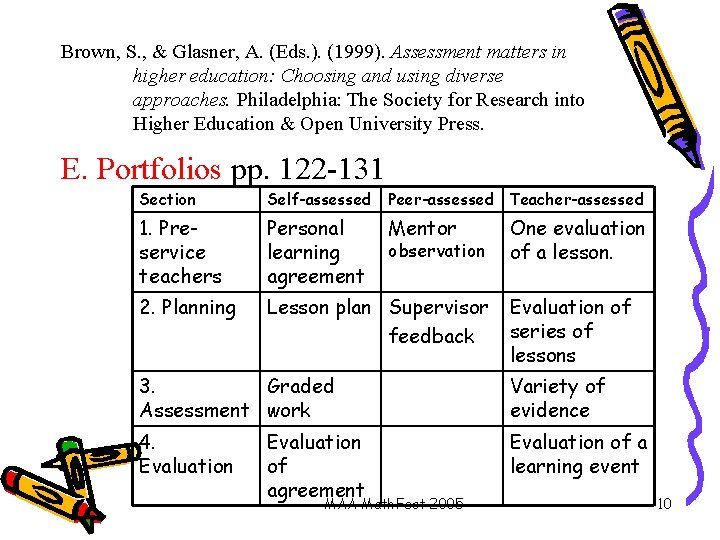
Brown, S. , & Glasner, A. (Eds. ). (1999). Assessment matters in higher education: Choosing and using diverse approaches. Philadelphia: The Society for Research into Higher Education & Open University Press. E. Portfolios pp. 122 -131 Section Self-assessed Peer-assessed Teacher-assessed 1. Preservice teachers Personal learning agreement Mentor 2. Planning Lesson plan Supervisor feedback observation One evaluation of a lesson. Evaluation of series of lessons 3. Graded Assessment work Variety of evidence 4. Evaluation of a learning event Evaluation of agreement MAA Math. Fest 2005 10
Assessment for Pre-service Teachers Additional References Astin, A. (2002). Assessment for excellence: The philosophy and practice of assessment and evaluation in higher education. Westport, CT: American Council on Education. Banta, T. , Lund, J. , Black, K. , & Oblander. (1996). Assessment in practice: Putting principles to work on college campuses. San Francisco: Jossey-Bass. Measuring-up: Prototypes for mathematics assessment. (1993). Washington, DC: Mathematical Sciences Education Board. Pumala, V. , & Klabunde, D. (2005). Learning measurement through practice. Mathematics Teaching in the Middle-School, 10(9), 452 -460. Ross-Fisher, R. (2005). Developing effective success rubrics. Kappa Delta Pi Record, 41(3), 131 -135. Schulman, J. , Lotan, R. , & Whitcomb, J. (Eds. ). (1998). Groupwork in diverse classrooms: A guidebook for educators. New York: Teachers College Press. MAA Math. Fest 2005 11
Assessment for Pre-service Teachers MAA Math. Fest 2005 12