
CURRENT HUMAN POPULATION GROWTH AND IMPLICATIONS HUMAN POPULATION
- Slides: 24
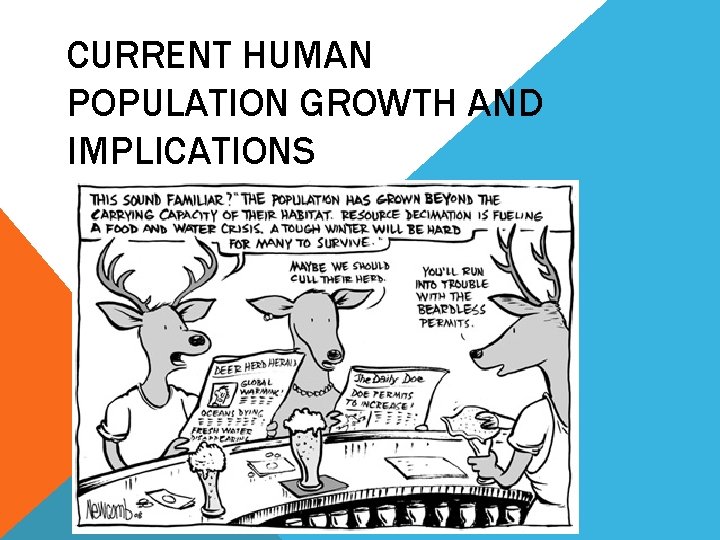
CURRENT HUMAN POPULATION GROWTH AND IMPLICATIONS
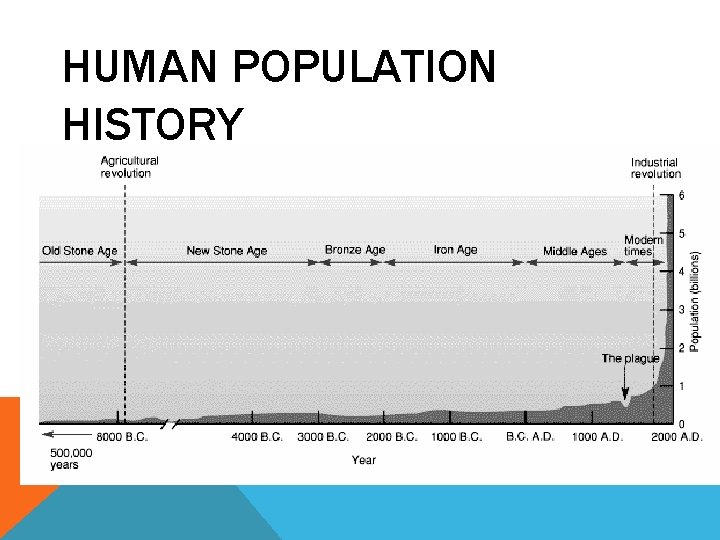
HUMAN POPULATION HISTORY
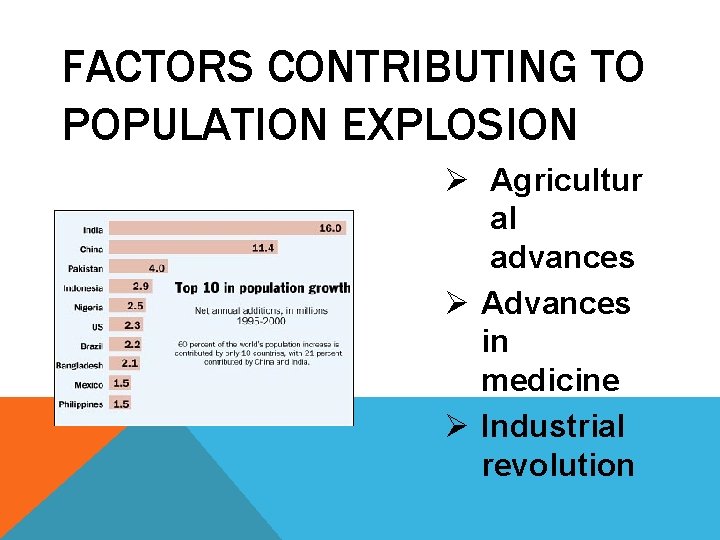
FACTORS CONTRIBUTING TO POPULATION EXPLOSION Ø Agricultur al advances Ø Advances in medicine Ø Industrial revolution
REASONS FOR EXPONENTIAL GROWTH OF HUMAN POPULATION • Increased food supply • Improvements in medical and public health and technology • Improvements in sanitation and personal hygiene • Safer water supplies
THOMAS MALTHUS • Studied the decline of living conditions in 19 th century England • Blamed this decline on: § Too many children § Inability of resources to replenish at levels with increased population § Irresponsibility of lower class • Proposed regulating family size of lower class to limit it to a level they could support
MALTHUS CONTINUED • He said “positive checks” like food shortages and disease kept population at appropriate levels • He said population growth was exponential but food production could not keep growing exponentially. • As of today, he was wrong due to GM foods.
CURRENT STATS World Population: 7 billion people U. S. Population: 314 million people Kentucky Population: 4. 3 million people Louisville Population: 250, 000 people The U. S. is only 5% of the world’s population, but we use ~ 1/3 of the Earth’s natural resources!!!
CRUDE BIRTH RATE AND CDR CBR= the number of live births per 1000 members of the population in one year. CDR= the number of deaths per 1000 members of the population in one year. v When calculating population change you must take into account total population size when using CDR and CBR.
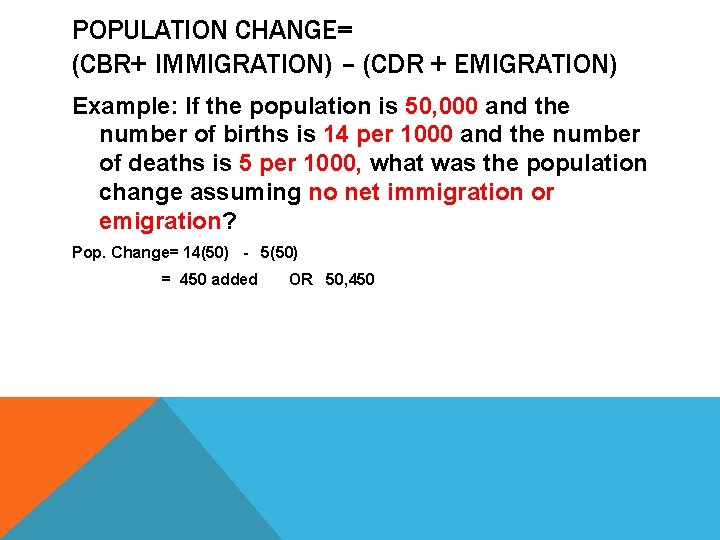
POPULATION CHANGE= (CBR+ IMMIGRATION) – (CDR + EMIGRATION) Example: If the population is 50, 000 and the number of births is 14 per 1000 and the number of deaths is 5 per 1000, what was the population change assuming no net immigration or emigration? Pop. Change= 14(50) - 5(50) = 450 added OR 50, 450
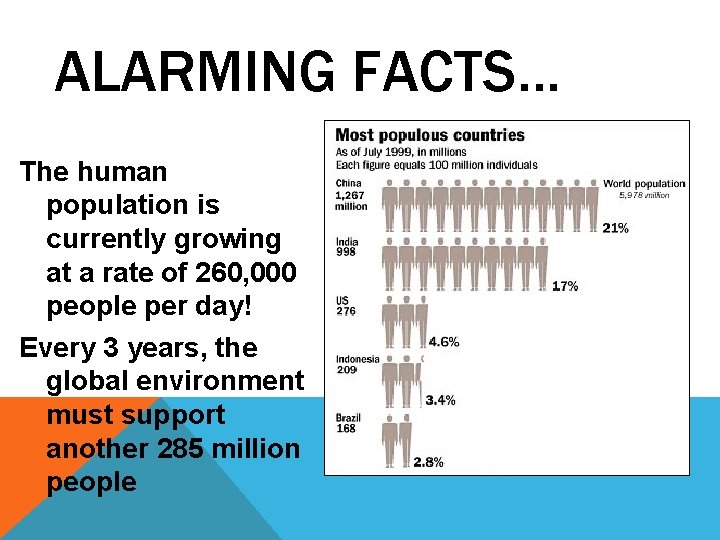
ALARMING FACTS… The human population is currently growing at a rate of 260, 000 people per day! Every 3 years, the global environment must support another 285 million people
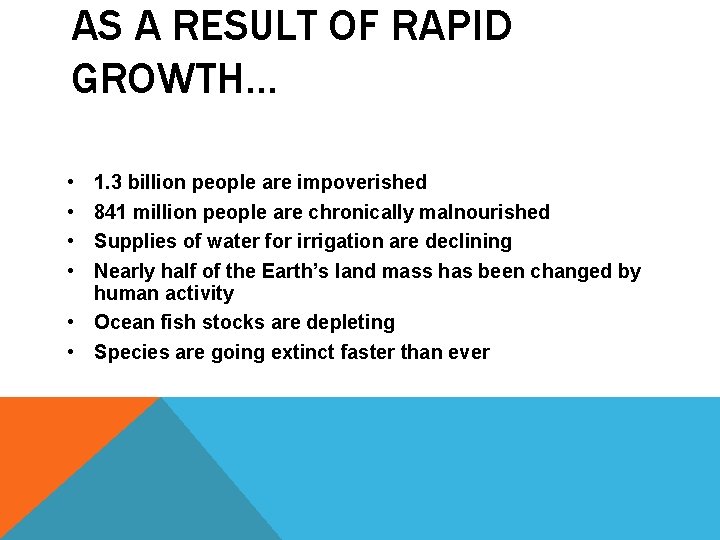
AS A RESULT OF RAPID GROWTH… • • 1. 3 billion people are impoverished 841 million people are chronically malnourished Supplies of water for irrigation are declining Nearly half of the Earth’s land mass has been changed by human activity • Ocean fish stocks are depleting • Species are going extinct faster than ever
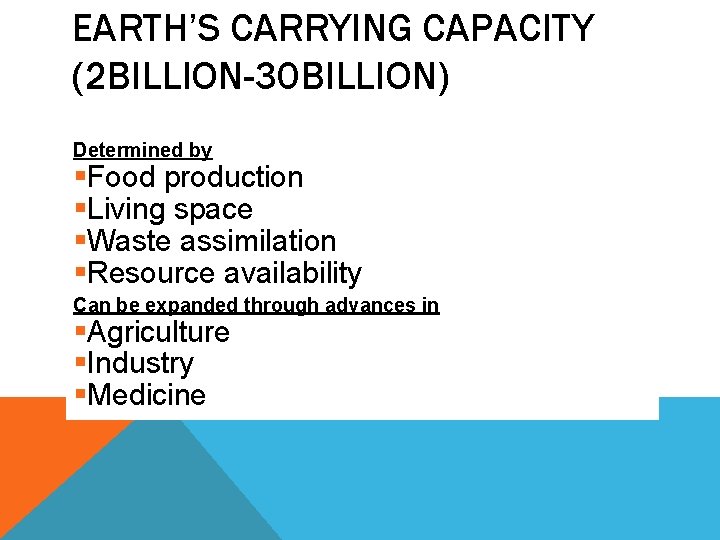
EARTH’S CARRYING CAPACITY (2 BILLION-30 BILLION) Determined by §Food production §Living space §Waste assimilation §Resource availability Can be expanded through advances in §Agriculture §Industry §Medicine
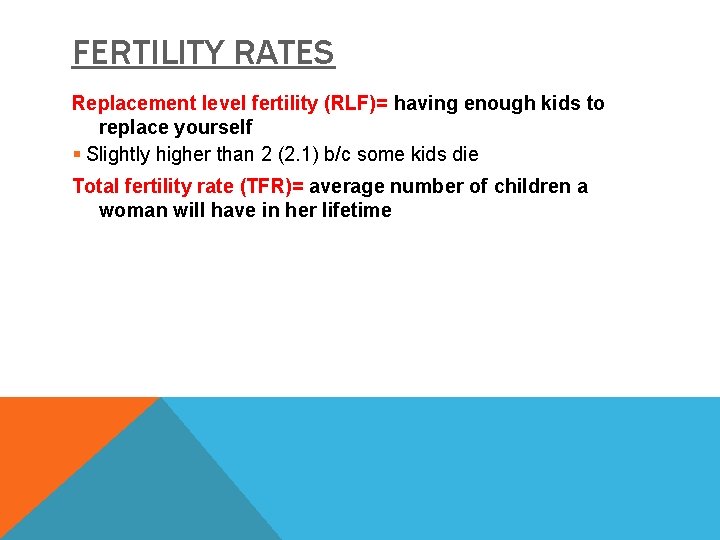
FERTILITY RATES Replacement level fertility (RLF)= having enough kids to replace yourself § Slightly higher than 2 (2. 1) b/c some kids die Total fertility rate (TFR)= average number of children a woman will have in her lifetime
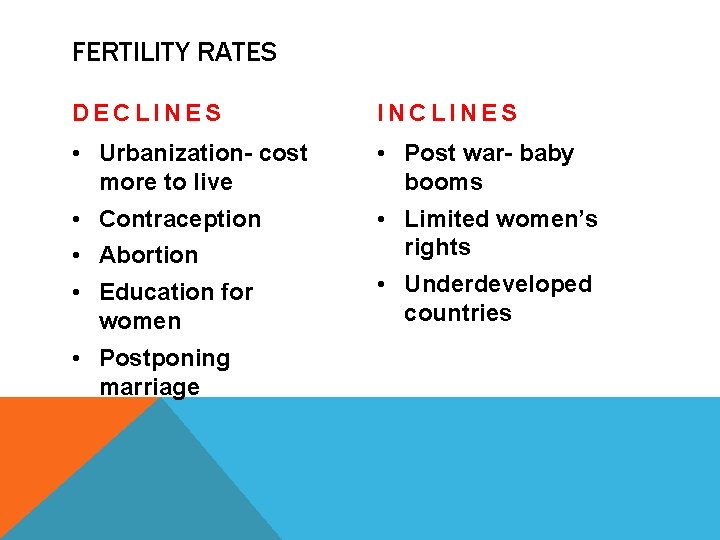
FERTILITY RATES DECLINES INCLINES • Urbanization- cost more to live • Post war- baby booms • Contraception • Abortion • Limited women’s rights • Education for women • Underdeveloped countries • Postponing marriage
INDICATORS OF OVERALL HUMAN HEALTH: v Life expectancy v Infant mortality rate
OTHER FACTORS THAT AFFECT POPULATION GROWTH ü Policies to encourage immigration ü Environmental refugees ü Religious persecution ü Baby boom generation in US § Why are they waiting to retire? § How their retirement will affect the rest of us?
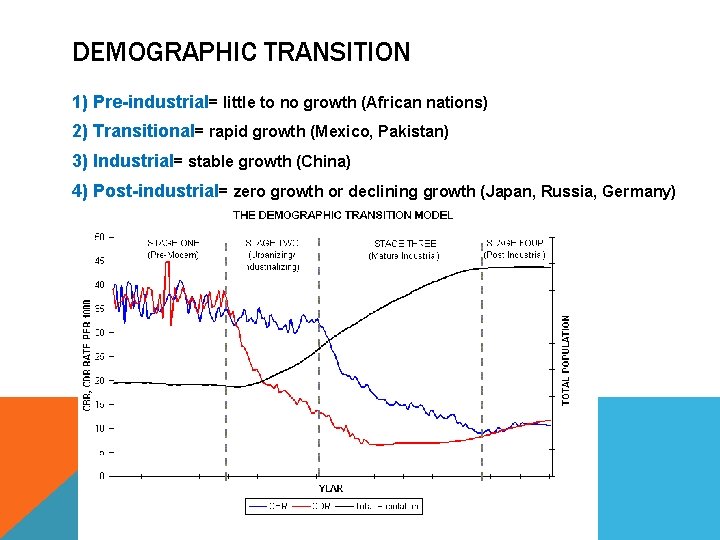
DEMOGRAPHIC TRANSITION 1) Pre-industrial= little to no growth (African nations) 2) Transitional= rapid growth (Mexico, Pakistan) 3) Industrial= stable growth (China) 4) Post-industrial= zero growth or declining growth (Japan, Russia, Germany)
WHY ARE DEVELOPING COUNTRIES LIKE INDIA NOT MOVING TOWARD INDUSTRIAL STAGE?
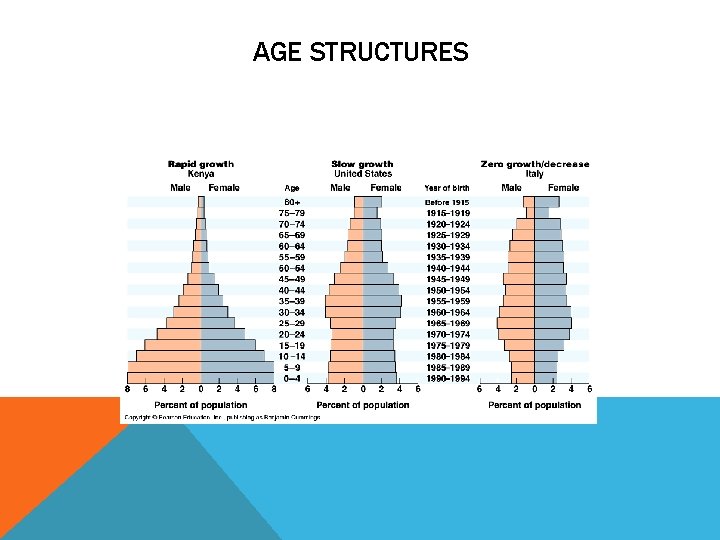
AGE STRUCTURES
WAYS TO LOWER POPULATION GROWTH: q Provide economic incentives for having fewer children q Empower and educate women q More education means more money for work which mean less children are needed to take care of parents q More education usually means having children later in life which usually means having less children q Family planning including contraceptives, legal abortions q Improve prenatal and infant health care (need less kids if they survive
CHINA AND INDIA AS CASE STUDIES ON FAMILY PLANNING v What are the policies on family planning in China? India? v What do you think of these interventions?
WHAT DO YOU THINK? Ø What is the US’s role (thus the taxpayers role) in other country’s population control?
WHY SHOULD P 0 PULATION GROWTH BE CONTROLLED/MONITORED? o Poverty o Droughts o Populations have surpassed the carrying capacity o Political instability o Pestilence o Foreign investors o Resource depletion and habitat destruction