
Current flowing Electricity Its electric a boogiewoogie Electrical
Current (flowing) Electricity It’s electric (a boogie-woogie)
“Electrical River” A river’s FLOW RATE describes how many gallons of water pass a certain point each second. l Water temperatures can vary based on the ENERGY of the molecules. l It is more DIFFICULT for the river to flow when it reaches shallow or narrow sections. l
Current (I) l Rate = flow rate of flow of electrical charge through a conductor l Measured in Amperes (A) • 1 A = 1 C/s l Since a coulomb defines # of electrons, 1 Amp means 6. 25 x 1018 electrons per second
Producing Current l Battery: Uses chemical properties of metals and an acid solution to create a separation of charge. (Direct current = DC) l Generator: Turns a magnet inside a coil of wire, creating a flow of electrons (Alternating current = AC)
“Current” Facts A 60 W light bulb has about 0. 5 A running through it. l 0. 07 A from a household outlet can cause the heart to stop. l A bolt of lightning carries 10’s of thousands of Amps. l Electric chairs use from 5 to 20 Amps. l
Voltage (V) = energy As in an atom, electrons can contain different amounts of “Electrical Potential Energy” l Electrons flowing thru a battery or generator gain energy. l Electrical devices take energy from the electrons passing thru them. l
Voltage cont. Although the total energy of an electron cannot be measured, we can determine how much energy it gains or loses. l This “Potential Difference” is commonly called Voltage (measured in Volts (V)) l l Common household outlets provide 110 V. l Our van de Graff generator provides over 100, 000 V (at a very small current).
Resistance (R) = “difficulty” l Different materials conduct electricity at different rates. l Resistance (R, measured in Ohms (W)) defines how difficult it is for current to flow thru a material.
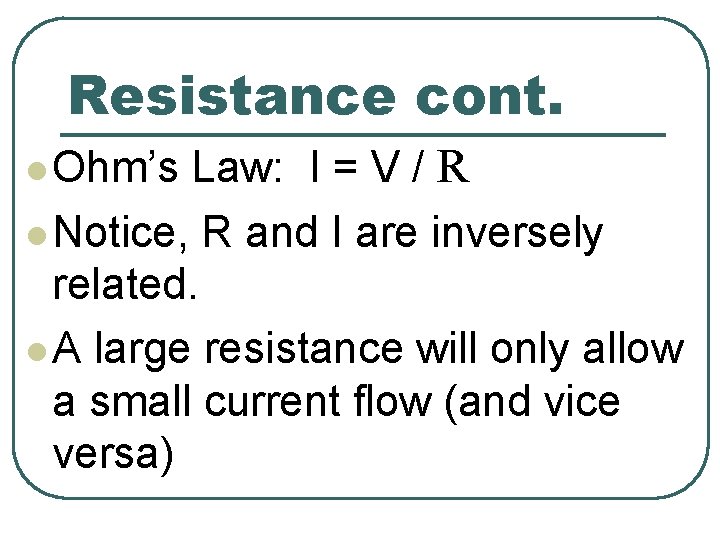
Resistance cont. Law: I = V / R l Notice, R and I are inversely related. l A large resistance will only allow a small current flow (and vice versa) l Ohm’s
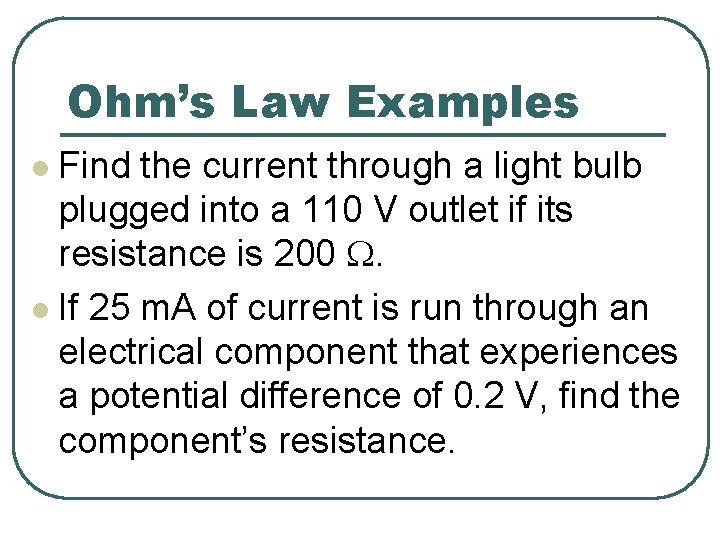
Ohm’s Law Examples l Find the current through a light bulb plugged into a 110 V outlet if its resistance is 200 W. l If 25 m. A of current is run through an electrical component that experiences a potential difference of 0. 2 V, find the component’s resistance.
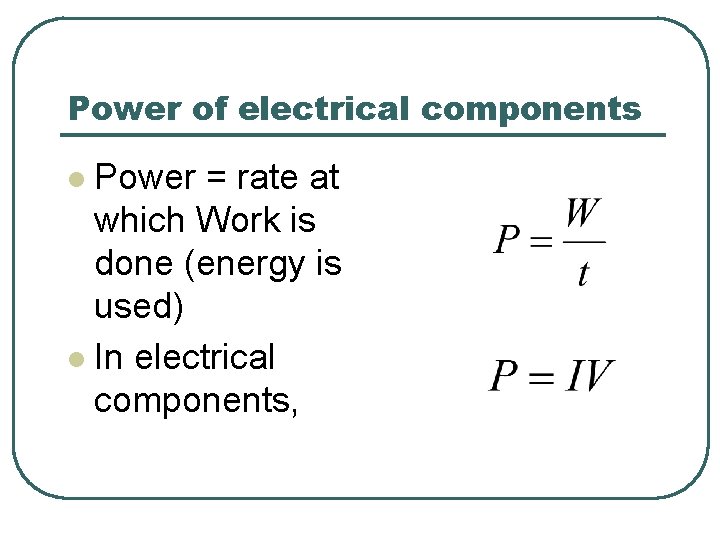
Power of electrical components Power = rate at which Work is done (energy is used) l In electrical components, l
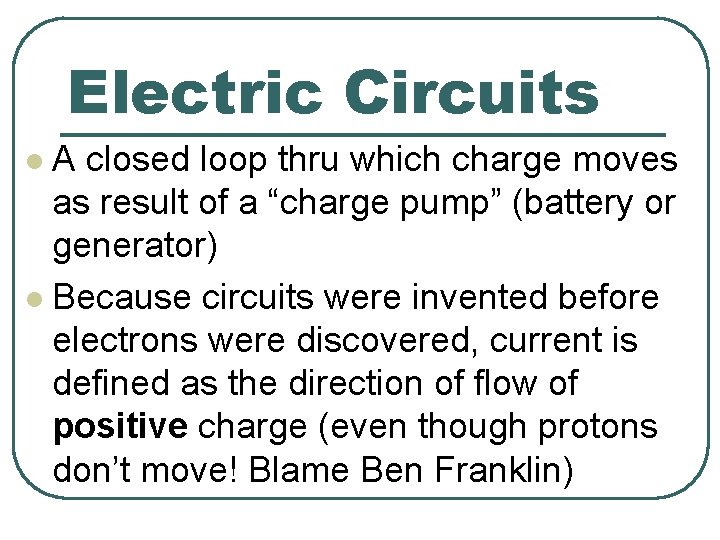
Electric Circuits A closed loop thru which charge moves as result of a “charge pump” (battery or generator) l Because circuits were invented before electrons were discovered, current is defined as the direction of flow of positive charge (even though protons don’t move! Blame Ben Franklin) l
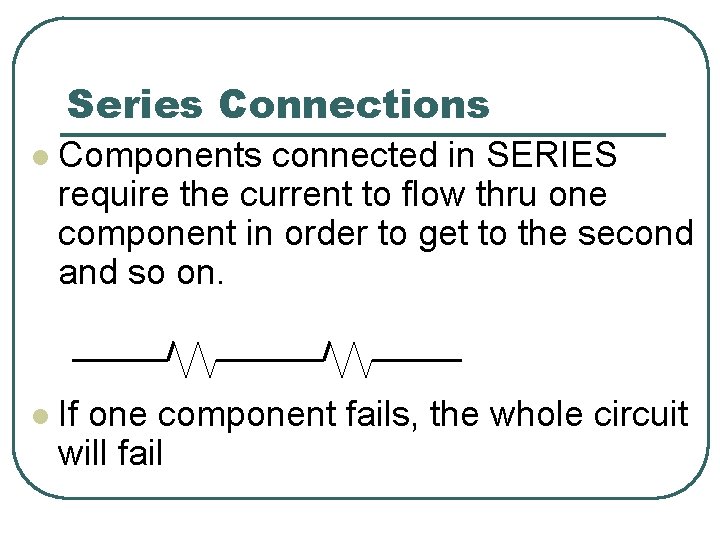
Series Connections l Components connected in SERIES require the current to flow thru one component in order to get to the second and so on. l If one component fails, the whole circuit will fail
Series Connections l l Advantages of Series • Easier to wire Disadvantages of Series • If one component fails, the whole circuit will fail • Adding components decreases the current thru the circuit (lights would get dimmer)
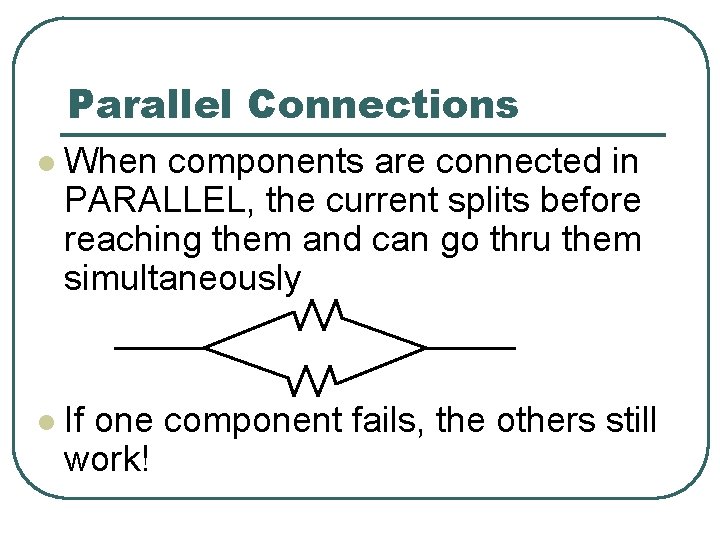
Parallel Connections l When components are connected in PARALLEL, the current splits before reaching them and can go thru them simultaneously l If one component fails, the others still work!
Parallel Connections l l l Advantages of Parallel • If one component fails, the rest still work • Adding a component does not affect the current thru each Disadvantages of Parallel • Adding components increases the total current which can cause fires. Circuits in your home are connected in Parallel
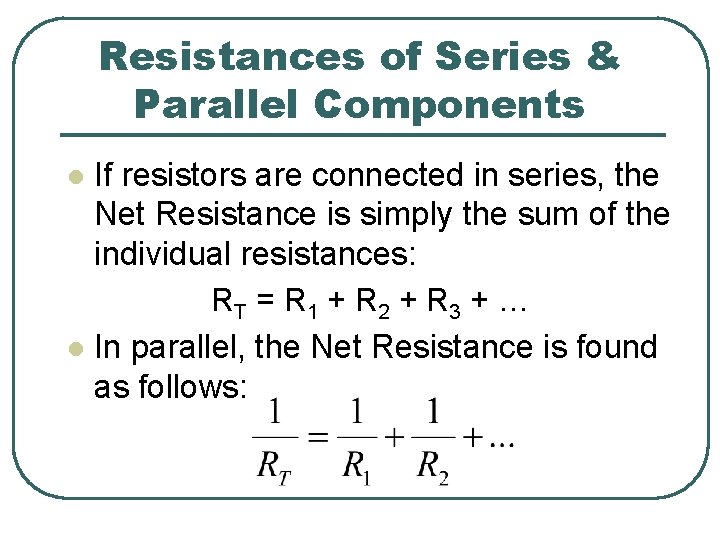
Resistances of Series & Parallel Components If resistors are connected in series, the Net Resistance is simply the sum of the individual resistances: RT = R 1 + R 2 + R 3 + … l In parallel, the Net Resistance is found as follows: l
Examples: Three resistors of resistance 5 W, 10 W and 15 W are connected in series. What is the total resistance? • 30 W l If the same 3 resistors are connected in parallel, what is the total resistance? • 2. 73 W l
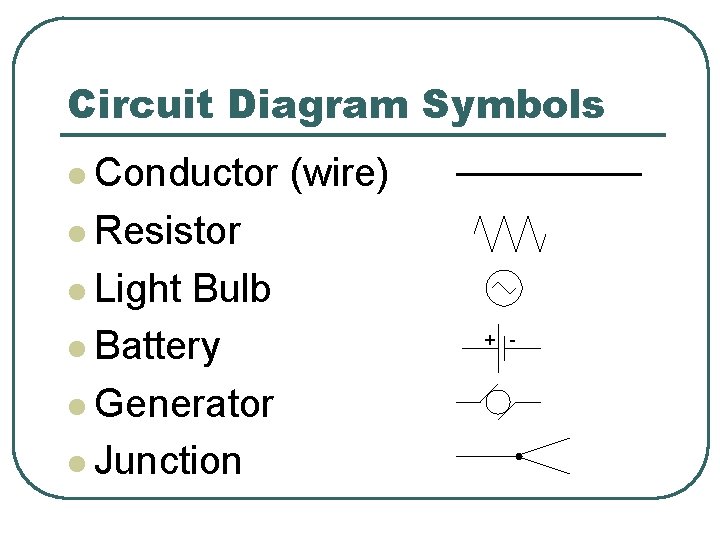
Circuit Diagram Symbols l Conductor (wire) l Resistor l Light Bulb l Battery l Generator l Junction + -
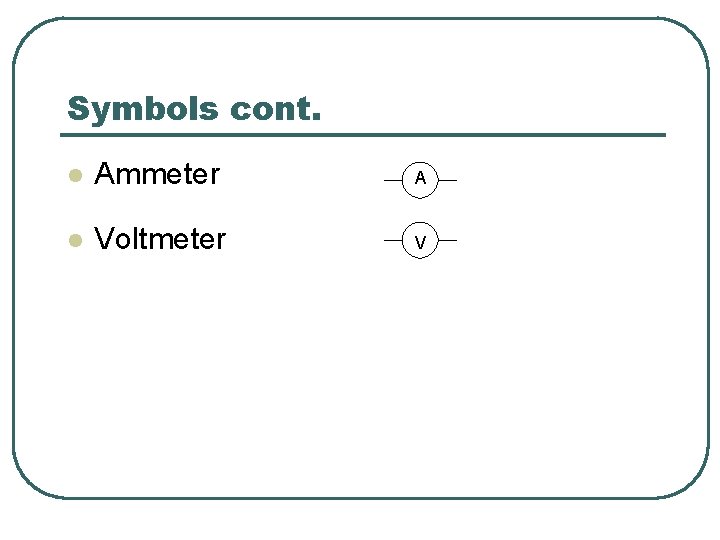
Symbols cont. l Ammeter A l Voltmeter V
Circuit Rules l l l Kirchoff’s Loop Rule: The Potential Difference (Voltage) of the power supply in any loop of a circuit is equal to the sum of the voltages of the resistors in that loop. Kirchoff’s Junction Rule: The total current approaching a junction is equal to the total current leaving the junction. Parallel Rule: Parallel sections of a circuit experience equal potential drops (voltage). (This is a direct conclusion of the loop rule)
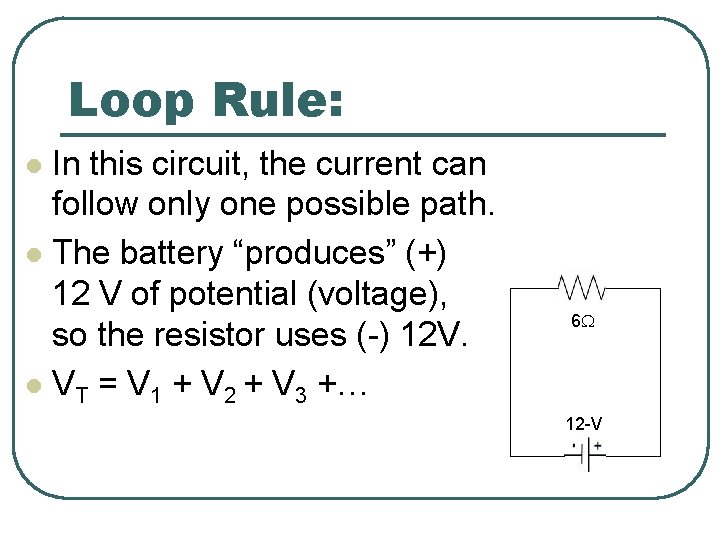
Loop Rule: In this circuit, the current can follow only one possible path. l The battery “produces” (+) 12 V of potential (voltage), so the resistor uses (-) 12 V. l VT = V 1 + V 2 + V 3 +… l 6 W 12 -V
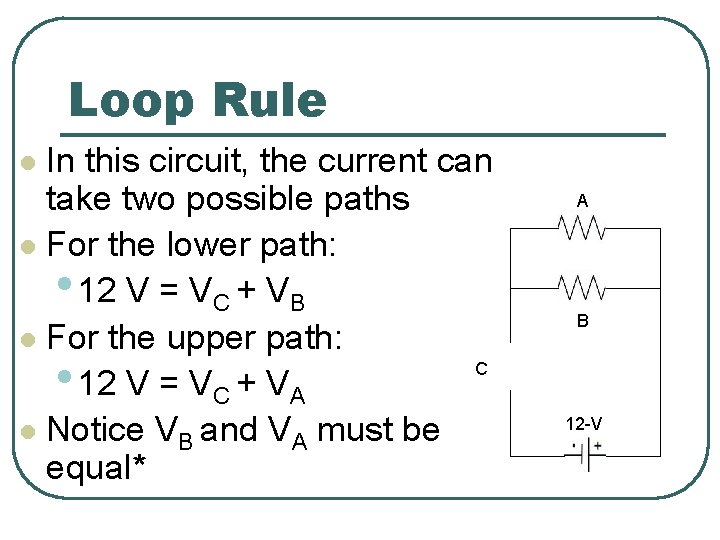
Loop Rule In this circuit, the current can take two possible paths l For the lower path: • 12 V = VC + VB l For the upper path: C • 12 V = VC + VA l Notice VB and VA must be equal* l A B 12 -V
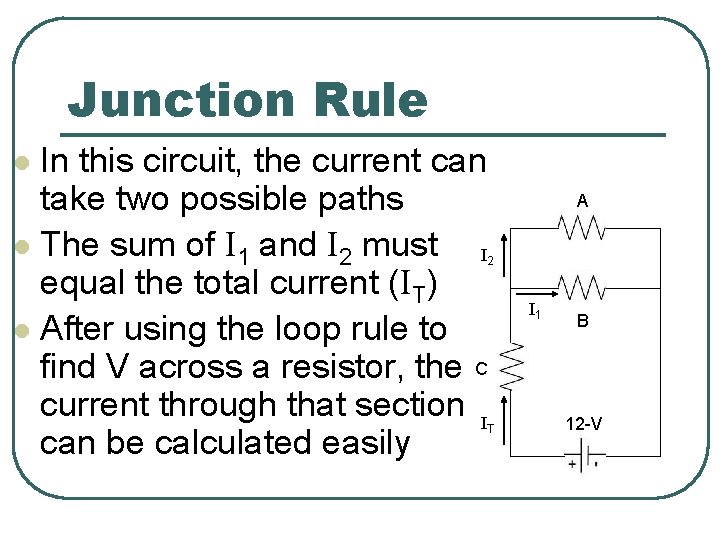
Junction Rule In this circuit, the current can take two possible paths l The sum of I 1 and I 2 must I equal the total current (IT) l After using the loop rule to find V across a resistor, the C current through that section I can be calculated easily l A 2 T I 1 B 12 -V
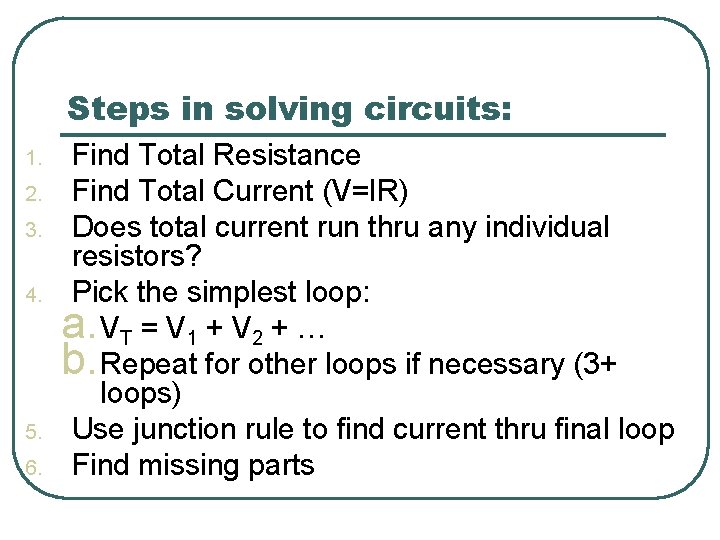
Steps in solving circuits: 1. 2. 3. 4. 5. 6. Find Total Resistance Find Total Current (V=IR) Does total current run thru any individual resistors? Pick the simplest loop: a. VT = V 1 + V 2 + … b. Repeat for other loops if necessary (3+ loops) Use junction rule to find current thru final loop Find missing parts
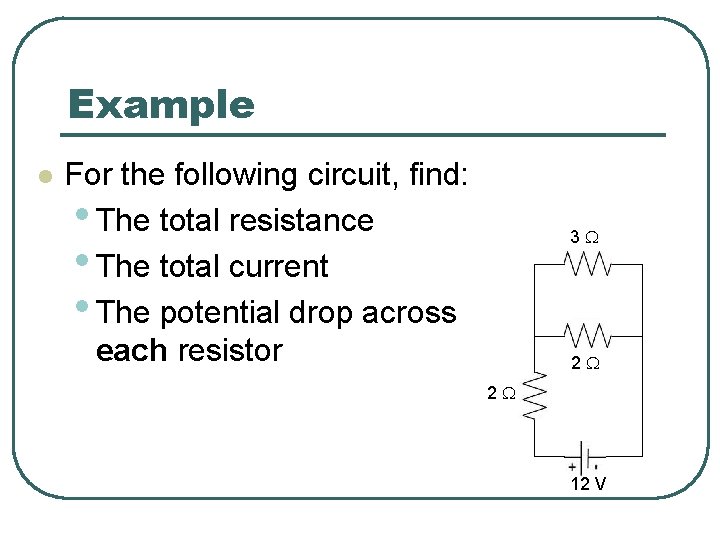
Example l For the following circuit, find: • The total resistance • The total current • The potential drop across each resistor 3 W 2 W 2 W 12 V
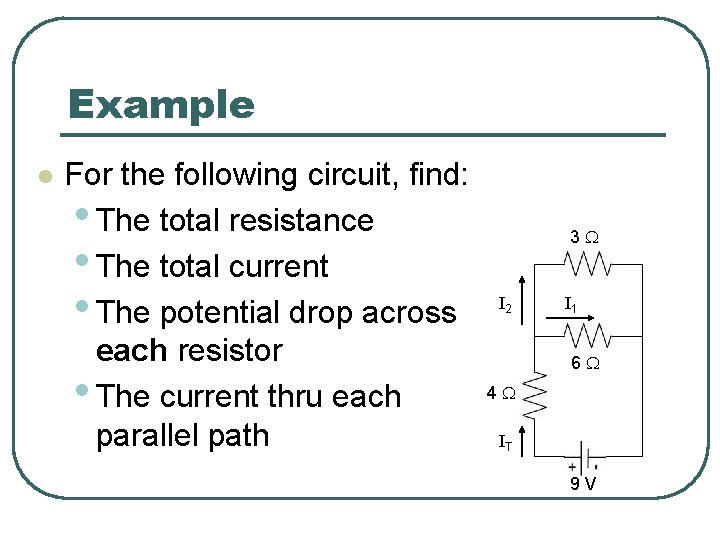
Example l For the following circuit, find: • The total resistance • The total current • The potential drop across each resistor • The current thru each parallel path 3 W I 2 I 1 6 W 4 W IT 9 V
- Slides: 27