
Current fat testing limitations Rapid techniques NMR NIR


- Slides: 34
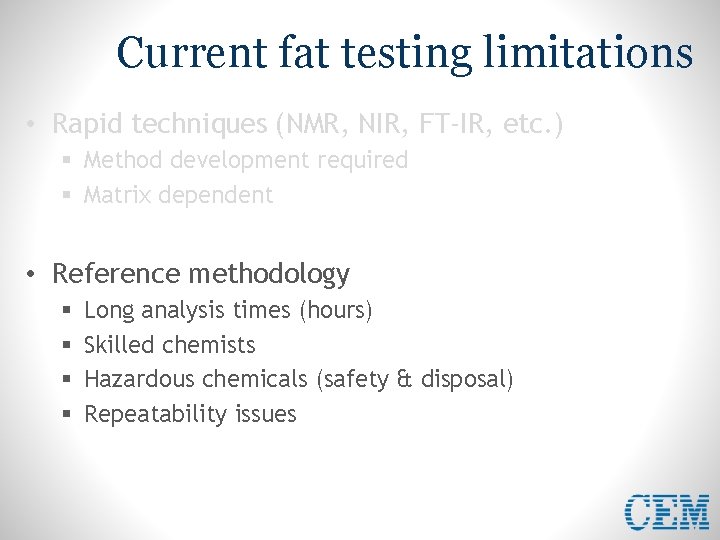
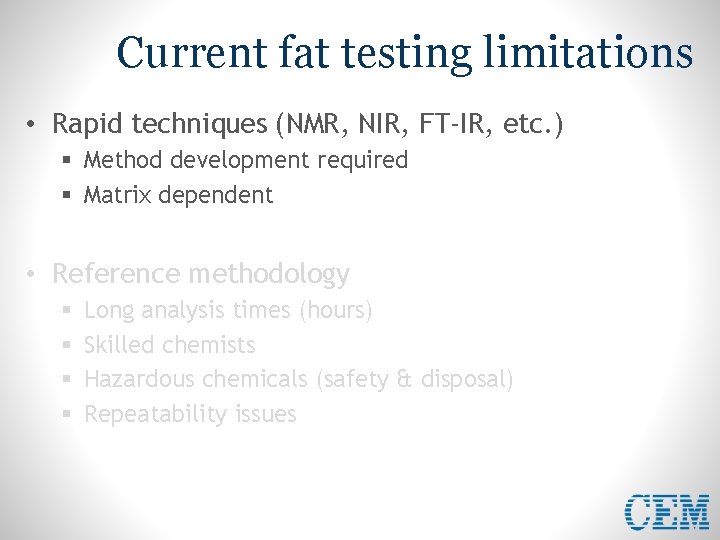
Current fat testing limitations • Rapid techniques (NMR, NIR, FT-IR, etc. ) § Method development required § Matrix dependent • Reference methodology § § Long analysis times (hours) Skilled chemists Hazardous chemicals (safety & disposal) Repeatability issues
Original Scope Design Goal: Create a universal fat system that removes the bottlenecks and limitations of reference chemistries and rapid techniques. Design a rapid system that no longer requires any form of method development. Long-term vision: To become the standard reference technique for fat testing worldwide
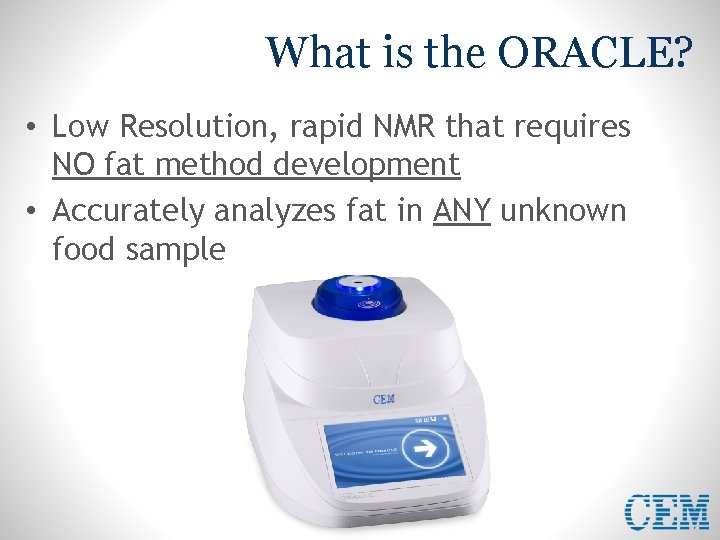
What is the ORACLE? • Low Resolution, rapid NMR that requires NO fat method development • Accurately analyzes fat in ANY unknown food sample
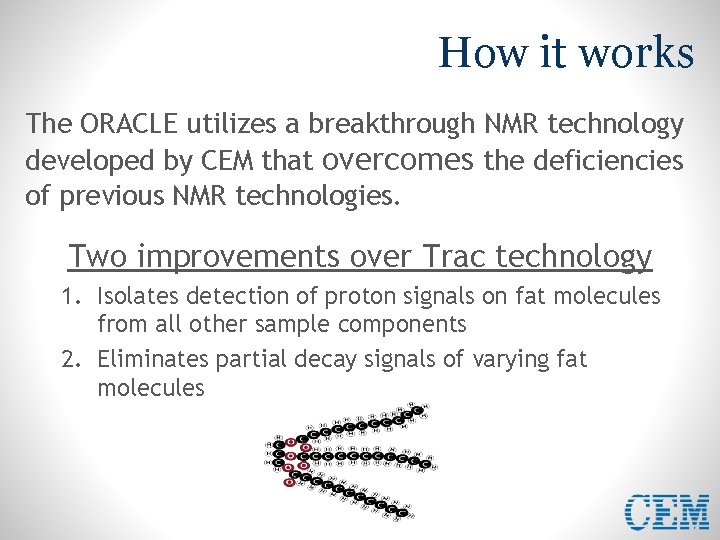
How it works The ORACLE utilizes a breakthrough NMR technology developed by CEM that overcomes the deficiencies of previous NMR technologies. Two improvements over Trac technology 1. Isolates detection of proton signals on fat molecules from all other sample components 2. Eliminates partial decay signals of varying fat molecules
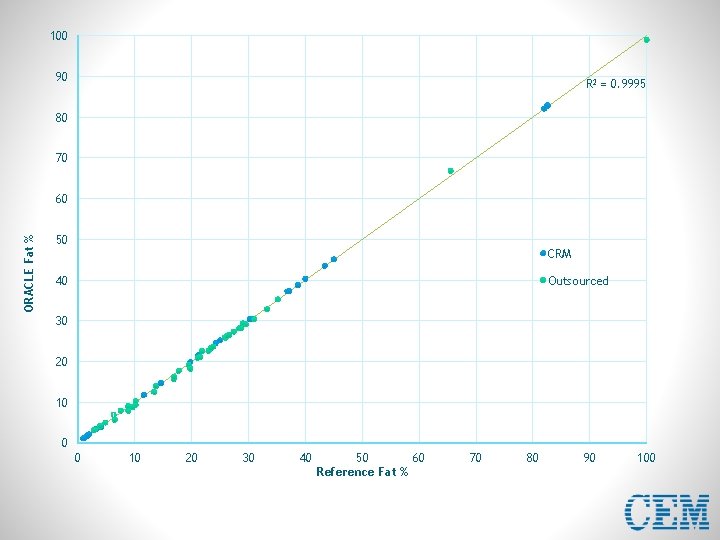
Validation of Technology • ~30 CRM’s analyzed on ORACLE • Samples extensively tested in collaborative studies (typically 10+ certified laboratories) • CEM outsourced 100’s of samples to Eurofins and Silliker • Submitted samples in “blind” and “non-blind” fashion to capture true sample variability
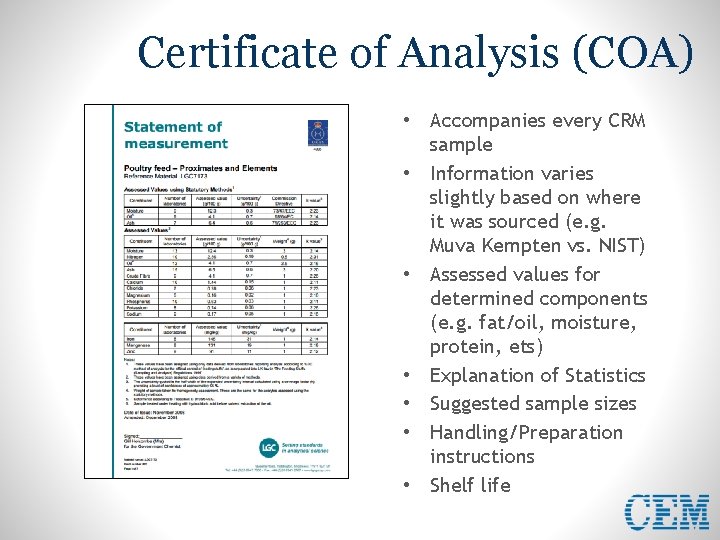
Certificate of Analysis (COA) • Accompanies every CRM sample • Information varies slightly based on where it was sourced (e. g. Muva Kempten vs. NIST) • Assessed values for determined components (e. g. fat/oil, moisture, protein, ets) • Explanation of Statistics • Suggested sample sizes • Handling/Preparation instructions • Shelf life
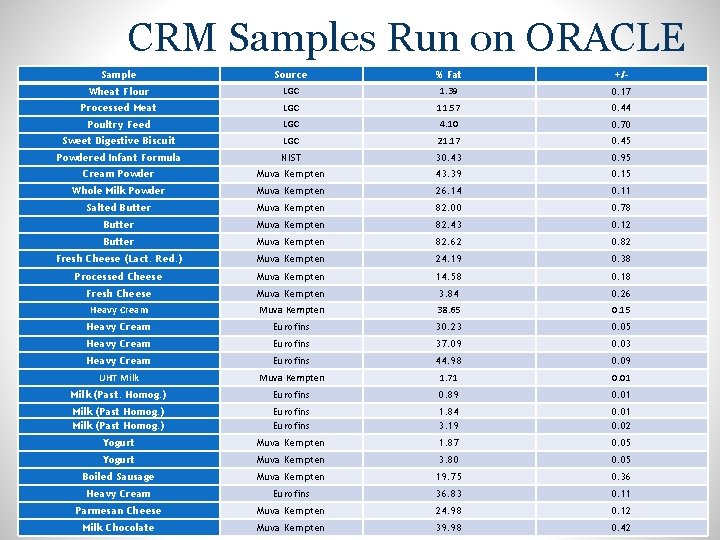
CRM Samples Run on ORACLE Sample Source % Fat +/- Wheat Flour LGC 1. 39 0. 17 Processed Meat LGC 11. 57 0. 44 Poultry Feed LGC 4. 10 0. 70 Sweet Digestive Biscuit LGC 21. 17 0. 45 Powdered Infant Formula NIST 30. 43 0. 95 Cream Powder Muva Kempten 43. 39 0. 15 Whole Milk Powder Muva Kempten 26. 14 0. 11 Salted Butter Muva Kempten 82. 00 0. 78 Butter Muva Kempten 82. 43 0. 12 Butter Muva Kempten 82. 62 0. 82 Fresh Cheese (Lact. Red. ) Muva Kempten 24. 19 0. 38 Processed Cheese Muva Kempten 14. 58 0. 18 Fresh Cheese Muva Kempten 3. 84 0. 26 Heavy Cream Muva Kempten 38. 65 0. 15 Heavy Cream Eurofins 30. 23 0. 05 Heavy Cream Eurofins 37. 09 0. 03 Heavy Cream Eurofins 44. 98 0. 09 UHT Milk Muva Kempten 1. 71 0. 01 Milk (Past. Homog. ) Eurofins 0. 89 0. 01 Milk (Past Homog. ) Eurofins 1. 84 3. 19 0. 01 0. 02 Yogurt Muva Kempten 1. 87 0. 05 Yogurt Muva Kempten 3. 80 0. 05 Boiled Sausage Muva Kempten 19. 75 0. 36 Heavy Cream Eurofins 36. 83 0. 11 Parmesan Cheese Muva Kempten 24. 98 0. 12 Milk Chocolate Muva Kempten 39. 98 0. 42
100 90 R 2 = 0. 9995 80 70 ORACLE Fat % 60 50 CRM 40 Outsourced 30 20 10 0 0 10 20 30 40 50 60 Reference Fat % 70 80 90 100
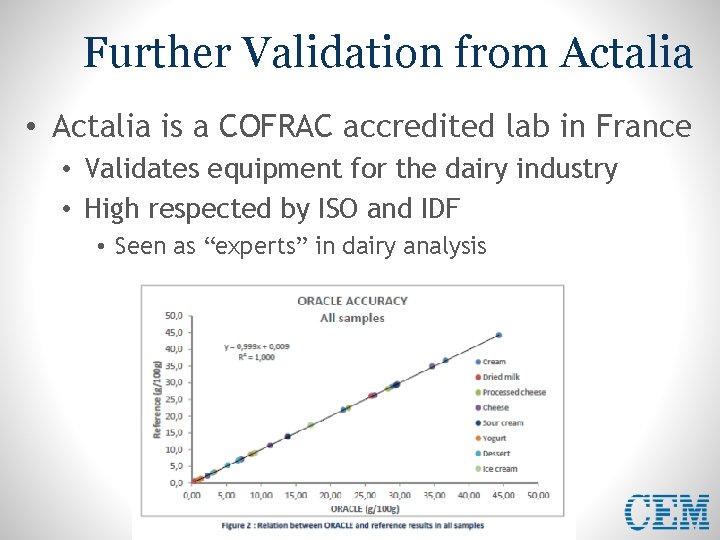
Further Validation from Actalia • Actalia is a COFRAC accredited lab in France • Validates equipment for the dairy industry • High respected by ISO and IDF • Seen as “experts” in dairy analysis
Actalia Study • 2 major conclusions from ORACLE testing 1. The ORACLE “. . reproducibility of the instrument is lower than the reproducibility of the reference method. ” 2. The accuracy of the ORACLE compared to reference chemistry showed the “…regression slope (0. 999) and the intercept (0. 009) are not significantly different, respectively from 1. 00 and zero (P=5%). ”
Using the ORACLE
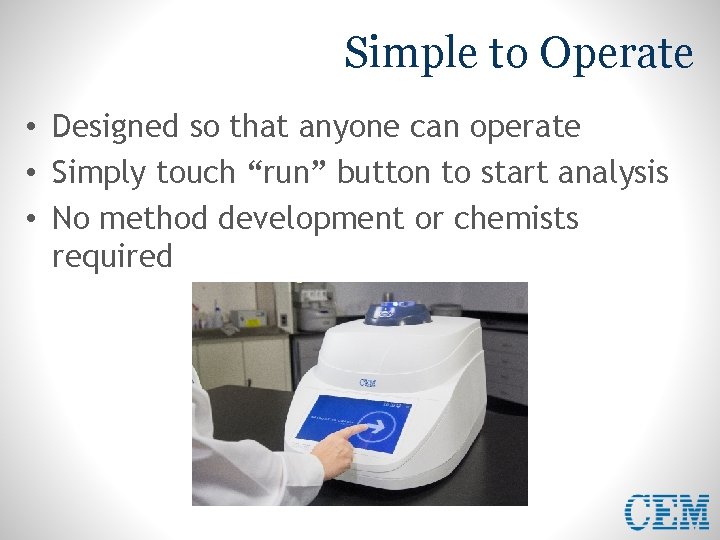
Simple to Operate • Designed so that anyone can operate • Simply touch “run” button to start analysis • No method development or chemists required
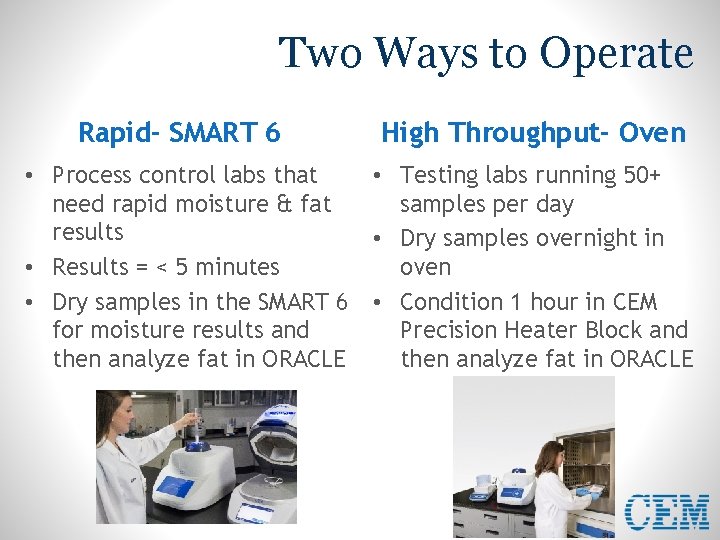
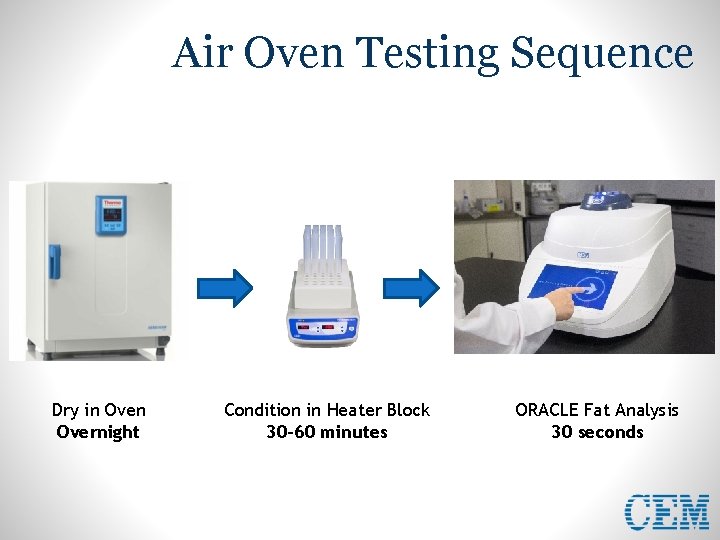
Two Ways to Operate Rapid- SMART 6 High Throughput- Oven • Process control labs that need rapid moisture & fat results • Results = < 5 minutes • Dry samples in the SMART 6 for moisture results and then analyze fat in ORACLE • Testing labs running 50+ samples per day • Dry samples overnight in oven • Condition 1 hour in CEM Precision Heater Block and then analyze fat in ORACLE
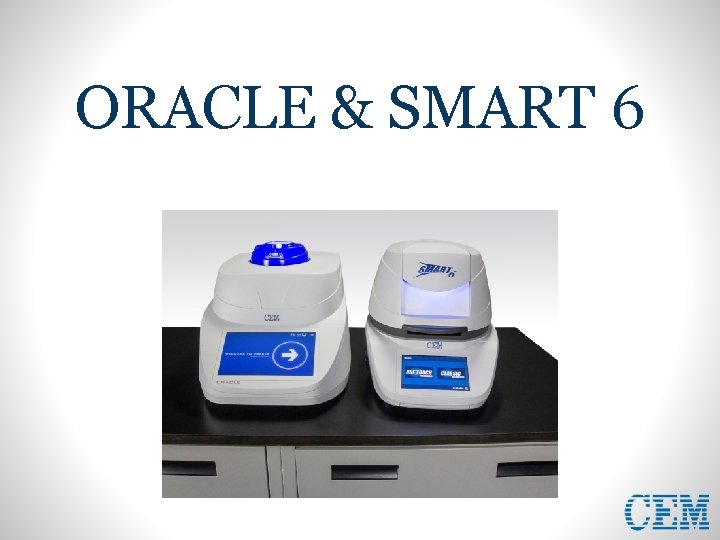
ORACLE & SMART 6
SMART 6 + ORACLE • Ideal for process control customers requiring rapid results (i. e. food production facilities) • Results in 3 -5 minutes • Analyze moisture and fat in any sample- wet or dry
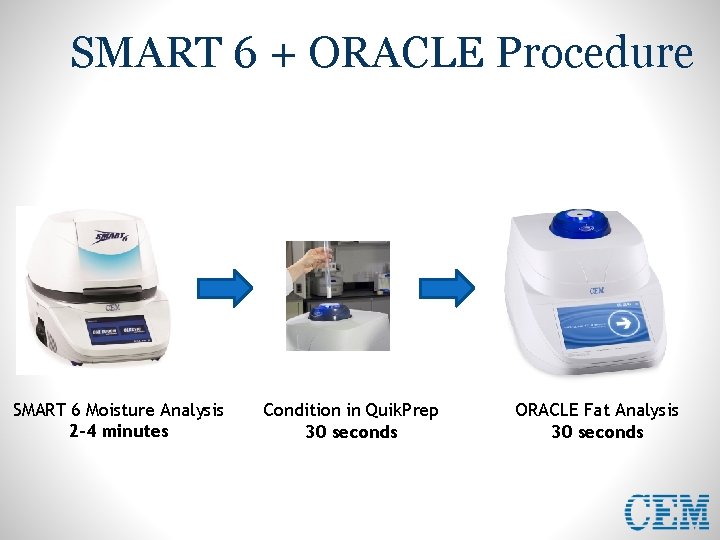
SMART 6 + ORACLE Procedure SMART 6 Moisture Analysis 2 -4 minutes Condition in Quik. Prep 30 seconds ORACLE Fat Analysis 30 seconds
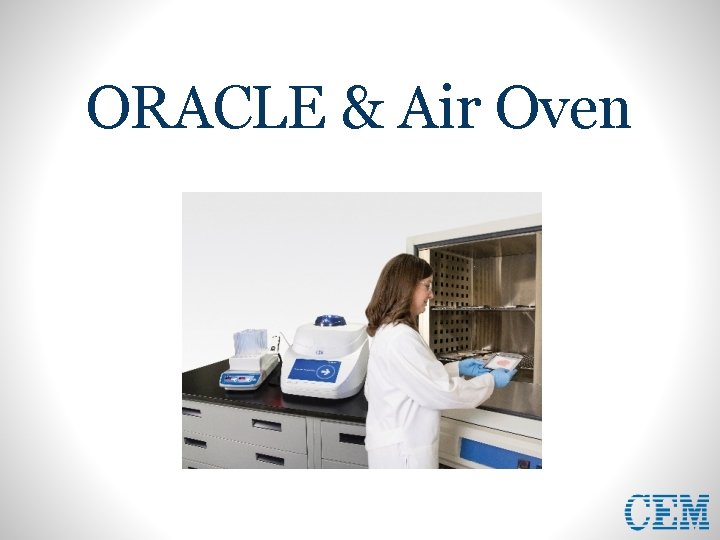
ORACLE & Air Oven
Air Oven Testing Sequence Dry in Overnight Condition in Heater Block 30 -60 minutes ORACLE Fat Analysis 30 seconds
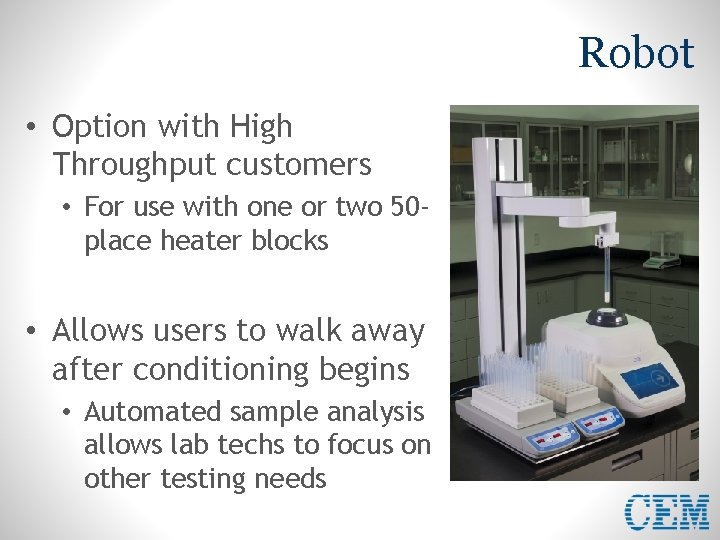
Robot • Option with High Throughput customers • For use with one or two 50 place heater blocks • Allows users to walk away after conditioning begins • Automated sample analysis allows lab techs to focus on other testing needs
Global Repeatability • All ORACLEs are designed to produce the same NMR signal • Ensures consistent results across suppliers and manufacturers worldwide
ORACLE vs Reference Chemistry
Current fat testing limitations • Rapid techniques (NMR, NIR, FT-IR, etc. ) § Method development required § Matrix dependent • Reference methodology § § Long analysis times (hours) Skilled chemists Hazardous chemicals (safety & disposal) Repeatability issues
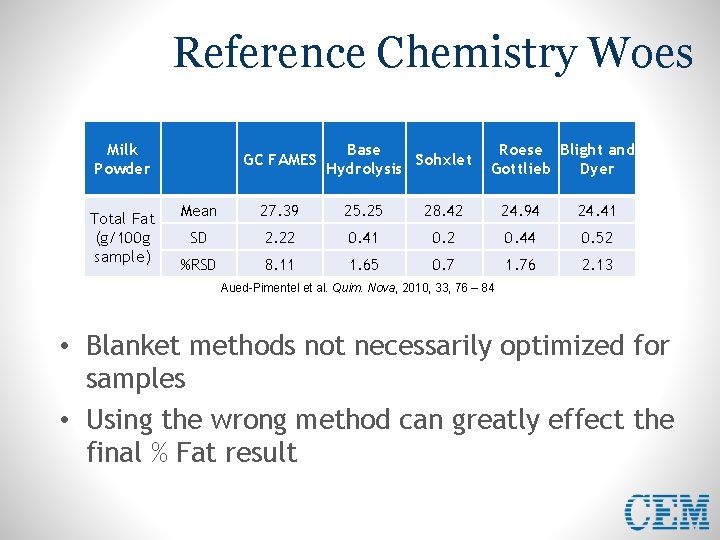
Reference Chemistry Woes Milk Powder Total Fat (g/100 g sample) GC FAMES Base Sohxlet Hydrolysis Roese Blight and Gottlieb Dyer Mean 27. 39 25. 25 28. 42 24. 94 24. 41 SD 2. 22 0. 41 0. 2 0. 44 0. 52 %RSD 8. 11 1. 65 0. 7 1. 76 2. 13 Aued-Pimentel et al. Quim. Nova, 2010, 33, 76 – 84 • Blanket methods not necessarily optimized for samples • Using the wrong method can greatly effect the final % Fat result
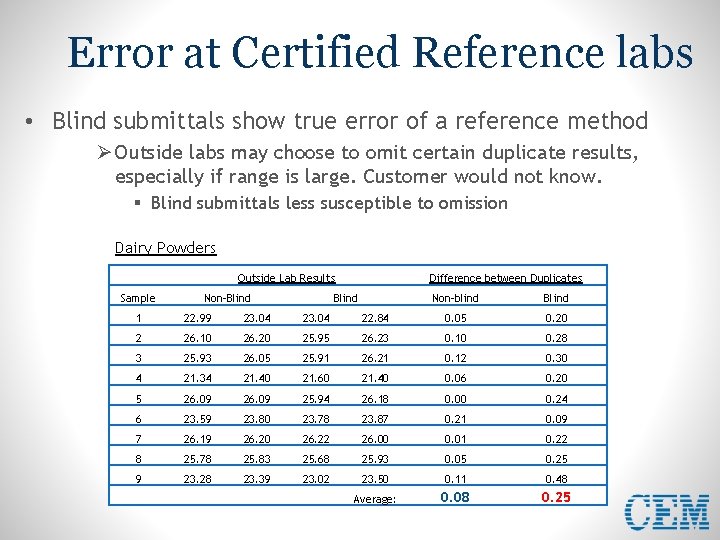
Error at Certified Reference labs • Blind submittals show true error of a reference method Ø Outside labs may choose to omit certain duplicate results, especially if range is large. Customer would not know. § Blind submittals less susceptible to omission Dairy Powders Outside Lab Results Sample Non-Blind Difference between Duplicates Blind Non-blind Blind 1 22. 99 23. 04 22. 84 0. 05 0. 20 2 26. 10 26. 20 25. 95 26. 23 0. 10 0. 28 3 25. 93 26. 05 25. 91 26. 21 0. 12 0. 30 4 21. 34 21. 40 21. 60 21. 40 0. 06 0. 20 5 26. 09 25. 94 26. 18 0. 00 0. 24 6 23. 59 23. 80 23. 78 23. 87 0. 21 0. 09 7 26. 19 26. 20 26. 22 26. 00 0. 01 0. 22 8 25. 78 25. 83 25. 68 25. 93 0. 05 0. 25 9 23. 28 23. 39 23. 02 23. 50 0. 11 0. 48 Average: 0. 08 0. 25
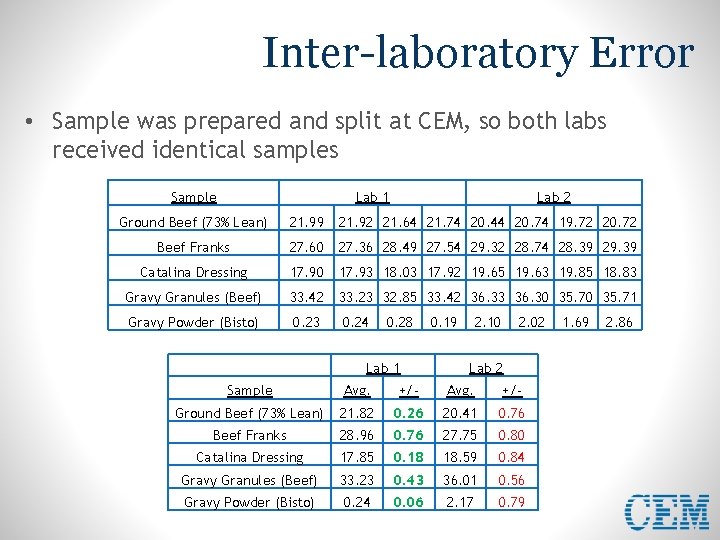
Inter-laboratory Error • Sample was prepared and split at CEM, so both labs received identical samples Sample Lab 1 Lab 2 Ground Beef (73% Lean) 21. 99 21. 92 21. 64 21. 74 20. 44 20. 74 19. 72 20. 72 Beef Franks 27. 60 27. 36 28. 49 27. 54 29. 32 28. 74 28. 39 29. 39 Catalina Dressing 17. 90 17. 93 18. 03 17. 92 19. 65 19. 63 19. 85 18. 83 Gravy Granules (Beef) 33. 42 33. 23 32. 85 33. 42 36. 33 36. 30 35. 71 Gravy Powder (Bisto) 0. 23 0. 24 0. 28 Lab 1 0. 19 2. 10 2. 02 Lab 2 Sample Avg. +/- Ground Beef (73% Lean) 21. 82 0. 26 20. 41 0. 76 Beef Franks 28. 96 0. 76 27. 75 0. 80 Catalina Dressing 17. 85 0. 18 18. 59 0. 84 Gravy Granules (Beef) 33. 23 0. 43 36. 01 0. 56 Gravy Powder (Bisto) 0. 24 0. 06 2. 17 0. 79 1. 69 2. 86
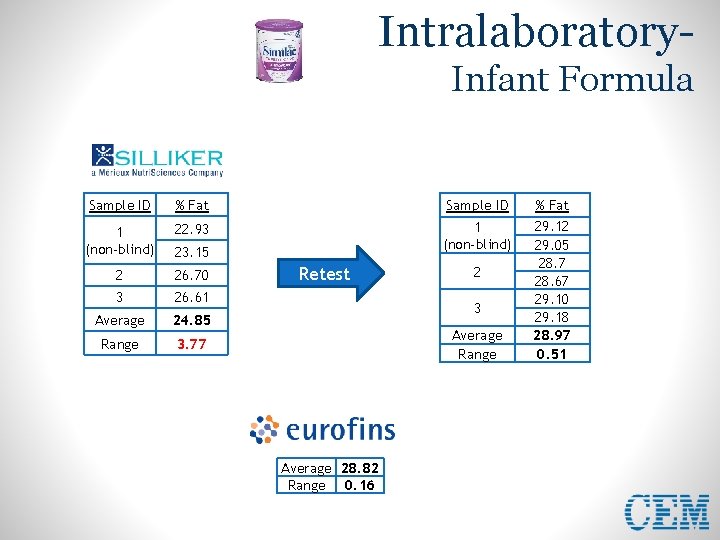
Intralaboratory. Infant Formula Sample ID % Fat 1 (non-blind) 22. 93 1 (non-blind) 2 26. 70 3 26. 61 Average 24. 85 Range 3. 77 29. 12 29. 05 28. 7 28. 67 29. 10 29. 18 28. 97 0. 51 23. 15 Retest 2 3 Average Range Average 28. 82 Range 0. 16
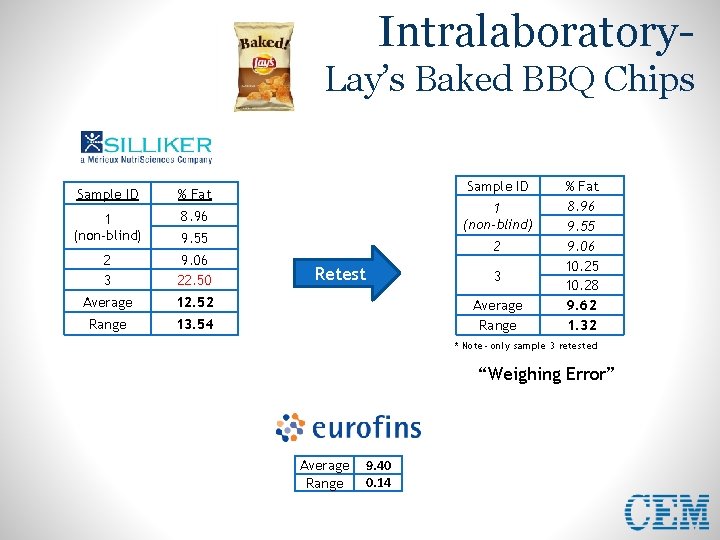
Intralaboratory. Lay’s Baked BBQ Chips Sample ID % Fat 1 (non-blind) 8. 96 2 3 9. 06 22. 50 Average 12. 52 Range 13. 54 Sample ID 1 (non-blind) 9. 55 2 Retest 3 Average Range % Fat 8. 96 9. 55 9. 06 10. 25 10. 28 9. 62 1. 32 * Note- only sample 3 retested “Weighing Error” Average Range 9. 40 0. 14
ORACLE vs NIR/FT-IR
Current fat testing limitations • Rapid techniques (NMR, NIR, FT-IR, etc. ) § Method development required § Matrix dependent • Reference methodology § § Long analysis times (hours) Skilled chemists Hazardous chemicals (safety & disposal) Repeatability issues
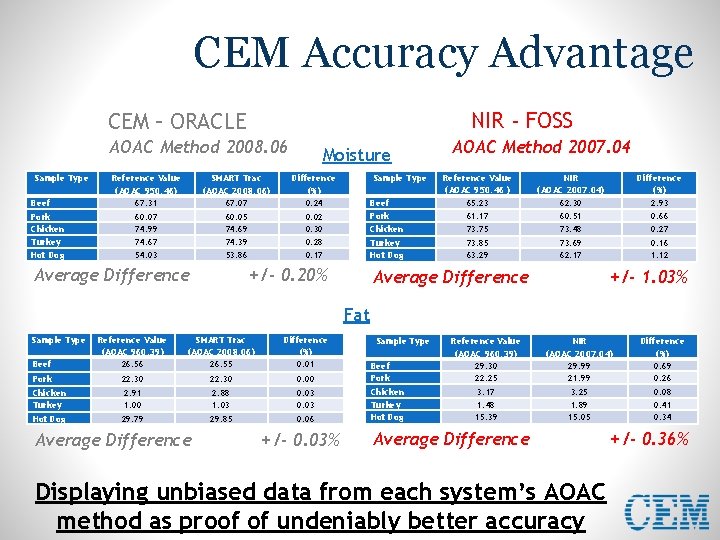
CEM Accuracy Advantage NIR - FOSS CEM – ORACLE AOAC Method 2008. 06 Sample Type Beef Pork Chicken Turkey Hot Dog Reference Value (AOAC 950. 46) 67. 31 60. 07 74. 99 74. 67 54. 03 SMART Trac (AOAC 2008. 06) 67. 07 60. 05 74. 69 74. 39 53. 86 Average Difference Moisture Sample Type Difference (%) 0. 24 0. 02 0. 30 0. 28 0. 17 Beef Pork Chicken Turkey Hot Dog +/- 0. 20% AOAC Method 2007. 04 Reference Value (AOAC 950. 46 ) 65. 23 61. 17 73. 75 73. 85 63. 29 NIR (AOAC 2007. 04) 62. 30 60. 51 73. 48 73. 69 62. 17 Average Difference (%) 2. 93 0. 66 0. 27 0. 16 1. 12 +/- 1. 03% Fat Sample Type Beef Reference Value (AOAC 960. 39) 26. 56 SMART Trac (AOAC 2008. 06) 26. 55 Difference (%) 0. 01 Pork 22. 30 0. 00 Chicken Turkey Hot Dog 2. 91 1. 00 29. 79 2. 88 1. 03 29. 85 0. 03 0. 06 Average Difference +/- 0. 03% Sample Type Beef Pork Chicken Turkey Hot Dog Reference Value (AOAC 960. 39) 29. 30 22. 25 3. 17 1. 48 15. 39 NIR (AOAC 2007. 04) 29. 99 21. 99 3. 25 1. 89 15. 05 Average Difference Displaying unbiased data from each system’s AOAC method as proof of undeniably better accuracy Difference (%) 0. 69 0. 26 0. 08 0. 41 0. 34 +/- 0. 36%
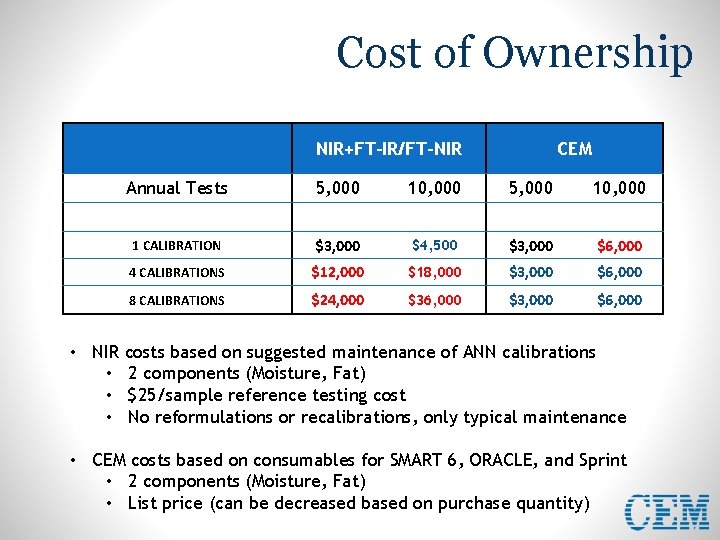
Cost of Ownership NIR+FT-IR/FT-NIR CEM Annual Tests 5, 000 10, 000 1 CALIBRATION $3, 000 $4, 500 $3, 000 $6, 000 4 CALIBRATIONS $12, 000 $18, 000 $3, 000 $6, 000 8 CALIBRATIONS $24, 000 $36, 000 $3, 000 $6, 000 • NIR costs based on suggested maintenance of ANN calibrations • 2 components (Moisture, Fat) • $25/sample reference testing cost • No reformulations or recalibrations, only typical maintenance • CEM costs based on consumables for SMART 6, ORACLE, and Sprint • 2 components (Moisture, Fat) • List price (can be decreased based on purchase quantity)
One System, Any Sample • Moisture and Fat analysis for any sample can be tested on the ORACLE • Liquid, Powder, semi-solid, cultured, and more • NIR AND FT-IR must be used to analyze the full range of samples • FT-IR for liquid, NIR for cultured and powder • Increased costs instruments, service, calibrations, software upgrades • New products require new NIR/FT-IR calibrations, which require additional time and capital
QUESTIONS?