
Current electricity The basics Definitions working and measurements

Current electricity The basics Definitions, working and measurements
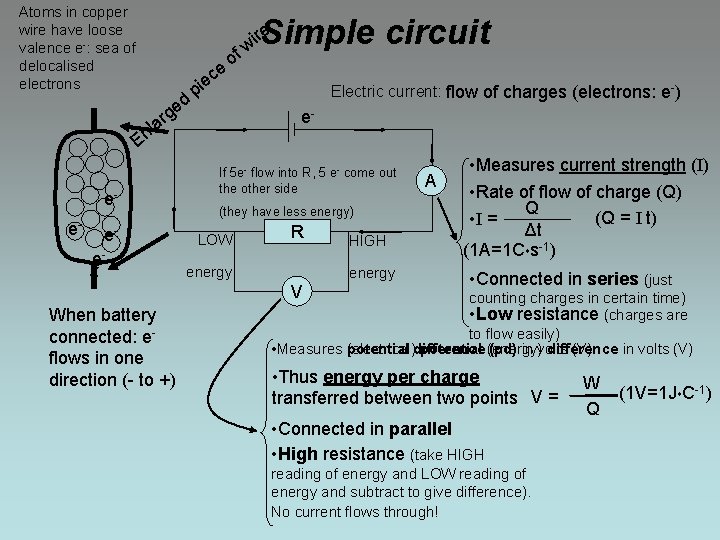
Atoms in copper wire have loose valence e-: sea of delocalised electrons ed ce e i of p g r la n E ee- eee- Simple circuit re i w Electric current: flow of charges (electrons: e-) e. If 5 e- flow into R, 5 e- come out the other side (they have less energy) LOW R energy V When battery connected: eflows in one direction (- to +) HIGH A • Measures current strength (I) • Rate of flow of charge (Q) Q (Q = I t) • I = Δt (1 A=1 C s-1) • Connected in series (just counting charges in certain time) • Low resistance (charges are to flow easily) • Measures (electrical) potential difference potential (energy) (pd) in volts difference (V) in volts (V) • Thus energy per charge transferred between two points V = • Connected in parallel • High resistance (take HIGH reading of energy and LOW reading of energy and subtract to give difference). No current flows through! W Q (1 V=1 J C-1)
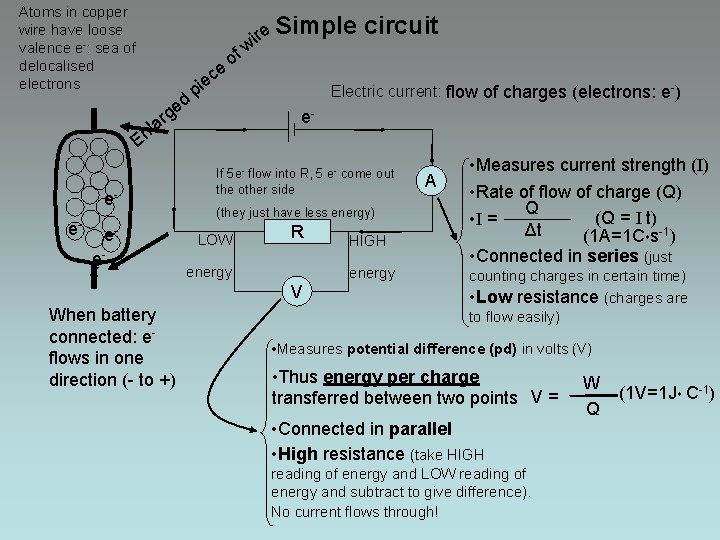
Atoms in copper wire have loose valence e-: sea of delocalised electrons ed ce e i of ee- eee- Simple circuit p g r la n E re i w Electric current: flow of charges (electrons: e-) e. If 5 e- flow into R, 5 e- come out the other side (they just have less energy) LOW R energy V When battery connected: eflows in one direction (- to +) HIGH A • Measures current strength (I) • Rate of flow of charge (Q) Q (Q = I t) • I = Δt (1 A=1 C s-1) • Connected in series (just counting charges in certain time) • Low resistance (charges are to flow easily) • Measures potential difference (pd) in volts (V) • Thus energy per charge transferred between two points V = • Connected in parallel • High resistance (take HIGH reading of energy and LOW reading of energy and subtract to give difference). No current flows through! W Q (1 V=1 J C-1)
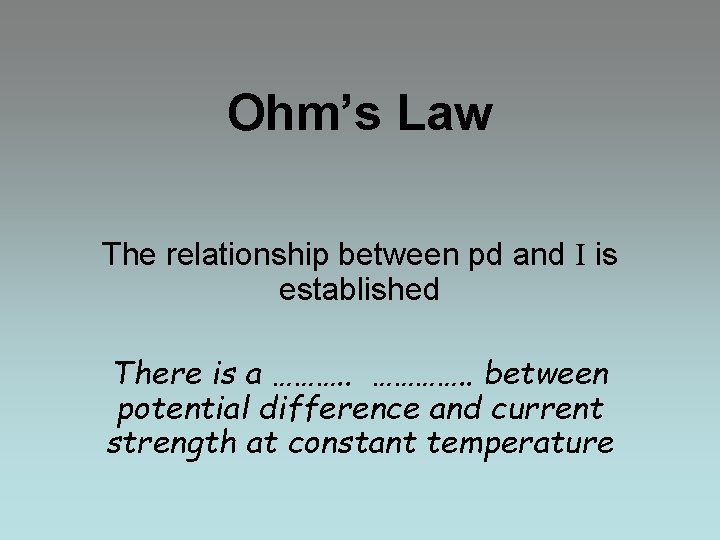
Ohm’s Law The relationship between pd and I is established There is a ………. . …………. . between potential difference and current strength at constant temperature
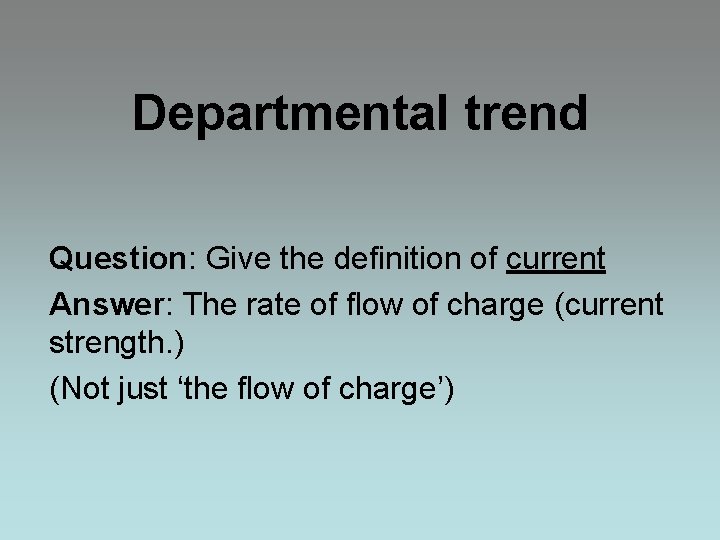
Departmental trend Question: Give the definition of current Answer: The rate of flow of charge (current strength. ) (Not just ‘the flow of charge’)
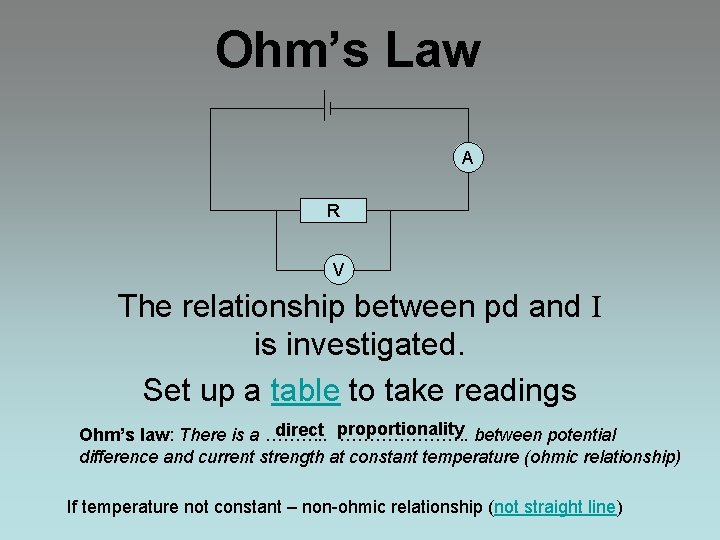
Ohm’s Law A R V The relationship between pd and I is investigated. Set up a table to take readings direct proportionality Ohm’s law: There is a ………. . …………………. between potential difference and current strength at constant temperature (ohmic relationship) If temperature not constant – non-ohmic relationship (not straight line)
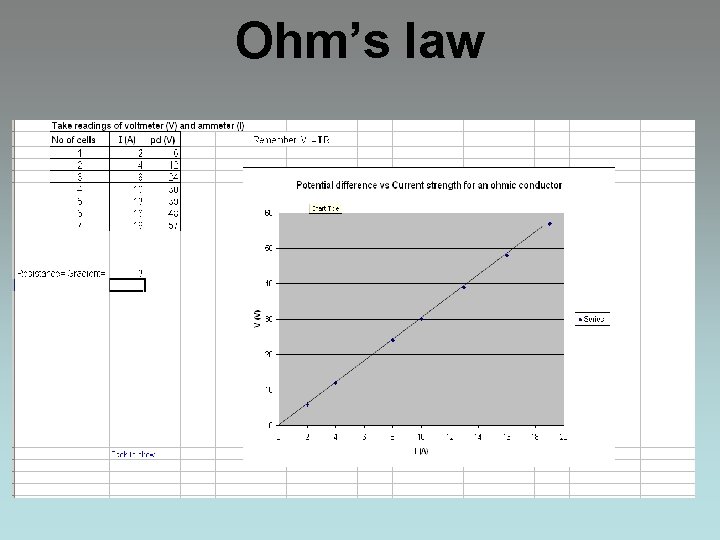
Ohm’s law
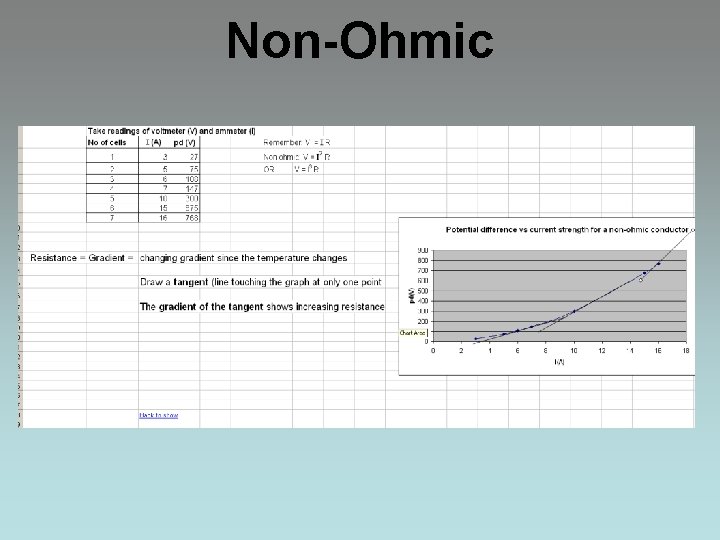
Non-Ohmic
- Slides: 8