
Current Concepts in the Scientific and Clinical Rationale

- Slides: 13
Current Concepts in the Scientific and Clinical Rationale Behind Exercises for Glenohumeral and Scapulothoracic Musculature Michael De. Lucia, SPT Cleveland State University 4/4/18
Purpose Combines knowledge of anatomy, biomechanics, and function of specific musculature to develop the most advantageous rehabilitation program. Provide an overview of the biomechanical and clinical implications associated with rehabilitation of the glenohumeral and scapulothoracic joints. Goal is to provide clinicians with a thorough overview of the available information to develop safe, potentially effective, and appropriate exercise programs for injury rehabilitation and prevention.
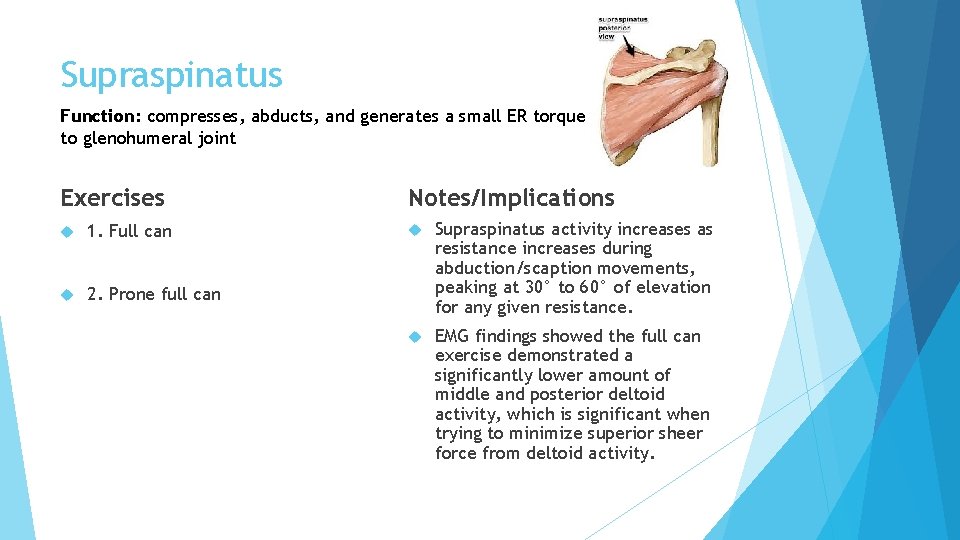
Supraspinatus Function: compresses, abducts, and generates a small ER torque to glenohumeral joint Exercises 1. Full can 2. Prone full can Notes/Implications Supraspinatus activity increases as resistance increases during abduction/scaption movements, peaking at 30° to 60° of elevation for any given resistance. EMG findings showed the full can exercise demonstrated a significantly lower amount of middle and posterior deltoid activity, which is significant when trying to minimize superior sheer force from deltoid activity.
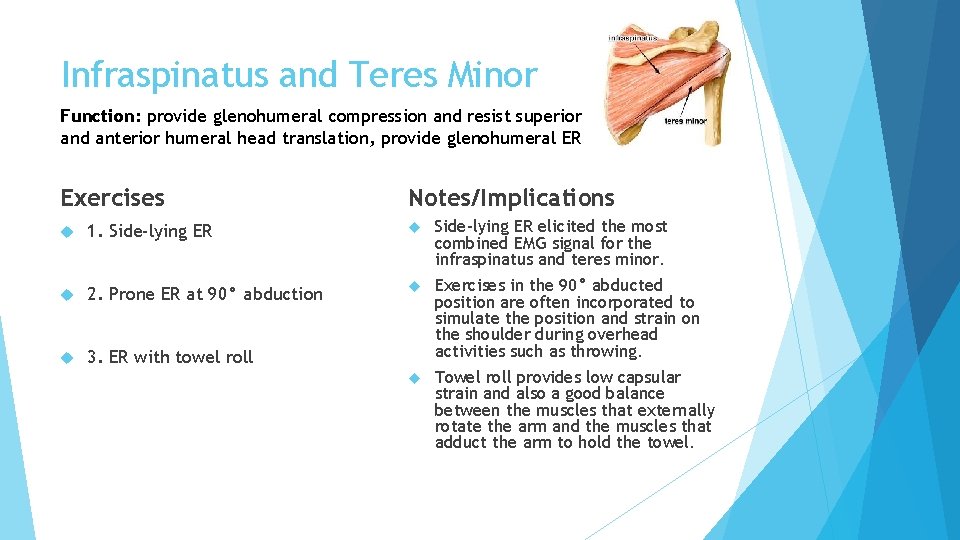
Infraspinatus and Teres Minor Function: provide glenohumeral compression and resist superior and anterior humeral head translation, provide glenohumeral ER Exercises Notes/Implications 1. Side-lying ER elicited the most combined EMG signal for the infraspinatus and teres minor. 2. Prone ER at 90° abduction 3. ER with towel roll Exercises in the 90° abducted position are often incorporated to simulate the position and strain on the shoulder during overhead activities such as throwing. Towel roll provides low capsular strain and also a good balance between the muscles that externally rotate the arm and the muscles that adduct the arm to hold the towel.
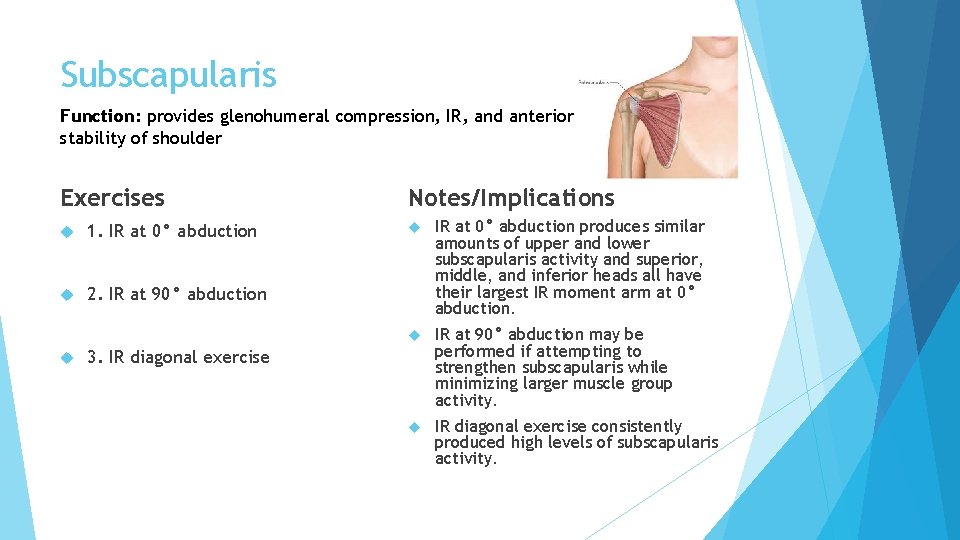
Subscapularis Function: provides glenohumeral compression, IR, and anterior stability of shoulder Exercises 1. IR at 0° abduction 2. IR at 90° abduction Notes/Implications IR at 0° abduction produces similar amounts of upper and lower subscapularis activity and superior, middle, and inferior heads all have their largest IR moment arm at 0° abduction. IR at 90° abduction may be performed if attempting to strengthen subscapularis while minimizing larger muscle group activity. IR diagonal exercise consistently produced high levels of subscapularis activity. 3. IR diagonal exercise
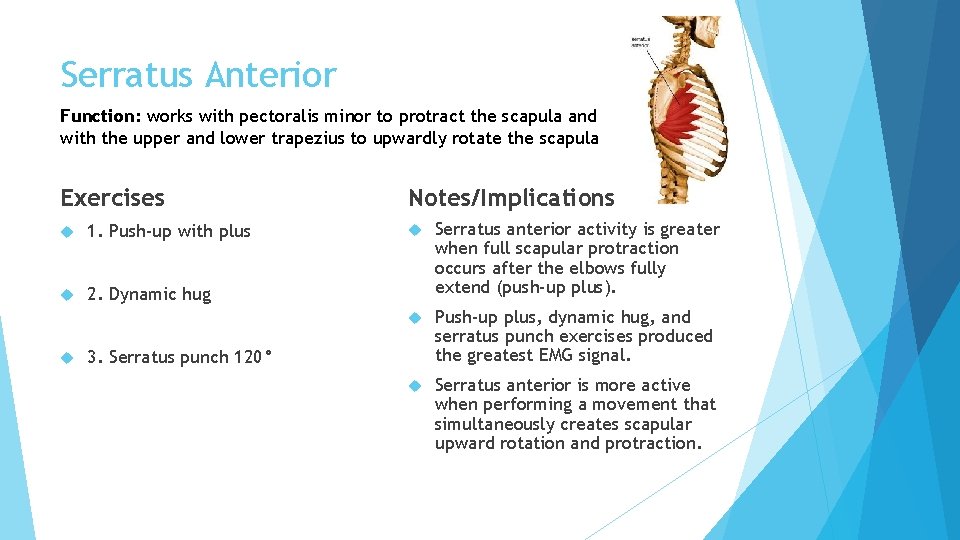
Serratus Anterior Function: works with pectoralis minor to protract the scapula and with the upper and lower trapezius to upwardly rotate the scapula Exercises 1. Push-up with plus 2. Dynamic hug Notes/Implications Serratus anterior activity is greater when full scapular protraction occurs after the elbows fully extend (push-up plus). Push-up plus, dynamic hug, and serratus punch exercises produced the greatest EMG signal. Serratus anterior is more active when performing a movement that simultaneously creates scapular upward rotation and protraction. 3. Serratus punch 120°
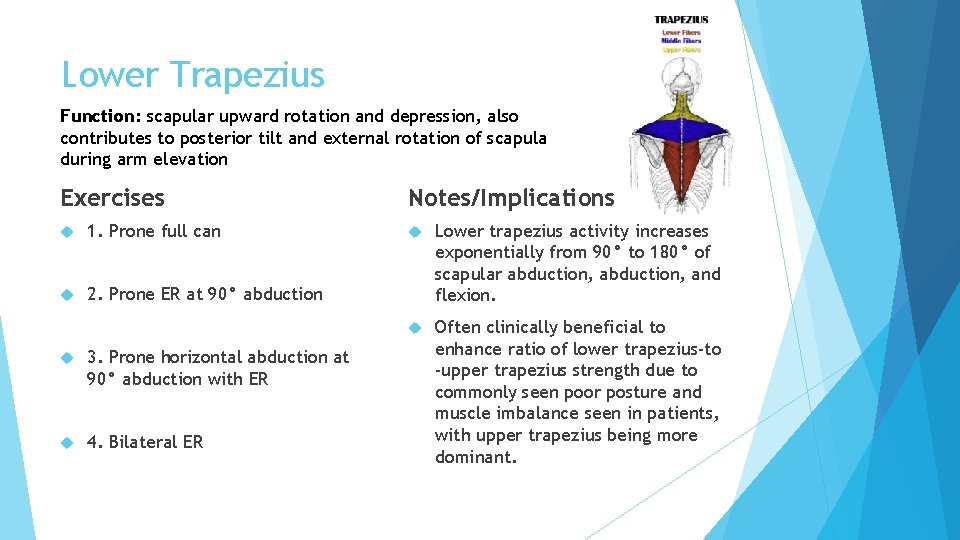
Lower Trapezius Function: scapular upward rotation and depression, also contributes to posterior tilt and external rotation of scapula during arm elevation Exercises 1. Prone full can 2. Prone ER at 90° abduction 3. Prone horizontal abduction at 90° abduction with ER 4. Bilateral ER Notes/Implications Lower trapezius activity increases exponentially from 90° to 180° of scapular abduction, and flexion. Often clinically beneficial to enhance ratio of lower trapezius-to -upper trapezius strength due to commonly seen poor posture and muscle imbalance seen in patients, with upper trapezius being more dominant.
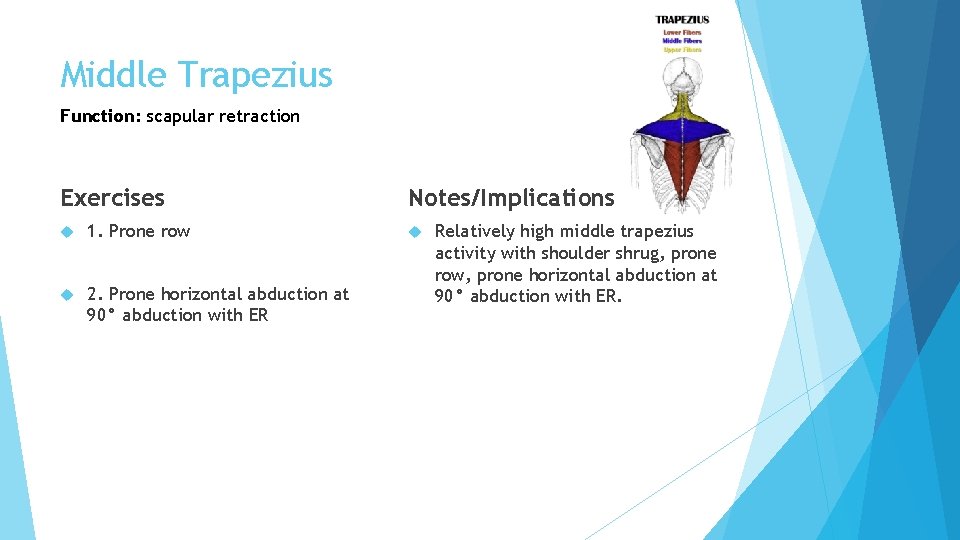
Middle Trapezius Function: scapular retraction Exercises 1. Prone row 2. Prone horizontal abduction at 90° abduction with ER Notes/Implications Relatively high middle trapezius activity with shoulder shrug, prone row, prone horizontal abduction at 90° abduction with ER.
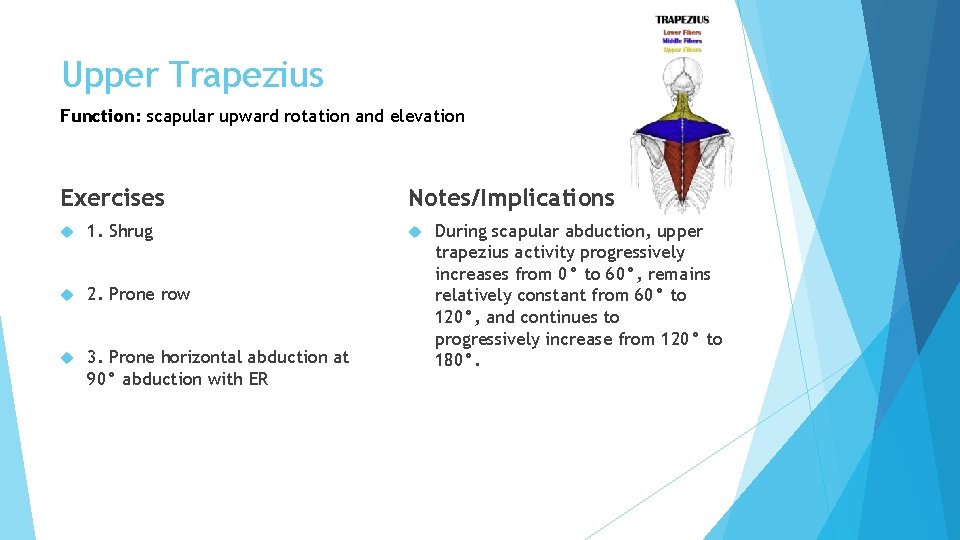
Upper Trapezius Function: scapular upward rotation and elevation Exercises 1. Shrug 2. Prone row 3. Prone horizontal abduction at 90° abduction with ER Notes/Implications During scapular abduction, upper trapezius activity progressively increases from 0° to 60°, remains relatively constant from 60° to 120°, and continues to progressively increase from 120° to 180°.
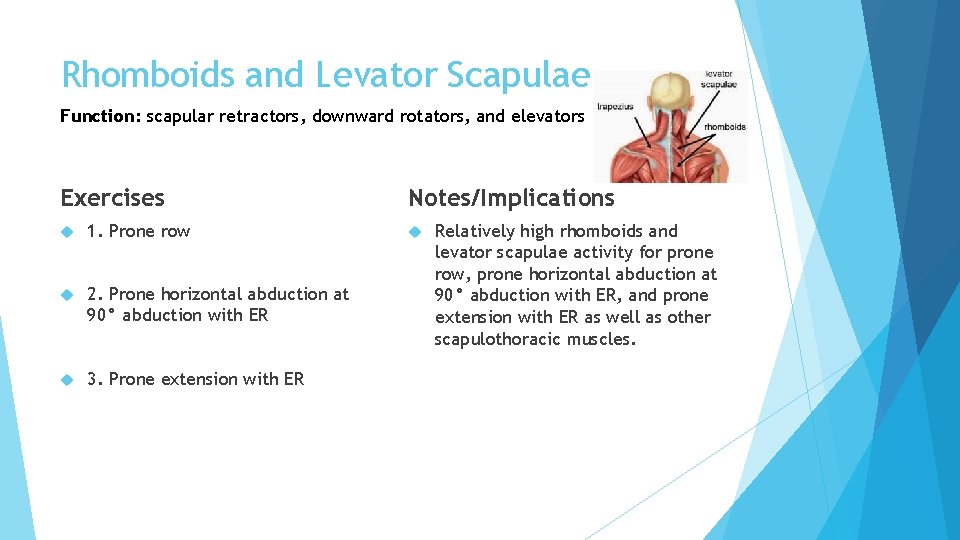
Rhomboids and Levator Scapulae Function: scapular retractors, downward rotators, and elevators Exercises 1. Prone row 2. Prone horizontal abduction at 90° abduction with ER 3. Prone extension with ER Notes/Implications Relatively high rhomboids and levator scapulae activity for prone row, prone horizontal abduction at 90° abduction with ER, and prone extension with ER as well as other scapulothoracic muscles.
Recommendations A common recommendation in rehabilitation is to limit the amount of weight used during glenohumeral and scapulothoracic exercises to assure that the appropriate muscles are being utilized and not larger compensatory muscles. However, more recent studies suggest that it appears that larger muscle groups do NOT overpower smaller groups, such as the rotator cuff. Thus, weight selection should be based on the individual goals and performance of each patient and it does not appear necessary to limit the amount of weight performed during these rotator cuff exercises.
Conclusion A thorough understanding of the biomechanical factors associated with normal shoulder movement, and during exercises, is necessary to safely and effectively design appropriate programs. These glenohumeral and scapulothoracic findings can be used clinically to design appropriate rehabilitation and injury prevention programs.
References Reinold MM, Escamilla R, Wilk KE. Current concepts in the scientific and clinical rationale behind exercises for glenohumeral and scapulothoracic musculature. Journal of Orthopaedic & Sports Physical Therapy. 2009; 39: 105 -117.