
Current Breast Cancer Screening Guidelines Women at Average
Current Breast Cancer Screening Guidelines: Women at Average Risk
Objectives During this presentation the learner will be able to: 1. Understand current breast cancer screening guidelines for mammography. 2. Compare and contrast the current breast cancer screening guidelines for clinical breast exam and breast self exam. 3. Do a clinical breast exam according to the most current recommendations.
Breast Cancer in the US According to ACS : • Most common cancer among American women, except for skin cancers. • Is the second leading cause of cancer death in women, exceeded only by lung cancer. • About 1 in 8 (12%) women in the US will develop invasive breast cancer during their lifetime( Life time risk 12%) •
Breast Cancer in the US • The chance that breast cancer will be responsible for a woman's death is about 1 in 36 (about 3%). • Since 1989, breast cancer deaths have been declining. Larger decreases in women <50 yrs old. • 2. 9 million breast cancer survivors in the United States. • 10 Year Risk for breast cancer : • Age 40 - 1 in 69 • Age 50 1 in 42 • Age 60 1 in 29 According to ACS , In 2013: • 232, 340 new cases of invasive breast cancer • 64, 640 new cases of in situ breast cancer • 39, 620 breast cancer deaths.

Breast Cancer Screening Recommendations for Women at Average Risk Susan G. Komen for the Cure American Cancer Society National Cancer Institute NCCN U. S Preventive Services Task Force ACOG Mammography Every year beginning at age 40. Every 1 -2 years beginning at age 40. Every year beginning at age 40. Informed decision-making with a health care provider ages 40 -49 - although (C recommendation) USPSTF recommends against. Every 2 years ages 50 -74. Screening mammography every 1 -2 years for women aged 40 -49 years Screening mammography every year for women aged 50 years or older. Clinical Breast Exam At least every 3 years ages 20 -39. Every year beginning at age 40. No specific recommendation Every 1 -3 years ages 20 -39. Every year beginning at age 40. Use as supplement. Not enough evidence to recommend for or against. CBE every year for women aged 19 or older Breast Self Exam Providers should discuss benefits & Not recommended as screening tool. Recommends However rec: patients become familiar with limitations. Patient may “breast awareness” their breasts choose to do BSE or choose not too. Moderate certainty harm>benefit (based on 2 trials outside US). Recommends against teaching breast self-examination (BSE). BSE has the potential to detect palpable breast cancer and can be recommended.
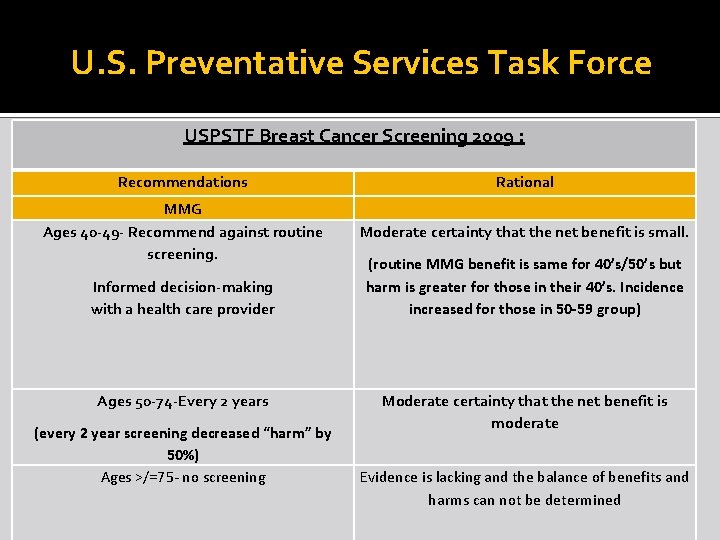
U. S. Preventative Services Task Force USPSTF Breast Cancer Screening 2009 : Recommendations Rational MMG Ages 40 -49 - Recommend against routine screening. Moderate certainty that the net benefit is small. Informed decision-making with a health care provider Ages 50 -74 -Every 2 years (every 2 year screening decreased “harm” by 50%) Ages >/=75 - no screening (routine MMG benefit is same for 40’s/50’s but harm is greater for those in their 40’s. Incidence increased for those in 50 -59 group) Moderate certainty that the net benefit is moderate Evidence is lacking and the balance of benefits and harms can not be determined
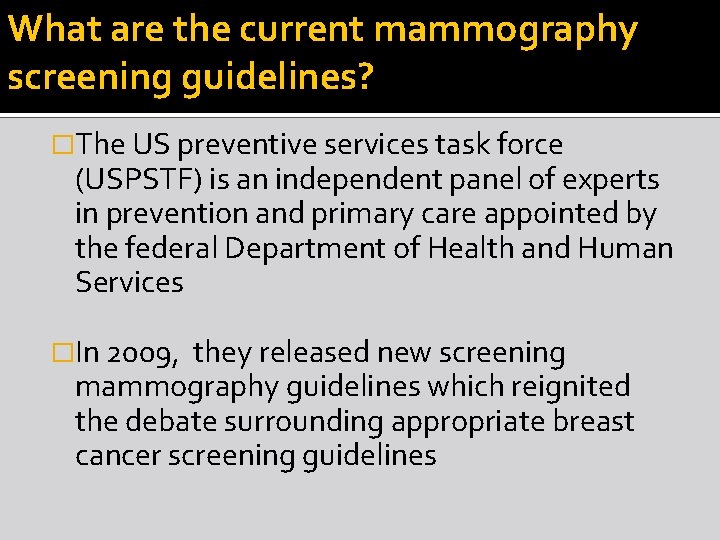
What are the current mammography screening guidelines? �The US preventive services task force (USPSTF) is an independent panel of experts in prevention and primary care appointed by the federal Department of Health and Human Services �In 2009, they released new screening mammography guidelines which reignited the debate surrounding appropriate breast cancer screening guidelines
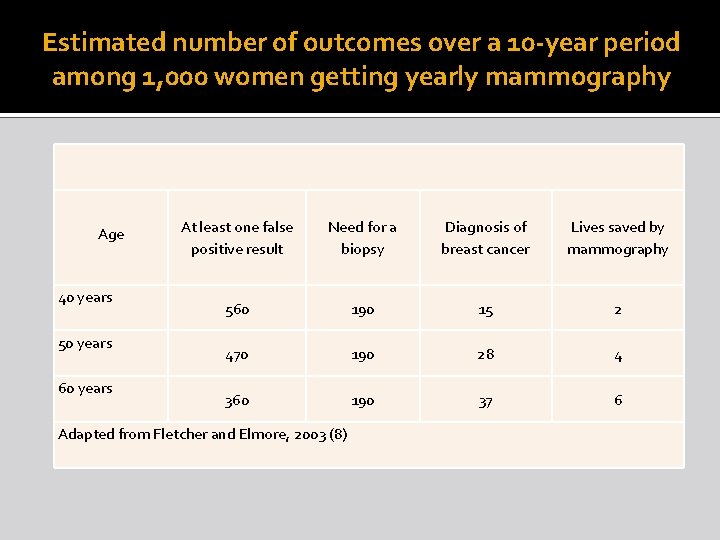
Estimated number of outcomes over a 10 -year period among 1, 000 women getting yearly mammography Age 40 years 50 years 60 years At least one false positive result Need for a biopsy Diagnosis of breast cancer Lives saved by mammography 560 190 15 2 470 190 28 4 360 190 37 6 Adapted from Fletcher and Elmore, 2003 (8)
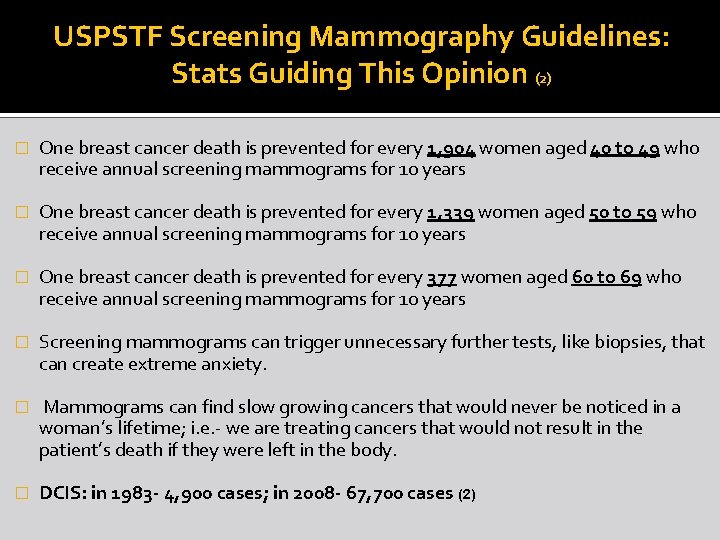
USPSTF Screening Mammography Guidelines: Stats Guiding This Opinion (2) � One breast cancer death is prevented for every 1, 904 women aged 40 to 49 who receive annual screening mammograms for 10 years � One breast cancer death is prevented for every 1, 339 women aged 50 to 59 who receive annual screening mammograms for 10 years � One breast cancer death is prevented for every 377 women aged 60 to 69 who receive annual screening mammograms for 10 years � Screening mammograms can trigger unnecessary further tests, like biopsies, that can create extreme anxiety. � Mammograms can find slow growing cancers that would never be noticed in a woman’s lifetime; i. e. - we are treating cancers that would not result in the patient’s death if they were left in the body. � DCIS: in 1983 - 4, 900 cases; in 2008 - 67, 700 cases (2)
“Overdiagnosis” � When screening detects early-stage IBC & DCIS Older- probably to die of another cause Younger- finding non aggressive lesions which would never progress to invasive cancer. � A 2012 journal article (Annals of Internal Medicine- April) analyzed different counties in Norway – screened & unscreened. �* Since science cannot accurately predict which tumors are harmless and which are more aggressive, it’s necessary to treat any tumor that's found as if it's deadly.
Early MMG Screening: �According to ACOG (7) ▪ Screening mammography every 1 -2 years for women aged 40 -49 years In 2008 – 10 yr expected breast cancer deaths over 10 yr period for women aged 40 -49 - 204 out of 100, 000= 45, 492 RR: 0. 85 breast cancer mortality in women in their 40’s by MMG~ an estimated 38, 668 deaths would occur in a screened population over 10 yrs 6800 fewer deaths than the expected 10 yr death rate. Fewer deaths expected with screening compared to the predicted deaths demonstrates the significant benefit of screening on mortality in this age group.
Clinical Breast Exam: � According to ACOG : � According to USPTF : � Studies on CBEs suggest they can help detect breast cancer early, particularly when used in conjunction with mammograms. MMG sensitivity @ 85 -90%- age >50; MMG sensitivity @ 75% - age 40 -50. MMG will miss 1 in every 4 breast cancers in women between the ages of 40 and 50. CBE addresses gaps in screening sensitivity. CBE + MMG= > detection of breast cancer ages >/=40 Recommends: Women ages 19 -39 should have a CBE every 1 -3 yrs by their provider. Recommends: Women age >/=40 should have an annual CBE by their provider. Not Enough Evidence for or against. May use as supplemental. Challenges Identified: False positive/ false negatives Lack of standardization (terminology, format, interpretation & reporting) No randomized trials / Limited availability of data to address questions about CBE in its role in breast cancer detection
Breast Self Exam: � According to ACOG: BSE has the potential to detect palpable breast cancer and can be recommended. � According to USPSTF: � Recommends against BSE- Moderate certainty harm>benefit (based on 2 trials outside US). ** Challenges Identified: � "The goal is for women to be alert to any changes, no matter how small, in their breasts, and report them to their doctor, " Jennifer Griffin, MD, MPH, co-author of the ACOG guidelines Fear of “doing it right” False positive/ false negative Unnecessary biopsies & additional diagnostic resources Recommendations by supporters: Performing them regularly Newer concept called "breast self-awareness. “ BSE techniques should be reviewed during PE with provider and warning signs of breast cancer should be reviewed. Reporting changes to health care professional
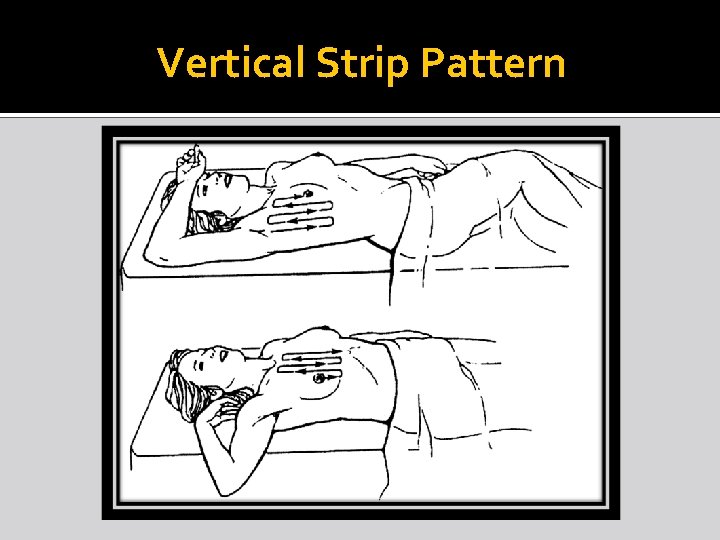
Vertical Strip Pattern
CBE Video �Patient education Clinical Breast Exam Video: �http: //vimeo. com/36117114
Discussion • Why is all of this important? • Healthcare reform • Patients • Others • What if it was your mother, sister/ friend? • Questions to ponder?
Apply it: Which of these statements would a nurse include in her teaching to a 42 year old at her annual exam? a. She does not have a family history of breast cancer so she should wait until she is 50 to have her first MMG. b. She should be given information regarding the various recommendations for breast cancer screening and she can choose to have a baseline MMG now. c. She should be taught breast awareness. d. She should begin her MMG at age 50 and should have a MMG every 5 years.
Reference List � � American Cancer Society (2014). American Cancer Society recommendations for early breast cancer detection in women without breast symptoms. Retrieved on June 9, 2014 from http: //www. cancer. org/cancer/breastcancer/moreinformation/breastcancerearlydetection/breast-cancer-early-detection-acs -recs � American Cancer Society (2014). What are the key statistics about breast cancer? Retrieved on June 9, 2014 from http: //www. cancer. org/cancer/breastcancer/detailedguide/breast-cancer-key-statistics � American College of Obstetrics & Gynecology. (2009). Interpreting the U. S. Preventive Services Task Force Breast Cancer Screening Recommendations for the General Population. Retrieved on June 9, 2014 from http: //www. acog. org/About_ACOG/News_Room/News_Releases/2009/Interpreting_the_US_Preventive_Services_Task_For ce � Fletcher SW and Elmore JG (2009). Clinical practice. Mammographic screening for breast cancer. N ew England Journal of Medicine, 348: 1672 -80. � National Cancer Institute (2010) Seer Stat fact Sheets: Breast Cancer. Retrieved on June 9, 2014 from http: //seer. cancer. gov/statfacts/html/breast. html � National Comprehensive Cancer Network. (2013). Patient Guidelines. Retrieved on April 10, 2013 from http: //www. nccn. org/patients/patient_guidelines/breast/index. html � Susan B. Komen (2014). Breast cancer Screening Recommendations for Women at Average Risk. Retrieved on June 9, 2014 from http: //ww 5. komen. org/Breast. Cancer/General. Recommendations. html � United States Preventative Services Task Force (2009). Screening for Breast Cancer. Retrieved on June 9, 2014 from http: //www. uspreventiveservicestaskforce. org/uspstf 09/breastcancer/brcanrs. htm
- Slides: 18