
Current and Resistance Goal of the class Describe
Current and Resistance
Goal of the class • Describe the basic properties of electric current, and solve problems relating current, charge, and time. • Calculate resistance, current, and potential difference by using the definition of resistance • Question of the Day: What factors affect the resistance of a piece of wire? • Previous answer: No previous question
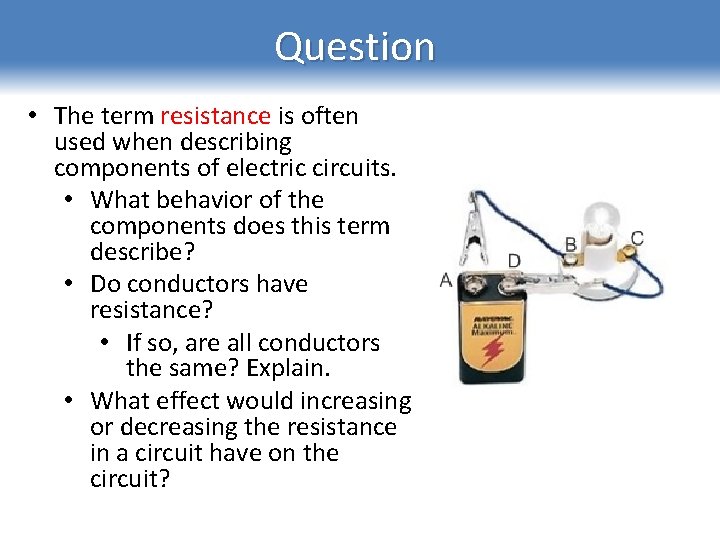
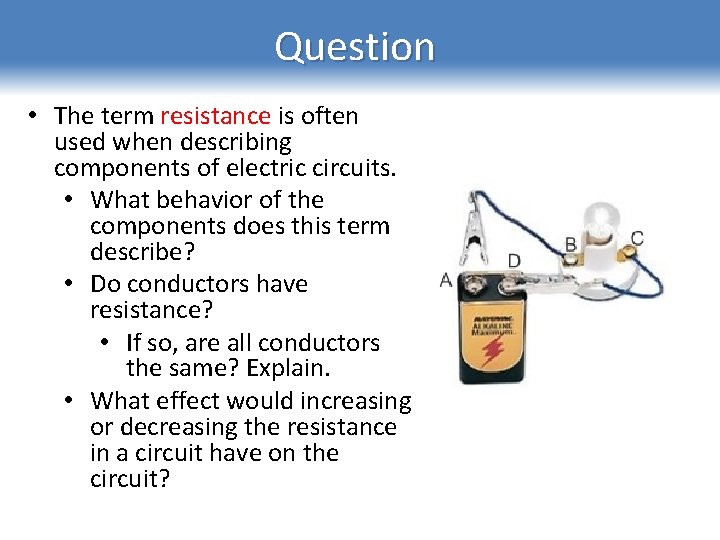
Question • The term resistance is often used when describing components of electric circuits. • What behavior of the components does this term describe? • Do conductors have resistance? • If so, are all conductors the same? Explain. • What effect would increasing or decreasing the resistance in a circuit have on the circuit?
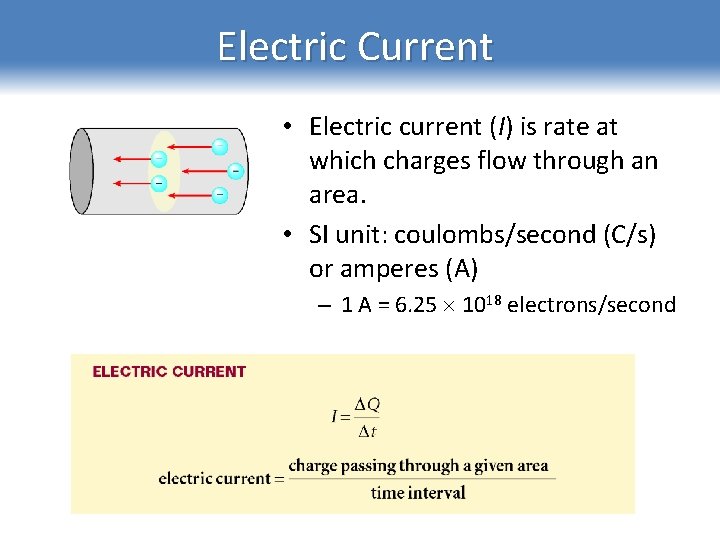
Electric Current • Electric current (I) is rate at which charges flow through an area. • SI unit: coulombs/second (C/s) or amperes (A) – 1 A = 6. 25 1018 electrons/second - +
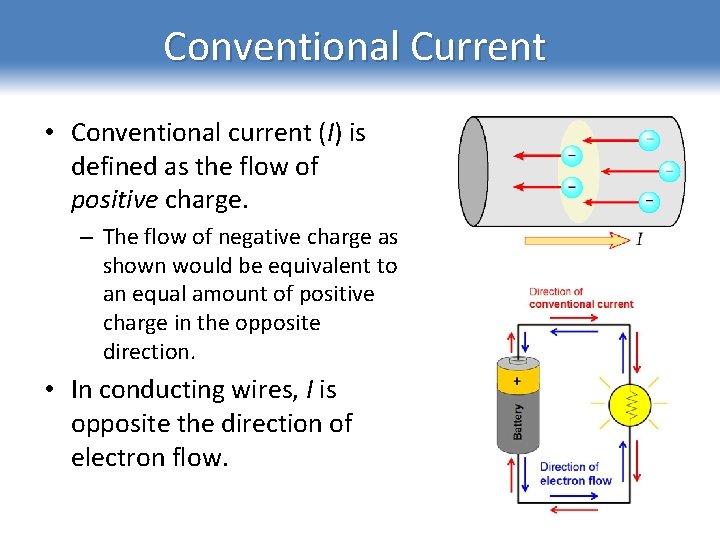
Conventional Current • Conventional current (I) is defined as the flow of positive charge. – The flow of negative charge as shown would be equivalent to an equal amount of positive charge in the opposite direction. • In conducting wires, I is opposite the direction of electron flow.
Velocity of Electrons Through Wires • When you turn on a wall switch for a light, electrons flow through the bulb. Which speed below do you believe most closely approximates that of the electrons? – The speed of light (300 000 m/s) – 1 000 m/s – 10 m/s – 0. 0001 m/s • Why do you think so?
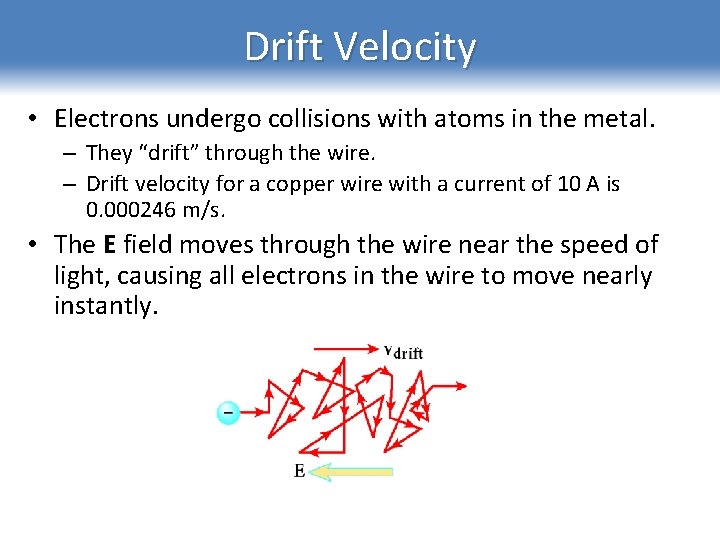
Drift Velocity • Electrons undergo collisions with atoms in the metal. – They “drift” through the wire. – Drift velocity for a copper wire with a current of 10 A is 0. 000246 m/s. • The E field moves through the wire near the speed of light, causing all electrons in the wire to move nearly instantly.
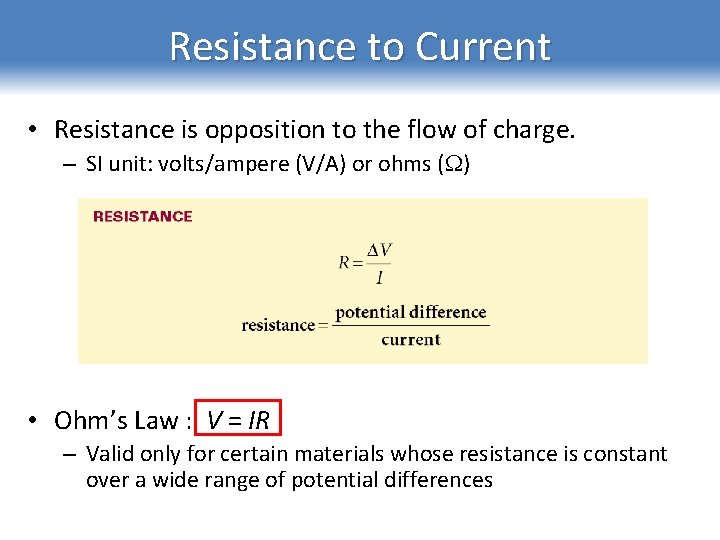
Resistance to Current • Resistance is opposition to the flow of charge. – SI unit: volts/ampere (V/A) or ohms ( ) • Ohm’s Law : V = IR – Valid only for certain materials whose resistance is constant over a wide range of potential differences
Practice Problems • A typical 100 W light bulb has a current of 0. 83 A. How much charge flows through the bulb filament in 1. 0 h? How many electrons would flow through in the same time period? – Answers: 3. 0 103 C, 1. 9 1022 electrons • This same 100 watt bulb is connected across a 120 V potential difference. Find the resistance of the bulb. – Answer: 1. 4 102
Resistance of a Wire • On the next slide, predict the change necessary to increase the resistance of a piece of wire with respect to: – Length of wire – Cross sectional area or thickness of the wire – Type of wire – Temperature of the wire
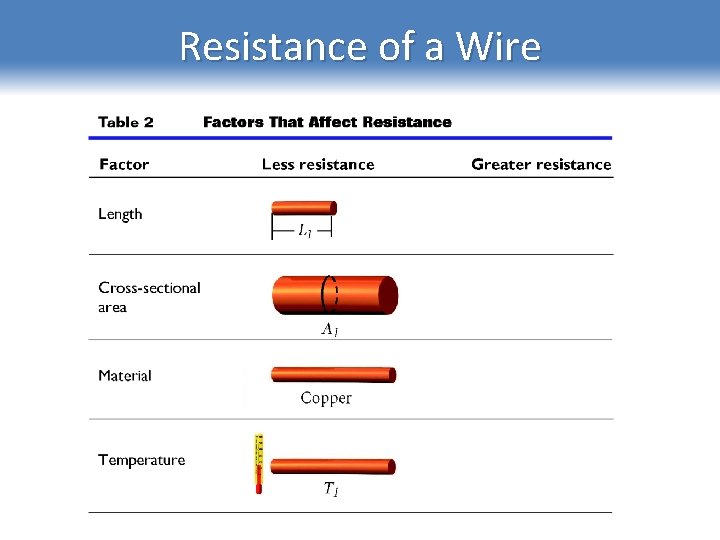
Resistance of a Wire
Applications • Resistors in a circuit can change the current. – Variable resistors (potentiometers) are used in dimmer switches and volume controls. – Resistors on circuit boards control the current to components. • The human body’s resistance ranges from 500, 000 (dry) to 100 (soaked with salt water). – Currents under 0. 01 A cause tingling. – Currents greater than 0. 15 A disrupt the heart’s electrical activity.
Question • The term resistance is often used when describing components of electric circuits. • What behavior of the components does this term describe? • Do conductors have resistance? • If so, are all conductors the same? Explain. • What effect would increasing or decreasing the resistance in a circuit have on the circuit?
Homework • Please complete questions on page 616 • Q 22, 29, 33, 35, 42
- Slides: 14