
Current and Resistance Chapter 17 Lesson 3 p

- Slides: 17
Current and Resistance Chapter 17 Lesson 3 p. 608
Current and Charge Movement • Electricity became an integral part of our daily lives when scientists learned to control the movement of electric charge, called current. • Electric currents are even part of the human body. (Luigi Galvani’s experiment) • Electric currents are responsible for transmitting messages between body muscles and the brain. In fact, every function involving the nervous system is initiated by electrical activity.
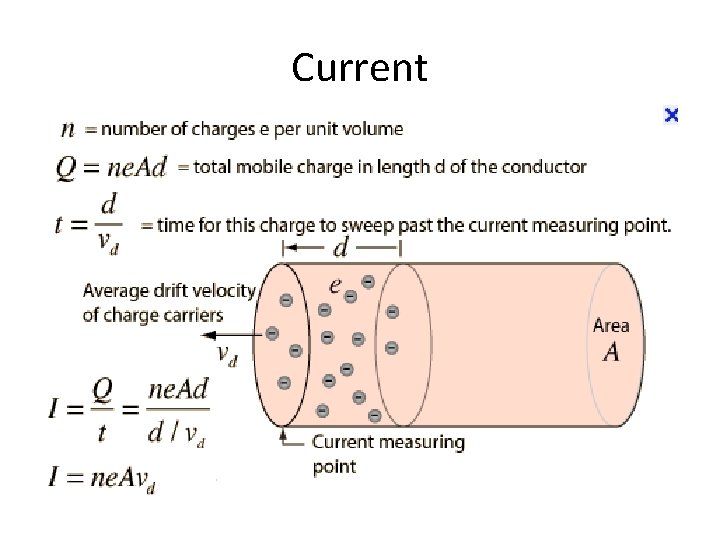
Current
Electric Current • Definition: the rate at which electric charges pass through a given area. • Formula: electric current = charge passing through a given area time interval • The SI unit for current is ampere. • 1 A = 1 C/s
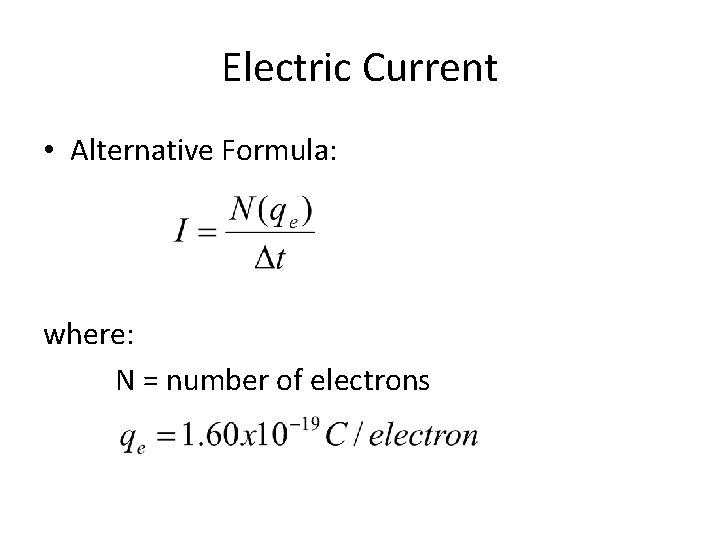
Electric Current • Alternative Formula: where: N = number of electrons
Word Problems (Practice C) 1. The current in a light bulb is 0. 835 A. How long does it take for a total charge of 1. 67 C to pass through the filament of the bulb? (Sample Problem C, p. 609) 2. The compressor on an air conditioner draws 40. 0 A when it starts up. If the start-up time is 0. 50 s, how much charge passes a crosssectional area of the circuit in this time? (Practice C, # 4, p. 609)
Word Problems 3. A total charge of 9. 0 m. C passes through a cross-sectional area of a nichrome wire in 3. 5 s. a. What is the current in the wire? b. How many electrons pass through the cross -sectional area in 10. 0 s? c. If the number of charges that pass through the cross-sectional area during the given time interval doubles, what is the resulting current? (Practice C, # 5, p. 609)
Conventional Current • Positive and negative charges in motion are called charge carriers. • Conventional current is defined in terms of the flow of positive charges. • For a material to be a good conductor, charge carriers in the material must be able to move easily through the material. • Body fluids and salt water are able to conduct electric charge because they contain charged atoms called ions. • An electrolyte is a solute that dissolves in water to give a solution that conducts electric current.
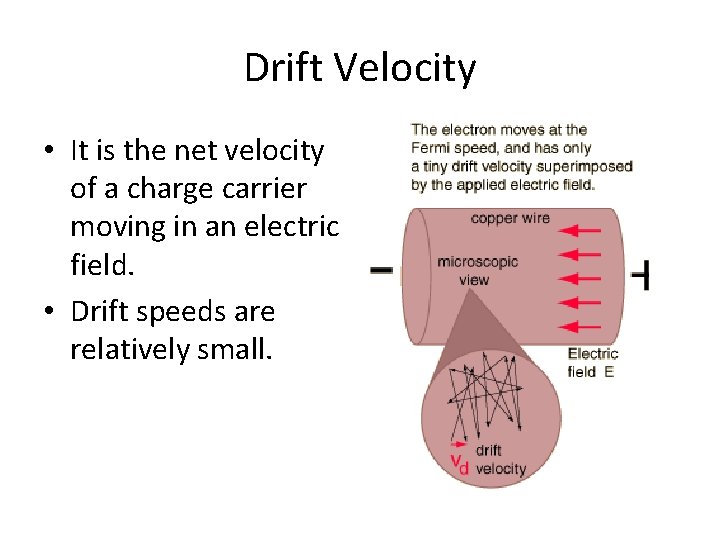
Drift Velocity • It is the net velocity of a charge carrier moving in an electric field. • Drift speeds are relatively small.
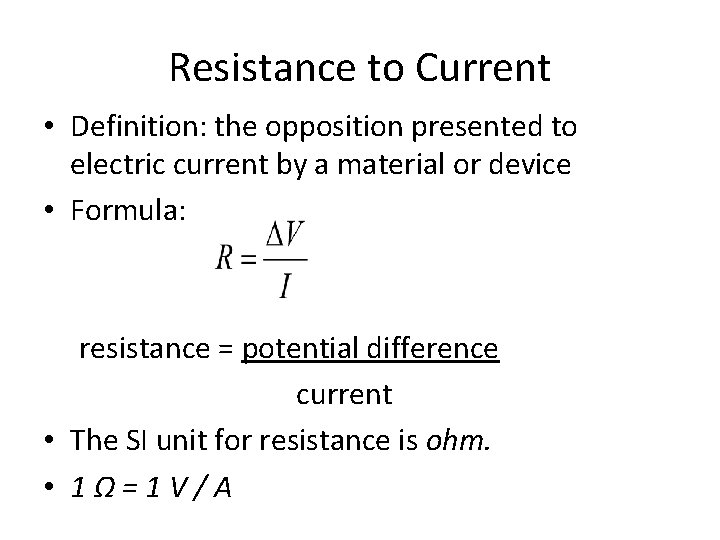
Resistance to Current • Definition: the opposition presented to electric current by a material or device • Formula: resistance = potential difference current • The SI unit for resistance is ohm. • 1Ω=1 V/A
Ohm’s Law • Resistance is constant over a range of potential differences. • Georg Simon Ohm (1789 – 1854), was the first to conduct a systematic study of electrical resistance. • ∆V = IR • Ohm’s law does not hold true for all materials. (non-ohmic, e. g. diode)
Factors Affecting Resistance 1. Length – the longer, the greater resistance 2. Cross-sectional Area – the larger, the lesser resistance 3. Material – conductors have lesser resistance than insulators 4. Temperature – higher temperature means greater resistance
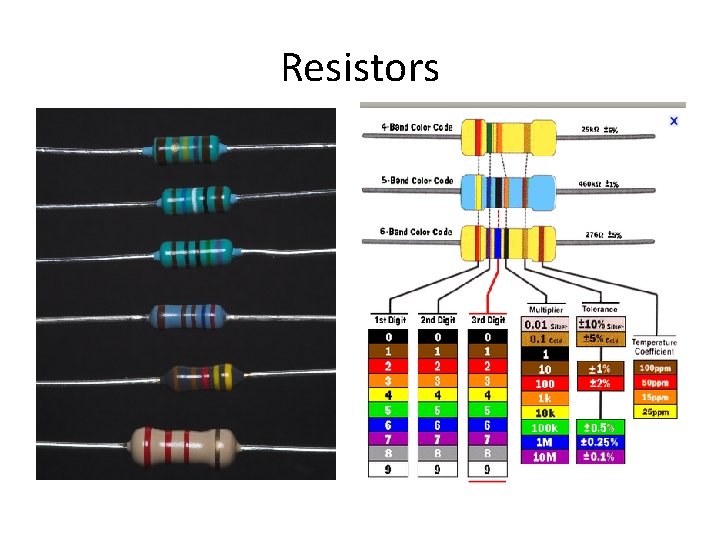
Resistors
Resistors • Resistors can be used to control the amount of current in a conductor. This is often more practical than changing the potential difference or the properties of the conductor. • Salt water and perspiration lower the body’s resistance. • Salt water contains ions that readily conduct electric charge.
Resistors • In a galvanic skin response (GSR) test, commonly used as a stress test and as part some so-called lie detectors, a very small potential difference is set up across the body. • In GSR tests, a state of low stress and high resistance, or “normal” state, is used as a control, and a state of higher stress is reflected as a decreased resistance compared with the normal state.
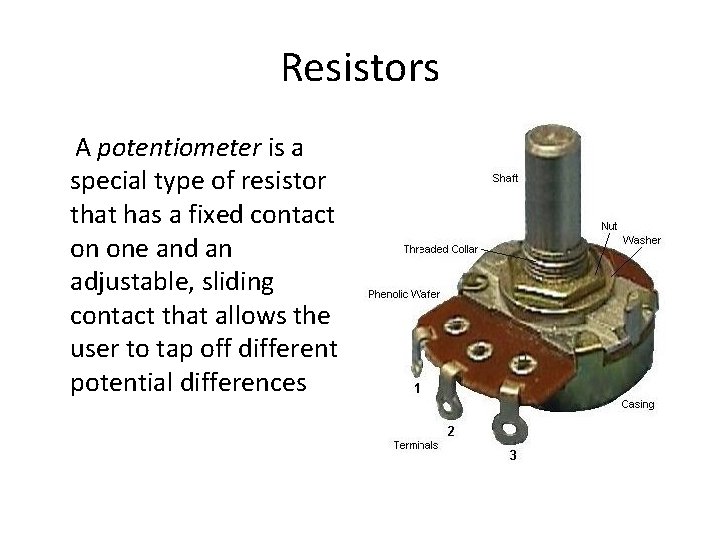
Resistors A potentiometer is a special type of resistor that has a fixed contact on one and an adjustable, sliding contact that allows the user to tap off different potential differences
Word Problems (Practice D) 1. A 1. 5 V battery is connected to a small light bulb with a resistance of 3. 5 Ω. What is the current in the bulb? (#1, p. 615) 2. The current in a microwave oven is 6. 25 A. If the resistance of the oven’s circuitry is 17. 6 Ω, what is the potential difference across the oven? (# 4, p. 615) 3. A typical color television draws 2. 5 A of current when connected across a potential difference of 115 V. What is the effective resistance of the television set? (#5, p. 615)