
Current and potential difference Summary Series circuits Parallel

- Slides: 7
Current and potential difference
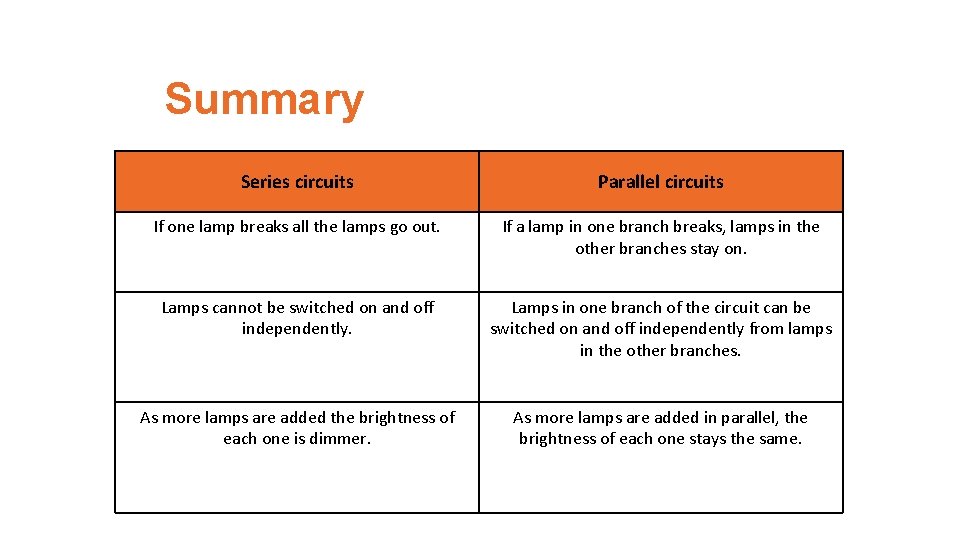
Summary Series circuits Parallel circuits If one lamp breaks all the lamps go out. If a lamp in one branch breaks, lamps in the other branches stay on. Lamps cannot be switched on and off independently. Lamps in one branch of the circuit can be switched on and off independently from lamps in the other branches. As more lamps are added the brightness of each one is dimmer. As more lamps are added in parallel, the brightness of each one stays the same.
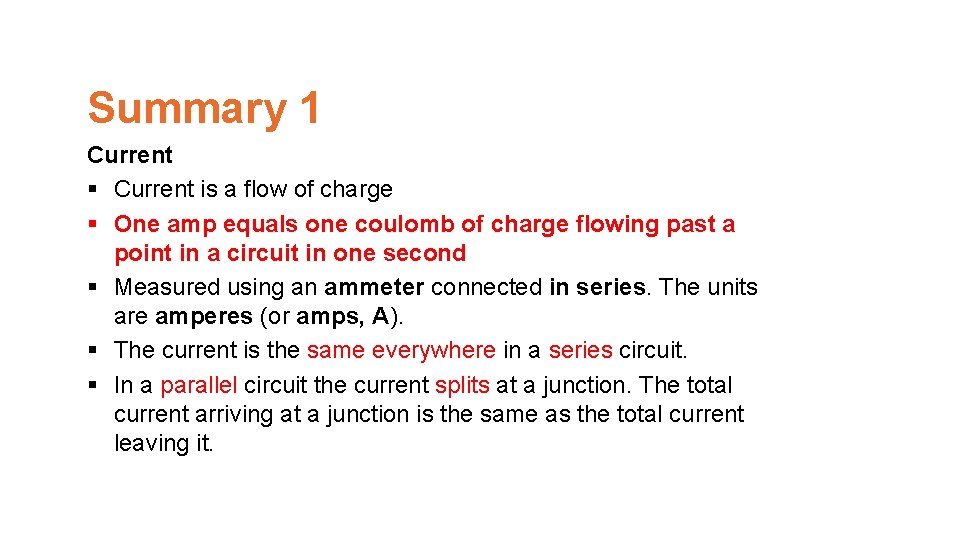
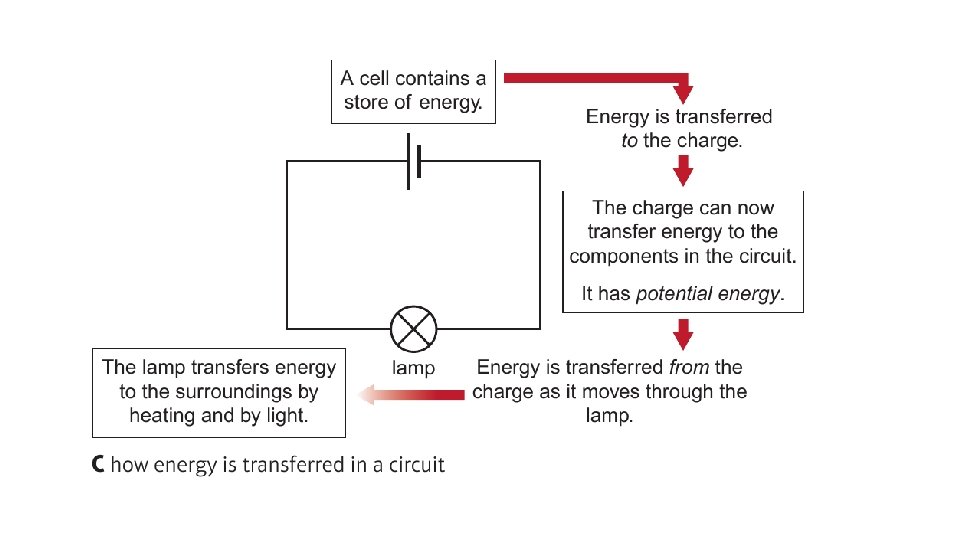
Summary 1 Current § Current is a flow of charge § One amp equals one coulomb of charge flowing past a point in a circuit in one second § Measured using an ammeter connected in series. The units are amperes (or amps, A). § The current is the same everywhere in a series circuit. § In a parallel circuit the current splits at a junction. The total current arriving at a junction is the same as the total current leaving it.
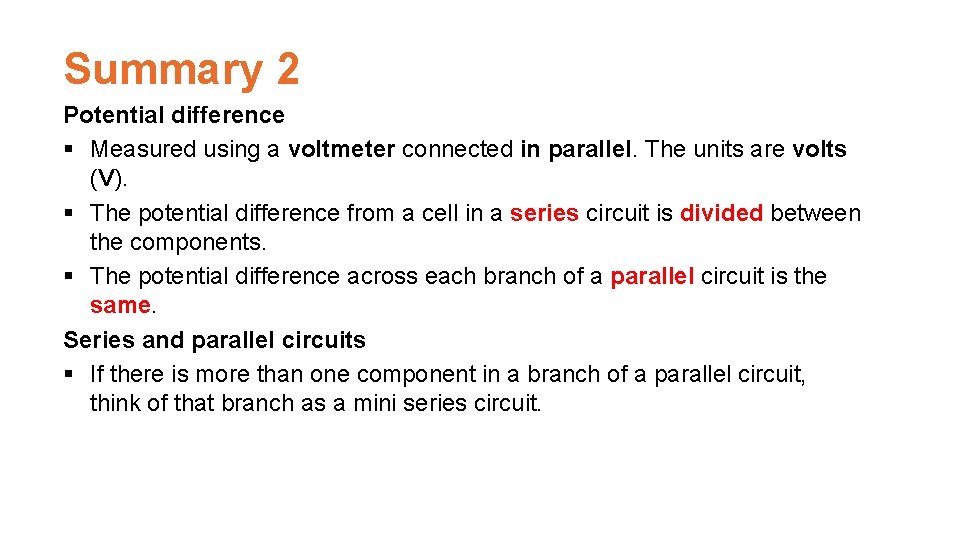
Summary 2 Potential difference § Measured using a voltmeter connected in parallel. The units are volts (V). § The potential difference from a cell in a series circuit is divided between the components. § The potential difference across each branch of a parallel circuit is the same. Series and parallel circuits § If there is more than one component in a branch of a parallel circuit, think of that branch as a mini series circuit.
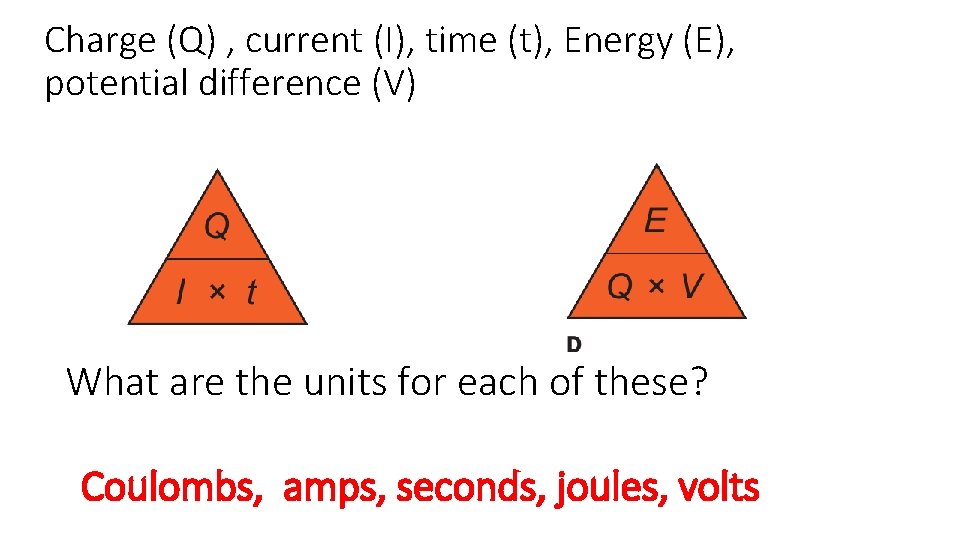
Charge (Q) , current (I), time (t), Energy (E), potential difference (V) What are the units for each of these? Coulombs, amps, seconds, joules, volts