
Current and future developments in alkene polymerization v
- Slides: 7
Current and future developments in alkene polymerization v Synthesis of polyolefins with long chain branches; v Synthesis of block copolymers via chain-shuttle polymerization; v. Nanocomposites based on polyolefins via in-situ polymerization; v Ethylene/polar alkenes copolimerization.
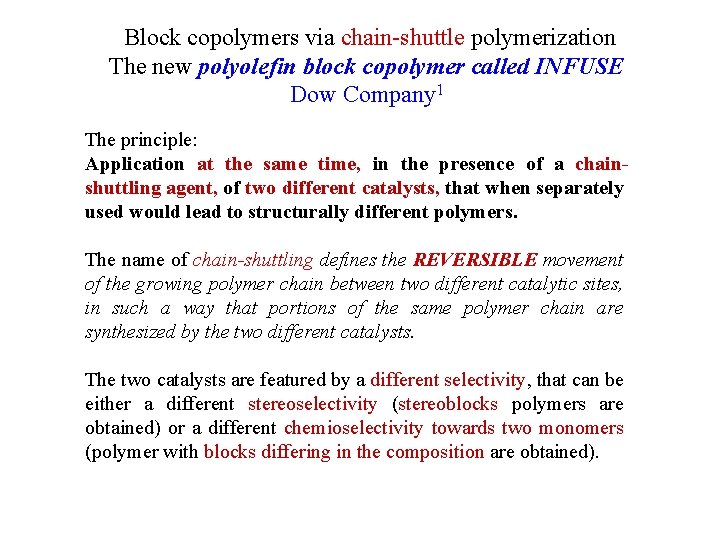
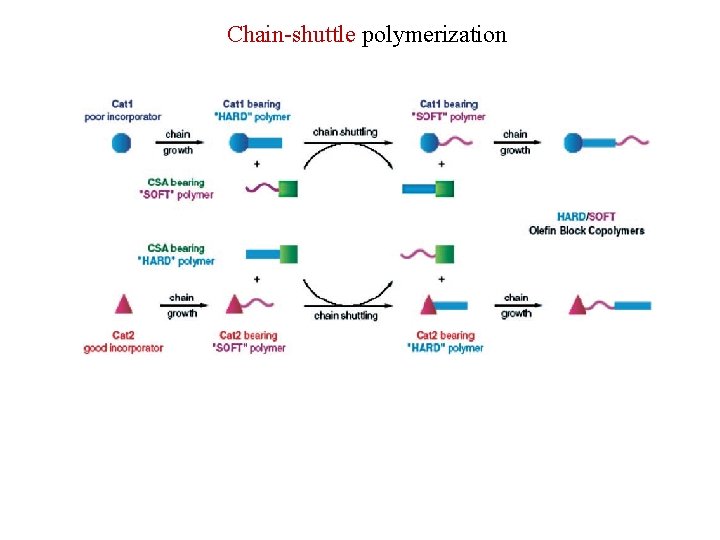
Block copolymers via chain-shuttle polymerization The new polyolefin block copolymer called INFUSE Dow Company 1 The principle: Application at the same time, in the presence of a chainshuttling agent, of two different catalysts, that when separately used would lead to structurally different polymers. The name of chain-shuttling defines the REVERSIBLE movement of the growing polymer chain between two different catalytic sites, in such a way that portions of the same polymer chain are synthesized by the two different catalysts. The two catalysts are featured by a different selectivity, that can be either a different stereoselectivity (stereoblocks polymers are obtained) or a different chemioselectivity towards two monomers (polymer with blocks differing in the composition are obtained).
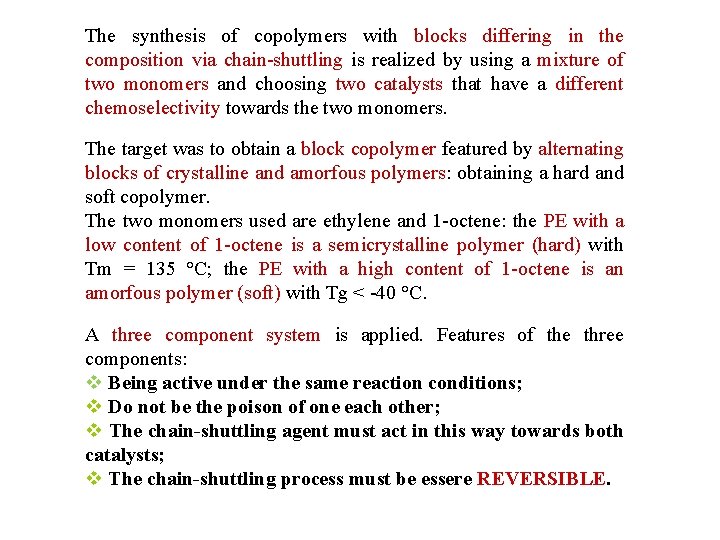
The synthesis of copolymers with blocks differing in the composition via chain-shuttling is realized by using a mixture of two monomers and choosing two catalysts that have a different chemoselectivity towards the two monomers. The target was to obtain a block copolymer featured by alternating blocks of crystalline and amorfous polymers: obtaining a hard and soft copolymer. The two monomers used are ethylene and 1 -octene: the PE with a low content of 1 -octene is a semicrystalline polymer (hard) with Tm = 135 °C; the PE with a high content of 1 -octene is an amorfous polymer (soft) with Tg < -40 °C. A three component system is applied. Features of the three components: v Being active under the same reaction conditions; v Do not be the poison of one each other; v The chain-shuttling agent must act in this way towards both catalysts; v The chain-shuttling process must be essere REVERSIBLE.
Chain-shuttle polymerization
The catalytic system is very versatile v the hard/soft ratio in the polymer is controlled by the relative amount of the two catalysts; v the content of the two monomers in the relavant blocks is controlled either by the content of the two monomers in the starting mixture or by varying the catalyst; v the average length of the blocks is controlled by the [CSA]/[monomer] ratio.
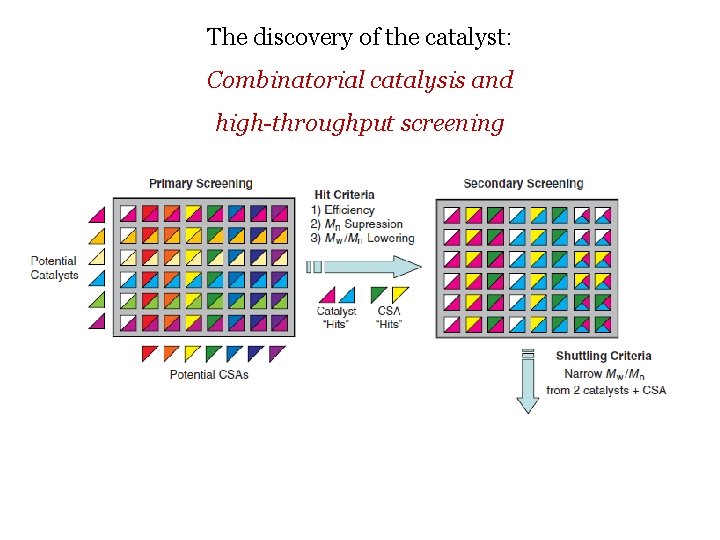
The discovery of the catalyst: Combinatorial catalysis and high-throughput screening
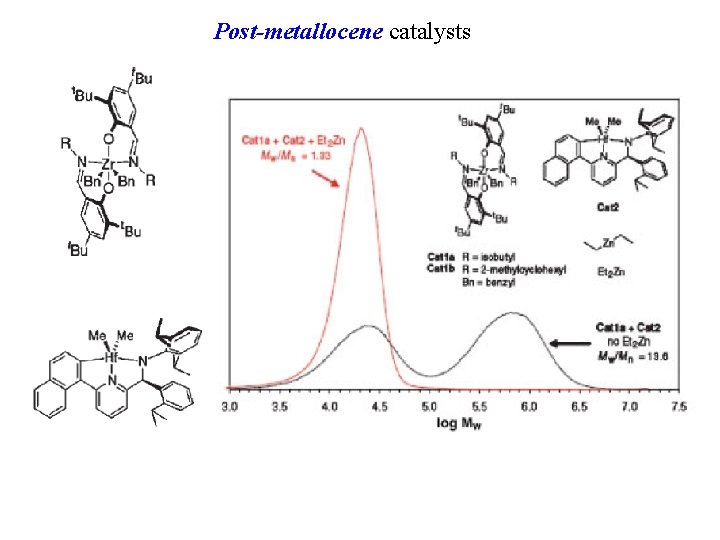
Post-metallocene catalysts