
Curl Curl is effect of differential dimensional changes


- Slides: 11
Curl: Curl is effect of differential dimensional changes between layers in a sheet. Basically curl occurs when layers within a sheet expand or contract unevenly when they originally started out at equal length. Uneven shrinkage (or expansion) produces a bending moment because of uneven shear forces.
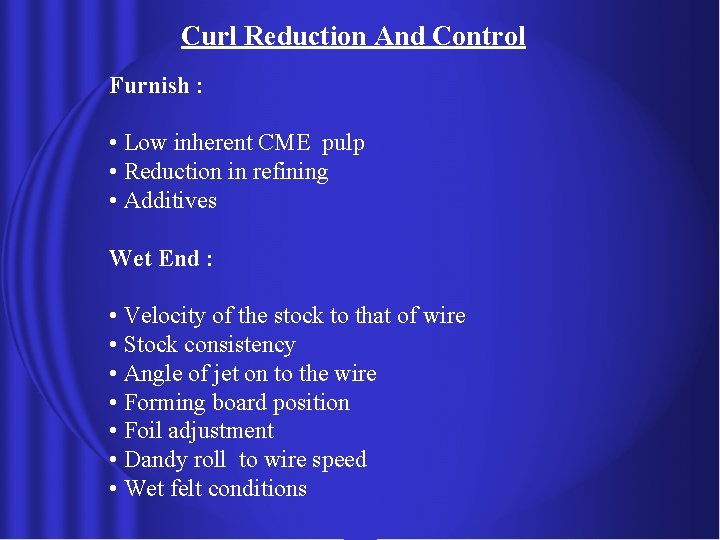
Curl occurs when sheet layers expand unevenly: 1. Differences can caused by the effects of fiber orientation, composition, bending, when passing a sheet through a printing process. 2. Most frequently differential fiber orientation develops from velocity differentials between the forming fabric and the slurry forming the paper. To improve curl we can adjust "jet" speed in small increments. 3. Board should be evaluated by comparing the properties of their layers by measuring the CME of free dried samples. 4. Curl reduction and control include lowering the inherent CME of pulps, reducing refining, adjusting the stock to wire speed to be more equal, and adjusting top to bottom drying. 6. If coatings are used, a balancing of wire to felt side binder coat weight is important.
How Curl formed in manufacture Basic components in curl formation • Furnish • Wet end sheet formation • Drying • End use
Misconception “A usual misconception is that curl is controlled by top verses bottom drying temperatures, whereas , it only compensates for the “Structural Curl” developed during sheet formation, sometime only to have curl form again in end use. This “Structural Curl” is like a memory that can be temporarily hidden by adjustments in drying. ”
Curl Reduction And Control Furnish : • Low inherent CME pulp • Reduction in refining • Additives Wet End : • Velocity of the stock to that of wire • Stock consistency • Angle of jet on to the wire • Forming board position • Foil adjustment • Dandy roll to wire speed • Wet felt conditions
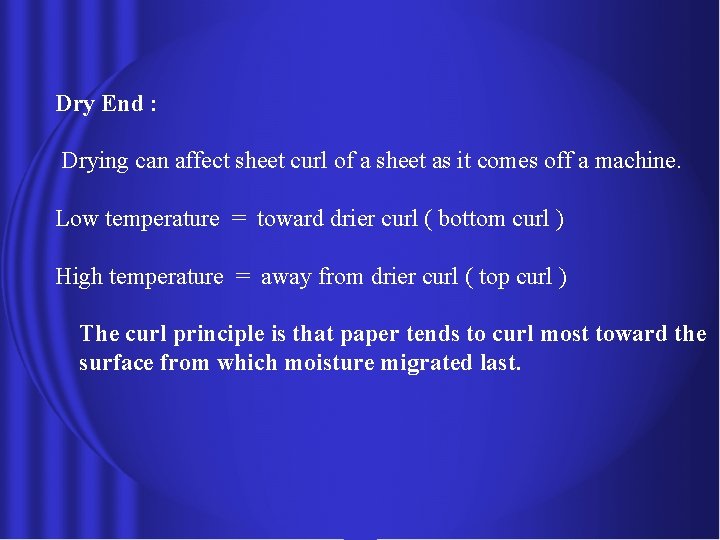
Dry End : Drying can affect sheet curl of a sheet as it comes off a machine. Low temperature = toward drier curl ( bottom curl ) High temperature = away from drier curl ( top curl ) The curl principle is that paper tends to curl most toward the surface from which moisture migrated last.
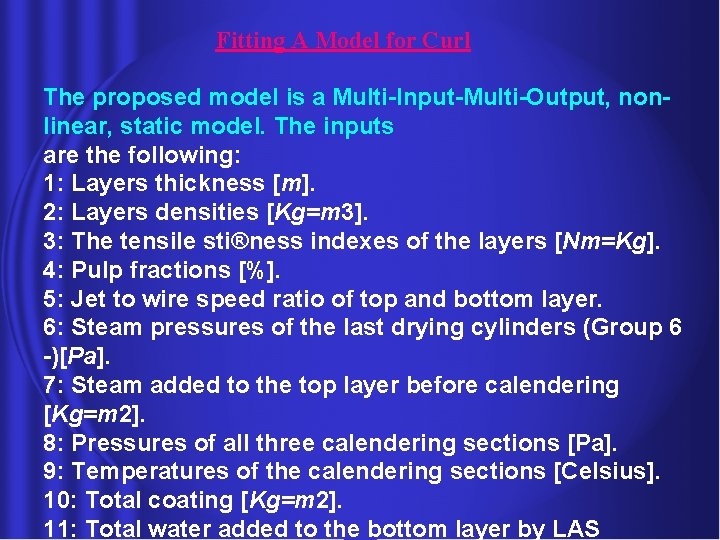
Fitting A Model for Curl The proposed model is a Multi-Input-Multi-Output, nonlinear, static model. The inputs are the following: 1: Layers thickness [m]. 2: Layers densities [Kg=m 3]. 3: The tensile sti®ness indexes of the layers [Nm=Kg]. 4: Pulp fractions [%]. 5: Jet to wire speed ratio of top and bottom layer. 6: Steam pressures of the last drying cylinders (Group 6 -)[Pa]. 7: Steam added to the top layer before calendering [Kg=m 2]. 8: Pressures of all three calendering sections [Pa]. 9: Temperatures of the calendering sections [Celsius]. 10: Total coating [Kg=m 2]. 11: Total water added to the bottom layer by LAS
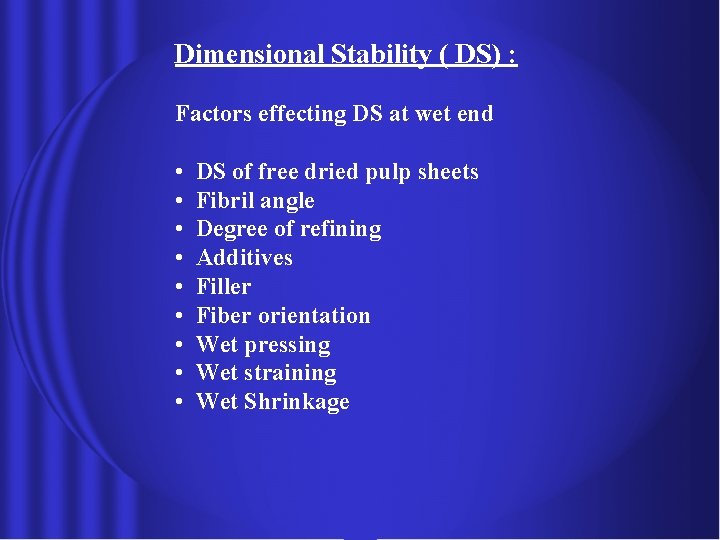
Dimensional Stability ( DS) : Factors effecting DS at wet end • • • DS of free dried pulp sheets Fibril angle Degree of refining Additives Filler Fiber orientation Wet pressing Wet straining Wet Shrinkage
Shrinkage Factors effecting shrinkage in dry end • • Tensile Stiffness Tensile Strength Compressive Strength Breaking Strain
Thank You