
Curating an Exhibition NEH Museum of Art Honors
Curating an Exhibition NEH Museum of Art Honors 3020 Spring 2016
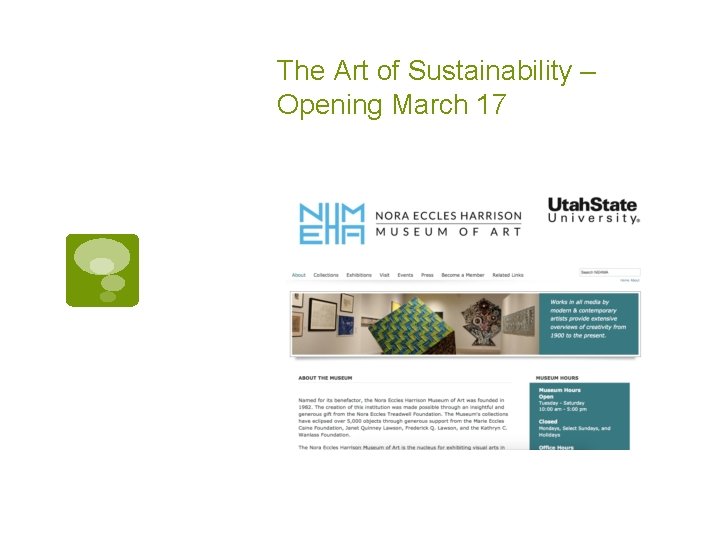
The Art of Sustainability – Opening March 17
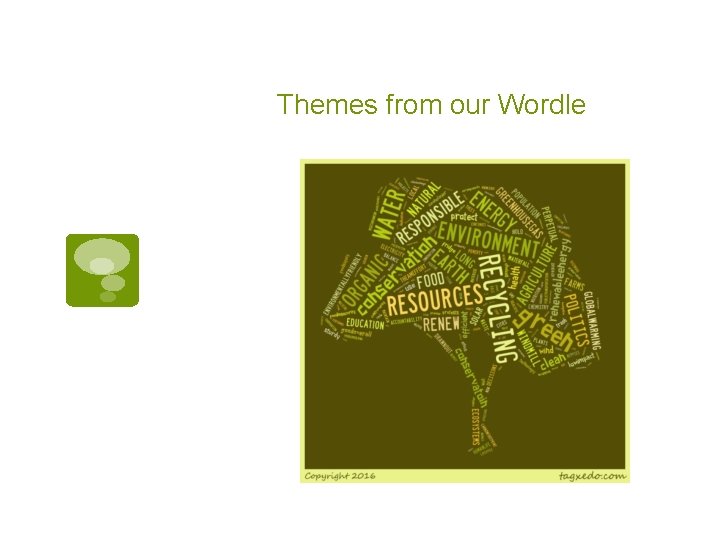
Themes from our Wordle
Themes from our Text § The Noble Farmer § Westward Expansion § Hard Times: Depression, Labor Movement § Back to the Farm § Farming as the New Sexy § Poetry, Children’s Literature
Curatorial Calendar § January § Introduction to the Art Museum and to a list of possible works selected by the museum staff (January 21) § § Choose works of art from the Power. Point and handout provided. Do the research in preparation for writing signage (didactics) and serving as a docent § § February § § § Research strategies: artists’ files (at the Museum); books on reserve; Internet search. Sign up for a time to do your research at the museum. Develop didactics (signage); Work with museum staff on layout and exhibition (February 4) March § § § (Spring Break) installation of exhibition by the museum staff; March 17 Exhibition Opening Students serving as docents for public forums (e. g. Art Family Day; After Hours; Honors Reception)
Thursday, January 21 § 1. Establish Goals of Exhibition as they relate to the Goals of the Course. These two to three goals should focus on what is to be achieved with the audience. § 2. Identify potential works from NEHMA collection that relate to the exhibition goals with assistance of NEHMA staff. The staff will have a list developed with likely works. Each student will select 3 works to oversee; please draw from at least two media (3 dimensional, painting, photography) and also two different artists. Please be mindful that we want to achieve diversity among artists.
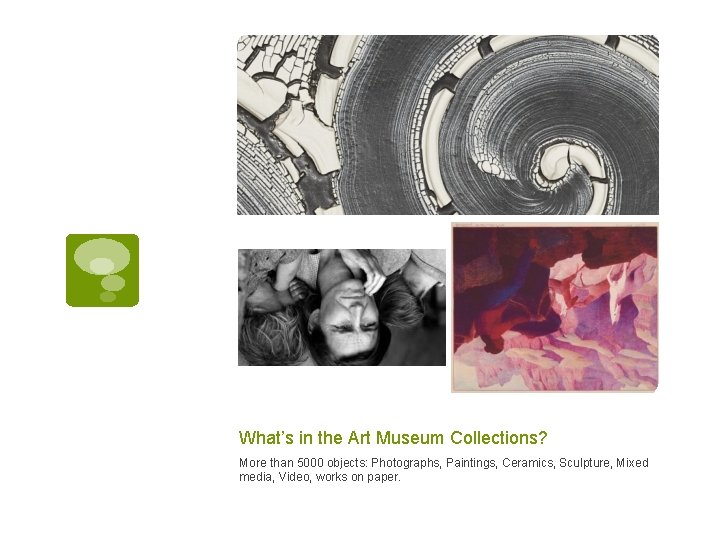
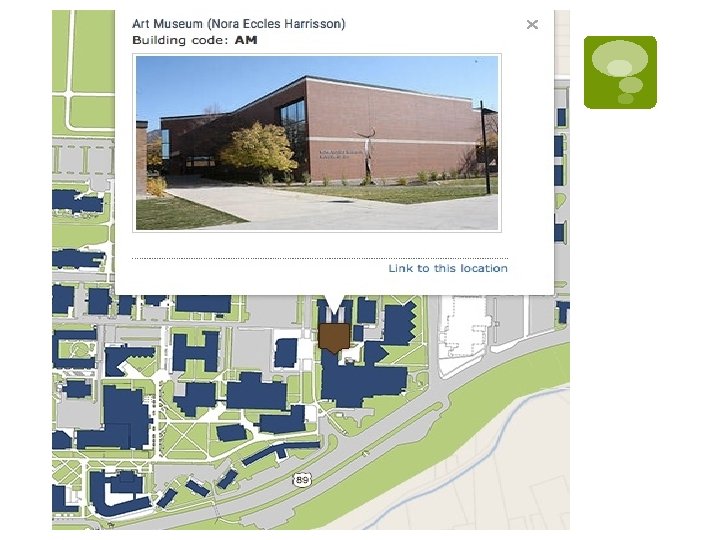
What’s in the Art Museum Collections? More than 5000 objects: Photographs, Paintings, Ceramics, Sculpture, Mixed media, Video, works on paper.
Research Phase § The Museum staff will pull the files needed for your research (for artists and objects that they have on file), and they will also have a staff member or student assistant who can help as needed. § Sign Up Sheet: January 22, 25, 26, 27 and 28 between 10 -3: 30. (The museum closes at 5 pm. ) If these times do not work in your schedule, then special arrangements can be made.
Drafting Labels & Didactics § Labels are identifying text for an artwork placed in a museum gallery room containing an exhibition. Label information may include the name of the artist who created the artwork, the title and dimensions of the object, its media, date of creation, owner, accession number and in some cases a block of didactic (interpretive) text related to the artwork. Labels with didactic text are often named "extended labels. " Labels are also referred to as "captions" or "tombstones. " § Didactic texts are interpretive/educational texts related to an exhibition, usually written by exhibition curators, which are displayed on panels on exhibition gallery walls or as part of art object labels. Wall panels, also named didactic wall panels, are blocks of didactic text explaining an exhibition that are placed on the walls of a gallery room, or rooms, containing the exhibition. § Please review this helpful guide to exhibit text writing from the Victoria & Albert Museum link. See page 8, which provides recommended word counts—about 50 -70 words for an object label. To arrive at 50 words of useful content, it is necessary to research and write more to begin. § http: //www. vam. ac. uk/__data/assets/pdf_file/0005/177089/10808_file. pdf

What is a Label, Didactic? § Writing assignment: Please describe the works of art that you have chosen, including title, artist, date, artist’s country. Include important contextual information. Then using sustainability as a lens to look at the work, analyze why this work is important to theme of our exhibition. Each work should be described in about 50 -70 words, which is standard for display text. We will do one, review it, and then move on to writing the other two. Didactic #1 due January 29. Didactics #2 and #3 due February 3. Please include the works of art (. jpg) with your essay. (We should have these on the class Canvas site. )
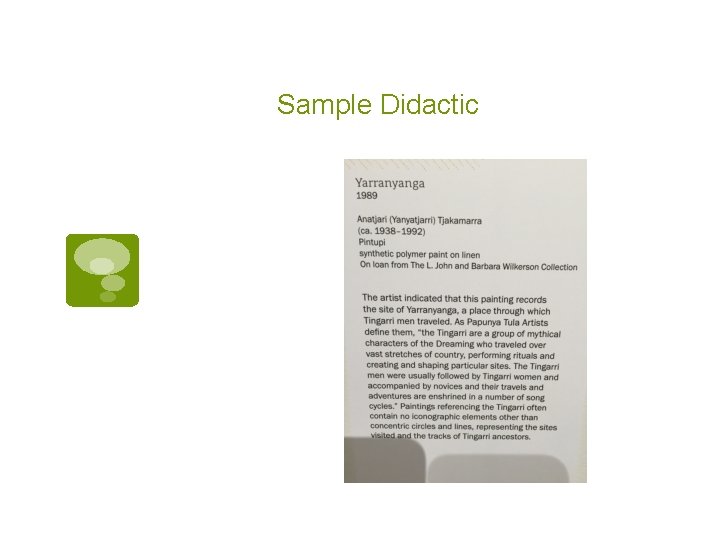
Sample Didactic
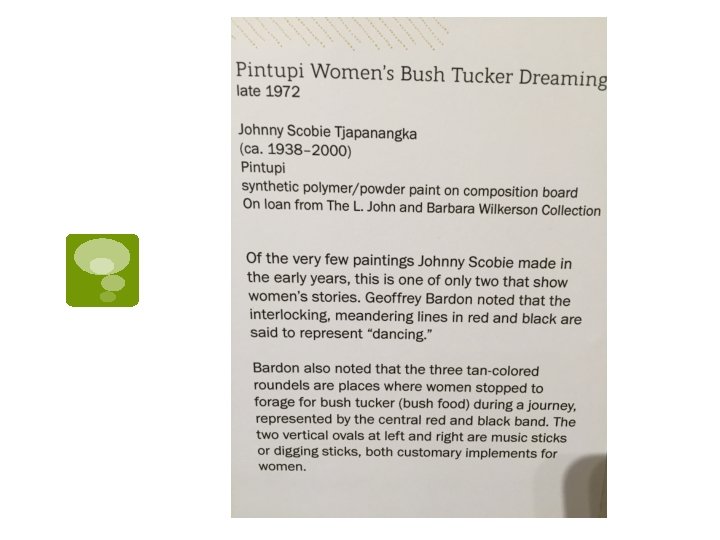
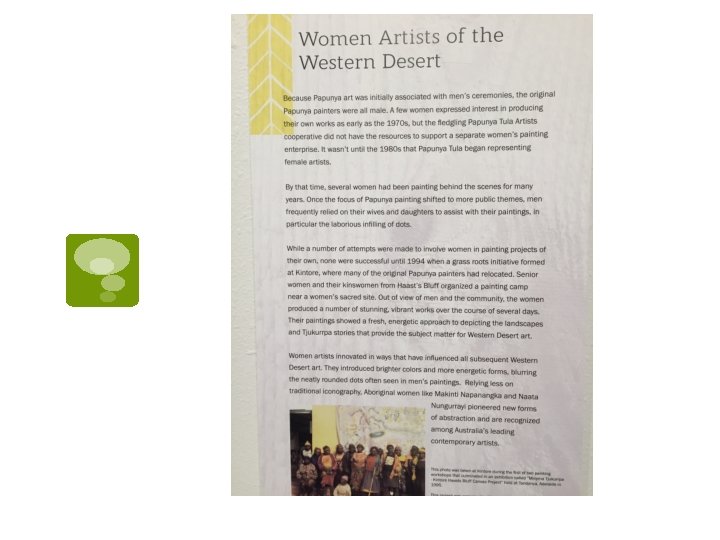
Designing the Exhibit § During the February 4 class meeting at the Museum, the curatorial staff will have a scaled floor plan on oversized paper and scaled images on a table to play with the layout and groupings. The final selections for the exhibit will be made. Note that often objects are cut during layout and discussion process. The curatorial staff will confirm important themes and overarching ideas for the exhibition. Your ideas are crucial for determining the introductory text that museum visitors read first before looking at the individual works. The staff members will draft this text for our review. Revise didactics as needed; due February 8. § Review and finalize Exhibition Introduction/Overview: February 22/23. § Finalize label and didactic information that will accompany artworks for delivery to museum staff: February 25.
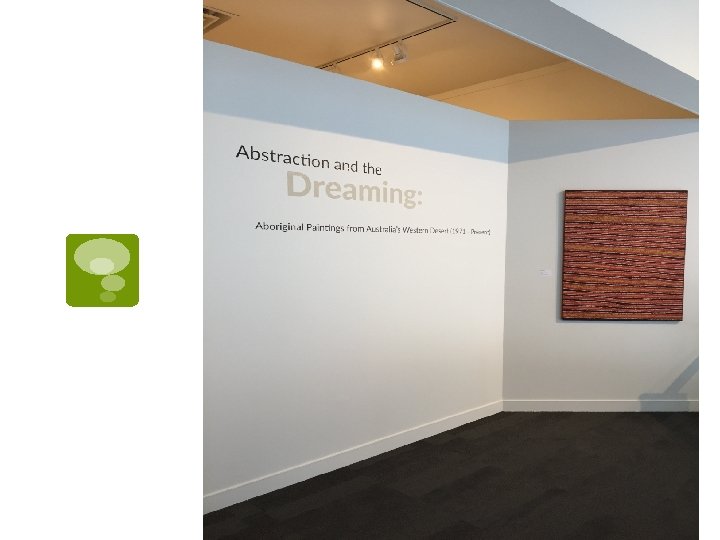





The Reception and Opening § Docent Training by Museum Staff Member Nadra Haffar: March 1 (meet at Art Museum); docent script drafted and dry run in class March 3. § Installation of artworks (done by NEHMA staff—Spring Break, March 7 -11). § FYI: National Agriculture Day, March 15, 2016. § Opening: Thursday, March 17, 1: 00 -2: 45 pm. Serve as docents § FYI: Reception for “A Matter of Taste, ” January 23, 7 -9 pm (optional)
Our Collaborators § Art Museum Staff: § Katie Lee Koven (Executive Director & Chief Curator); § Rebecca Dunham (Curator of Collections & Exhibitions); § Adriane Dalton (Assistant Curator); § Nadra Haffar (Education Curator)
Questions? Suggestions? Comments?
- Slides: 24