
Cuneiform Hieroglyphics The Worlds First Writing Systems Writing
- Slides: 9
Cuneiform & Hieroglyphics The World’s First Writing Systems
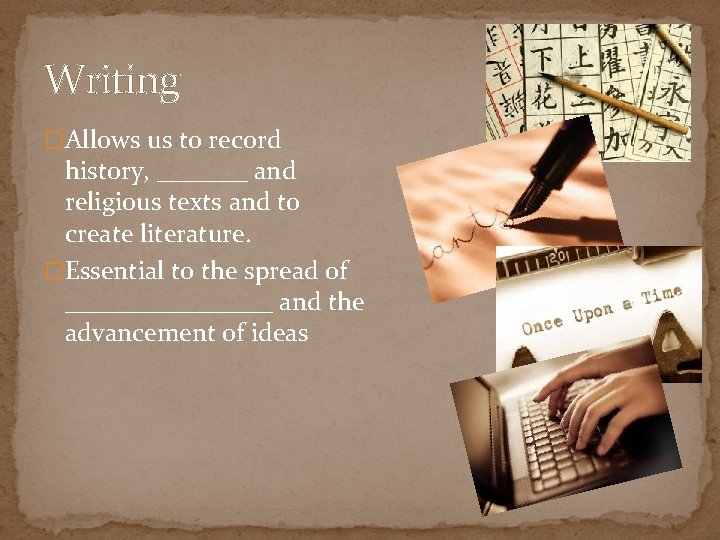
Writing �Allows us to record history, _______ and religious texts and to create literature. �Essential to the spread of ________ and the advancement of ideas
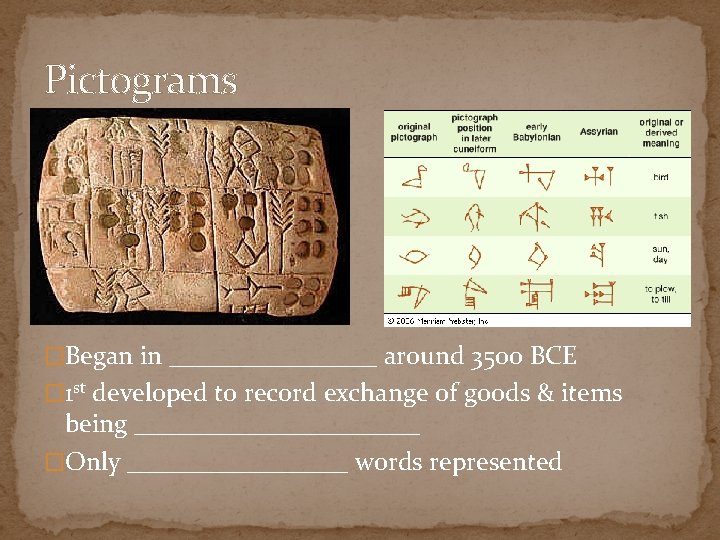
Pictograms �Began in ________ around 3500 BCE � 1 st developed to record exchange of goods & items being ___________ �Only _________ words represented
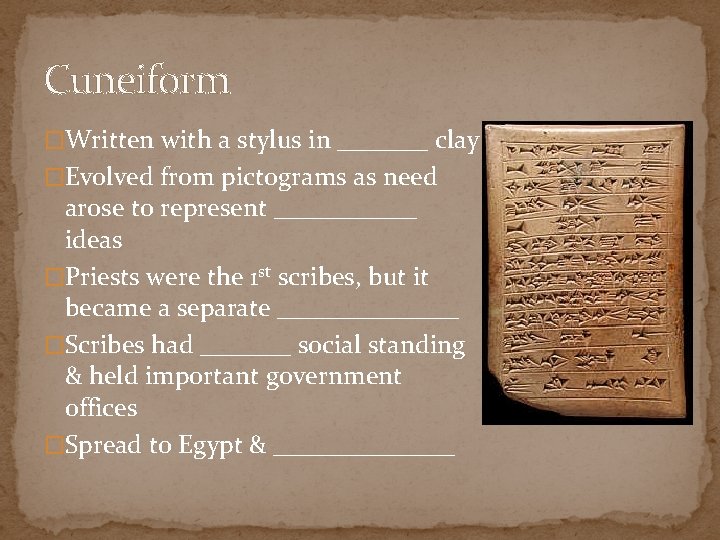
Cuneiform �Written with a stylus in _______ clay �Evolved from pictograms as need arose to represent ______ ideas �Priests were the 1 st scribes, but it became a separate _______ �Scribes had _______ social standing & held important government offices �Spread to Egypt & _______
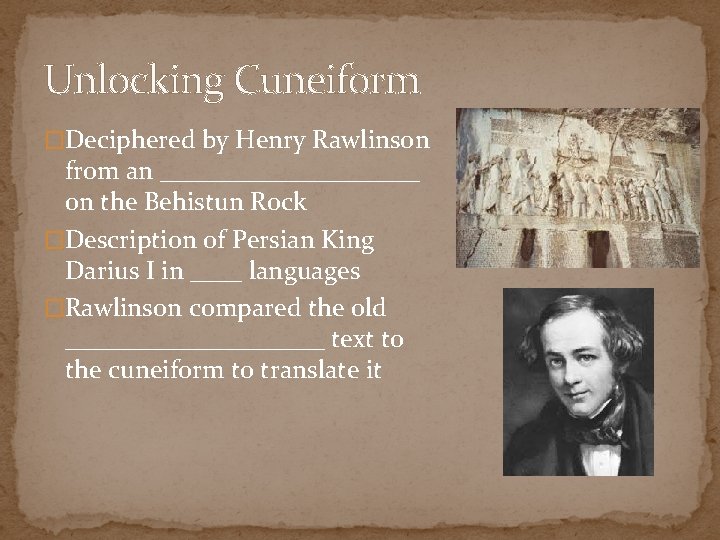
Unlocking Cuneiform �Deciphered by Henry Rawlinson from an __________ on the Behistun Rock �Description of Persian King Darius I in ____ languages �Rawlinson compared the old __________ text to the cuneiform to translate it
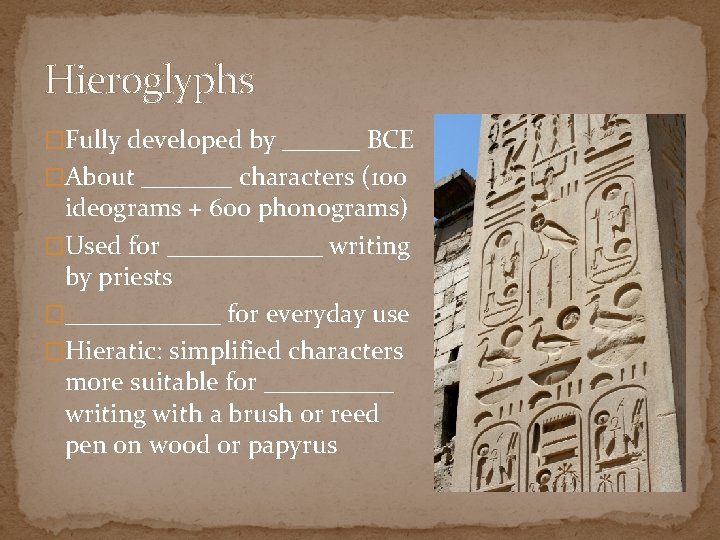
Hieroglyphs �Fully developed by ______ BCE �About _______ characters (100 ideograms + 600 phonograms) �Used for ______ writing by priests �______ for everyday use �Hieratic: simplified characters more suitable for _____ writing with a brush or reed pen on wood or papyrus
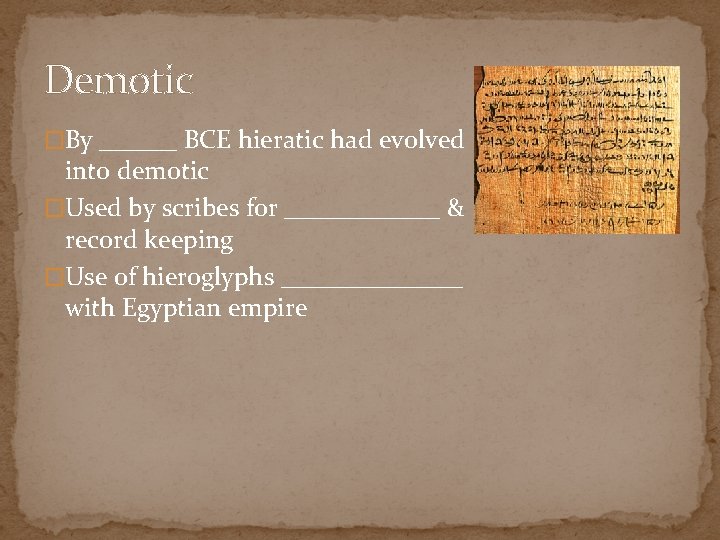
Demotic �By ______ BCE hieratic had evolved into demotic �Used by scribes for ______ & record keeping �Use of hieroglyphs _______ with Egyptian empire
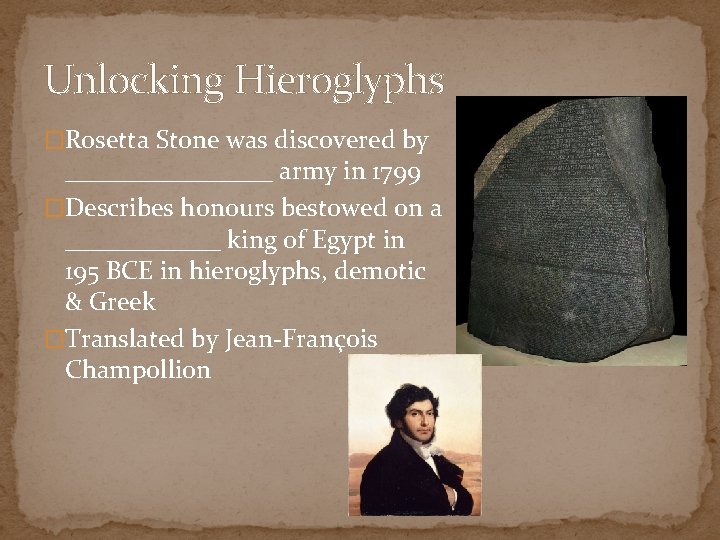
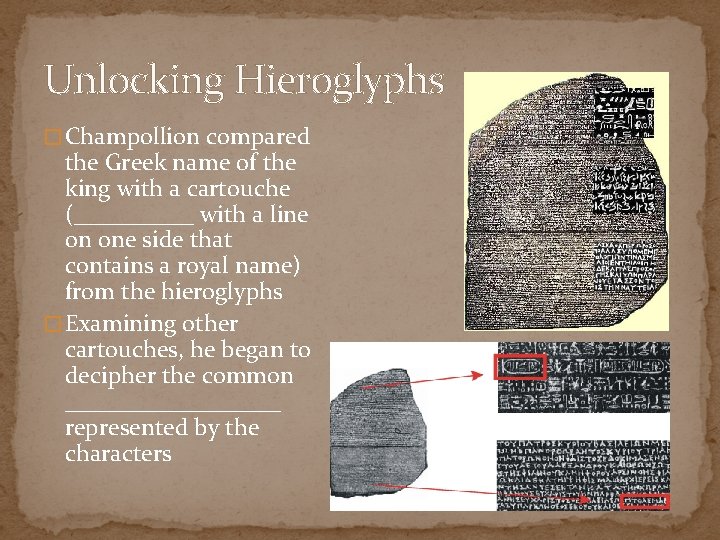
Unlocking Hieroglyphs �Rosetta Stone was discovered by ________ army in 1799 �Describes honours bestowed on a ______ king of Egypt in 195 BCE in hieroglyphs, demotic & Greek �Translated by Jean-François Champollion
Unlocking Hieroglyphs � Champollion compared the Greek name of the king with a cartouche (_____ with a line on one side that contains a royal name) from the hieroglyphs � Examining other cartouches, he began to decipher the common _________ represented by the characters