
Culture SOCIOLOGY Lesson Outline 2 What is Culture
- Slides: 29
Culture SOCIOLOGY
Lesson Outline 2 �What is Culture? �Components of Culture �Language and the Sapir-Whorf Hypothesis �Variations in Culture �Different ways of Viewing Culture �Cultural Change �American culture in perspective Introduction to Sociology: Culture
What is Culture? 3 �Culture is the entire way of life for a group of people (including both material and symbolic elements). �It is a lens through which one views the world and is passed from one generation to the next. �It is what makes us human. Introduction to Sociology: Culture
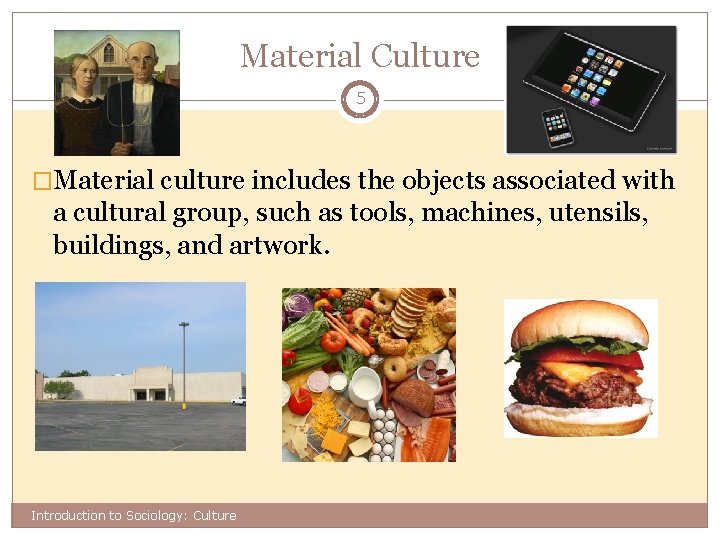
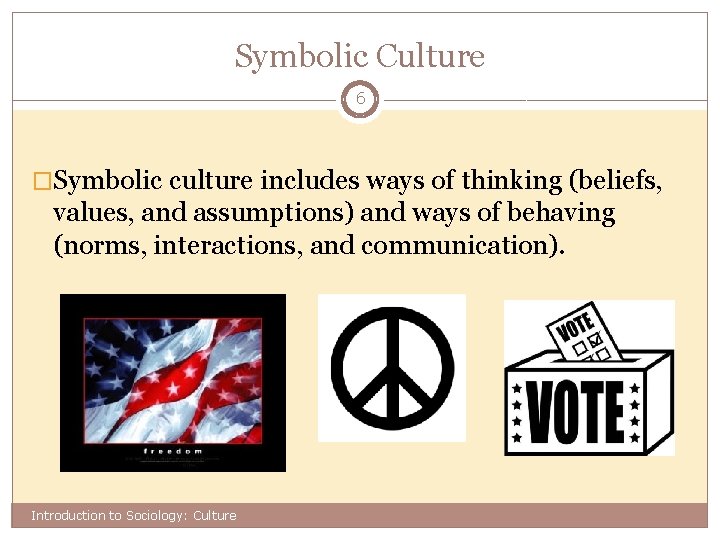
What makes up culture? 4 �Sociologists see culture as consisting of two different categories: material culture (any physical object to which we give social meaning) and symbolic culture (the ideas associated with a cultural group). Introduction to Sociology: Culture
Material Culture 5 �Material culture includes the objects associated with a cultural group, such as tools, machines, utensils, buildings, and artwork. Introduction to Sociology: Culture
Symbolic Culture 6 �Symbolic culture includes ways of thinking (beliefs, values, and assumptions) and ways of behaving (norms, interactions, and communication). Introduction to Sociology: Culture
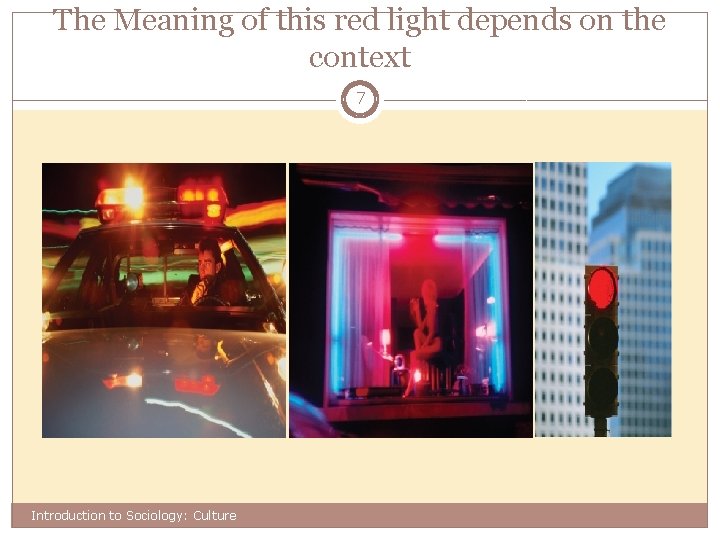
The Meaning of this red light depends on the context 7 Introduction to Sociology: Culture
Components of Culture 8 �One of the most important functions of symbolic culture is it allows us to communicate through signs, gestures, and language. �Signs (or symbols), such as a traffic signal or product logo, are used to meaningfully represent something else. Gestures are the signs that we make with our body, such as hand gestures and facial expressions; it is important that these gestures also carry meaning. Introduction to Sociology: Culture
Components of Culture (cont) 9 �Finally language, a system of communication using vocal sounds, gestures, and written symbols, is probably the most significant component of culture because it allows us to communicate. �Language is so important that many have argued that it shapes not only our communication but our perceptions of how we see things as well. Introduction to Sociology: Culture
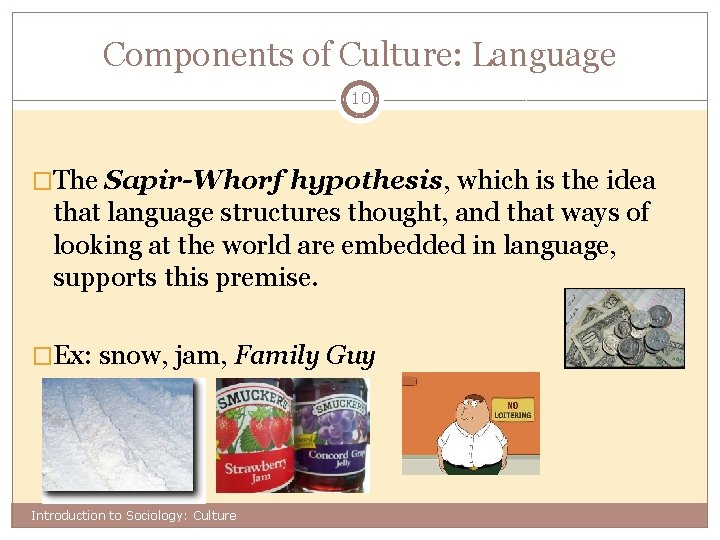
Components of Culture: Language 10 �The Sapir-Whorf hypothesis, which is the idea that language structures thought, and that ways of looking at the world are embedded in language, supports this premise. �Ex: snow, jam, Family Guy Introduction to Sociology: Culture
The Importance of Language 11 �Language facilitates culture �Is American English the same and British English, dude? �Where would you find Eggplant in the grocery store? �Cheese + hamburger = cheeseburger �Lettuce + hamburger ≠ lettuceburger Introduction to Sociology: Culture
Components of Culture (cont) 12 �Values, shared beliefs about what a group considers worthwhile or desirable, guide the creation of norms, the formal and informal rules regarding what kinds of behavior are acceptable and appropriate within a culture. �Norms govern our behavior Introduction to Sociology: Culture
Components of Culture: Norms 13 �Norms are specific to a culture, time period, and situation. Norms can be either formal, such as a law (a common type of formally defined norm that provides an explicit statement about what is permissible and what is illegal in a society) or the rules for playing soccer, or informal, which are not written down and are unspoken. Introduction to Sociology: Culture
Components of Culture: Norms 14 �Types of norms can also be distinguished by the strictness with which they are enforced. �A folkway is a loosely enforced norm that involves common customs, practices, or procedures that ensure smooth social interaction and acceptance. Introduction to Sociology: Culture
Components of Culture: Norms 15 �A more (more-ray) is a norm that carries greater moral significance, is closely related to the core values of a group, and often involves severe repercussions for violators. �A taboo is a norm engrained so deeply that even thinking about violating it evokes strong feelings of disgust, horror, or revulsion for most people. Introduction to Sociology: Culture
Social Control and Sanctions 16 �Sanctions are positive or negative reactions to the ways that people follow or disobey norms, including rewards for conformity and punishments for norm violators. �Sanctions help to establish social control, the formal and informal mechanisms used to increase conformity to values and norms and thus increase social cohesion. Introduction to Sociology: Culture
Looking at Culture(s) 17 �Sociologists who study culture often focus on their own cultures. �Some sociologists, however, engage in the process of “othering” by studying unusual, extraordinary, or deviant cultural groups. Introduction to Sociology: Culture
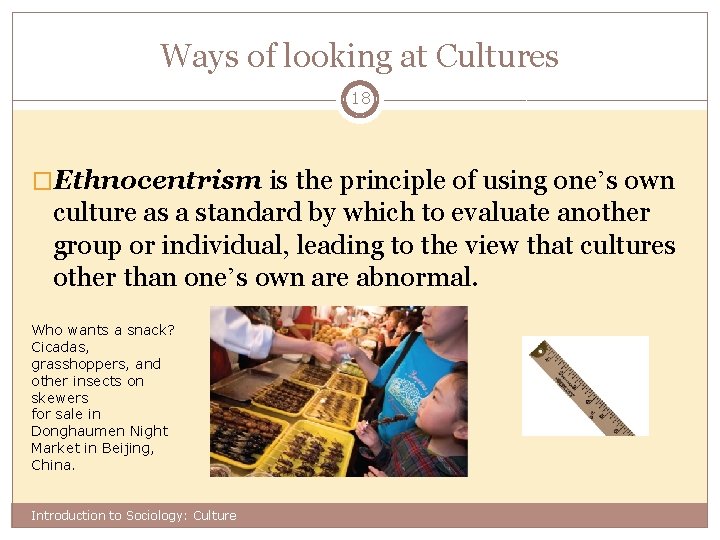
Ways of looking at Cultures 18 �Ethnocentrism is the principle of using one’s own culture as a standard by which to evaluate another group or individual, leading to the view that cultures other than one’s own are abnormal. Who wants a snack? Cicadas, grasshoppers, and other insects on skewers for sale in Donghaumen Night Market in Beijing, China. Introduction to Sociology: Culture
Ways of looking at Cultures 19 �Cultural relativism is the principle of understanding other cultures on their own terms, rather than judging according to one’s own culture. �When studying any group, it is important to try to employ cultural relativism because it helps sociologists see others more objectively. Introduction to Sociology: Culture
Variations in Culture 20 �Although much research focuses on the differences between cultures, there is also tremendous variation within a culture. �Multiculturalism values diverse racial, ethnic, national, and linguistic backgrounds and so encourages the retention of cultural differences within society, rather than assimilation. Introduction to Sociology: Culture
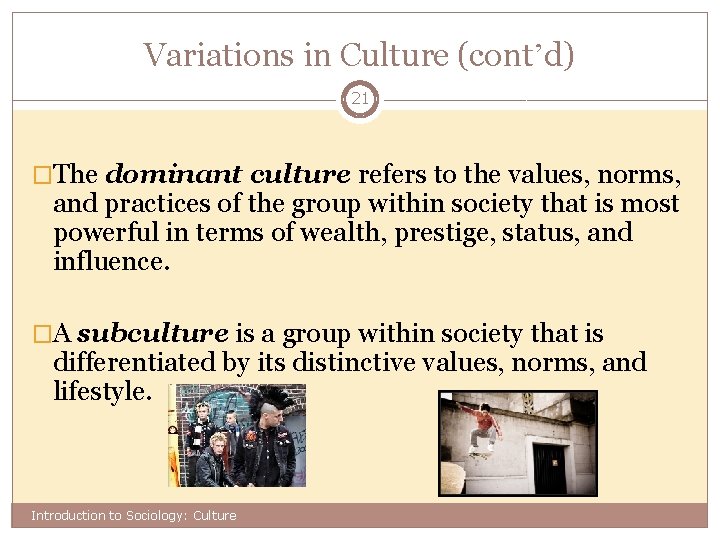
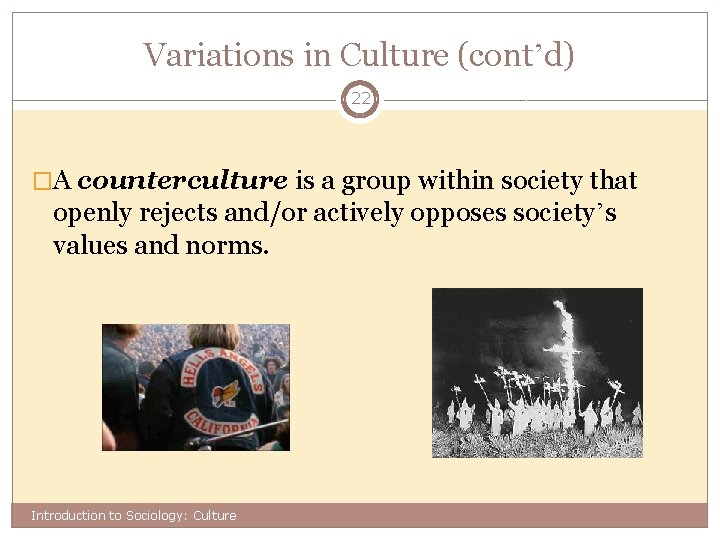
Variations in Culture (cont’d) 21 �The dominant culture refers to the values, norms, and practices of the group within society that is most powerful in terms of wealth, prestige, status, and influence. �A subculture is a group within society that is differentiated by its distinctive values, norms, and lifestyle. Introduction to Sociology: Culture
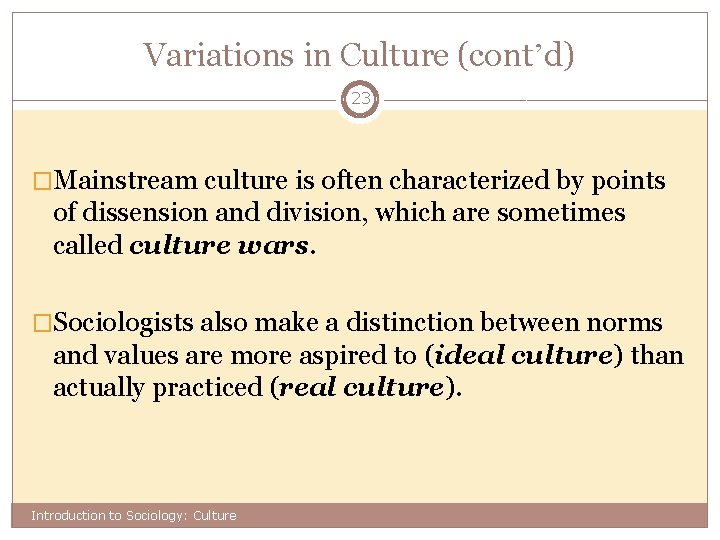
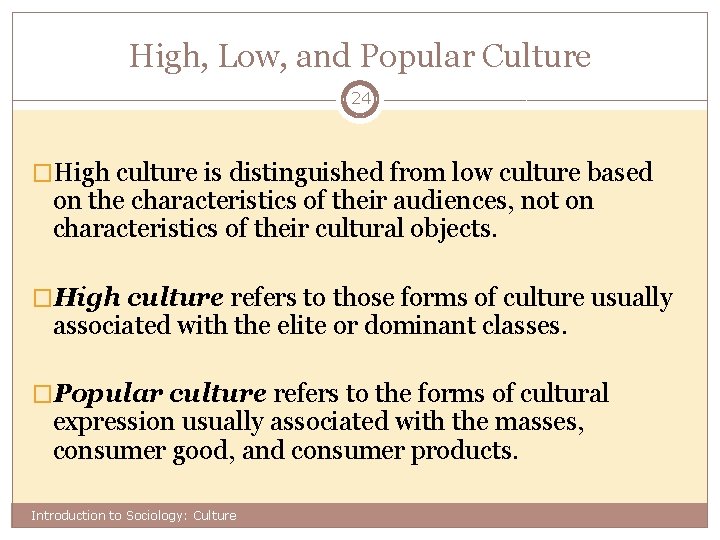
Variations in Culture (cont’d) 22 �A counterculture is a group within society that openly rejects and/or actively opposes society’s values and norms. Introduction to Sociology: Culture
Variations in Culture (cont’d) 23 �Mainstream culture is often characterized by points of dissension and division, which are sometimes called culture wars. �Sociologists also make a distinction between norms and values are more aspired to (ideal culture) than actually practiced (real culture). Introduction to Sociology: Culture
High, Low, and Popular Culture 24 �High culture is distinguished from low culture based on the characteristics of their audiences, not on characteristics of their cultural objects. �High culture refers to those forms of culture usually associated with the elite or dominant classes. �Popular culture refers to the forms of cultural expression usually associated with the masses, consumer good, and consumer products. Introduction to Sociology: Culture
Cultural Change 25 �Cultures usually change slowly and incrementally, though change can also happen in rapid and dramatic ways. �One of the key ways that material culture can change is through technology. Introduction to Sociology: Culture
Cultural Change (cont’d) 26 �Cultural change can also occur through cultural diffusion, which is when different groups share their material and nonmaterial culture with each other. �Cultural leveling occurs when cultures that were once distinct become increasingly similar to one another. Introduction to Sociology: Culture
Cultural Change (cont’d) 27 �Cultural imperialism is the imposition of one culture’s beliefs, practices, and artifacts on another culture through mass media and consumer products. Introduction to Sociology: Culture
American Culture in Perspective 28 �Since American culture is highly visible worldwide, the country’s moral and political values have equally high visibility. �The value placed on individualism, sexual freedom, and material satisfaction in American life can antagonize cultures that place a higher value on familial involvement and moral and social restraint, and may result in anti-American sentiment. �Our perceived failures to live up to our own political values and ideals can also lead to such sentiment. Introduction to Sociology: Culture
Take Away Points 29 �Culture is a lens through which we view the world around us. �It is also a filter that we are (mostly) unaware modifies our perception of reality. �Culture is bequeathed to us from our ancestors and we recreate it through interaction with other people. Introduction to Sociology: Culture