
CULTURE SOCIETY DIVERSITY DEFINITION AND CHARACTERISTICS Society 3
- Slides: 20
CULTURE, SOCIETY & DIVERSITY DEFINITION AND CHARACTERISTICS
Society (3) Greetings From Around the World - Travel Channel - You. Tube The term Society have been derived from the Latin word ‘socius’ which means by association or companionship. SOCIETY : A group of people living interdependently with a common purpose, in a single community within a defined territorial space. It is sometimes seen as a collection of people living in the same area over time. Therefore, society is considered to be a group of people who share a common culture, occupy a particular territorial area and usually constitutes a unified and distinct entity. (Frisby and Sayer, 1986) (3) How to greet people in 19 countries around the world - You. Tube
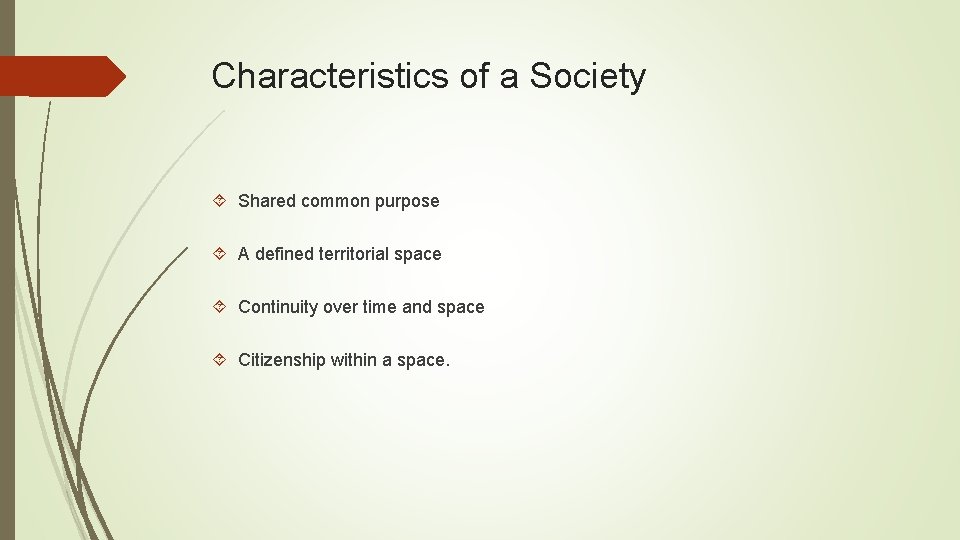
Characteristics of a Society Shared common purpose A defined territorial space Continuity over time and space Citizenship within a space.
CHARACTERISTICS OF SOCIETY SHARED COMMON PURPOSE: In the Caribbean, we share a common history and experiences. These shared experiences have given rise to a common culture, norms and value system. These help characterize how we relate to each other. For example, there is a shared belief that all persons should have an equal opportunity to improve their social and economic standing in society. There are no clear limitations placed on race, religious beliefs or gender. However, some believe that there is no shared common purpose. This is so because of our cultural diversity and the plural nature of our society; these factors are sometimes in conflict with each other.
CHARACTERISTICS OF SOCIETY DEFINED TERRITORIAL SPACE: Some may use the geographical space on a map to define the location of the Caribbean society. CONTINUITY OVER TIME AND SPACE The existence of a group and the most permanent aspects of their culture within a space over a particular period of time is another characteristic of society. CITIZENSHIP WITHIN A SPACE Society can be defined as a group of people native to a state/ country (Nationals). The citizens by birth, do not necessarily live in the space; they may have migrated. The Diaspora. Illegal immigrants may also be included in the framework of a society. In summary, a complete definition of Caribbean society is a large group of people, living within the geographical spaces of the Caribbean as well those of the diaspora. These people share a common cultural identity, a common purpose and a birthright to the region. They have acknowledged themselves as people belonging to the region and continue to practice aspects of Caribbean culture.
KEY CONCEPTS OF CULTURE Values are a culture’s standard for discerning what is good and just in society. Values are deeply embedded and critical for transmitting and teaching a culture’s beliefs. Beliefs are the tenets or convictions that people hold to be true. Individuals in a society have specific beliefs, but they also share collective value. Symbols—such as gestures, signs, objects, signals, and words—help people understand the world. Symbols provide clues to understanding experiences. They convey recognizable meanings that are shared by societies. Language: It makes culture possible since this is the mode through which people communicate The Sapir-Whorf Hypothesis is based on the idea that people experience their world through their language. Thus they are able to understand their world through the culture that is embedded in language.
CULTURE The word culture comes from the Latin word, ‘cultura’ which means to cultivate and guard. Anthropologist E B Tylor (1871) defined culture as, “The complex whole which includes knowledge, beliefs, arts, morals, law, customs, and any other capabilities and habits acquired by [a human] as a member of society. ” CULTURE: The collective habits, practices and norms of behaviour that form the way of life of a particular people. CULTURAL IDENTITY: The feeling of belonging to a social group that has its own distinct culture.
CHARACTERISTICS OF CULTURE LEARNT BEHAVIOUR: Culture is learnt; it shapes our behaviour. It involves the following concepts: Enculturation: The process by which culture is passed on from one generation to another. This is done through, experience, observation and instruction. Socialisation: The process through which individuals learn accepted and unaccepted behaviours and values in society. These are communicated through customs, beliefs systems and laws. . CULTURE IS ADAPTIVE Adaptation is the process of using cultural knowledge and innovation to improve on how the group overcomes problems in their human and physical environment. (Mohammed, 2015)
CHARACTERISTICS OF CULTURE CUSTOMS AND TRADITIONS: These are expressions of culture that are based on practices that have been passed down from generation to generation. They become important because the preserve Caribbean cultural identity. Therefore, these customs and traditions highlight the fact that culture is: SHARED: It must be passed on from generation to generation and amongst the members of the society. SYMBOLIC: Deep meanings are placed behind material and non-material culture. CULTURE IS DYNAMIC: Culture will vary over time and space. Change has occurred in the Caribbean culture due to historical, economic, social, political, environmental, legal and technological antecedents and developments.
CHARACTERISTICS OF CULTURE NORMS AND VALUES: Cultural values are commonly held standards within a society that dictate what society regards as acceptable and unacceptable behaviour. (Respect for elders, the need for children to be educated, equal access to opportunity) Cultural norms are common and/or acceptable ways of behaving that are already rooted in society. (Greeting the adults in the room upon entering, wining on strangers). Formal norms: Laws and Regulations that are constitutionally and legally binding Informal norms: Unspoken and unwritten rules in society that are generally accepted and understood. Beliefs are convictions based on vales and scientific facts, religion, superstition or past experiences. ( Blue marks on skin means that you had an encounter with a Soucouyant. ) These norms and values are upheld and protected by sanctions and laws. Values and norms can change over time, for example, “Buggery Laws”.
CHARACTERISTICS OF CULTURE INSTITUTIONS WHICH PRESCRIBE BEHAVIOUR ARE THE MAIN UPHOLDERS OF NORMS AND VALUES OF A SOCIETY: Social institutions such as religious organizations', the justice system, the educational system and the family are important to the socialisation process. These institutions serve to teach and influence what are accepted and unaccepted forms of behaviour in society. These institutions also influence both sanctions and rewards for certain types of beliefs and values. They also influence the value placed on particular attitudes and behaviour.
CHARACTERISTICS OF CULTURE GENDERED PRACTICES: Gender is a factor that determines one’s identity. Therefore Gender ideologies and practices influence culture. Many Caribbean families such as Africans, East Indians, Europeans and Chinese all have ideologies that define gender. The education system also contributes to gender ideologies e. g. subject choice, career choices, employment opportunities.
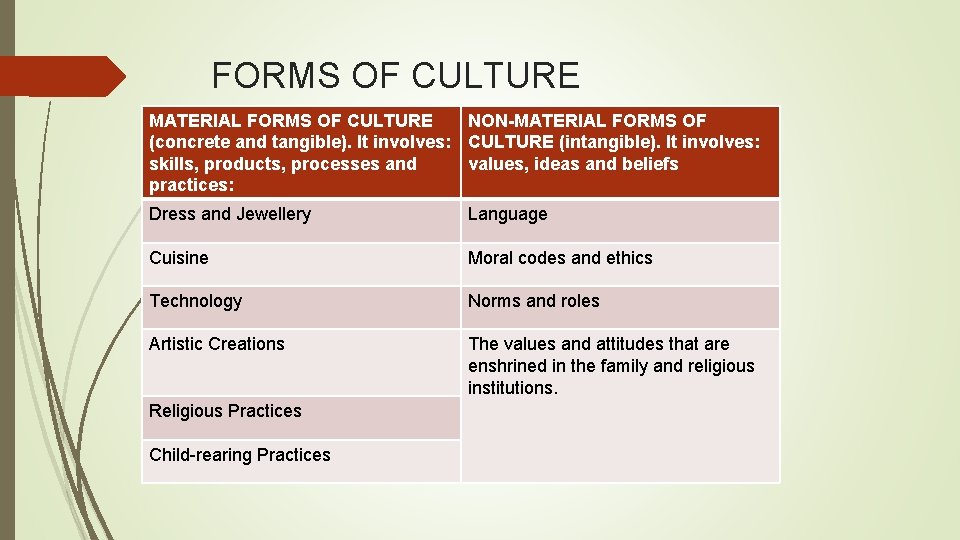
FORMS OF CULTURE MATERIAL FORMS OF CULTURE NON-MATERIAL FORMS OF (concrete and tangible). It involves: CULTURE (intangible). It involves: skills, products, processes and values, ideas and beliefs practices: Dress and Jewellery Language Cuisine Moral codes and ethics Technology Norms and roles Artistic Creations The values and attitudes that are enshrined in the family and religious institutions. Religious Practices Child-rearing Practices
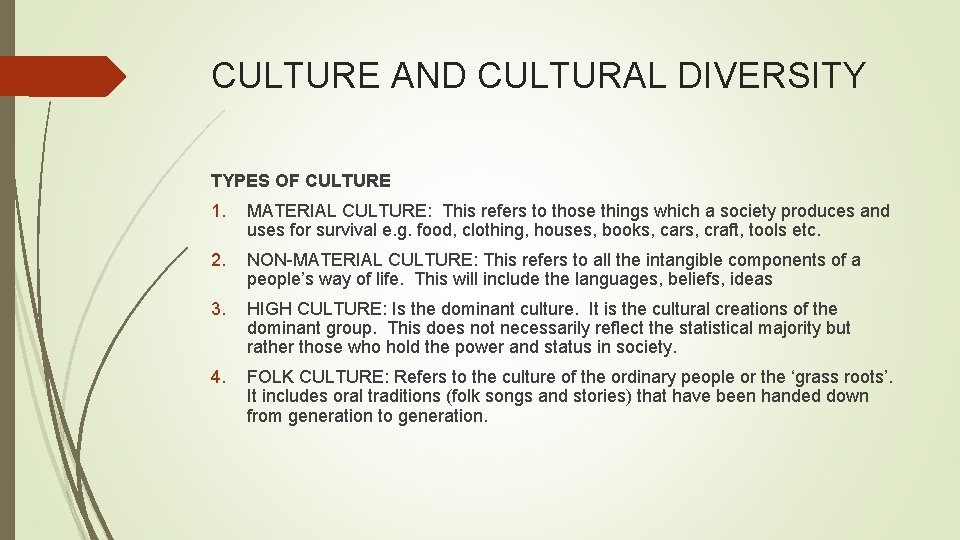
CULTURE AND CULTURAL DIVERSITY TYPES OF CULTURE 1. MATERIAL CULTURE: This refers to those things which a society produces and uses for survival e. g. food, clothing, houses, books, cars, craft, tools etc. 2. NON-MATERIAL CULTURE: This refers to all the intangible components of a people’s way of life. This will include the languages, beliefs, ideas 3. HIGH CULTURE: Is the dominant culture. It is the cultural creations of the dominant group. This does not necessarily reflect the statistical majority but rather those who hold the power and status in society. 4. FOLK CULTURE: Refers to the culture of the ordinary people or the ‘grass roots’. It includes oral traditions (folk songs and stories) that have been handed down from generation to generation.
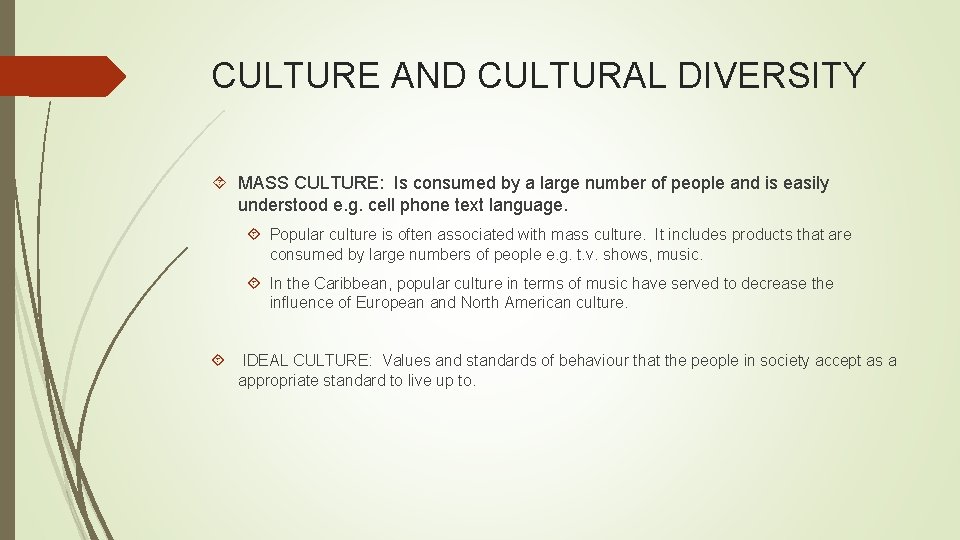
CULTURE AND CULTURAL DIVERSITY MASS CULTURE: Is consumed by a large number of people and is easily understood e. g. cell phone text language. Popular culture is often associated with mass culture. It includes products that are consumed by large numbers of people e. g. t. v. shows, music. In the Caribbean, popular culture in terms of music have served to decrease the influence of European and North American culture. IDEAL CULTURE: Values and standards of behaviour that the people in society accept as a appropriate standard to live up to.
Identify the Aspects of the Material and Non-Material as of Culture http: //islandlyrics. com/lyrics-denyse_plummer-nah_leaving_2001. htm (3) ❀❀♫ �eɳyse ��umɱeɾ || NAH LEAVING ♫♥♥ || ☂ [LYRICS] © Trinidad & Tobago - You. Tube
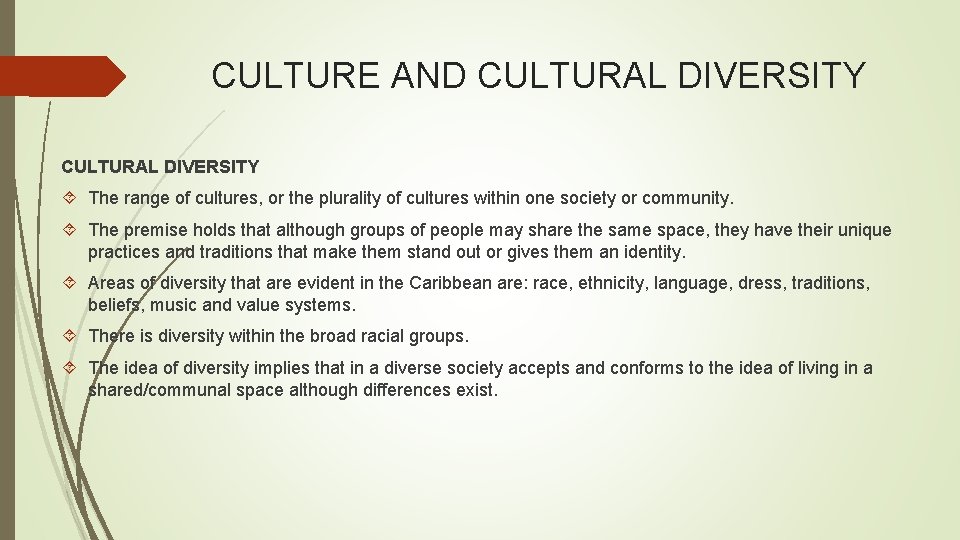
CULTURE AND CULTURAL DIVERSITY The range of cultures, or the plurality of cultures within one society or community. The premise holds that although groups of people may share the same space, they have their unique practices and traditions that make them stand out or gives them an identity. Areas of diversity that are evident in the Caribbean are: race, ethnicity, language, dress, traditions, beliefs, music and value systems. There is diversity within the broad racial groups. The idea of diversity implies that in a diverse society accepts and conforms to the idea of living in a shared/communal space although differences exist.
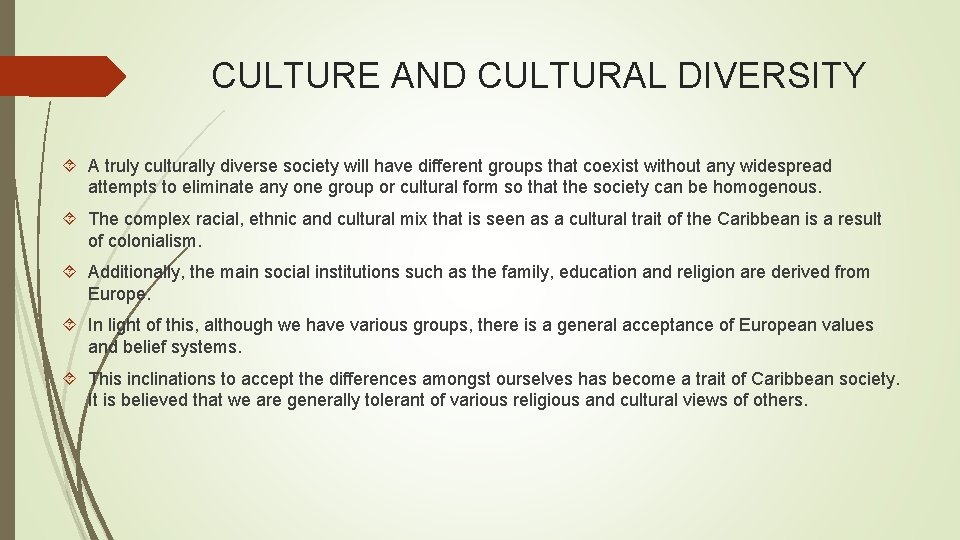
CULTURE AND CULTURAL DIVERSITY A truly culturally diverse society will have different groups that coexist without any widespread attempts to eliminate any one group or cultural form so that the society can be homogenous. The complex racial, ethnic and cultural mix that is seen as a cultural trait of the Caribbean is a result of colonialism. Additionally, the main social institutions such as the family, education and religion are derived from Europe. In light of this, although we have various groups, there is a general acceptance of European values and belief systems. This inclinations to accept the differences amongst ourselves has become a trait of Caribbean society. It is believed that we are generally tolerant of various religious and cultural views of others.
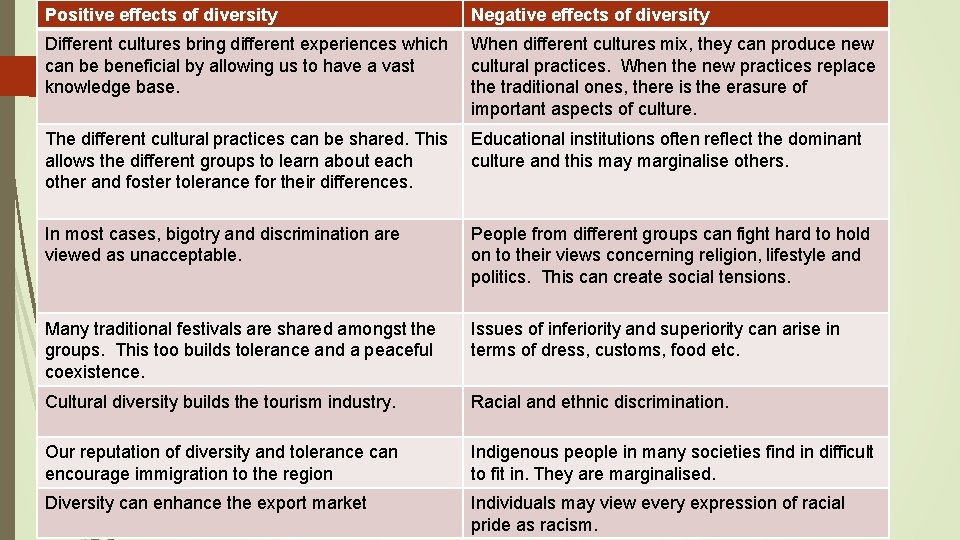
Positive effects of diversity Negative effects of diversity Different cultures bring different experiences which can be beneficial by allowing us to have a vast knowledge base. When different cultures mix, they can produce new cultural practices. When the new practices replace the traditional ones, there is the erasure of important aspects of culture. The different cultural practices can be shared. This allows the different groups to learn about each other and foster tolerance for their differences. Educational institutions often reflect the dominant culture and this may marginalise others. In most cases, bigotry and discrimination are viewed as unacceptable. People from different groups can fight hard to hold on to their views concerning religion, lifestyle and politics. This can create social tensions. Many traditional festivals are shared amongst the groups. This too builds tolerance and a peaceful coexistence. Issues of inferiority and superiority can arise in terms of dress, customs, food etc. Cultural diversity builds the tourism industry. Racial and ethnic discrimination. Our reputation of diversity and tolerance can encourage immigration to the region Indigenous people in many societies find in difficult to fit in. They are marginalised. Diversity can enhance the export market Individuals may view every expression of racial pride as racism.
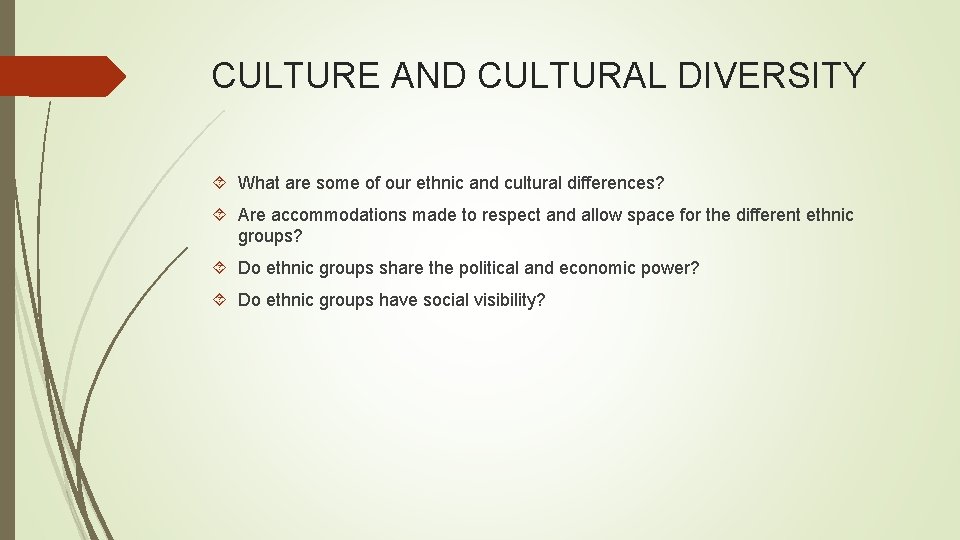
CULTURE AND CULTURAL DIVERSITY What are some of our ethnic and cultural differences? Are accommodations made to respect and allow space for the different ethnic groups? Do ethnic groups share the political and economic power? Do ethnic groups have social visibility?