
Culture Review The way of life of a
- Slides: 25
Culture Review
• The way of life of a group of people who share • culture similar beliefs and customs
• A group that shares the same language, religion, and history • ethnic group
• An area that shares similar cultural traits • cultural region
• A behavior or characteristic of a people, such as language, religion or custom, passed down from one generation to the next • cultural trait
• The things that all cultures have in common like the need for food, water, shelter • cultural universal
• The process of spreading ideas, languages and customs from one culture to another • cultural diffusion
• A local form of a language that is distinct from • dialect other areas
• A highly developed culture • civilization
• The development of a worldwide culture with an • globalization interdependent economic system
• The way a society organizes itself into smaller groups • social structure
• An important practice, relationship, or organization in a society or culture (government, religion, education, economic) • institutions
• mom, dad, and children • nuclear family
• mom, dad, and children with grandparents, aunts and uncles • extended family
• standard of accepted behavior • ethics
• beliefs of a person or social group in which they have an emotional investment • values
• actions or words that are considered inappropriate to a specific culture. • taboos
• The basic unit of any culture • family
• People learn their • religious values and ethics from which cultural institution?
• Give the name of an • Police department example of a • Fire department government • Supreme Court institution • Congress
Essay • Define cultural diffusion. Give two examples of cultural diffusion that has occurred in the United States today.
Religions • Things to know for each religion: – Founders – Sacred Text – One religious holiday or practice
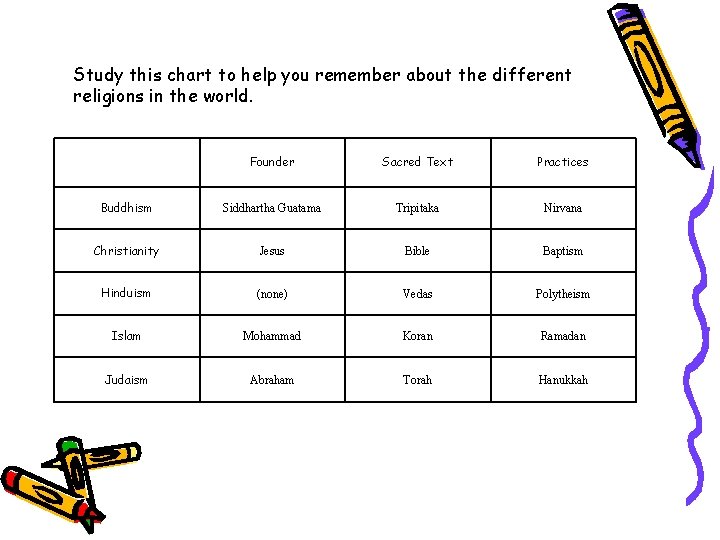
Study this chart to help you remember about the different religions in the world. Founder Sacred Text Practices Buddhism Siddhartha Guatama Tripitaka Nirvana Christianity Jesus Bible Baptism Hinduism (none) Vedas Polytheism Islam Mohammad Koran Ramadan Judaism Abraham Torah Hanukkah
Government systems • Democracy – people have a say in government • Monarchy – ruled by a king or a queen who is born into that position • Dictatorship – a person who rules by force – and has total control
Economic Systems • Be able to tell the differences between traditional, command (communism), market (capitalism), and mixed (socialism) economies – give examples of each