
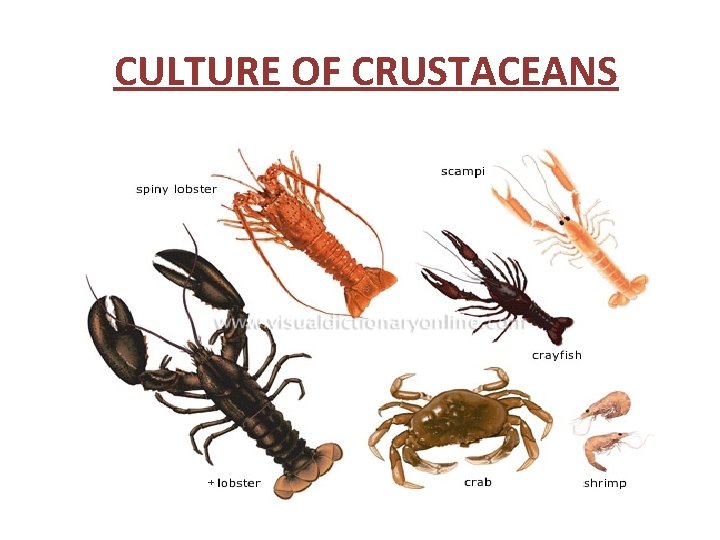
CULTURE OF CRUSTACEANS SHRIMP CULTURE Major cultivated species
- Slides: 26
CULTURE OF CRUSTACEANS
SHRIMP CULTURE Major cultivated species of shrimps: • In Asia important species are Penaeus monodon, P. merguiensis, P. semisulcatus and P. chinensis. P. penicillatus is a species cultured in Taiwan • Metapenaeus monoceros, M. brevicornis and M. ensis form subsidiary species in shrimp farms in several Asian countries • In Central and South America are P. vannamei and P. stylirostris. P. japonicus is the major species in temperate countries like Japan and Taiwan and in a less intensive way in France, Italy and Brazil • P. orientalis = P. chinensis is the major species grown in China and Korea. P. setiferus is the species of interest in temperate USA
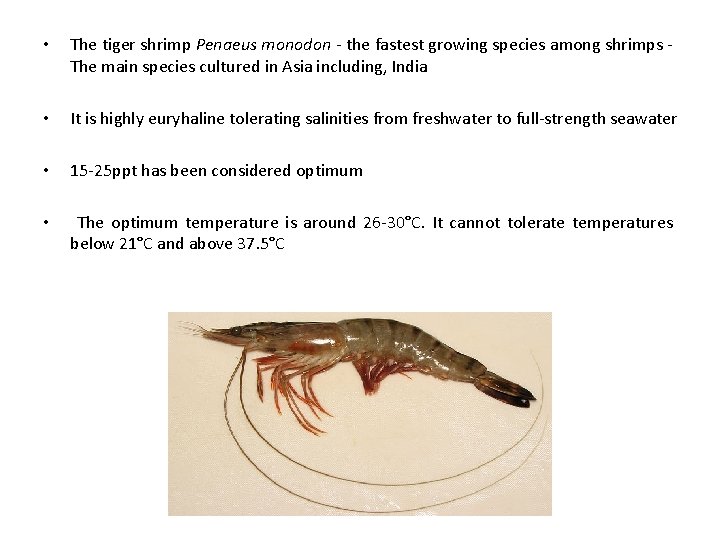
• The tiger shrimp Penaeus monodon - the fastest growing species among shrimps The main species cultured in Asia including, India • It is highly euryhaline tolerating salinities from freshwater to full-strength seawater • 15 -25 ppt has been considered optimum • The optimum temperature is around 26 -30°C. It cannot tolerate temperatures below 21°C and above 37. 5°C
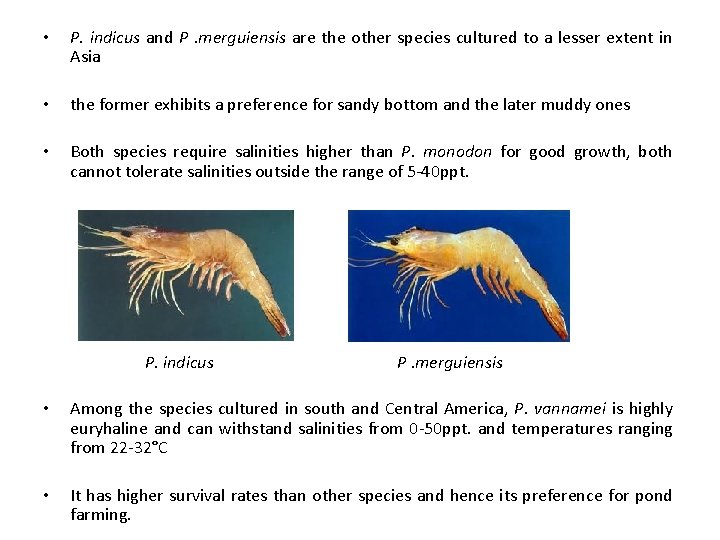
• P. indicus and P. merguiensis are the other species cultured to a lesser extent in Asia • the former exhibits a preference for sandy bottom and the later muddy ones • Both species require salinities higher than P. monodon for good growth, both cannot tolerate salinities outside the range of 5 -40 ppt. P. indicus P. merguiensis • Among the species cultured in south and Central America, P. vannamei is highly euryhaline and can withstand salinities from 0 -50 ppt. and temperatures ranging from 22 -32°C • It has higher survival rates than other species and hence its preference for pond farming.
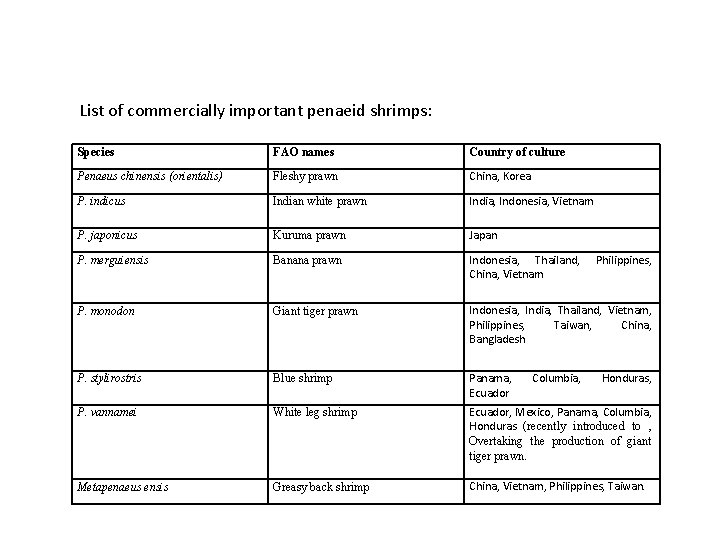
List of commercially important penaeid shrimps: Species FAO names Country of culture Penaeus chinensis (orientalis) Fleshy prawn China, Korea P. indicus Indian white prawn India, Indonesia, Vietnam P. japonicus Kuruma prawn Japan P. merguiensis Banana prawn Indonesia, Thailand, China, Vietnam P. monodon Giant tiger prawn Indonesia, India, Thailand, Vietnam, Philippines, Taiwan, China, Bangladesh P. stylirostris Blue shrimp Panama, Ecuador P. vannamei White leg shrimp Ecuador, Mexico, Panama, Columbia, Honduras (recently introduced to , Overtaking the production of giant tiger prawn. Metapenaeus ensis Greasy back shrimp China, Vietnam, Philippines, Taiwan. Columbia, Philippines, Honduras,
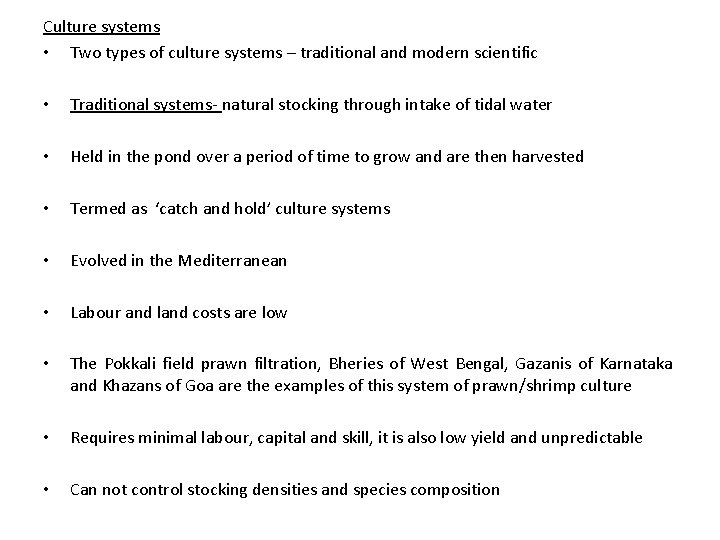
Culture systems • Two types of culture systems – traditional and modern scientific • Traditional systems- natural stocking through intake of tidal water • Held in the pond over a period of time to grow and are then harvested • Termed as ‘catch and hold’ culture systems • Evolved in the Mediterranean • Labour and land costs are low • The Pokkali field prawn filtration, Bheries of West Bengal, Gazanis of Karnataka and Khazans of Goa are the examples of this system of prawn/shrimp culture • Requires minimal labour, capital and skill, it is also low yield and unpredictable • Can not control stocking densities and species composition
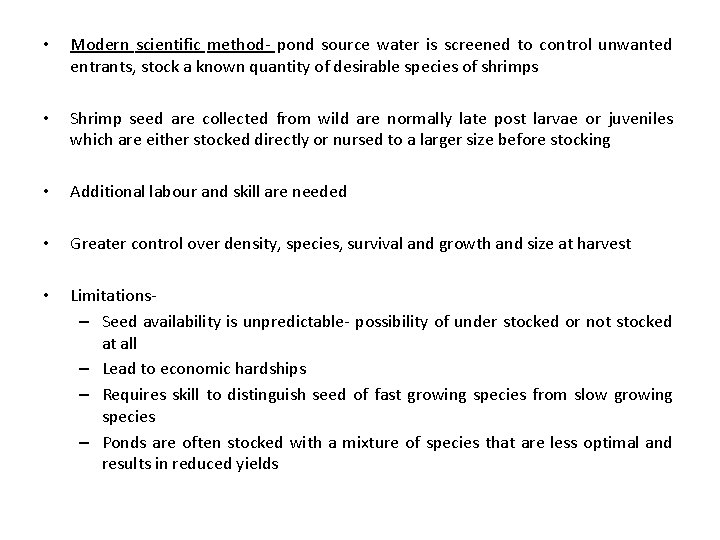
• Modern scientific method- pond source water is screened to control unwanted entrants, stock a known quantity of desirable species of shrimps • Shrimp seed are collected from wild are normally late post larvae or juveniles which are either stocked directly or nursed to a larger size before stocking • Additional labour and skill are needed • Greater control over density, species, survival and growth and size at harvest • Limitations– Seed availability is unpredictable- possibility of under stocked or not stocked at all – Lead to economic hardships – Requires skill to distinguish seed of fast growing species from slow growing species – Ponds are often stocked with a mixture of species that are less optimal and results in reduced yields
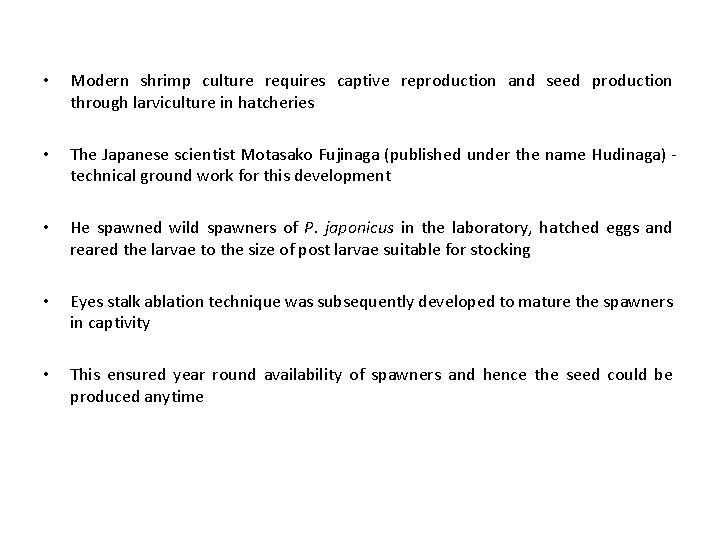
• Modern shrimp culture requires captive reproduction and seed production through larviculture in hatcheries • The Japanese scientist Motasako Fujinaga (published under the name Hudinaga) technical ground work for this development • He spawned wild spawners of P. japonicus in the laboratory, hatched eggs and reared the larvae to the size of post larvae suitable for stocking • Eyes stalk ablation technique was subsequently developed to mature the spawners in captivity • This ensured year round availability of spawners and hence the seed could be produced anytime
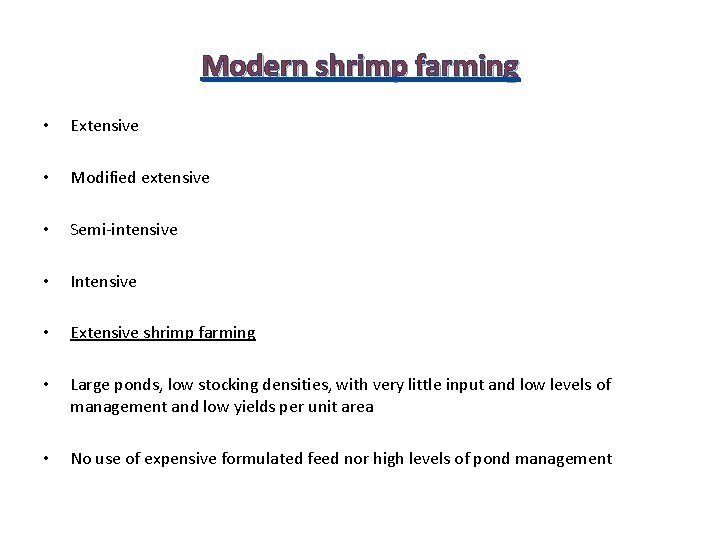
Modern shrimp farming • Extensive • Modified extensive • Semi-intensive • Intensive • Extensive shrimp farming • Large ponds, low stocking densities, with very little input and low levels of management and low yields per unit area • No use of expensive formulated feed nor high levels of pond management
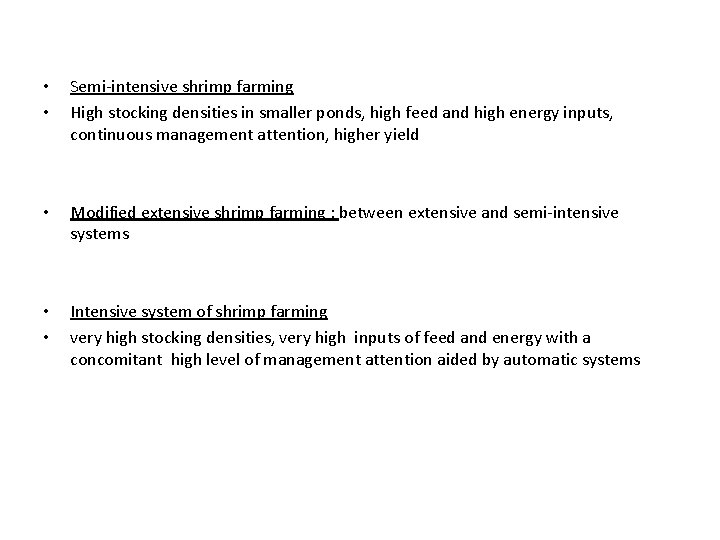
• • Semi-intensive shrimp farming High stocking densities in smaller ponds, high feed and high energy inputs, continuous management attention, higher yield • Modified extensive shrimp farming : between extensive and semi-intensive systems • • Intensive system of shrimp farming very high stocking densities, very high inputs of feed and energy with a concomitant high level of management attention aided by automatic systems
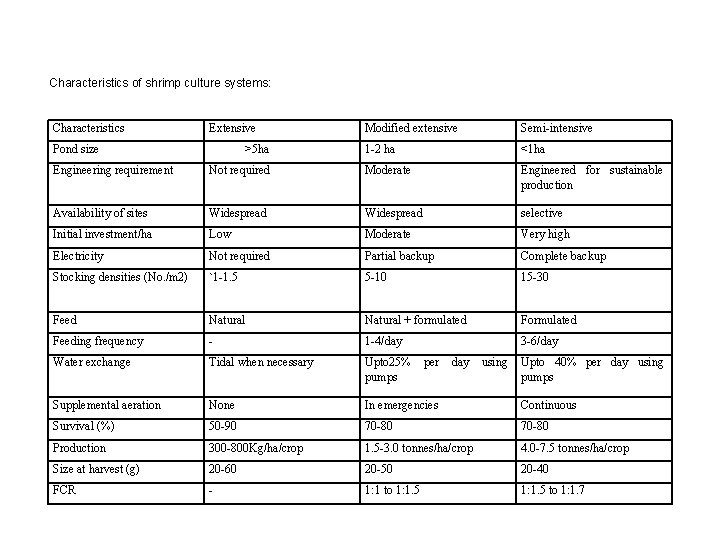
Characteristics of shrimp culture systems: Characteristics Extensive Pond size >5 ha Modified extensive Semi-intensive 1 -2 ha <1 ha Engineering requirement Not required Moderate Engineered for sustainable production Availability of sites Widespread selective Initial investment/ha Low Moderate Very high Electricity Not required Partial backup Complete backup Stocking densities (No. /m 2) `1 -1. 5 5 -10 15 -30 Feed Natural + formulated Feeding frequency - 1 -4/day 3 -6/day Water exchange Tidal when necessary Upto 25% pumps Supplemental aeration None In emergencies Continuous Survival (%) 50 -90 70 -80 Production 300 -800 Kg/ha/crop 1. 5 -3. 0 tonnes/ha/crop 4. 0 -7. 5 tonnes/ha/crop Size at harvest (g) 20 -60 20 -50 20 -40 FCR - 1: 1 to 1: 1. 5 to 1: 1. 7 per day using Upto 40% per day using pumps
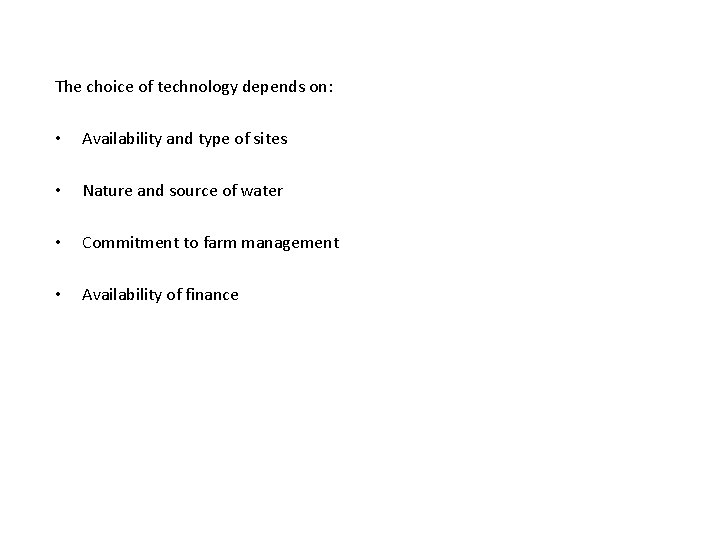
The choice of technology depends on: • Availability and type of sites • Nature and source of water • Commitment to farm management • Availability of finance
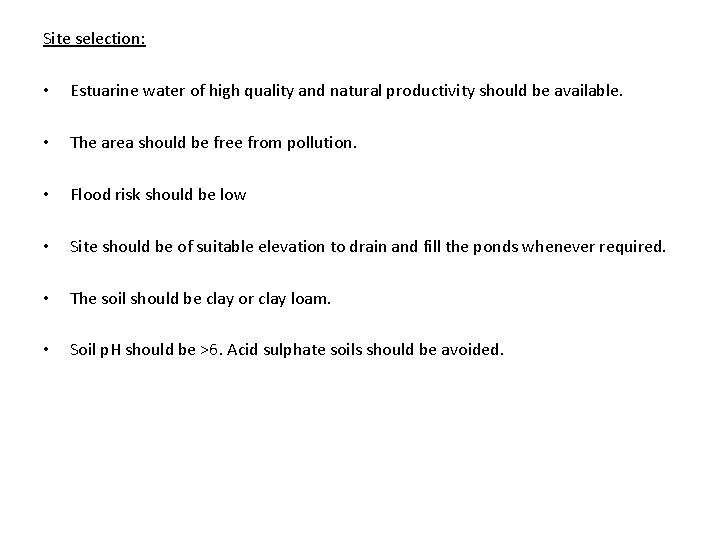
Site selection: • Estuarine water of high quality and natural productivity should be available. • The area should be free from pollution. • Flood risk should be low • Site should be of suitable elevation to drain and fill the ponds whenever required. • The soil should be clay or clay loam. • Soil p. H should be >6. Acid sulphate soils should be avoided.
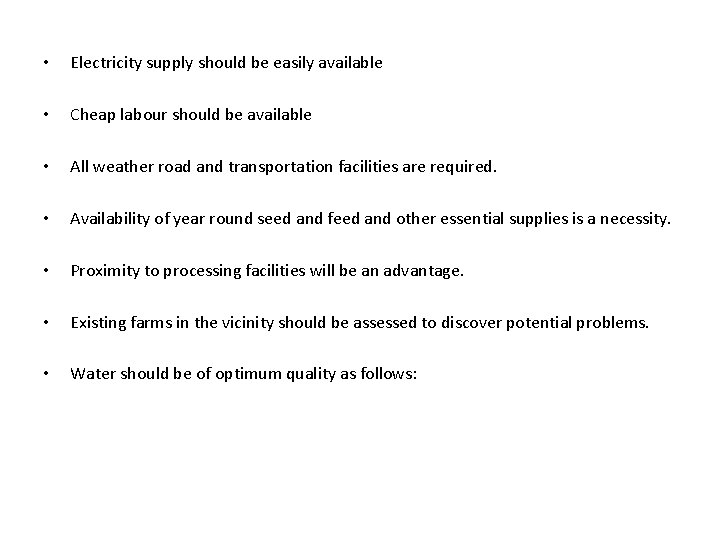
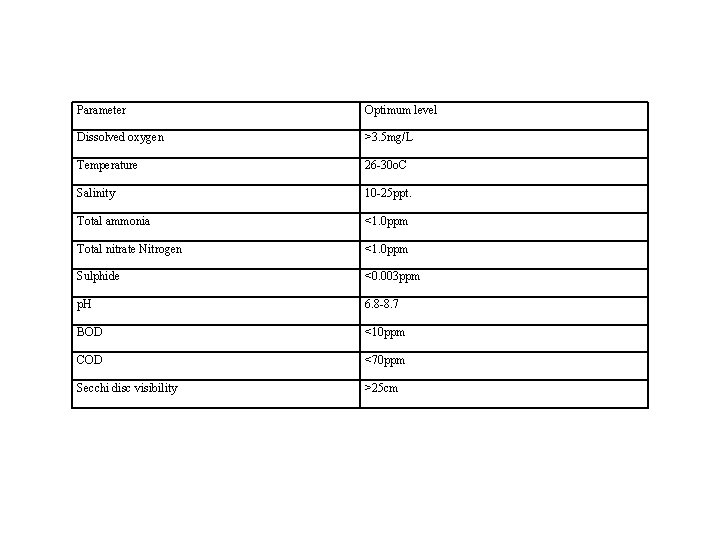
• Electricity supply should be easily available • Cheap labour should be available • All weather road and transportation facilities are required. • Availability of year round seed and feed and other essential supplies is a necessity. • Proximity to processing facilities will be an advantage. • Existing farms in the vicinity should be assessed to discover potential problems. • Water should be of optimum quality as follows:
Parameter Optimum level Dissolved oxygen >3. 5 mg/L Temperature 26 -30 o. C Salinity 10 -25 ppt. Total ammonia <1. 0 ppm Total nitrate Nitrogen <1. 0 ppm Sulphide <0. 003 ppm p. H 6. 8 -8. 7 BOD <10 ppm COD <70 ppm Secchi disc visibility >25 cm
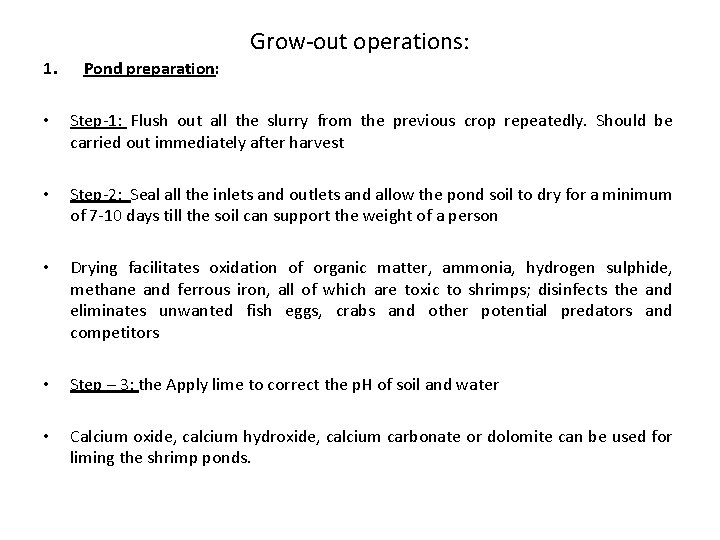
Grow-out operations: 1. Pond preparation: • Step-1: Flush out all the slurry from the previous crop repeatedly. Should be carried out immediately after harvest • Step-2: Seal all the inlets and outlets and allow the pond soil to dry for a minimum of 7 -10 days till the soil can support the weight of a person • Drying facilitates oxidation of organic matter, ammonia, hydrogen sulphide, methane and ferrous iron, all of which are toxic to shrimps; disinfects the and eliminates unwanted fish eggs, crabs and other potential predators and competitors • Step – 3: the Apply lime to correct the p. H of soil and water • Calcium oxide, calcium hydroxide, calcium carbonate or dolomite can be used for liming the shrimp ponds.
• Step – 4: Fill ponds with 30 cm of water and leave for 3 days • Drain when colour becomes light green. • Step – 5: Apply urea @ 50 -100 Kg/ha and single super phosphate @ 7. 5 -15 Kg/ha to facilitate growth of diatoms - good for shrimp post larvae • For modified extensive shrimp farming - poultry manure or cow dung @ 10001500 Kg/ha • Step – 6: Fill water 10 cm every day up to a depth of 100 -120 cm; water p. H-7. 5 and 8. 5 • Indicators to know the rediness of the pond: • Secchi disc reading 40 -25 cm; Stable p. H; Algal blooms – the water should be brown with yellowish hue; Water temperature should be above 25°C
2. Selection of shrimp fry (post larvae): • The most important criteria -stage of development • The age of the fry influences size variation at harvest and the survival • PL 20 is the most ideal size to stock • If fry of size less than PL 20 are stocked in the ponds it will result in least size variation but also low survival. If fry of more than PL 20 are stocked in the ponds, it will improve survival but results in greater size variation
What to look for in the fry • Fry should be transparent and not cloudy or with white spots or covered with stains • Rostrum and head should not be wrinkled • Abdomen should have long black line along the body – indicates that the gut is full and therefore fry are healthy since they are feeding well • Uropods should be well spread out • Fry should be of uniform size • Fry should swim against the currents. • The fry should be transported in polythene bags filled with water and oxygen in the ratio of 1: 3.
3. Stocking: • Stocking density according to the type of culture • Acclimatisation in the ponds the following way– Transfer fry to plastic basins – Slowly add pond water to the basins – Tilt the basins slowly after acclimatization, if the fry swim out it indicates that they are acclimatized – If not they need further acclimatization. – Stock the fry during cool hours preferably in the night or early morning.
4. Feeding • Quality of feed - direct impact on the growth and production of shrimps • First two weeks - @ 1 Kg/1 lakh seed • The feed quantity is doubled the next two weeks • From the second month onwards, feeding is based on the biomass/body weight of the shrimp • Actual feeding rate will depend on results of the check trays • Place 1% of the feed in each check tray
• Inspect the check tray two hours later for shrimp of size less than 10 g; one and half hour later for shrimps size 10 -20 g and after one hour after feeding for shrimps more than 20 g in size. • Too much left over feed in the trays- over feeding. No feed in the trays after one hour - under feeding • The feeding frequency should be as follows: • • • 1 st month 2 nd month 3 rd month onwards - 3 times per day - 4 times per day - 5 to 6 times per day
Water quality management: • The water quality maintained by proper water exchange, aeration and addition of chemicals such as lime, zeolite, dolomite etc. • Water exchanged when water quality parameters go beyond optimum levels • The rate of water exchange depends on the density of shrimps in the pond and feeding rate • Higher the density, more the feed applied to the pond, hence higher the rate of water exchange
• In modified extensive pond water is exchanged every neap and spring tide • One third of the water is let out every day and replaced with fresh brackish water each day for three consecutive days • In semi-intensive culture there is a progressive increase in the rate of water exchange over the culture period • The rate of exchange initially may be 5% per day increasing to 30% per day during the end of the culture period
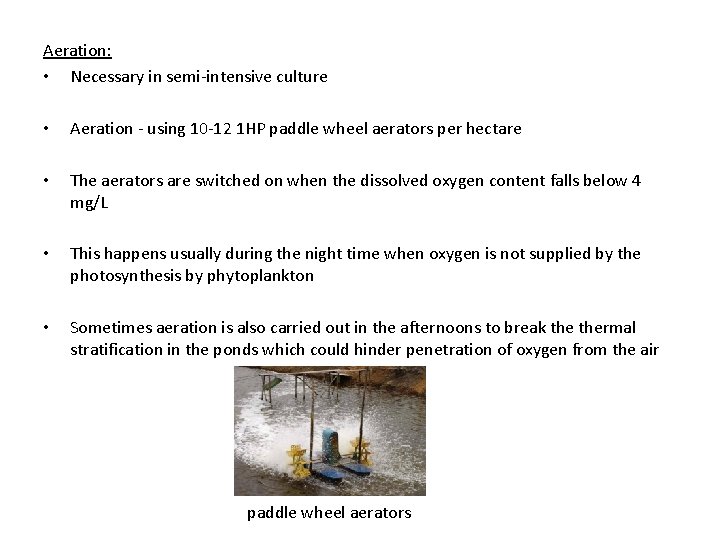
Aeration: • Necessary in semi-intensive culture • Aeration - using 10 -12 1 HP paddle wheel aerators per hectare • The aerators are switched on when the dissolved oxygen content falls below 4 mg/L • This happens usually during the night time when oxygen is not supplied by the photosynthesis by phytoplankton • Sometimes aeration is also carried out in the afternoons to break thermal stratification in the ponds which could hinder penetration of oxygen from the air paddle wheel aerators
Harvesting: • Harvested when they reach marketable size of 20 -40 g in 3 -5 months • Shrimps are carried by the out-flowing water which gets collected in the net fixed to the outlet • Shrimps - periodically collected from the net, washed with clean estuarine water, ice-chilled and sold to the processors.