
Culture media Media Providing Nutrients in the Laboratory
Culture media
Media: Providing Nutrients in the Laboratory �At least 500 different types �Contained in test tubes, flasks, or Petri dishes �Inoculated by loops, needles, pipettes, and swabs �Sterile technique necessary �Classification of media Physical state Chemical composition Functional type

Classification of Media by Physical State �Liquid media: water-based solutions, do not solidify at temperatures above freezing, flow freely when container is tilted Broths, milks, or infusions Growth seen as cloudiness or particulates �Semisolid media: clotlike consistency at room temperature Used to determine motility and to localize reactions at a specific site �Solid media: a firm surface on which cells can form discrete colonies Liquefiable and nonliquefiable Useful for isolating and culturing bacteria and fungi

Classification of Media by Chemical Content �Synthetic media- compositions are precisely chemically defined �Complex (nonsynthetic) media- if even just one component is not chemically definable

Classification of Media by Function �General purpose media- to grow as broad a spectrum of microbes as possible Usually nonsynthetic Contain a mixture of nutrients to support a variety of microbes Examples: nutrient agar and broth, brain-heart infusion, trypticase soy agar (TSA).
Enriched Media �Enriched media- contain complex organic substances (for example blood, serum, growth factors) to support the growth of fastidious bacteria. �chocolate agar, blood agar
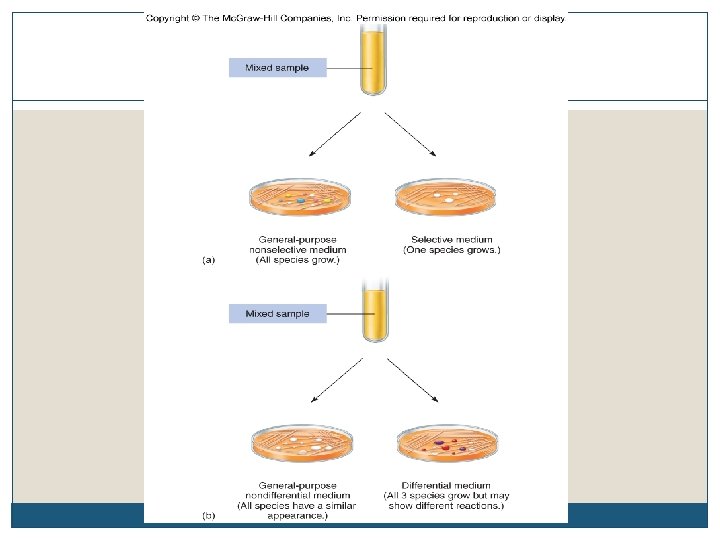
Selective and Differential Media �Selective media- contains one or more agents that inhibit the growth of certain microbes but not others. Example: Mannitol salt agar (MSA), Mac. Conkey agar. �Differential media- allow multiple types of microorganisms to grow but display visible differences among those microorganisms. Mac. Conkey agar can be used as a differential medium as well.
Miscellaneous Media �Reducing media- absorbs oxygen or slows its penetration in the medium; used for growing anaerobes or for determining oxygen requirements �Carbohydrate fermentation media- contain sugars that can be fermented and a p. H indicator; useful for identification of microorganisms �Transport media- used to maintain and preserve specimens that need to be held for a period of time �Assay media- used to test the effectiveness of antibiotics, disinfectants, antiseptics, etc. �Enumeration media- used to count the numbers of organisms in a sample.

Culture Pure culture- growth of only a single known species (also called axenic) �Usually created by subculture Mixed culture- holds two or more identified species Contaminated culture- includes unwanted microorganisms of uncertain identity, or contaminants.

Thank you
- Slides: 12