
Culture Communicates US Diplomacy That Works By Ms
Culture Communicates: US Diplomacy That Works By Ms. Joanne Delone & Simona Serban
Cultural Diplomacy • What is Cultural Diplomacy and how does it benefits us as a Nation?

Cultural Diplomacy defined The exchange of ideas, information, art and other aspects of culture among nations and their peoples to foster mutual understanding, forms an important component of the broader endeavour of public diplomacy, which basically comprises all that a nation does to explain itself to the world.
The Benefits of Cultural Diplomacy • Allows nations to share forms of their creative expression. • It is enjoyable and can therefore be one of the most effective tools in any diplomatic toolbox. • It is a prime example of ‘soft power’, or the ability to persuade through culture, values and ideas, as opposed to ‘hard power’, which conquers or coerces through military might.

Need some examples. . • As we think about cultural diplomacy and its influences, can you provided me with some examples of what the United Stated and other Nations have done that can be deemed as Cultural Diplomacy?
American Public Diplomacy in Crisis. . . ? • A consensus has emerged that American public diplomacy is in crisis. At least that is what the numerous task forces convened since ‘ 9/11’ to study the dilemma of how to improve US public diplomacy would suggest. • Despite the success the Cold War little attention to the category of cultural diplomacy made. • One might have expected the United States to turn to cultural diplomacy in the wake of ‘ 9/11’ to increase understanding between America and the Arab/Muslim world.
Question • Why does the author say that, “the early success of cultural programmes sowed the seeds for their[U. S. ] demise?
Answer • Without the threat of the former Soviet Union, cultural and public diplomacy programmes suffered increasing cutbacks until the home of cultural diplomacy, the United States Information Agency (USIA), was dissolved and its functions and people absorbed into the State Department.
They did not heed Walter Laqueur’s warning. . . • Question: Why did some believe that cultural diplomacy was no longer need? • Lanqueur agrued that the world has entered a period of great disorder. In facing these new dangers, a re-examination of old priorities is needed. Cultural diplomacy, in the widest sense, has increased in importance, whereas traditional diplomacy and military power. . . Are of limited use in coping with most of these dangers.
Discussion for your mind • Do you believe that 9/11 accorded as a result of the diminishing presence of cultural diplomacy? If so, why or why not?
Can you explain. . . • What was the reasons behind the decline of cultural diplomacy in the United States from the 1990 s to the present?
Why did it happen. . . • Neither by the Clinton nor the George W. Bush administration. Short-sighted cost cutting and euphoria over the crumbling Berlin wall led to drastic reductions in the scope and effectiveness of cultural and public diplomacy programmes. • The integration of all public diplomacy activities into the State Department in 1999 dealt cultural diplomacy a near-death blow. By 2000 the total budget for all public and cultural diplomacy activities amounted to less than eight per cent of the State Department budget, or approximately one-third of one per cent of the Pentagon budget.
American culture and understanding America until the Cold War Long before cultural diplomacy was employed by the US government, American cultural expression was influencing audiences throughout the world. Invariably, non-Americans have recognized the power of American culture more than have Americans.
Discussion for your development Who is Walt Whitman and what role did he play is promoting the image of the Unites State during his era?
Answer. . . • According to this chapter: Anyone who wishes to understand America must first carry over his concept of Democracy from the political and social field to the cultural and generally human. The best way to do this continues to be reading Walt Whitman. . . There is no stronger promoter of democracy in this sense than the cinema. It accustoms low, to a single common view of life. • Other states indicate themselves in their deputies. . . but the genius of the United States is not best or most in its executives or legislatures, nor in its ambassadors or authors or colleges or churches or parlors, nor even in its newspapers or inventors. . . but always most in the common people.
How did they do it. . ? • Creative expression can help to shape the image of a nation and to communicate its values, but it was during the Cold War that America harnessed the power of culture as the stealth weapon against the US’s enemy – the former Soviet Union – and its ideology – communism. • The US government, through the State Department and other agencies, among them the CIA, orchestrated an unprecedented dissemination of American thought and creative expression throughout the world. • Cultural programmes, from the huge gathering of intellectuals—the Congress for Cultural Freedom – to more intimate artists’ and writers’ exchanges and to music programmes on Radio Free Europe, helped to turn Europeans away from socialism and communism and opened the door of Western culture and lifestyle to Soviet artists and citizens.
Cold War Cultural Diplomacy: Have you learned. . ? • What values can the Unites States learn from the cultural diplomacy that was practice during the Cold War as it is facing current challenges with Middle Eastern countries?
Food for thought. . • US diplomats understood the importance of cultural expression to the Russians and respected their literary and artistic achievements. • Like many Middle Eastern countries, notably Iraq and Iran, Russia had a distinguished literary tradition that was closely identified with its national identity. By honouring Russia’s literary giants of the past and dissident writers of the present, the US government gained important allies in Soviet society and through them was able to communicate broadly with the Soviet people. • As the United States seeks avenues for communicating with the Arab/Muslim world, literary and scientific publications provide ideal vehicles.
Food for thought. . con’t • While security risks prohibit American writers and artists from visiting Iraq at present, Iraqi writers and artists could be invited to the United States and other Western countries for frank exchanges modeled after those in the 1950 s. • Arguably even more potent than literature in revealing the cracks in the communist façade and communicating the freedoms of the West was music, particularly jazz and rock ‘n’ roll. Western music penetrated the Iron Curtain through the nightly programming of Music USA, hosted by Willis Connover from 1955 until his death in 1996. • Until the fall of the Soviet Union and its empire, both public and private entities contributed to the shaping of the image of the US abroad.
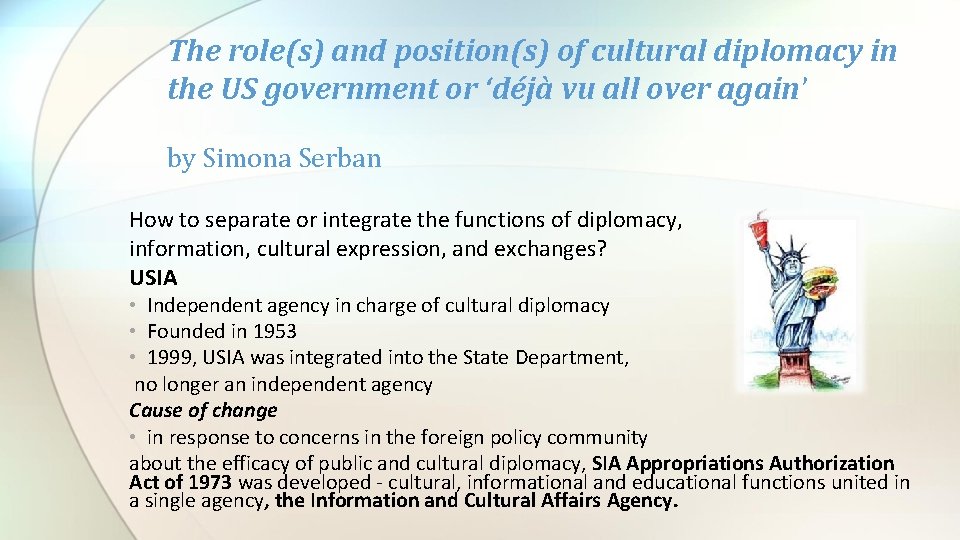
The role(s) and position(s) of cultural diplomacy in the US government or ‘déjà vu all over again’ by Simona Serban How to separate or integrate the functions of diplomacy, information, cultural expression, and exchanges? USIA • Independent agency in charge of cultural diplomacy • Founded in 1953 • 1999, USIA was integrated into the State Department, no longer an independent agency Cause of change • in response to concerns in the foreign policy community about the efficacy of public and cultural diplomacy, SIA Appropriations Authorization Act of 1973 was developed - cultural, informational and educational functions united in a single agency, the Information and Cultural Affairs Agency.
The role(s) and position(s) of cultural diplomacy in the US government or ‘déjà vu all over again’ cont’d Effects of change • USIA integration into the State Department resulted in reduction in budget, personnel and effectiveness of public and cultural diplomacy and a profound misunderstanding of diplomacy in the post-Cold War world. • With the collapse of the Soviet Union and the installing of the communist regime, the need to communicate democratic values and ideas with people at all levels of society was greater than ever. Precisely at this moment US made some bad decisions: • Shut the doors to its libraries and ‘America Houses’ • Cut the number of public and cultural affairs’ officers all over the world, eliminating some posts entirely • Replaced libraries by ‘Information Resource Centers’- thousand of books were thrown away.
The role(s) and position(s) of cultural diplomacy in the US government or ‘déjà vu all over again’ cont’d Cultural diplomacy and its role in foreign affairs • The establishment of USIA as a separate agency reflected the belief that cultural diplomacy should be independent towards foreign policy. • The consolidation of USIA into the State Department reflects the opposite: cultural diplomacy at present it should be linked to increasing understanding and support for US policies.
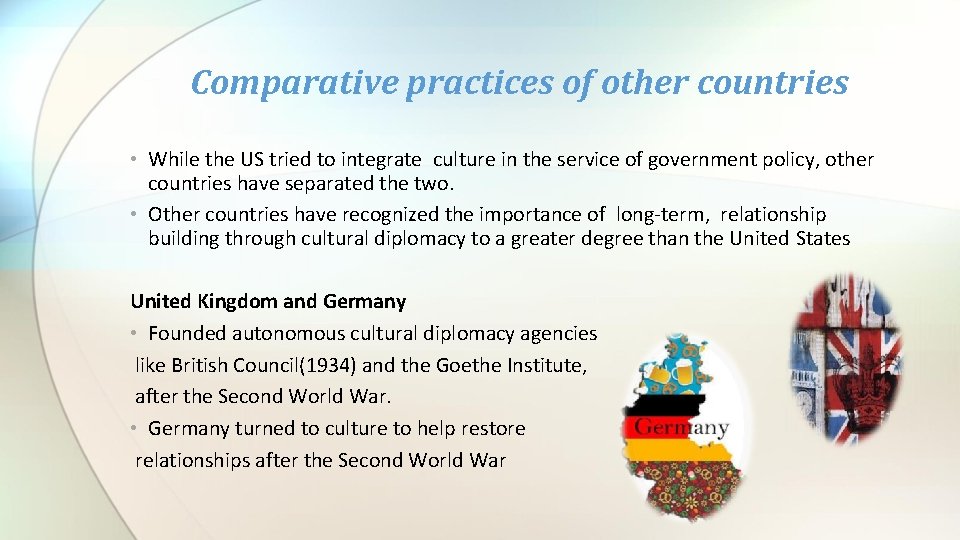
Comparative practices of other countries • While the US tried to integrate culture in the service of government policy, other countries have separated the two. • Other countries have recognized the importance of long-term, relationship building through cultural diplomacy to a greater degree than the United States United Kingdom and Germany • Founded autonomous cultural diplomacy agencies like British Council(1934) and the Goethe Institute, after the Second World War. • Germany turned to culture to help restore relationships after the Second World War
Comparative practices of other countries cont’d Soviet Union • Tried to establish links with US in spite of the profound differences between the systems of the two countries, with artists such as the dancers of the Bolshoi and Kirov ballets. France and Netherlands • potential cultural initiatives are evaluated on the basis of quality, not political efficacy. • culture provides a means to expand upon ideas and images created by the market.
Cultural diplomacy in the twenty-first century • During the Clinton administration the value and importance of cultural diplomacy was reasserted. • Events like House Conference on Cultural Diplomacy, opening with speeches by President Clinton and First Lady Hillary Rodham Clinton, followed by remarks by Nobel Laureate Wole Soyinka, former US Poet Laureate Rita Dove, Doris Duke Foundation President Joan Spero, Italian Cultural Minister Giovanna Melandri, cellist Yo-Yo Ma, and His Highness the Aga Khan. Why US cultural diplomacy in the twenty-first century had a limited effect? • Gradual diminution in importance of cultural programs and those who promoted them. • Culture is subordinated to public diplomacy, politics and economics are valued more then culture • Embassies will not take advantage of the opportunities afforded by private visits of US artists and musicians • No institutional support - cultural diplomacy is not systematic, but capricious and sporadic, reflecting the interests of individual ambassadors.
The challenges of cultural diplomacy today Never have the challenges of cultural diplomacy for America been greater than today, when public opinion about the United States stands is lower then ever Europe • favorable views of the US have dropped by 40 percentage points or more in the United Kingdom, France, Germany, Italy and Spain. Middle East • negative views previously held in the Middle East have spread to other Muslim populations, such as in Indonesia and Nigeria because policies of the US government not with their values, most notably the war and occupation in Iraq.
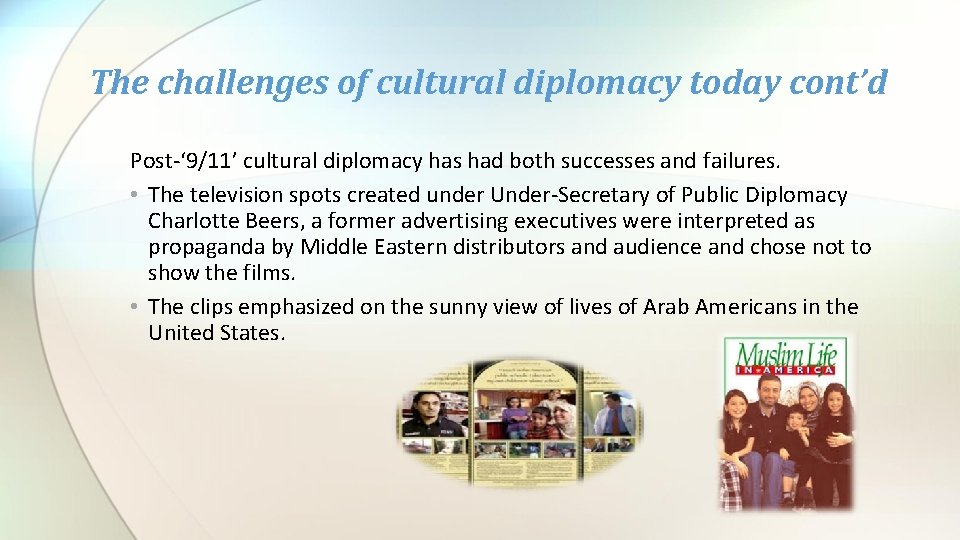
The challenges of cultural diplomacy today cont’d Post-‘ 9/11’ cultural diplomacy has had both successes and failures. • The television spots created under Under-Secretary of Public Diplomacy Charlotte Beers, a former advertising executives were interpreted as propaganda by Middle Eastern distributors and audience and chose not to show the films. • The clips emphasized on the sunny view of lives of Arab Americans in the United States.
The challenges of cultural diplomacy today cont’d Limitations • Less than three million US dollars per year is allocated to send American performers abroad, compared with smaller countries like France’s budget for performances and exhibitions per year – over 600 million dollars. • the strictness of visa requirements with the Patriot Act is significantly diminishing the number of foreign students at US universities and the number of cultural exchanges.
The challenges of cultural diplomacy today cont’d Broadcasting • merge cultural diplomacy with popular culture • The Broadcasting Board of Governors launched new stations in the Middle East, both on radio – Radio Sawa – and TV – Alhurra Radio Sawa • successful alternates between contemporary Arab and Western music, with periodic news spots, aiming to appeal to the 60 per cent of the Middle East’s population that is aged under 30. TV station Alhurra • is struggling harder to establish itself, partially because of the more competitive television market (over 100 cable channels), and partially because of inherent suspicion in the Middle East of government-sponsored media A less costly alternative to creating a new television station in a market that is already flooded would be to provide programming for the numerous extant stations- private ventures such as Layalina Productions. Layalina will offer both news and content programs, including a series targeted towards youth in which an Arab and a Western boy travel back in time to famous events in Arab and Western history.
The challenges of cultural diplomacy today cont’d Successful cultural initiatives Culture Connect programme • sends the best in American culture(concerts and master classes) abroad Ambassador’s Fund for cultural and historical preservation • has had a enormous positive impact despite of being under budgeted by developing world select historical preservation projects that meet local needs and priorities American Corners • numbering more than 130 located primarily in the former Soviet Union, • placed inside local libraries and cultural institutions offer access to the internet, plus videos, CDs and books about the US.
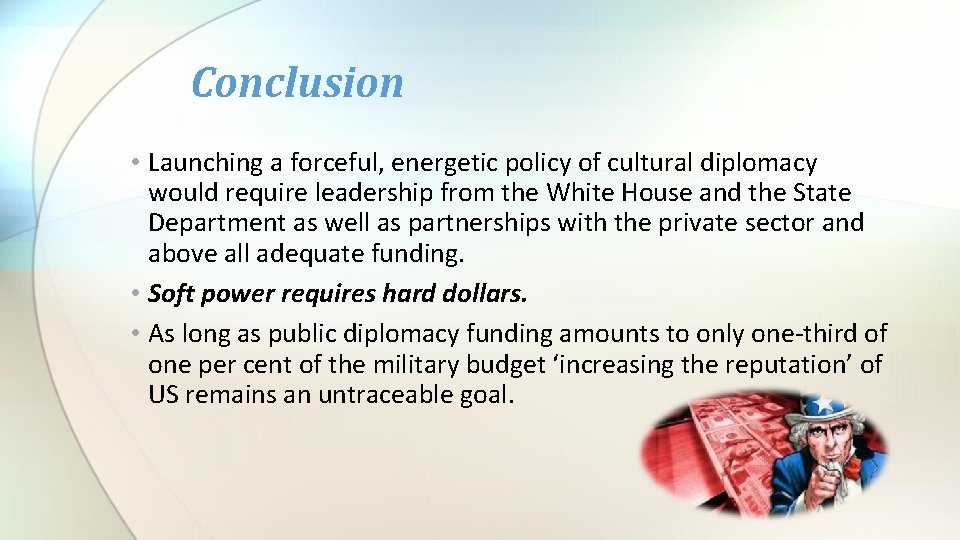
Conclusion • Launching a forceful, energetic policy of cultural diplomacy would require leadership from the White House and the State Department as well as partnerships with the private sector and above all adequate funding. • Soft power requires hard dollars. • As long as public diplomacy funding amounts to only one-third of one per cent of the military budget ‘increasing the reputation’ of US remains an untraceable goal.
Chapter 11: Lighting for Video Megan A. Perry
Reminder: Good lighting can transform a routine, uninteresting shot into an attractive, appealing image that draws the audience’s attention. Terms • Barn doors: Metal flaps that are attached to the top, bottom, and sides of the light in order to shape the beam. • Diffusion material: Material that can be attached to the front of a light in order to reduce the intensity of the light beam. • Ellipsoidal: A light that is sharply focused/defined spotlight. • Flood lighting: This light scatters in all directions, providing a broad, non-directional light. • Fresnel: An unfocused spotlight. • Gel: Colored flexible plastic filter used to adjust the color of lights.
• Grip clamps: Designed so that a light can easily be attached. The clamp is then used to attach the light to almost anything. • LED light panel: A camera or studio light that is made from a series of small LED bulbs. • Photographic lighting: See Three-point lighting. • Scoop: A simple floodlight. It is inexpensive, usually not adjustable, lightweight, and does not have a sharp outline. • Soft light: Provides a large level of diffused light. • Spotlight: A highly directional light. • Three-point lighting: A lighting technique that utilizes three lights (key, fill, and back lights) to illuminate the subject.
Lighting for Everyone So much depends on where and when shooting takes place. Time of day, interior, or exterior, a lot of shooting will depend on the sort of atmosphere the director is aiming to convey to the audience. The Camera does not Compensate Human beings are able to see a remarkably even when lighting conditions are poor, however not all cameras can. Cameras respond to what is there, within its limitations. When lighting is the essential difference between the way the human eye and brain registers a scene and the limited, literal way the camera reproduces it. The eye and brain compensate (sometimes overcompensate) in subtle ways.
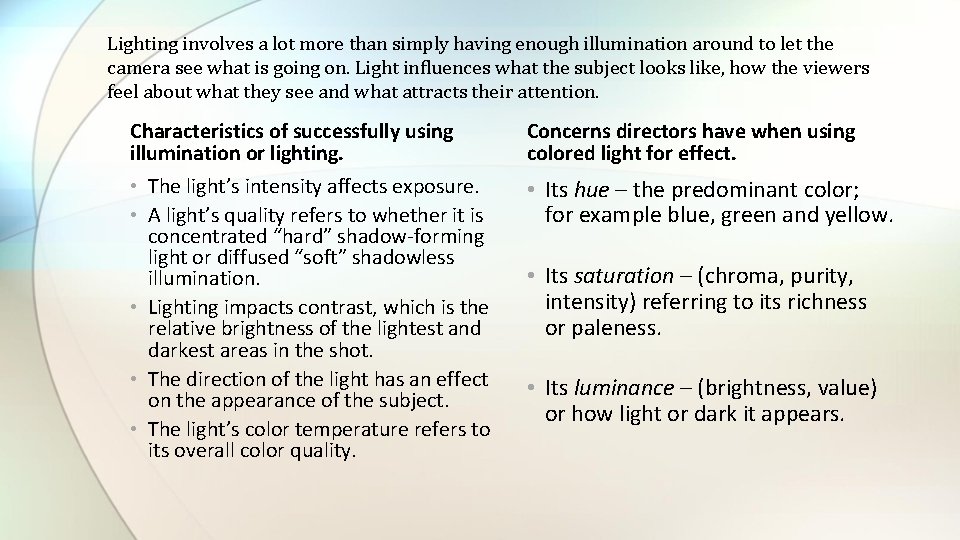
Lighting involves a lot more than simply having enough illumination around to let the camera see what is going on. Light influences what the subject looks like, how the viewers feel about what they see and what attracts their attention. Characteristics of successfully using illumination or lighting. Concerns directors have when using colored light for effect. • The light’s intensity affects exposure. • A light’s quality refers to whether it is concentrated “hard” shadow-forming light or diffused “soft” shadowless illumination. • Lighting impacts contrast, which is the relative brightness of the lightest and darkest areas in the shot. • The direction of the light has an effect on the appearance of the subject. • The light’s color temperature refers to its overall color quality. • Its hue – the predominant color; for example blue, green and yellow. • Its saturation – (chroma, purity, intensity) referring to its richness or paleness. • Its luminance – (brightness, value) or how light or dark it appears.
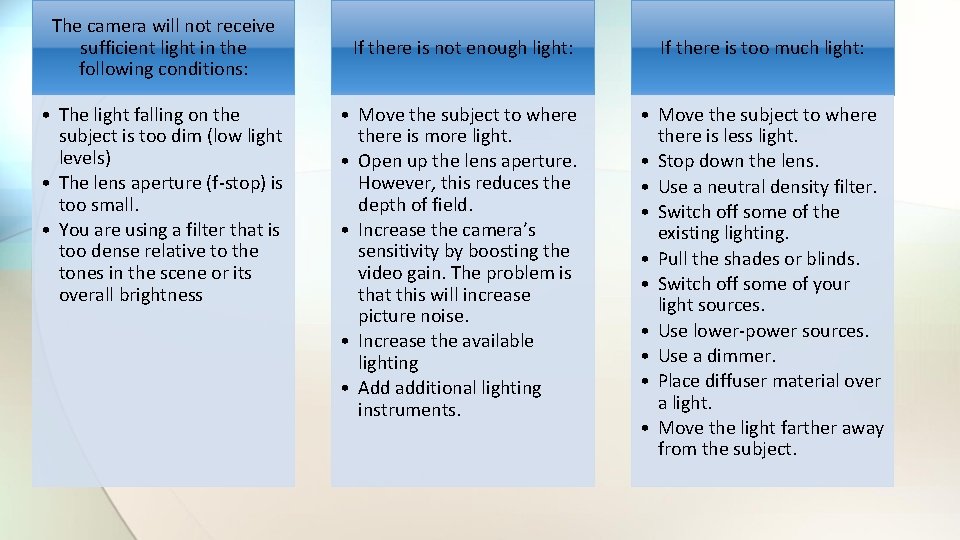
The camera will not receive sufficient light in the following conditions: • The light falling on the subject is too dim (low light levels) • The lens aperture (f-stop) is too small. • You are using a filter that is too dense relative to the tones in the scene or its overall brightness If there is not enough light: If there is too much light: • Move the subject to where there is more light. • Open up the lens aperture. However, this reduces the depth of field. • Increase the camera’s sensitivity by boosting the video gain. The problem is that this will increase picture noise. • Increase the available lighting • Add additional lighting instruments. • Move the subject to where there is less light. • Stop down the lens. • Use a neutral density filter. • Switch off some of the existing lighting. • Pull the shades or blinds. • Switch off some of your light sources. • Use lower-power sources. • Use a dimmer. • Place diffuser material over a light. • Move the light farther away from the subject.
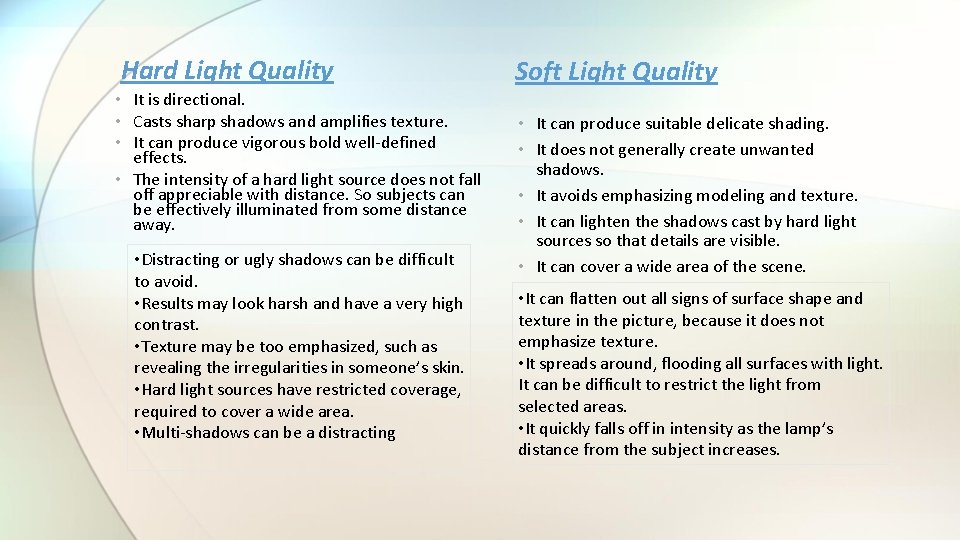
Hard Light Quality • It is directional. • Casts sharp shadows and amplifies texture. • It can produce vigorous bold well-defined effects. • The intensity of a hard light source does not fall off appreciable with distance. So subjects can be effectively illuminated from some distance away. • Distracting or ugly shadows can be difficult to avoid. • Results may look harsh and have a very high contrast. • Texture may be too emphasized, such as revealing the irregularities in someone’s skin. • Hard light sources have restricted coverage, required to cover a wide area. • Multi-shadows can be a distracting Soft Light Quality • It can produce suitable delicate shading. • It does not generally create unwanted shadows. • It avoids emphasizing modeling and texture. • It can lighten the shadows cast by hard light sources so that details are visible. • It can cover a wide area of the scene. • It can flatten out all signs of surface shape and texture in the picture, because it does not emphasize texture. • It spreads around, flooding all surfaces with light. It can be difficult to restrict the light from selected areas. • It quickly falls off in intensity as the lamp’s distance from the subject increases.
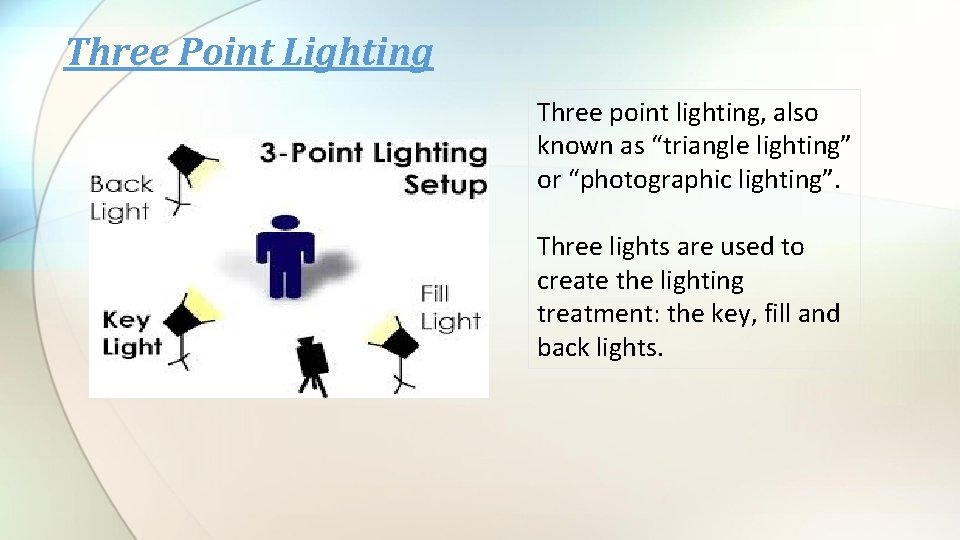
Three Point Lighting Three point lighting, also known as “triangle lighting” or “photographic lighting”. Three lights are used to create the lighting treatment: the key, fill and back lights.
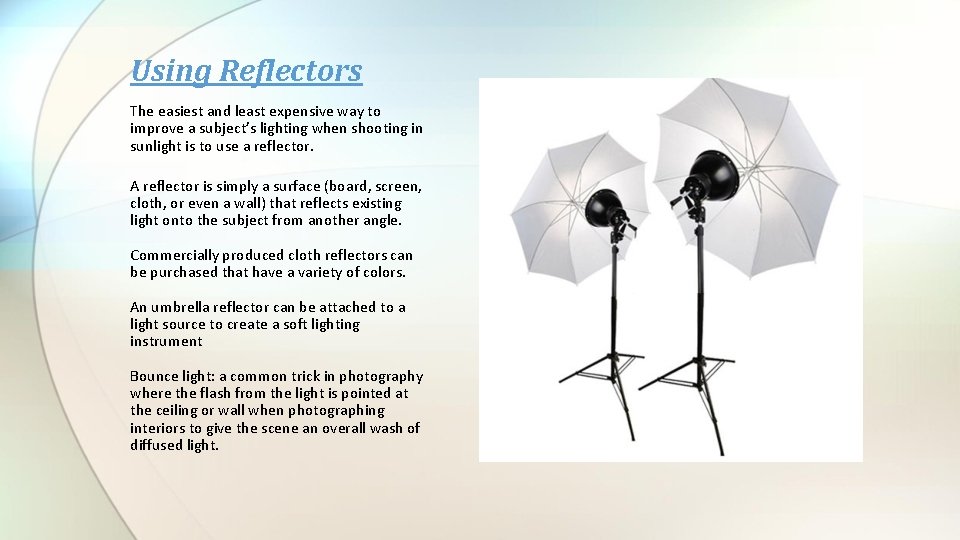
Using Reflectors The easiest and least expensive way to improve a subject’s lighting when shooting in sunlight is to use a reflector. A reflector is simply a surface (board, screen, cloth, or even a wall) that reflects existing light onto the subject from another angle. Commercially produced cloth reflectors can be purchased that have a variety of colors. An umbrella reflector can be attached to a light source to create a soft lighting instrument Bounce light: a common trick in photography where the flash from the light is pointed at the ceiling or wall when photographing interiors to give the scene an overall wash of diffused light.
Lighting Options • Shooting the scene with existing light. • Increase the intensity of the lighting that is already present. • Add some lights to the present lighting. • Remove the existing lighting and bring in the television lights. Existing Light Existing light shooting is a matter of taking advantage of whatever lighting is available to enhance the image. Production personnel begin by asking the following questions: • Can the scene be shot from the chosen camera position with the present lighting? • Is it possible to expose the picture properly? • Is there good detail and tonal gradation in the subject? • If part of the subject is in the shadow, does that matter? • Would some fill light from the reflector or an additional small light beside the camera? • Are there any distractions in the shot?
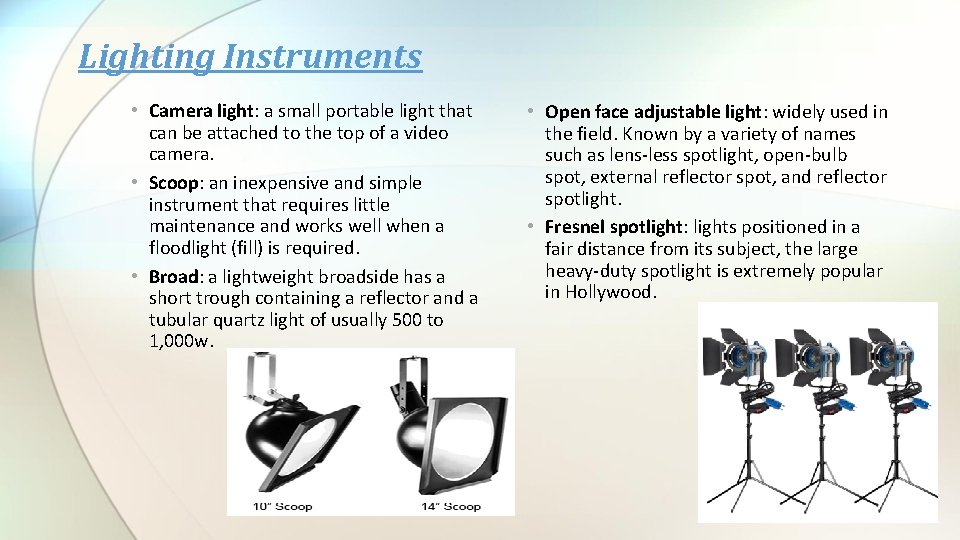
Lighting Instruments • Camera light: a small portable light that can be attached to the top of a video camera. • Scoop: an inexpensive and simple instrument that requires little maintenance and works well when a floodlight (fill) is required. • Broad: a lightweight broadside has a short trough containing a reflector and a tubular quartz light of usually 500 to 1, 000 w. • Open face adjustable light: widely used in the field. Known by a variety of names such as lens-less spotlight, open-bulb spot, external reflector spot, and reflector spotlight. • Fresnel spotlight: lights positioned in a fair distance from its subject, the large heavy-duty spotlight is extremely popular in Hollywood.
The Background ORAJIUBA CHIOMA
The importance and impact of the background • Importance The importance of the background depends on the director, the way the subject is approached, and the chosen style and form therefore where we shoot the program may be vital to what we want to tell our audience. • Impact It is not just a matter of choosing a background that looks appropriate or attractive. We must determine whether its audience impact is right for the specific points we are making in the program. The background we choose for our action, and the way we shoot it, can affect how persuasively points are communicated to our audience.
Real and unreal backgrounds Most audiences are not concerned about whether the background is real or an illusion all that matters is the effect, however backgrounds can be derived in a number of ways : • Use of actual place – Sahara desert • Use of substitute- The action is shot in a convenient location that looks sufficiently like part of the Sahara desert. • Use of a set- The action is shot in a studio that has been built to resemble the real thing. • Suggested location-The camera shows location shots of the Eiffel Tower Thanks to the sound of traffic and other sound effects, the viewer assumes that the action was shot in Paris. • Virtual set
• Set design for 16: 9 - The 16: 9 format has changed the design of set and made it more complex, including impacting the locations of the talent. It’s important to create clean, visually interesting header elements while not dedicating too much of the budget to elements that viewers will see for only a short period. • The neutral background -Basically, neutral backgrounds are usually made with scenic units, positioned in front of a cyclorama or cyc. A cyclorama is a curved wall that is used as a background for a television production while cyc provides an extremely useful general-purpose background surface for studios of all sizes.
• Economical sets - it is possible to develop attractive sets, simply and economically, by using just a few multipurpose set units in front of a cyclorama or a background wall. - Lighting alone can significantly change the appearance of a background, whether it is a plain wall or a cyc. - An open set can be created by carefully grouping a few pieces of furniture in front of the wall. -Support frames can be constructed from lengths of aluminum or wood. - Various materials can be stretched across these support frames to make flats, and they can be taped, nailed, or stapled on. - Modular units can be constructed out of all different materials, from wood products to plastic sheeting and aluminum.
• Semi-permanent and permanent sets advantages • Most of the set is assembled, ready to be used. • The set can be dressed and left in place (various props and furnishings). • Lamps, both set illumination and on-set lights, usually have already been hung and adjusted and then left in position.
• Chroma-key/matting - Chroma-keying is used extensively to create backgrounds and is based on a simple principle. Chroma-key is probably the most used technique to give the illusion that a person is standing in front of a real location such as a castle, a field, the seashore, or a town square all done at the press of a button. If done well, this technique can be convincing and effective with the audience • Virtual sets- use a blue or green seamless background and chromakey the computer-generated set into the scene. Most virtual sets employ sophisticated tracking computer software that monitors the camera’s movements so that as it zooms, tilts, pans, or moves in any other way, the background moves in a corresponding way. This system automatically adjusts the background with each shot change, changing the background size and angle to simulate a real set.
• Outside/back-lot sets - Building an outdoors back-lot set requires quite a financial commitment in both building the set and maintaining it, however these sets can be rented and do offer flexibility. The nice thing about them is that, if designed effectively, they can be reused. • The location as a background - Location backgrounds bring context to the production. They make the production look real and genuine in a way that it is hard to imitate in any studio also they usually bring a credibility and urgency to the production.
• Watch the background 1 -Windows can be the cause of embarrassment when shooting interiors. A large patch of sky in the shot can create problems. Even if the interior is exposed properly, this bright blank area still grabs the audience’s attention 2 -Reflecting surfaces in the background are difficult to avoid. 3 -Low-intensity reflections give sparkle and life to a surface. Strong light reflections are a pain, both technically and artistically. 4 -Flashing signs, prominent posters, direction signs, and billboards are among the visual diversions that can easily ruin a shot.
• Camera height - The camera’s height has a significant effect on how much of the scene is visible in the shot. From a lower viewpoint, less of the middle ground is visible, and this reduces the feeling of space and distance in the picture. Things nearer to the camera become more prominent perhaps over-prominent. Even small foreground objects nearby can obscure the shot. But raise the camera just a little, and not only will it shoot over these obstructions, but the audience will not even realize that they are there. • Foreground pieces - Objects can be deliberately positioned in the foreground of an image to improve its composition, to increase the impression of distance, or simply to hide some- thing in the scene.
• Creating depth - Foreground pieces can add depth to a limited background, create depth by shooting through objects, such as a bookshelf, a fence, or flowers. Usually the foreground is kept slightly out of focus so as to draw the audience’s attention to the primary subject. • Versions of reality - The camera does not tell the truth. It interprets. Each aspect of the picture and the sound influences how members of the audience respond to what they see and hear.
What can we do about the background? • Natural lighting can be used, rather than introducing lights. • room’s tones cannot necessarily be changed, it may be possible to shade your lamps off a light-toned surface to prevent them from appearing too bright. • angling the frame or furniture properly may cure the dilemma. • Closing, or partly closing, the room’s curtains may help you to adjust the lighting balance in a room • If you are shooting a corridor or hallway, it can help if doors in a side wall are opened enough to let extra light in. • Even if you are shooting in daylight, it may provide more interesting images if the table lamps or other lights in the room are turned on.
• Rearranging the background -It is important to look at the background of any location to make sure that nothing is growing from the talent’s head, or balancing on it, and that no vertical or horizontal lines cut through the center of the head or across the shoulders. These visual accidents can make the picture look contrived or comic.
Altering the background • Rearrange the furniture. • Replace furniture with other pieces from nearby rooms. • Add or remove rugs. • Hide a doorway with a folding screen. • Attach display posters to the walls. • Position indoor plants (e. g. , ferns) to break up the background. • Introduce notices and signs on walls and doors.
Partial settings • Partial settings- This is a strategy for convincing your audience that a modest setting is not only the real thing but is much more extensive than it actually is. With partial settings, it is important to concentrate on building up a section of the scene that is just large enough to fit the camera’s shot and no more. Examples 1 - An instant store can be created by putting the appropriate type of merchandise on a foreground table 2 -Sometimes even a single feature in the picture can suggest an environment. 3 -A convincing “room” can be created in a studio with just a couple of flats or screens and a chair.
• Facing reality - Among the problems facing all directors are the inevitable limitations of budget and facilities when faced with such problems Look for imaginative substitutes. Keep in mind that directors produce illusions. However basic the materials really are, the end result can appear to be the real thing
Well that’s all folks Thank you and goodnight!
- Slides: 59