
CULTURE CHANGE TEMPLATE Change your Corporate Culture Play
- Slides: 10
CULTURE CHANGE TEMPLATE Change your Corporate Culture Play to Win “Culture eats strategy for breakfast” Template Instructions: - Peter Drucker These slides are used to facilitate a discussion about changing the corporate culture of your organization. Slide 2: should be an individual reflection, followed by a group discussion about the strength of culture in your organization. Slide 3 and 4 are informational slides to set the table for a conversation about the desirable elements of corporate culture. Slide 5 provides the overview of building a map of your corporate culture. Slide 6, 7, 8, 9 are the worksheets for changing culture and should be completed through a facilitated group discussion. Slide 10 provides ideas for designing experiences to initiate a culture change.
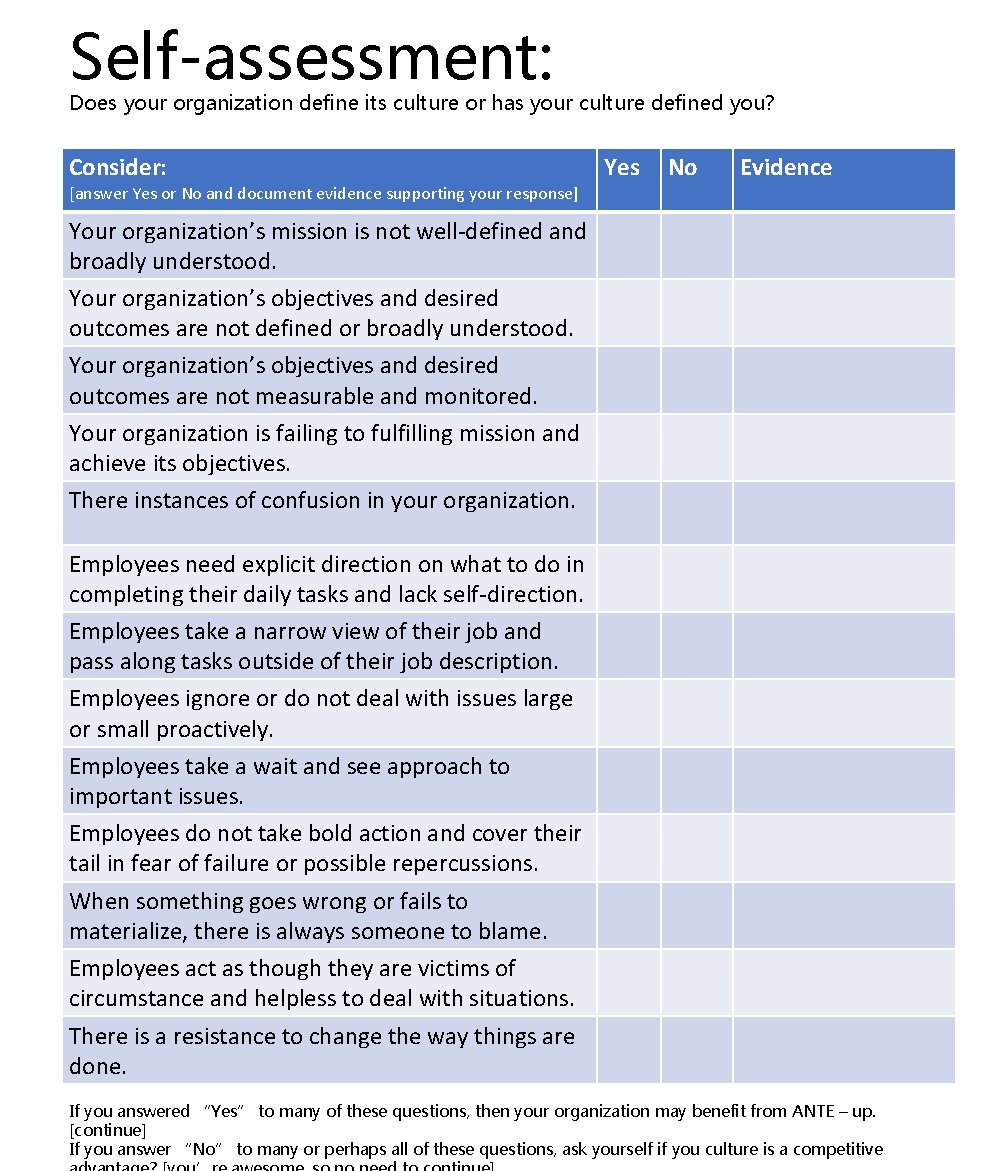
Self-assessment: Does your organization define its culture or has your culture defined you? Consider: [answer Yes or No and document evidence supporting your response] Yes No Evidence Your organization’s mission is not well-defined and broadly understood. Your organization’s objectives and desired outcomes are not defined or broadly understood. Your organization’s objectives and desired outcomes are not measurable and monitored. Your organization is failing to fulfilling mission and achieve its objectives. There instances of confusion in your organization. Employees need explicit direction on what to do in completing their daily tasks and lack self-direction. Employees take a narrow view of their job and pass along tasks outside of their job description. Employees ignore or do not deal with issues large or small proactively. Employees take a wait and see approach to important issues. Employees do not take bold action and cover their tail in fear of failure or possible repercussions. When something goes wrong or fails to materialize, there is always someone to blame. Employees act as though they are victims of circumstance and helpless to deal with situations. There is a resistance to change the way things are done. If you answered “Yes” to many of these questions, then your organization may benefit from ANTE – up. [continue] If you answer “No” to many or perhaps all of these questions, ask yourself if you culture is a competitive
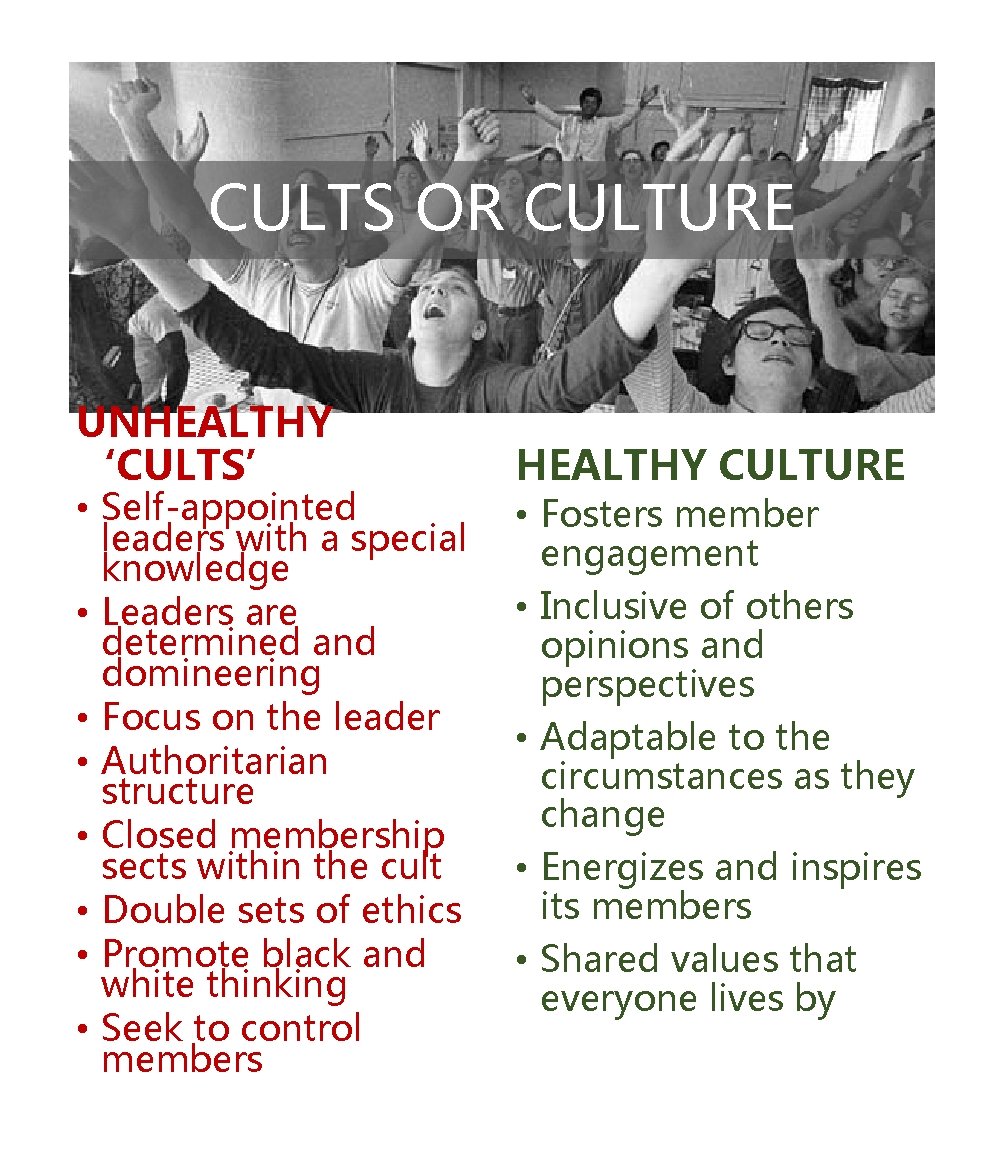
CULTS OR CULTURE UNHEALTHY ‘CULTS’ • Self-appointed leaders with a special knowledge • Leaders are determined and domineering • Focus on the leader • Authoritarian structure • Closed membership sects within the cult • Double sets of ethics • Promote black and white thinking • Seek to control members HEALTHY CULTURE • Fosters member engagement • Inclusive of others opinions and perspectives • Adaptable to the circumstances as they change • Energizes and inspires its members • Shared values that everyone lives by
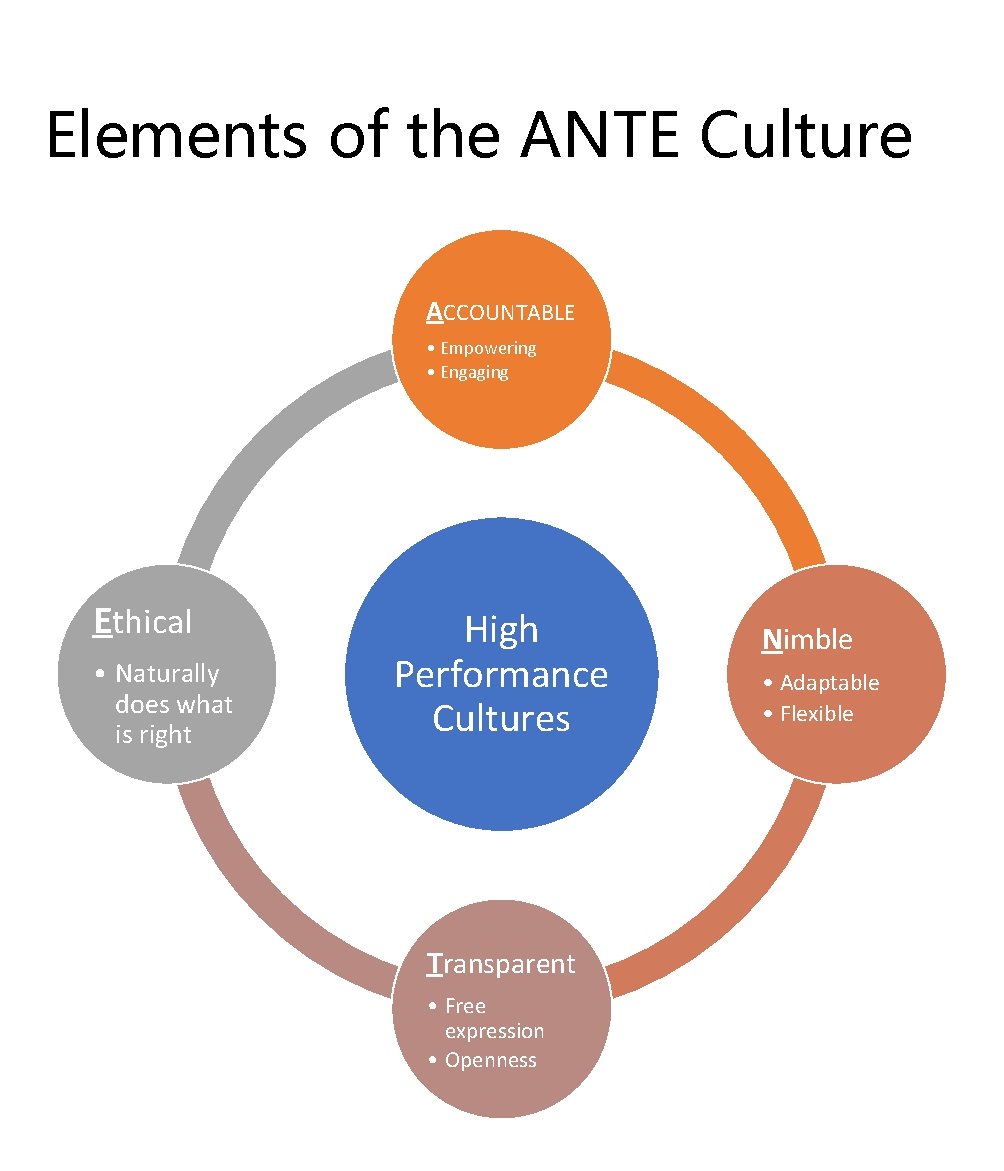
Elements of the ANTE Culture ACCOUNTABLE • Empowering • Engaging Ethical • Naturally does what is right High Performance Cultures Transparent • Free expression • Openness Nimble • Adaptable • Flexible
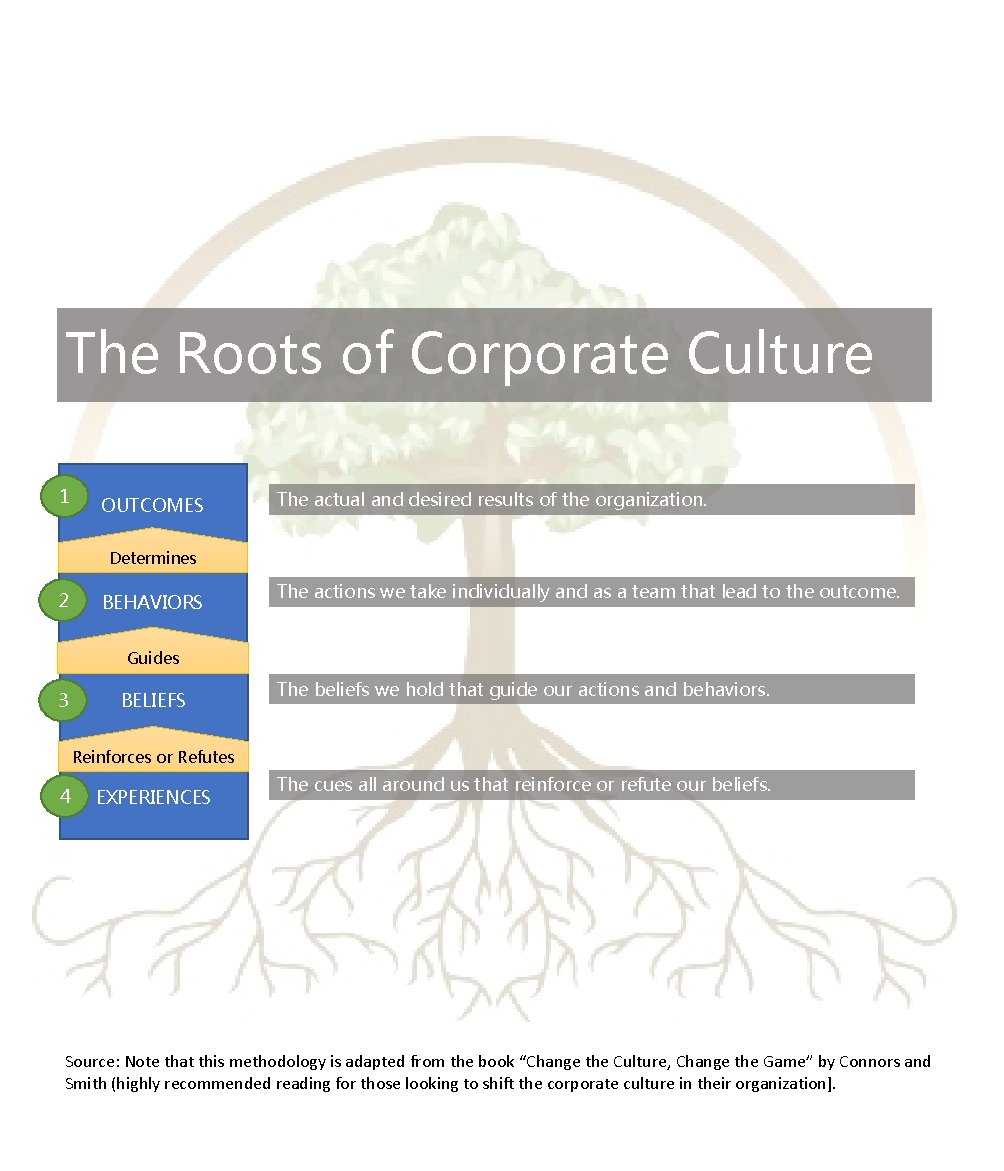
The Roots of Corporate Culture 1 OUTCOMES The actual and desired results of the organization. Determines 2 BEHAVIORS The actions we take individually and as a team that lead to the outcome. Guides 3 BELIEFS The beliefs we hold that guide our actions and behaviors. Reinforces or Refutes 4 EXPERIENCES The cues all around us that reinforce or refute our beliefs. Source: Note that this methodology is adapted from the book “Change the Culture, Change the Game” by Connors and Smith (highly recommended reading for those looking to shift the corporate culture in their organization].
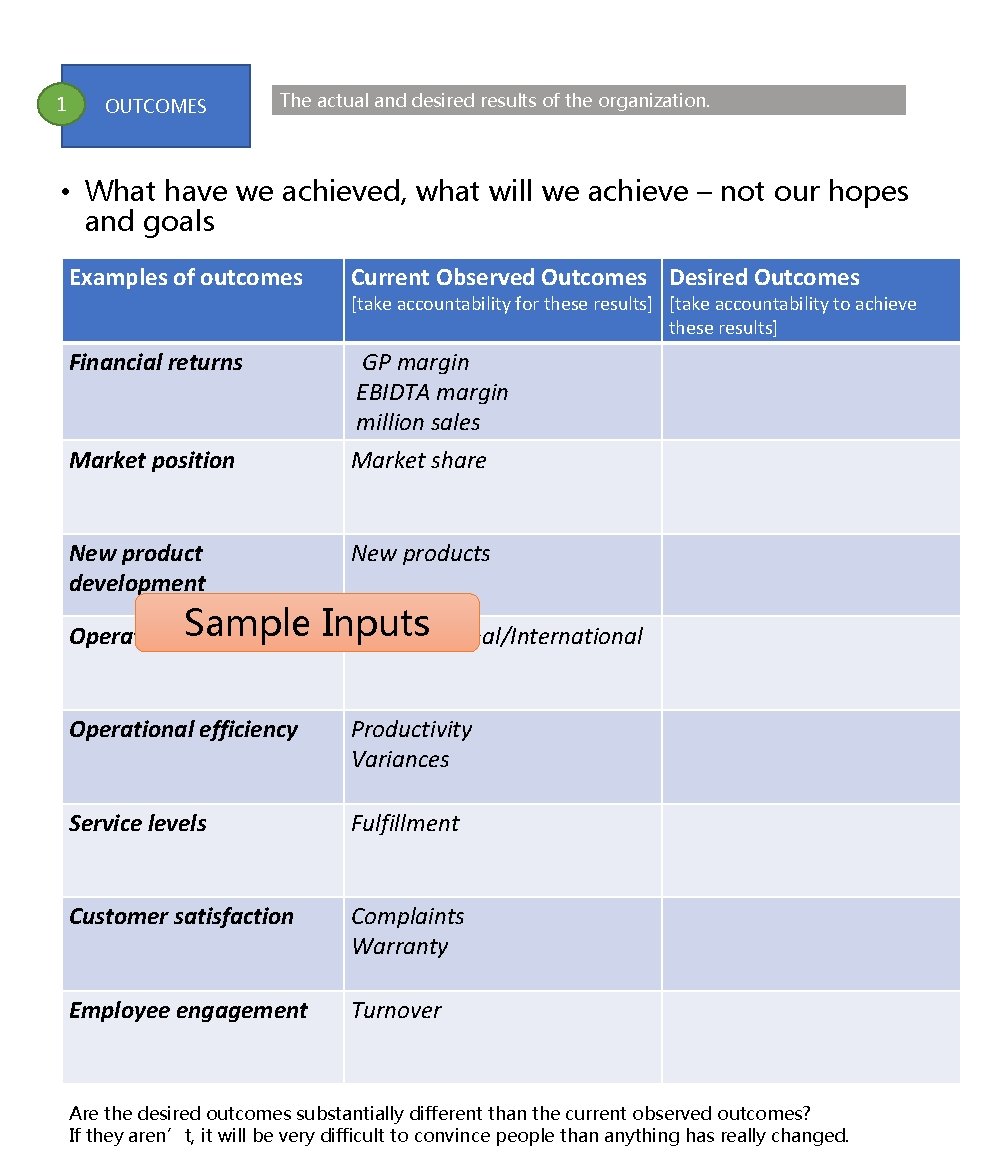
1 OUTCOMES The actual and desired results of the organization. • What have we achieved, what will we achieve – not our hopes and goals Examples of outcomes Current Observed Outcomes Desired Outcomes Financial returns GP margin EBIDTA margin million sales Market share Market position New product development Operational. Sample scope [take accountability for these results] [take accountability to achieve these results] New products Inputs Local/National/International Operational efficiency Productivity Variances Service levels Fulfillment Customer satisfaction Complaints Warranty Employee engagement Turnover Are the desired outcomes substantially different than the current observed outcomes? If they aren’t, it will be very difficult to convince people than anything has really changed.
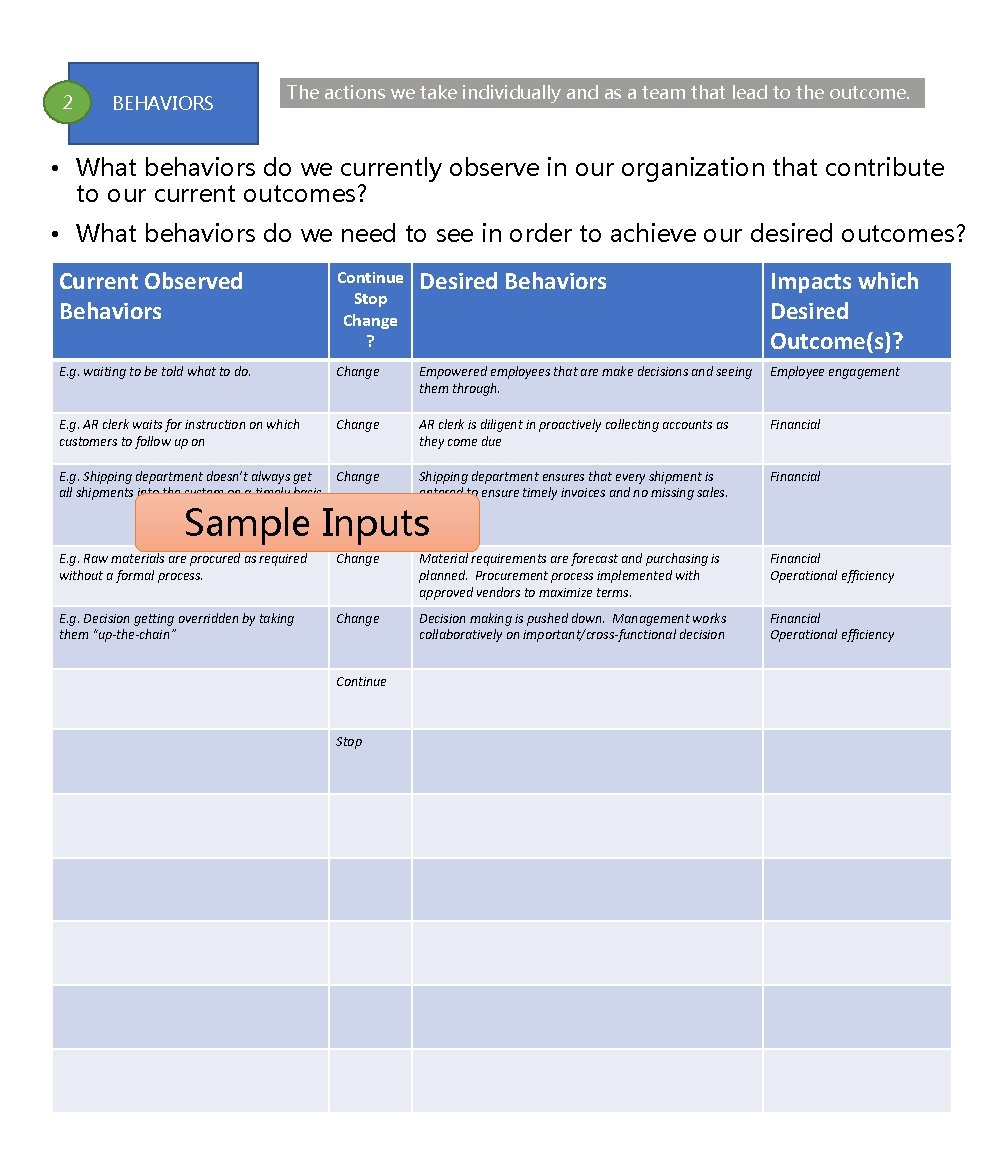
2 BEHAVIORS The actions we take individually and as a team that lead to the outcome. • What behaviors do we currently observe in our organization that contribute to our current outcomes? • What behaviors do we need to see in order to achieve our desired outcomes? Current Observed Behaviors Continue Stop Change ? Desired Behaviors Impacts which Desired Outcome(s)? E. g. waiting to be told what to do. Change Empowered employees that are make decisions and seeing them through. Employee engagement E. g. AR clerk waits for instruction on which customers to follow up on Change AR clerk is diligent in proactively collecting accounts as they come due Financial E. g. Shipping department doesn’t always get all shipments into the system on a timely basis Change Shipping department ensures that every shipment is entered to ensure timely invoices and no missing sales. Financial E. g. Raw materials are procured as required without a formal process. Change Material requirements are forecast and purchasing is planned. Procurement process implemented with approved vendors to maximize terms. Financial Operational efficiency E. g. Decision getting overridden by taking them “up-the-chain” Change Decision making is pushed down. Management works collaboratively on important/cross-functional decision Financial Operational efficiency Sample Inputs Continue Stop
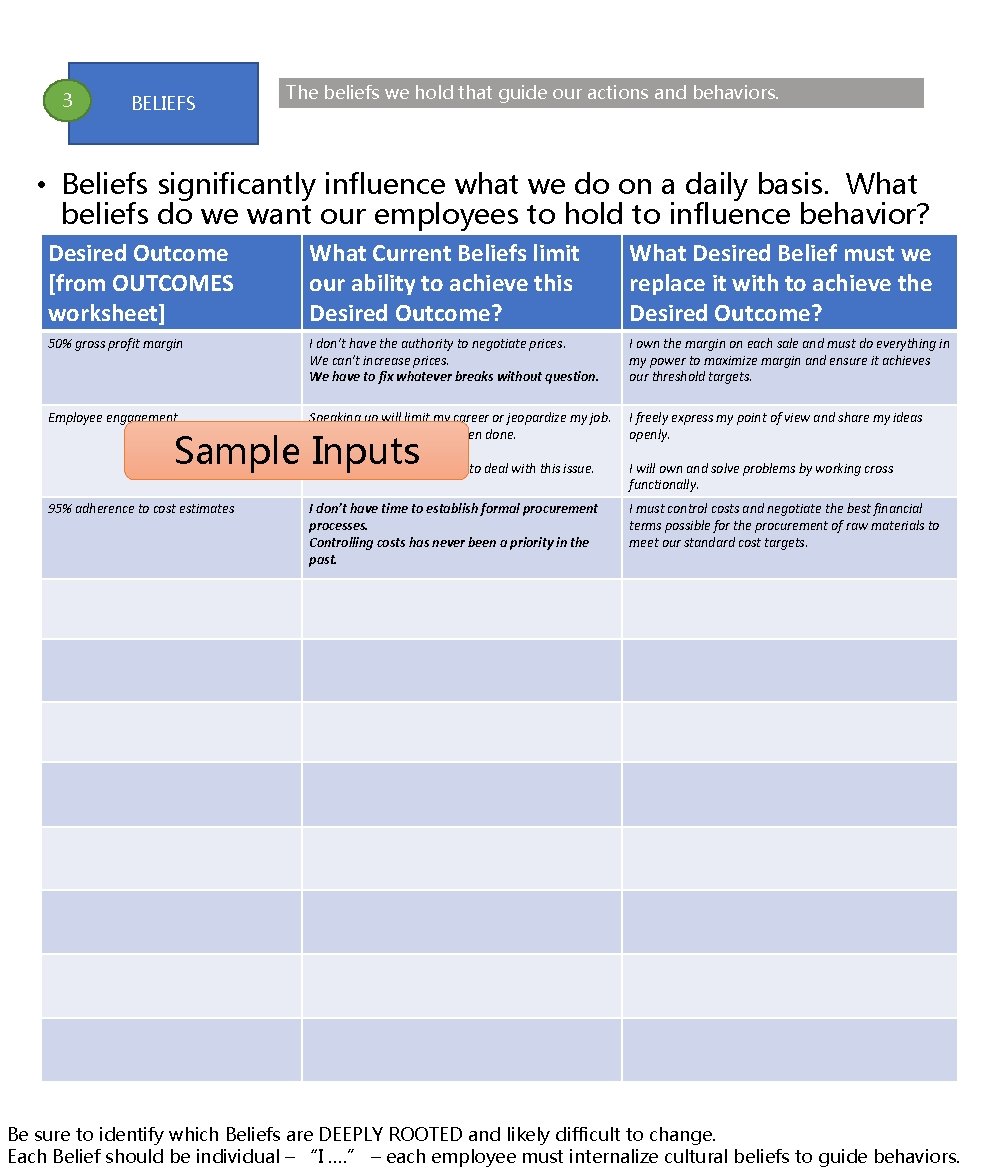
3 BELIEFS The beliefs we hold that guide our actions and behaviors. • Beliefs significantly influence what we do on a daily basis. What beliefs do we want our employees to hold to influence behavior? Desired Outcome [from OUTCOMES worksheet] What Current Beliefs limit our ability to achieve this Desired Outcome? What Desired Belief must we replace it with to achieve the Desired Outcome? 50% gross profit margin I don’t have the authority to negotiate prices. We can’t increase prices. We have to fix whatever breaks without question. I own the margin on each sale and must do everything in my power to maximize margin and ensure it achieves our threshold targets. Employee engagement Speaking up will limit my career or jeopardize my job. This is the way its always been done. I freely express my point of view and share my ideas openly. Its not in my job description to deal with this issue. I will own and solve problems by working cross functionally. I don’t have time to establish formal procurement processes. Controlling costs has never been a priority in the past. I must control costs and negotiate the best financial terms possible for the procurement of raw materials to meet our standard cost targets. Sample Inputs 95% adherence to cost estimates Be sure to identify which Beliefs are DEEPLY ROOTED and likely difficult to change. Each Belief should be individual – “I …. ” – each employee must internalize cultural beliefs to guide behaviors.
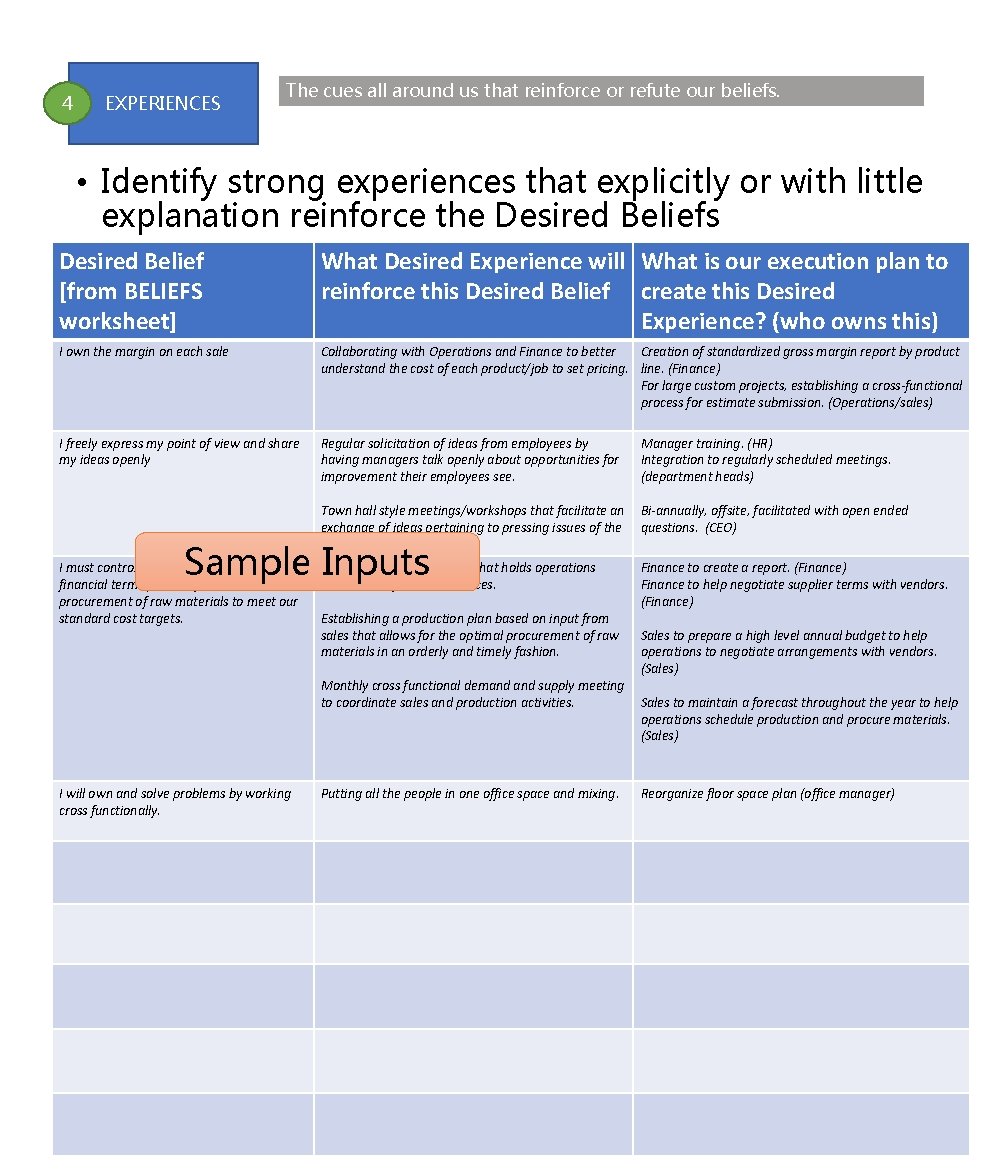
4 EXPERIENCES The cues all around us that reinforce or refute our beliefs. • Identify strong experiences that explicitly or with little explanation reinforce the Desired Beliefs Desired Belief [from BELIEFS worksheet] What Desired Experience will What is our execution plan to reinforce this Desired Belief create this Desired Experience? (who owns this) I own the margin on each sale Collaborating with Operations and Finance to better Creation of standardized gross margin report by product understand the cost of each product/job to set pricing. line. (Finance) For large custom projects, establishing a cross-functional process for estimate submission. (Operations/sales) I freely express my point of view and share my ideas openly Regular solicitation of ideas from employees by having managers talk openly about opportunities for improvement their employees see. Manager training. (HR) Integration to regularly scheduled meetings. (department heads) Town hall style meetings/workshops that facilitate an exchange of ideas pertaining to pressing issues of the business. Bi-annually, offsite, facilitated with open ended questions. (CEO) Establish a variance report that holds operations accountable for cost variances. Finance to create a report. (Finance) Finance to help negotiate supplier terms with vendors. (Finance) Sample Inputs I must control costs and negotiate the best financial terms possible for the procurement of raw materials to meet our standard cost targets. Establishing a production plan based on input from sales that allows for the optimal procurement of raw materials in an orderly and timely fashion. Monthly cross functional demand supply meeting to coordinate sales and production activities. I will own and solve problems by working cross functionally. Putting all the people in one office space and mixing. Sales to prepare a high level annual budget to help operations to negotiate arrangements with vendors. (Sales) Sales to maintain a forecast throughout the year to help operations schedule production and procure materials. (Sales) Reorganize floor space plan (office manager)
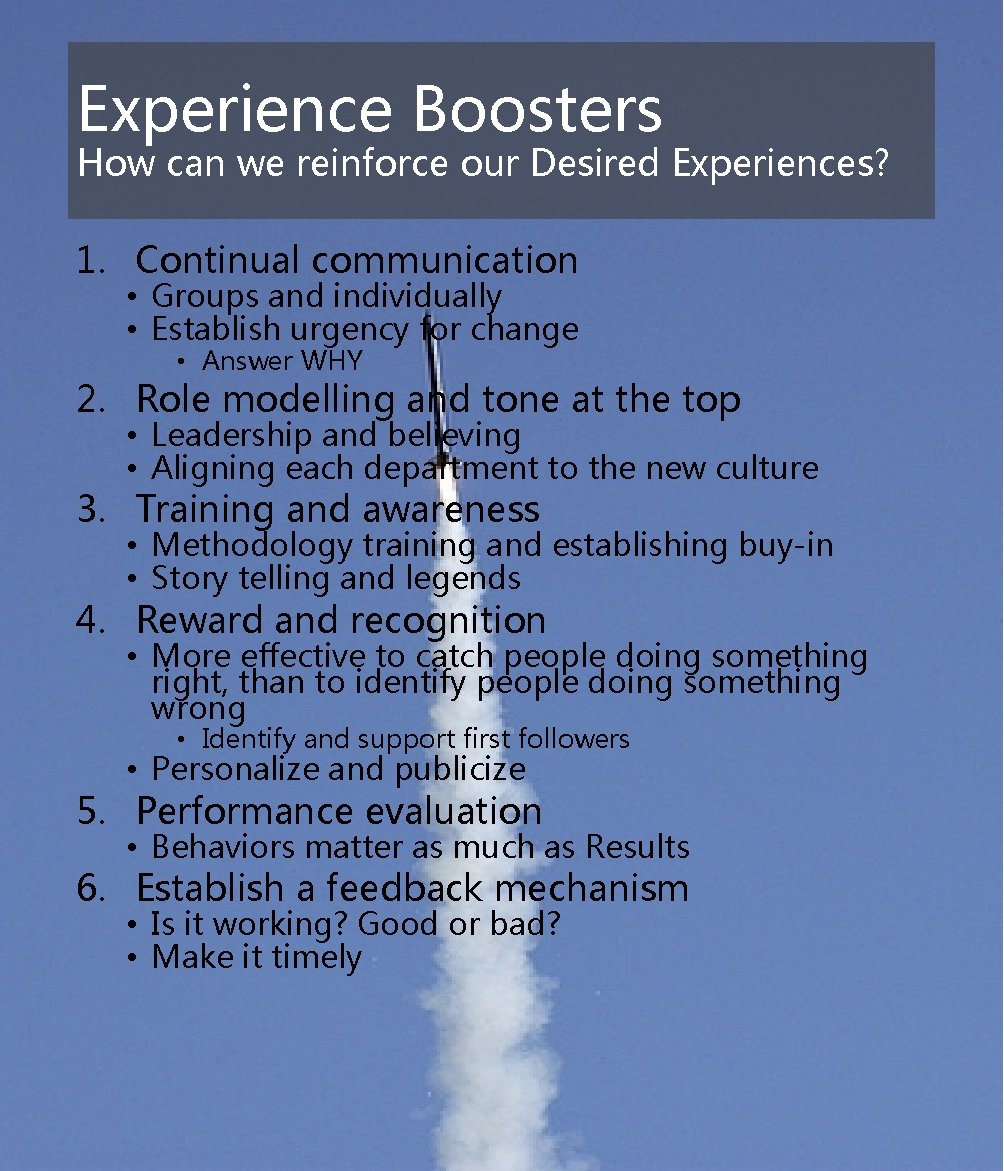
Experience Boosters How can we reinforce our Desired Experiences? 1. Continual communication • Groups and individually • Establish urgency for change • Answer WHY 2. Role modelling and tone at the top • Leadership and believing • Aligning each department to the new culture 3. Training and awareness • Methodology training and establishing buy-in • Story telling and legends 4. Reward and recognition • More effective to catch people doing something right, than to identify people doing something wrong • Identify and support first followers • Personalize and publicize 5. Performance evaluation • Behaviors matter as much as Results 6. Establish a feedback mechanism • Is it working? Good or bad? • Make it timely